Impossible to get abortion in Tahoe-Truckee

By Kathryn Reed

Legality is one thing; availability is another when it comes to abortions.

No practitioner performs the procedure in the Lake Tahoe Basin or Truckee. There is one provider in all of Northern Nevada and they are in Reno. Sacramento or Roseville are the closest options in California for those living in the Tahoe-Truckee region.

Norma McCorvey, who led the fight that culminated in the 1973 Supreme Court decision legalizing abortions in the United States, died Feb. 18 at age 69 from heart failure. She was the Roe (Jane Roe) in Roe v. Wade. Up until that court ruling abortions were only legal if the woman’s life was at risk.

In the 44 years since that decision there have been continued attempts to take away a woman’s choice.

There was a time when clinics were bombed and protestors would get in the face of women seeking services. This led to many doctors saying no to offering the procedure.

Now with the threat of those rights being taken away women are starting to fight back. Reproductive rights were a rallying call for many of the millions of women who marched last month, the day after Donald Trump’s inauguration.
Abortion is a divisive subject, with politics and religion seeming to override all medical discourse.

One of President Trump’s first acts in the Oval Office was to sign an executive order banning aid to foreign entities that provide abortions. In the U.S. it is near impossible to get Medicaid to pay for an abortion. Funding to Planned Parenthood is threatened with Republicans controlling both houses of Congress even though less than 3 percent of the agency’s services are related to abortions. Planned Parenthood in 2014 performed more than 30 percent of the abortions in the United States.

Planned Parenthood in Reno has not offered abortions since July 2015 because no doctors would be part of the practice.

“It is a frightening landscape we are looking at,” Daela Gibson with Planned Parenthood in Reno told Lake Tahoe News. “It is getting more difficult for women to get health care and it is definitely going to get more difficult if the current administration continues on this path.”

West End Women’s Medical Group in Reno is the only place in Northern Nevada that provides abortions. They would not provide stats to Lake Tahoe News, but the agency has to give them to the state.

According to the Nevada Department of Health and Human Services, from 2011-14 there were 141 reported abortions in Northern Nevada, with 3.2 percent of the women coming from the Tahoe area. Statistics are kept by ZIP code. In that time period women from Crystal Bay, Glenbrook, Zephyr Cove, Stateline, Incline Village, Carnelian Bay, Homewood, Tahoma, Kings Beach, Tahoe City, Tahoe Vista and South Lake Tahoe received an abortion at West End.

Those from California going to West End must pay cash – more than $700. This can be cost prohibitive for many.

California Department of Public Health did not return multiple calls.

One of several signs about women’s reproductive rights a the bistate women’s march on the South Shore on Jan. 21. Photo/Kathryn Reed

Getting to Sacramento can be a logistical obstacle, especially for younger girls. (In California parental consent is not required to get an abortion.) There are different procedures, with the number of weeks a woman is pregnant determining what is done. Sometimes a follow-up visit is required, which compounds the difficulty for some people.

Income is another hurdle in the quest to terminate a pregnancy.

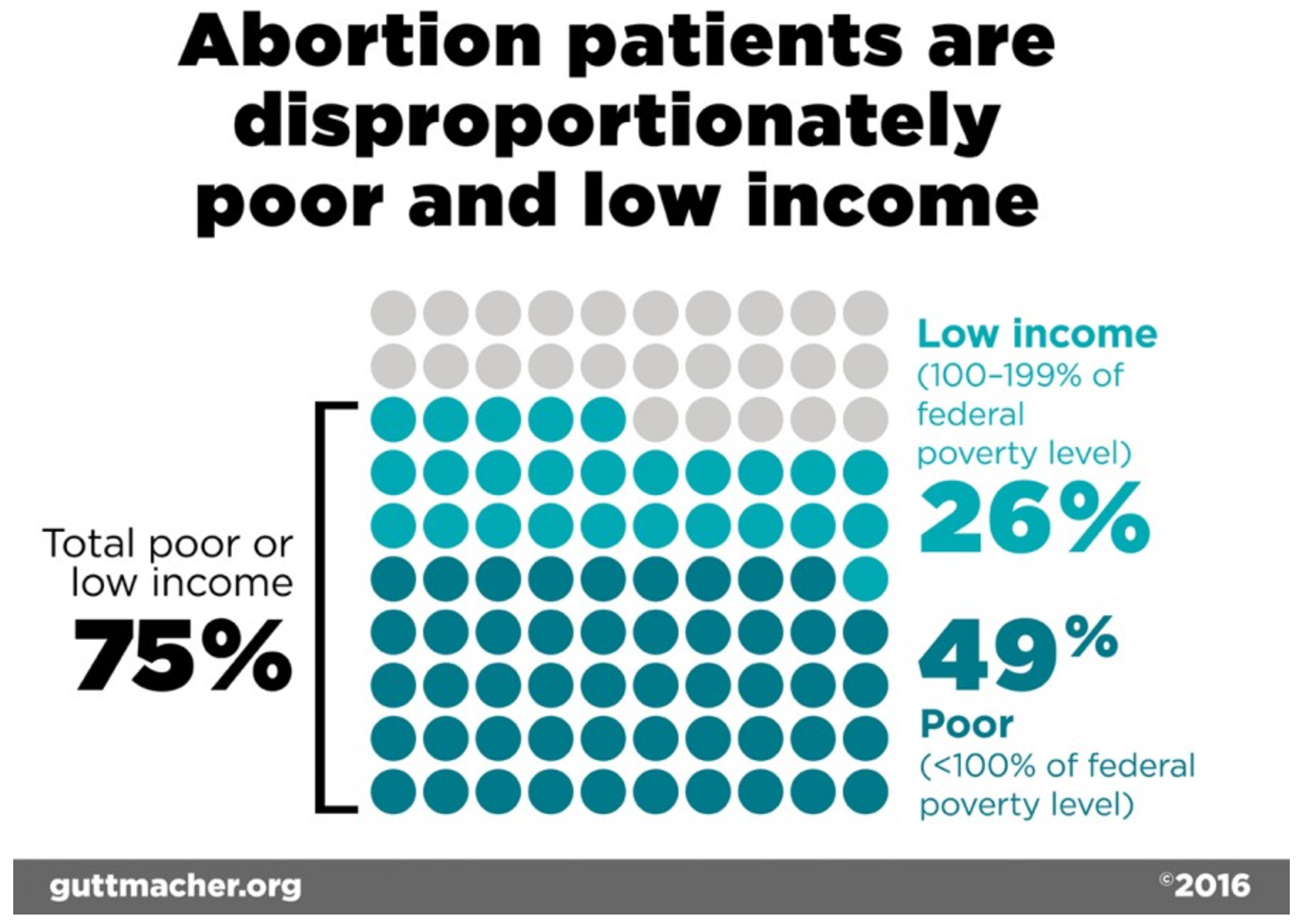
“Nearly half of abortion patients in the United States are poor and another 26 percent are low income,” according to the Guttmacher Institute, a leading research and policy organization committed to advancing sexual and reproductive health and rights in the United States and globally.

The morning after pill is an alternative at least in the first 48 hours after intercourse. While abortion medication is available through the Internet, this is not the route health care professionals prefer. Deciding to get an abortion is an emotional decision with potentially lingering psychological ramifications. Having someone to talk to, to provide counsel, to explain what to expect is part of the process at a clinic or doctor’s office.

“We would rather them be under doctor’s care or health clinic care and receive guidance instead of trying to handle such a difficult situation on their own,” Gibson said.

For Nichole Delaplante, a doctor with Barton Family Medicine, she talks to her patients about the options and the psychological aspects of abortion. “I give them information where they can safely and privately get an abortion.”

Placer, Washoe and Nevada counties provide family planning services. Not so in El Dorado County.

“We need accessible family planning services so abortion does not have to be an option,” Chris Cifelli, a nurse who has been a family planning provider for more than 30 years, told Lake Tahoe News. She works in South Lake Tahoe, Truckee and Reno.

Schools offer some assistance to students, but it’s a delicate topic between school nurse and student.

“In Placer county we are very neutral about women’s health choices. We work with people to help them figure out if we have resources to help them or if they need to get somewhere else,” Maureen Bauman, with Placer County Public Health, told Lake Tahoe News.

While Barton Community Health Center is listed as a referral by El Dorado County Public Health, the center does not do abortions, and never has, according to an employee.


Barton Health would not provide any historical numbers for abortions, and instead told Lake Tahoe News to check with the Centers for Disease Control and Prevention for stats.

CDC’s response was, “California does not report data on abortions to CDC, so we do not have state-specific data to offer.”

When presented with that information, Mindi Befu, chief spokeswoman for Barton told Lake Tahoe News, “Barton respects the privacy and confidentiality of its patients and community and does not release this information.”

Discussing abortion with Barton’s public relations folks was difficult, with few direct answers given. But stats about births, those are available and easy to come by.

Barton flacks didn’t even know doctors affiliated with the hospital don’t perform abortions any more. There was a time when Barton docs would do them in their offices, but that doesn’t happen anymore. (A doctor in Truckee performed abortions years ago in his office, too.)

When abortions were performed at Barton Memorial Hospital in South Lake Tahoe it was for medical reasons.

With Barton employing most of the doctors on the South Shore, as opposed to there being independent offices – which was the case even five years ago, the conglomerate has a monopoly on the local medical profession and can dictate (even if it’s not in writing) policy.

“We don’t have any providers. Either they are not trained or they don’t want to (perform abortions),” Barton Family Medicine’s Delaplante told Lake Tahoe News.


Massive snow means lots of work for ski patrollers

By Julie Brown, Powder
 
The morning after a February storm had shut down the ski resort for two days, the Sun Valley ski patrol started yet another day of work to open the mountain to the public.

The meeting started with announcements: race schedules, grooming reports, mountain closures, fallen trees from the storm. Then came the weather and avalanche mitigation report: Eight days, 60 inches of snow, quite a bit of wind, and one hell of a storm cycle.

This winter has already set records for Sun Valley, currently standing at the fourth largest snowpack since 1968. The ski area is currently 181 percent of average for snowfall in the month of February, which means ski patrol has been logging a lot of overtime.

Sun Valley is not alone. California dominated headlines all of January with an incessant pounding, leaving Mammoth Mountain with 430 inches of snowfall so far.


Most, or virtually all, ski patrol teams in the country have decades of combined experience, if not more, and the work routines and safety protocols are well reinforced. But their job is still one of risk. Last month, a Squaw Valley ski patroller died while conducting avalanche control at the top of a ridge inbounds. 

Read the whole story


Hospitality jobs require tech know-how

By Julie Weed, New York Times

The front desk manager or housekeeper may epitomize the hotel employee, but the hospitality industry is increasingly dependent on tech workers, vacuuming data scientists, web designers and other experts into its ranks.

More than ever, guests look to their phones and computers to research, book, stay in and communicate with hotels. That translates to critical technology needs in information security, mobile development and systems integration.

Inside hotel operations, data analysis can help find new customers, make a dining room more profitable or provide information to executives making business decisions.

Kate Walsh, interim dean of the School of Hotel Administration at Cornell, says she is seeing more companies coming on campus to hire students who are specializing in areas like digital marketing and business analytics. “They want foodies who code,” she said.

Read the whole story


Sun Valley ski resort — a mountain of history

By Kathryn Reed

SUN VALLEY, Idaho – In this era of corporate consolidation in the ski industry, Sun Valley ski resort stands out as being independent. But the area also stands out as being a company town.

The Holding family owns Sun Valley in Idaho and Snowbasin in Utah through their company Sinclair Oil. So, while their ski portfolio is not large, the family and affiliates know quite a bit about the corporate world.

The 220-room Sun Valley Lodge, Sun Valley Inn, restaurants, stores, three golf courses – and ski resort – are all under the same ownership. It’s diversification and control in a limited space. It seems to be working.

Like Lake Tahoe, Sun Valley is boasting about its incredible snowfall. Skier visits have hit record numbers on some days.

Sun Valley has 3,400 vertical feet of skiing. Photo/Pamala Ward

In early January they were getting pummeled by snow, no rain. One day the fog was so heavy Pam and I had no idea where we were. Oh, but, the smiles we had on our faces when we met the rest of the gang for lunch. The powder was simply glorious – thigh deep at times, light and bountiful.

The groomers seemed to go on forever. Bald Mountain tops out at 9,150 feet, with the base being 5,750 feet.

The mountain has two distinct sides – River Run and Warm Springs. The latter is where things started, the former is where most now begin their ski day.

The hot tub at Sun Valley Lodge is larger than some hotel pools. Photo/Pamala Ward

It was in 1936 that Sun Valley first opened. One claim to fame is that it had the country’s first ski lift.

Notable Olympians from the area are Kaitlyn Farrington who in 2014 won gold in halfpipe. Kaitlyn’s Bowl is named after her. Picabo’s Street is named after Picabo Street, who won multiple Olympic medals for ski racing. Gretchen’s Gold is for Gretchen Fraser who in 1948 became the first American to win an Olympic gold in skiing.

The mountain has plenty of terrain for those who will never even make the Olympic team, let alone medal.

Sun Valley has produced multiple Olympic athletes. Photo/Kathryn Reed

On our third day of skiing the sun finally came out – making me understand why it’s called Sun Valley. It really is a valley of sun.

Finally, I see the Sawtooth range – so craggily it’s understandable how it got its name. In a more populous area I’m sure those other mountains would be developed.

What helps this resort in the middle of Idaho survive despite being so remote is in part its location. People have to want to go there. There is no drive-up market to tap into like Tahoe does. It was built by railroad tycoon Averell Harriman as the country’s first destination ski resort and remains a destination today.

A full moon shines upon the historic Sun Valley Lodge. Photo/Pamala Ward

“I think one of the things about Sun Valley is that we are very iconic,” resort spokesman Mike Fitzgerald told Lake Tahoe News. “It is more of a year-round resort. We are a busy in summertime as we are in winter.”

People return year after year.

“Of our guests, about 76 percent are return visitors. We have incredible loyalty,” Fitzgerald said.

I’m one of those returnees, only it had been 35 years since I was last at Sun Valley. I don’t remember much about the mountain. What stands out from that trip with my parents, and my best friend and her parents was the sleigh ride to dinner. It’s still offered.

The free bus system through Sun Valley-Ketchum operates efficiently. We used it to get to and from the slopes each day. Stops are clearly marked and times given when the next bus will arrive. It was refreshing coming from a city that doesn’t even have a bus as a symbol at its stops.

Tom Ward pedals on the multi-use trails at the Nordic center. Photo/Pamala Ward

In 2007 three bus systems were consolidated into what is known today as Mountain Rides. “Mountain Rides operates as a public agency under a joint powers Agreement partnership that includes the cities of Bellevue, Hailey, Ketchum, Sun Valley and Blaine County. Mountain Rides’ funding comes from local option sales tax and general funds from its local funding partners, as well as from the Federal Transit Administration and revenue from fares,” the bus system’s website says.

In casually speaking with a variety of Sun Valley employees they raved about working for the company. Full-time workers get health and retirement benefits. Dorm style lodging is available for many employees.

One man used to live in Truckee. He’s happier in Idaho. It’s not as expensive to live. He boasts about the trail network being right in town and not needing to drive anywhere.

Still, others spoke of how it is expensive to live in this mountain area. Some drive more than hour to get go work.

Nonetheless, if the workers’ jovialness was an act, they’ve been trained well. Customer service is reminiscent of Deer Valley, only more authentic in the sense there wasn’t anything pretentious about Sun Valley.

The lodge was renovated a year ago, and the inn will be in the coming year.

I was there for a week in January with eight others. Three of us were in the same condo owned by Sun Valley. While it was adequate, it clearly was not on the most recent renovation schedule. We were under the impression going in that it was going to be a little higher end than it was.

We had access to the hot tub which is pool-size. It was an easy walk. But one of the best things about the lodge is the shuttle service. Perfect for getting a ride back to the condo after soaking. Drivers took us into town, to the Nordic center where Pam, Tom and I tried fat bike tires for the first time. (Fun, but no need to add another sport to my repertoire.) The center, though, would be worth exploring further because of the myriad snowshoe and cross country trails. In summer this is where golfers flock.

While the Sun Valley-Ketchum area has a bit of a rugged feel, it is also modern. The restaurants offer a variety of fare – from local trout to wild game to plenty of potatoes. Being a vegetarian was not a problem.


Technology slow to help predict avalanches

By Ethan Baron, Bay Area News Group

It’s a bountiful winter in the snowy Sierra Nevada, with the biggest snowpack in 22 years. That’s great news for skiers and snowboarders, but all that snow can transform in an instant from a beautiful blanket to a deadly shroud when an avalanche hits.

In December, Aptos doctor Tom Barker, 64, was swept more than 200 yards in an avalanche that left him buried under 9 feet of snow, after he and a friend skied into a closed area at the Mt. Rose ski resort without their avalanche-safety gear. Barker did not survive.

Slides kill one or two winter-wilderness travelers every couple of years in the Sierra around Lake Tahoe. For every death, avalanche experts say, about 10 people are caught in a cascade of snow and ice and barely escape with their lives.

The popularity, and the risk, are driving companies to develop new avalanche-safety products based on bleeding-edge technology better known in the fast-evolving realms of self-driving cars, the Internet of Things, and big-data computing. The technology holds promise for preventing fatalities, according to experts, but it’s in its infancy.

Read the whole story


Plenty of California disaster declarations

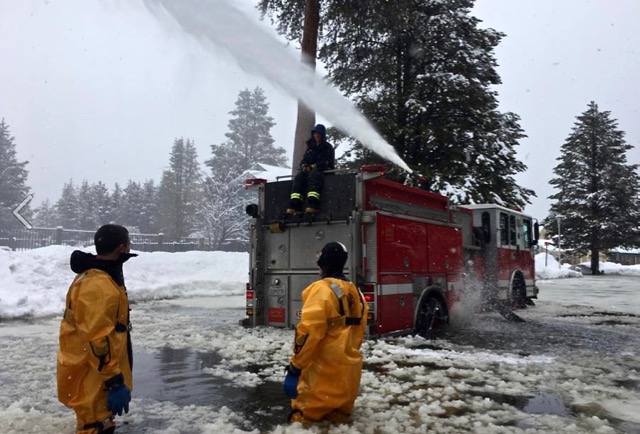
South Lake Tahoe fire crews this month get rid of ice and water on city streets. Photo/SLTFD

By Jim Miller, Sacramento Bee

This year’s heavy rains and the ongoing crisis at Oroville Dam recently prompted Gov. Jerry Brown to do what he and his predecessors have done many times before: ask for federal help.

Once approved, presidential declarations – the most common is a major disaster – open the door to assistance from a range of federal programs, such as money to fix roads or help with living expenses for people thrown out of work.

California knows the programs well.

Read the whole story


Government intervention likely in Truckee to help find solutions for affordable housing crisis

Publisher’s note: This is one in a series of stories about affordable housing in the Lake Tahoe-Truckee region. All articles may be accessed via the home page under Special Projects, 2017 Affordable Housing.

By Linda Fine Conaboy

TRUCKEE – With more and more recreational and business opportunities presenting themselves, the Tahoe-Truckee area has become hard pressed to identify enough affordable residential units to accommodate the rapidly increasing need. The situation is reaching a tipping point.

Enter the Tahoe Truckee Community Foundation, who embarked on a long-term study of the situation, with results becoming available last summer. The report, titled “Truckee North Lake Tahoe Regional Housing Needs Assessment”, contained a comprehensive review of the area’s needs and demographics and was funded by Placer County, Truckee, Nevada County and the Workforce Housing Association of Truckee Tahoe.

Stacy Caldwell, CEO of the Tahoe Truckee Community Foundation, was one of the speakers at the Truckee Donner Chamber of Commerce breakfast this week.

The affordable housing challenge within the region an issue which has been barreling to a point of crisis for years, with the rapid rate of growth within the region seen as the culprit.

The area of study for the report roughly encompassed the West Shore of Lake Tahoe into El Dorado County, Truckee, Tahoe City, Tahoma and Kings Beach as well as the Donner Summit area.

Briefly, the research discovered that:

·      55 percent of the households have incomes classified as moderate or low

·      59 percent of workers commute to their jobs

·      47 percent commute out of the region to their jobs

·      4,000-plus new jobs are expected to be created in the region over the next 15 years

·      Almost half spend more than 30 percent of their income on housing; 26 percent spend 50 percent of income on housing

·      Rental rates are high, and there is little rental housing available

·      80 percent of the region’s 474 below-market housing units are in Truckee, all with full waiting lists.

Caldwell admitted that TTCF’s foray into the housing world is “hard stuff.”  The results of the latest study, she said, can no longer sit on the shelf as previous housing surveys have.

Producing the comprehensive analysis, Caldwell said, involved many partners, including several funding collaborators, a large technical advisory group and BAE Urban Economics, an urban economics and development advisory consulting practice, all of whom conducted surveys, participated in public forums and produced myriad stories for publication.

What they found included the fact that because affordable housing is at a minimum, it’s hard to retain good teachers as well as other professionals; that more than half of the houses built within the study area were built before 1979; and that 65 percent sit vacant half of the time.

The median income within the region is $75,000, making it difficult to purchase an affordable home. Rents are high, resulting in elevated occupancy rates within very small spaces, and more than 12,000 additional units are needed to meet demand.

Truckee is suffering from a housing shortage like the Lake Tahoe Basin. Photo/Michael Nevins/U.S. Army Corps of Engineers

“Most mountain communities are facing the same problems,” Caldwell said. “We’re all learning from each other.” She added there is no beginning, middle or end. “We don’t want to lead a parade and have no one behind us. This study just can’t sit on the shelf. There’s widespread momentum now.”

Caldwell said the study has commitments from several partners, but she is hoping that Placer County will jump on board with funding as have other entities. “We need a three- to five-year commitment and everyone must be accountable to the plan.”

We have seen collaborative engagements, she said. “My hope and vision is that it brings the key decision-makers to the table who can offer up leaders, land, policy and money and show a clear signal to our community that we are taking the housing situation seriously and are committed to accelerated change. That’s the mission of my organization.”

Tony Lashbrook, Truckee town manager, said the housing crisis is a top priority for Truckee. “The lack of housing is having a real impact on the quality of life for residents. Medical help and education are suffering,” he said, “because there’s no money; it all goes to housing.”

Additionally, Lashbrook said the situation has an effect on the area’s business climate too. He added that, “Placer County and the town of Truckee are the 800 pound gorillas in the room who need to be at the table to make this collaboration work.”

He told Lake Tahoe News, “The town of Truckee has committed to participate in the Housing Council, subject to the participation of Placer County.”

The Housing Council Lashbrook referenced was proposed by TTCF. In brief, it requests that Truckee commit $50,000 per year for three years to launch the endeavor. Placer County has also been requested to make an identical commitment, while Nevada County and other stakeholders have been asked to participate, although at reduced costs. This information was gleaned from a 2017 document entitled “The Housing Crisis in Truckee”.

Additional speakers at the breakfast were Ulrik Binzer of Host Compliance, who is working with Truckee on its transit occupancy tax compliance on short-term rentals, and Hirsh Jain of Airbnb.

A press release from the Truckee Chamber of Commerce says that the short–term rental and the house-sharing market has grown rapidly in recent years, making it hard to ensure that these rentals are paying their transient occupancy tax. They also can create nuisances in neighborhoods as well as remove much needed housing from the available market.

Binzer said his company, a San Francisco-based startup, offers a solution to this problem. “We help local government implement and enforce short-term rental ordinances,” he said. “We make sure landlords are playing by the rules.”

He explained there are close to 1,150 short-term rental properties in Truckee, with 65 percent of them listed on multiple websites. “It’s a very dynamic market,” Binzer said.

“Originally, 398 single family residence were not in compliance, and now [with the help of Host Compliance] 32 percent of them have been brought into compliance and are paying their fair share of taxes. The problem is not yet solved, it’s a continuing effort.”

In the last five years, according to Placer County staff members, vacation rentals have increased dramatically—more than 300 percent in five years—but tax revenues have not kept pace.

Jain, a senior manager for Global Public Policy for Airbnb, provided an overview of Airbnb and discussed the impact of short-term rentals on housing availability.

From its roots in 2008 to its current global impact, Airbnb now has more than 2 million listings worldwide.

“We want to make sure Airbnb pays taxes,” Jain said. “And we want to build open and transparent communication.”

An op-ed in the February issue of Planning magazine said that the dramatic rise of Airbnb and other short-term rental and home-sharing companies has caused cities like Truckee to seek regulations to ease some of the problems caused, especially the impact on affordable housing.

However, Jain said his company is working on ways to promote responsible home sharing. He reminded the audience that people like to stay in a local environment and not in a hotel setting. They spend locally, they stay longer and they’re vitally important to the local economy.

“We want to work with cities,” Jain said. “We are committed to facilitating the process of collecting taxes. We’re eager to work this out. We’re good actors.”

And Caldwell’s take on the area’s housing crisis and the impact of the short-term rental market?

She told Lake Tahoe News, “This is a complex issue requiring a sophisticated approach. We all have to be at the table and track the solutions. I’m optimistic because we have more than a handful of partners who have stepped up. We see a blended approach to the solution. There are a lot of dynamics that play into this situation.”

She said that Airbnb does change the dynamic of what’s available on the housing market, but they are also trying to lift the burden. “We need our tourists. They’re a part of the economy.”


2016 Airbnb visits in Nevada top 340,000

By Associated Press

More than 340,000 people passed on Nevada’s hotel rooms last year and opted instead to book a place to stay using the home-sharing service Airbnb.

The growth in the short term rental market is good for homeowners who made money from their residences, but it could be a drain on the state’s all-important hospitality industry and eventually drive down room rates, according to an industry expert.

Hosts in the state took in $47 million, with most of the business centering in Las Vegas, figures released this week by the San Francisco-based company show. The number of guest arrivals represents a 151 percent year-over-year growth.

Las Vegas drew a record number of visitors for a third straight year in 2016, attracting 42.9 million tourists. People who opened their homes through Airbnb hosted more than a quarter of a million people and earned $35.5 million.

Hosts in the Lake Tahoe communities of Stateline and Incline Village welcomed 18,400 and 17,100 guests, respectively.

Mehmet Erdem, an associate professor of hotel operations and technology at UNLV, said the growth of the home-sharing business is happening around the world, not just in Nevada. He said convenience and prices are among the factors that draw visitors to short-term rental services.

“For the people who come here for a bachelor’s party, they could book on Airbnb, but I would bet my money that they are going to stay at an integrated resort,” Erdem said. “But if I’m driving to Las Vegas for a soccer tournament and I try to make it a family vacation, I’ll probably check Airbnb.”

Airbnb is one of several companies that facilitate short-term rentals. Others include VRBO, Homestay and Wimdu.

Erdem said hoteliers could be affected by the home-sharing business if they are eventually forced to bring down their rates. And even with occupancy rates above 90 percent, Erdem said the hospitality industry in the state should keep an eye on services like Airbnb.

“It takes years and years to bring the rates back up,” he said.

Airbnb estimates a typical Nevada host earns $6,600 annually. The company has collected $500,000 in taxes in Washoe County since 2015.

Ryan Tussing has hosted dozens of Chinese tourists, a Super Bowl party, the filming of two adult movies and many other events and visitors since listing his Las Vegas home on Airbnb. He made $17,000 in 2016 and hopes to make $20,000 this year.

Tussing, whose home is about 10 miles away from the Las Vegas Strip, said he believes the success of the home-sharing business is because it is a more personal experience compared to a hotel stay.

“I show all my guests how to park for free on the Strip,” he said. “I treat you like you are my friend.”

In Las Vegas, regulations on short-term rental businesses include a business license requirement and an annual $500 permit fee. Unincorporated Clark County — which includes properties near the Strip — does not allow short-term rentals in residential areas.


Hillsides are ‘weeping,’ falling on Calif. highways

By Tony Bizjak, Sacramento Bee

As the rain and snow have fallen this winter, so have California’s hillsides, forcing the closure of major roads through the Sierra Nevada and causing millions of dollars in damage.

The California Department of Transportation estimates that the winter’s pounding storms have caused $400 million in damage to California highways. And the worst may still be coming.

Caltrans officials said they hope to keep Interstate 80 and Highway 50 open throughout Presidents Day weekend, but travelers should be aware the door could shut at any moment as a series of storms dumps more rain on already saturated mountainsides.

Read the whole story


Higher lodging fee to fund Stateline event center

Edgewood Lodge once completed will add to Douglas County’s bed tax revenue. Photo/LTN

By Kathryn Reed

STATELINE – It is going to cost a little more to stay at a Stateline lodging property beginning May 1.

Douglas County commissioners on Feb. 16 agreed to increase the lodging license fee from 3 percent to 4 percent just for properties at the lake. The additional revenue will be for the sole purpose of planning, building and maintaining an events center.

Because this is a fee and not a tax it does not need to go before voters. It will bring the total hotel tax to 14 percent. This is the same rate tourists pay in the redevelopment area of South Lake Tahoe.

Based on last year’s lodging revenues, an additional 1 percent would have brought in $600,000. With the Edgewood Lodge expected to open in late spring, that will be additional revenue that has not been part of the mix.

The added fee will affect all short-term rentals, not just traditional hotels.

Since 2010 an effort has been under way to create a year-round event center. The goal is to be able to attract conventions that are too big for the casinos, bring in entertainment year-round, and have indoor athletic events.

The current proposal is for the event center to be built at the corner of Highway 50 and Lake Parkway in MontBleu’s parking lot.

Tahoe Douglas Visitors Authority would own and operate the facility.

TDVA in October approved the lodging fee.  That entity is responsible for spending the lodging fees and taxes collected by the county at the lake. The money is for tourism – including helping fund Lake Tahoe Visitors Authority, putting on the two fireworks shows on the South Shore, contributing to the celebrity golf tournament, outdoor concert series and other events.

At Thursday’s meeting the 11 people who spoke were all in favor of the proposal, including reps from LTVA, Harrah’s-Harveys, MontBleu, Ridge Tahoe, and Edgewood Tahoe.

This was the first reading of the ordinance, with one more to come. Then a business impact statement will be prepared.

Assuming those get approved, then TDVA will go forward with environmental documents and all associated studies. That process could take two years.