
Confederate landmark near Tahoe could get Native American name

By Mike Moffitt, San Francisco Chronicle
 
A distinctive peak near Lake Tahoe may not keep its controversial name much longer.

Alpine County supervisors have recommended that Jeff Davis Peak be renamed “Da-ek Dow Go-et,” a name proposed by the Hung-A-Lel-Ti Woodfords Washoe tribe. “Da-ek Dow Go-et” means “saddle between points.”

The proposed name change was made to the U.S. Board on Geographical Names, which has final say in the matter.

Read the whole story


EDC supe candidates face off in debate-style forum

Devin Middlebrook moderates the May 16 candidates forum in South Lake Tahoe. Photo/Susan Wood

By Susan Wood

Come June, it appears the South Shore constituency wants the winner among the four candidates running for the El Dorado County District 5 seat to think quick on his or her feet.

By the way – Kenny Curtzwiler, Sue Novasel, Norma Santiago and Jeffrey Spencer (in alphabetical order), if elected, people also like you to:

·      Do your homework

·      Care more about us than you

·      Escalate representation in a diverse West Slope-centered board

·      Make the tourists behave themselves, but leave their money here

·      Advocate responsible development; yet maintain the beauty and charm of Lake Tahoe living

·      Solve all of this small-town region’s myriad big problems ranging from housing (permanent and vacation) as well as development to cannabis and mental health

·      As an experienced government representative, keep the momentum of the solutions going; yet, as a bit of a maverick outsider, enact change in the way we do things.

And so it goes for the two women and two men from varying backgrounds, when asked pointed questions in rapid-fire succession at Wednesday night’s candidates’ forum at Hotel Azure in front of about 80 attendees. Some groaned, laughed, applauded and mumbled at times. Many had to pay attention at the forum hosted by the Tahoe Regional Young Professionals. 

The town hall resembled a quasi-quiz show, which moderator Devin Middlebrook told Lake Tahoe News afterward was established because the conventional Q&A seemed old and tired.

It was difficult not to feel a little sympathy for the candidates, who held their own and as a testament to their good graces, were quite respectful of each other. This was notable, despite the questionnaire set-up to incite a tight-ship debate in 30-, 60- and 90-second increments. Questions, which came from TRYP and the audience, were framed as hot-button issues with the majority designed to that specific candidate.

Novasel, as the incumbent, could have guessed that she’d be on the hot seat given the other three want her job, and it’s easy to find things wrong in the county.

At one point, she read from the Fair Political Practices Commission regulation that explained why she needed to recuse herself from the Meyers Area Plan. That conversation was biting as expected, with Curtzwiler taking issue with her not telling voters her property ownership’s role before she was elected. Then the other candidates joined in on a debate whether real property ownership in the area in question, (whether commercial or residential), should keep elected officials from representing their constituency.

“He would have to recuse himself or he would be breaking the law,” Novasel said of Curtzwiler’s and Spencer’s holdings. To that, the latter candidate jumped in saying he owns property outside the plan area.

Santiago assisted Novasel in clarifying “the caveat is (whether there’s) personal gain,” and the key is to create a sense of community that can dictate a solution.

Speaking of representation, all three challengers want the Board of Supervisors to visit, vote and vie for Tahoe more often. To this, the incumbent declared the panel has come up in an unprecedented three times in a year under her leadership – which has now expanded to vice chairwoman.

In between the “thank you” nudges to wrap up or cease speaking by TRYP panelists Middlebrook and Matt Palacio, Novasel wasn’t the only one on the defensive at times.

Santiago, a community consultant who had the supervisor job for over two terms after Dave Solaro retired, found herself explaining why she sued the county she wants to work for. She explained that she joined in the lawsuit with Supervisor Ron Briggs as a way of questioning the legal process and interpretation of the compensation rules.

On monetary matters, Santiago – in her quest to advocate for new types of revenue-generating industries from broadband to biomass – jumped on Curtzwiler’s claim that his tree-removal and roofing business tried and did not find new revenue opportunity in it. 

Curtzwiler was put to task with a direct question about whether he had time for the supervisor job given his commitment with his company K&K Services and his desire to be the “Ski Bum.”

He both grinned and winced as he pledged being a fulltime supervisor, turning the business over to his children and bypassing “a powder day” for an agendized workday.

Novasel quickly countered, saying the job has her working 60 hours a week – including trips to Placerville twice a week. She got in 10 ski days last year.

Spencer, who has listed a who’s who of nonprofit and other pertinent boards for experience, was still able to keep a lower profile. But how does that get one elected when voters are driven by familiar faces like his other three opponents in the public eye?

Like Novasel, the planner may take the stance of an experienced background – but of a different kind. Instead of continuing with the progress at hand as laid out by the incumbent, Spencer supports a change in direction – especially in the area of transportation. He contends growth is “putting too much stress on infrastructure.”

After the debate, Lake Tahoe Unified School District trustee Bonnie Turnbull told LTN she attended the meeting to do some fact checking. The quick responses provided a glimpse of the public’s attention span, and she declared issues are “more complex” than soundbites. Nonetheless, she admitted the debate was “a nice change” sending her “home to process.”

For those of you seeking the same experience on the candidates displaying more of a premeditated style of thinking and less spastic one-liners, you may read the profiles on Lake Tahoe News for Curtzwiler, Novasel, Santiago and Spencer.


Water planners work to enhance snowpack data

By Christine Souza, AgAlert

Access to precise, real-time data about the amount of water in the Sierra Nevada snowpack has become more critical than ever, California water managers say, in order to assist them in making informed decisions about an ever-less-predictable supply of water.

That’s why water managers came to a panel discussion about advancements in snow-measurement technology during an Association of California Water Agencies conference in Sacramento last week. The discussion focused on the Airborne Snow Observatory, or ASO program, developed by researchers at the NASA Jet Propulsion Laboratory in Pasadena.

Turlock Irrigation District Chief Hydrologist Wes Monier said TID, which co-owns Don Pedro Reservoir on the Tuolumne River, has taken advantage of the program for the past six years. Calling the ASO program “the best solution going forward for the next generation,” Monier said the technology helps with flood control, minimizes downstream impacts, provides more flexibility and optimizes the system.

Read the whole story


Forest loss can harm trees on the opposite coast

By University of Washington

Large swaths of U.S. forests are vulnerable to drought, forest fires and disease. Many local impacts of forest loss are well known: drier soils, stronger winds, increased erosion, loss of shade and habitat. But if a whole forest disappears, new research shows, this has ricocheting effects in the atmosphere that can affect vegetation on the other side of the country.

A University of Washington-led study published May 16 in Environmental Research Letters shows that forest die-offs in specific regions of the United States can influence plant growth in other parts of the country. The largest impacts seen were from losing forest cover in California, a region that is currently experiencing dramatic tree mortality.

Read the whole story


Crystal Basin recreation closures may impact basin

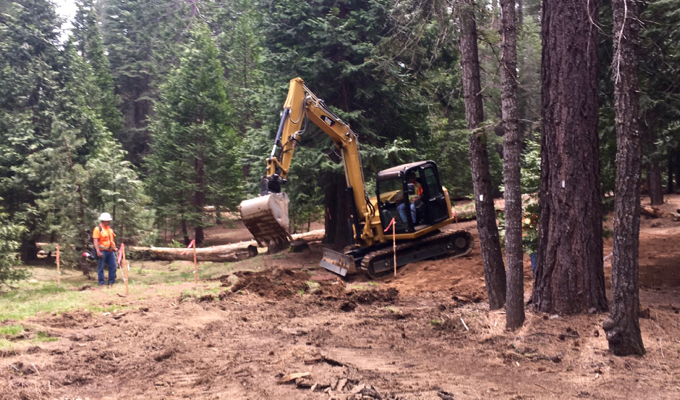
Crystal Basin Recreation Area is being overhauled. Photo/Terra Breeden

By Terra Breeden

The Crystal Basin Recreation Area is getting a $150 million makeover that could affect Tahoe while renovations are under way.

In an effort funded by the Sacramento Municipal Utility District (SMUD), the recreation area is being updated with new campsites, facilities, and installments. The massive renovation project is expected to take place over the next two decades.

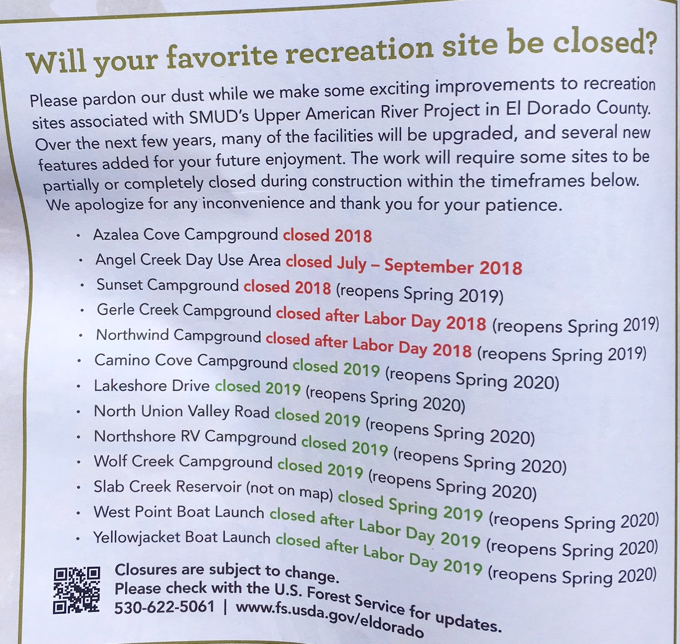
This summer, Sunset Campground, the largest campground in Crystal Basin with 131 sites, will undergo the first renovation and be clneosed to the public during construction, which will take two years. More campgrounds are slated for renovations afterward. U.S. Forest Service officials predict that the recreation area closures will defer many visitors to Tahoe for outdoor activities.

“Considering people will be displaced from Crystal Basin, there will most likely be an increase in visitation to adjacent areas, including Lake Tahoe,” District Recreation Officer of the Pacific Ranger District Becky Shufelt said.

Crystal Basin welcomes about 350,000 to 500,00 visitors annually and is by far the most popular recreation zone in Eldorado National Forest. Offering an array of activities like hiking, biking, camping and horseback riding, and boasting nine reservoirs, the region is a haven for outdoor enthusiasts.

The area was designated as an outdoor destination in 1957 through a partnership between the U.S. Forest Service and SMUD. Crystal Basin is part of the Upper American River hydroelectric project, founded by SMUD. The reservoirs and dams in the area provide electricity to homes in Sacramento and the Bay Area. Although the reservoirs were originally built to produce hydroelectricity, they have become a popular recreation zone in the decades since.

“When you create reservoirs, you create boating opportunities, and the SMUD partnership with the USFS is what made this recreation area possible,” SMUD rep Darold Perry told Lake Tahoe News.

However, as popular as Crystal Basin is, it has not been renovated since its creation, and campgrounds and facilities are severely outdated. Recently, SMUD obtained a new license from the USFS to operate the Upper American River project in the area and part of the agreement was that SMUD would renovate the Crystal Basin recreation facilities for visitors. The result is an enormous construction project that will take up to 20 years.

“The old deteriorated campgrounds were built over 50 years ago. It will be nice to get those updated and improve the visitor experience,” Shufelt said.

For the renovations, the Crystal Basin campgrounds will be updated with new picnic tables, animal-proof storage lockers, and several group sites will be added. New restroom and shower facilities will be built, and in an initiative to help lessen trash and alleviate some of the wildlife issues that have been rising in recent years, recycling bins will be installed in all of the campgrounds.

However, all of these renovations require closures. The campgrounds, especially Sunset Campground, are usually fully booked through the summer and although there are a few sites that are first come, first serve, there is often a line out the gate to claim these spots. With all of the campground closures due to construction, most significantly Sunset Campground, Forest Service officials expect to turn away many visitors this year.

“We are a very busy area and with all of the construction activity we are urging people to rethink if this is the area for them to come to or not,” Shufelt said. “Having a large campground like Sunset be closed for almost two seasons has a huge impact. The public may want to go to some other areas around the forest or explore neighboring national forests for their summertime recreation.”


Dems, GOP see tight Nev. race key to Senate control

By Michelle L. Price, AP

Democrats hoping to take control of the U.S. Senate in November believe one of their best chances to pick up a seat this year lies in battleground Nevada, where Sen. Dean Heller is the only Republican running for re-election in a state that Democrat Hillary Clinton carried in 2016.

Heller, who has spent nearly three decades in public office, is expected to face Democrat Jacky Rosen, a first-term congresswoman, in what could be one of the closest Senate battles in November.

Heller says it will be a close election but he’ll pull it off.

Democrats, who are anticipating a “blue wave” across the country driven by opposition to President Trump, have criticized Heller as a one-time critic of Trump’s who is now tied to him.

Read the whole story


Volcanic activity a real, but slim threat to Tahoe

By Sam Gross, Reno Gazette-Journal

As images of lava rivers engulfing homes in Hawaii reach mainland viewers, thoughts turn to our region’s own volcanic history, and wonder: Could it happen here?

The risk for an eruption happening within the bounds of the Silver State is slim, but that doesn’t mean Nevada is totally in the clear.

The risks mostly center on volcanoes just outside the state’s bounds.

Just over the border with California, two sizable and at one time destructive volcanic areas bookend the Reno-Tahoe region.

Read the whole story


SLT staff acts on its own; ignores council direction

By Kathryn Reed

South Lake Tahoe’s human resource director lied to the City Council on Tuesday when it came to the salary for the interim city manager.

Councilmember Brooke Laine asked how the $103.85 an hour salary that Tom Stuart negotiated came about when it’s not what the council agreed to. His response: “It’s in the top.”

Tom Stuart

But the top was really $15,833 a month as was agreed to May 1.

The monthly rate at the hourly wage that was approved is $18,000. That is nearly 14 percent higher than what the council originally allocated.

The council let the dollar figure go and didn’t call Stuart out on his lie. They just wanted to make sure there were no other payments coming from the city say for housing or a car allowance. And there won’t be.

Still, what Dirk Brazil will be making starting next month is higher than what the council had agreed to.

The money to pay him will come from undesignated reserves. It can’t just come out of the city manager’s account because it all got used up for this fiscal year and essentially into next year’s, which starts Oct. 1, because the council paid the former city manager nine months of severance for reasons no one has explained.

What the council had a hard time grasping on May 15 is that Brazil will be an hourly employee, not salaried. Brazil will also be keeping track of his own hours, according to Stuart. However, Councilmember Jason Collin pointed out that Brazil will be working for the council and accountable to them.

The hourly bit has to happen because Brazil is a CalPERS retiree. He’s allowed to double dip, so to speak, as long as he does not work more than 960 hours in a CalPERS fiscal year, which begins July 1. So, he could work unlimited hours in June per CalPERS, but the city will still be paying him more than 100 bucks an hour. The council did not set a hard limit on the pay/hours for Brazil to work in June.

The 960-hour mark would be reached in 24 weeks or about 5½ months, so mid-December, if Brazil works 40-hour weeks starting July 1.

It will be an adjustment for council members because they are used to calling-texting-emailing the city manager seven days a week, at all hours of the day and night and expecting an answer pronto. Now when they reach out it will be much like contacting the city attorney – it will be billable hours — at least if contact is not during the normal confines of the workday/workweek.

Brazil’s contract has no definitive end date. It’s supposed to be when a permanent city manager is hired.

But that process has been a bit convoluted. The council in April had asked for the city manager positions – interim and permanent – to be a priority over the city attorney. But Prothman Executive Recruitment, the firm that was hired to find both executives, has only started the city attorney process.

Part of the reason for this came to light at Tuesday’s council meeting. Staff arbitrarily agreed to stick with the salary range for the city attorney that had been on the books. They did so without council input. This meant Prothman could get started.

However, staff does not like the salary structure the former city manager had where some of her compensation was put into a 401(a)/457 instead of being subject to CalPERS. Her hourly salary was $80.25 or $166,928.94 a year. This didn’t account for the $50,000 a year put into the other retirement account. Staff doesn’t like the lower annual salary listing because they don’t all want that salary structure. Plus, it would be normal for staff to have a base salary less than city manager. If the city manager salary is really $216,000 a year, that makes for a better place from which staff can negotiate raises.

The city benefited from the restructured compensation package because its CalPERS obligation was lessened.

The staff report for the permanent city manager lists a salary range from $178,467.95 to $216,928.82.

Ultimately the council decided they wanted the city manager ads to say something about being open to a nontraditional pay structure like the former city manager had.

Council also directed the HR chief to tell the recruiting firm to concentrate on the city manager hire. Normally it would be the council, the mayor in particular, who would communicate with the recruiting firm. After all, the firm is working for the council – not staff.


Calif. voters might send $127 million to Tahoe

By Benjamin Spillman, Reno Gazette-Journal

California voters could approve spending $127 million for projects at Lake Tahoe in a series of ballot measures this year.

The Tahoe money would be just a small part of two bond measures that would total $13 billion, including $492 million in spending on projects in the Sierra Nevada.

“This is an unprecedented amount of potential funding for projects in the Sierra Nevada,” said Chris Mertens, government affairs director for the Sierra Business Council in Truckee.

Read the whole story


Calif. considers charge to create safe water fund

By Tess Townsend, Water Deeply

Gaps in funding for water treatment are a major problem in California. Water providers operate independently, relying virtually entirely on customer fees to cover costs. For agencies with scale, money and access to quality water sources, this model works well. But absent those resources, contamination persists for years without resolution.

About half a million people in the state receive water from a system that is out of compliance with safe drinking water standards, according to a November analysis by PPIC Water Center. Most of those failing systems are small – serving just a few thousand or a even a few hundred residents. While state bonds and grants can help systems build treatment facilities, there’s no state source of funding to subsidize ongoing operation costs for water providers that can’t afford them.

A piece of legislation, introduced last year as Senate Bill 623 and later included as a trailer bill in the governor’s proposed budget, seeks to solve this structural problem by raising a $140 million annual Safe and Affordable Drinking Water Fund, from a combination of charges on agriculture and residential water users. Money would go toward ongoing operation and maintenance costs for treatment in under-resourced districts. The charge on residential users would amount to about $1 a month for most households served by the 1,000 or so agencies collecting fund revenue.

Read the whole story