Publisher’s note: This is one in a series of stories about affordable housing in the Lake Tahoe-Truckee region. All articles may be accessed via the home page under Special Projects, 2017 Affordable Housing.
By Joann Eisenbrandt
Reviewing South Lake Tahoe’s housing elements chronologically is like taking a close-up look at the city in a mirror every few years. Sometimes, the changes are positive, other times, not so much. As the city has aged, some wrinkles have just gotten deeper and deeper. One of the most prominent of these is the continued inability of low- and middle-income residents to find quality, affordable housing in the same location where they work.
 As far back as 1988, the affordable housing shortfall for the city’s lowest wage earners was already evident. The 1988 housing element was an update of its 1980 predecessor. It found that due to constraints outside the city’s control, “… there has not been much progress toward solving the housing problems which exist in the city.” It called the housing supply situation “critical”—a term still being used to describe it in 2017.
The issues it identified are the same ones that subsequent housing elements have focused on. Of the city’s 13,891 housing units, only 9,385 were available to permanent residents. City planners noted that, “More and more homeowners are converting their homes into vacation rentals because of the profit gain involved. This process is fast reducing potential rental stock for local permanent residents.” In 1987, there were approximately 1,028 registered vacation rentals within the City of South Lake Tahoe. This was a 37 percent increase over the previous five years.
The condition of the city’s housing stock was declining. Over half of the city’s housing units were more than 20 years old. Rents and home prices were rising. “A serious overpayment situation (in relation to income) exists among renter and owner households,” the document stated. Impacts were greatest on the elderly, the unemployed and “low-wage casino and service employees.” “Overpayment” was defined as housing that exceeded 25 percent of total income.
Only two subsidized housing projects existed, Chateau Bijou and Sierra Gardens, but the demand for more was already clearly there. Both had a zero vacancy rate and a waiting period of six to eight months. Sixty-one percent of city residents rented rather than owned. The city housed many residents who worked across the state line. Casinos were expanding, and, “This situation has increased the burden on the Nevada counties to bear their fair share of housing for the employees which the gaming industry produces.”
Redevelopment was just in its formative stages. It had its own affordable housing requirements and was expected to help with the affordable housing issue. However, the lawsuits over the TRPA Regional Plan had not yet been resolved and the sewer plant was at capacity. There would be no more residential allocations from TRPA until it was expanded.
The housing element looked to the Renaissance 90 Committee, a public/private city-directed partnership, to provide updated information on city issues, including affordable housing. It was just one of many studies conducted by the city, hired consultants or community groups dealing with the affordable housing issue over the years.
 Where the rubber hits the road
In their 2012 Housing Element Update Guidance document, the California Department of Housing and Community Development (HCD), says, “An effective housing element provides the necessary conditions to support the development and the preservation of an adequate supply of housing, including housing affordable to seniors, families and workers.”
Kevin Fabino has been the city’s Development Services Director since May 2016. He told Lake Tahoe News, “I would really caution the community about using the housing element as a document to base future housing decisions on. It is a requirement of law. It doesn’t really address what’s going on in our community.” He adds, “The purpose of the housing element is to identify what the need is, and that comes from the Sacramento Area Council of Governments. That’s not the city’s perception of what the real need may be. The housing element makes that very clear. It’s our obligation to show that we can fulfill that obligation. But there are really two things going on: what the housing element requires and what’s really going on in our world.”
Fabino calls the Regional Housing Needs Allocation numbers that the Sacramento Area Council of Governments gets from the state, “an exercise in theory, not practicality.” He points to the fact that in the 2008 housing element, the city was required to provide 18 housing units dispersed between very low-, extremely-low and moderate-income levels. “What was actually produced in that timeframe was 50 units. Did the 50 units provided satisfy the real need in the community? No.” He hopes that in the future there is a, “more articulate conversation about those levels.”
Beyond this, there remain the constraints to the construction or rehabilitation of affordable housing outside the city’s control. Lake Tahoe News asked all five city councilmembers for their views on how well the city has implemented its housing element. Only Councilmembers Tom Davis and Wendy David responded.
“We need multi-family homes. We need TRPA to loosen up,” Davis said of the regulatory constraints. “We need to focus on where the need is greatest. We need to know how much land is actually available. We have to look at existing rules and work together with TRPA.” Davis pointed to South Tahoe Public Utility District’s reduction in sewer hook-up costs and suggested that if all the agencies in the basin reduced their fees for a trial four-year period and TRPA “backed away” on land coverage, deed-restricted affordable housing would have enough financial incentives to be attractive to developers. But, he concluded, “It’s going to be a long journey.”
David believes the city has been “active and proactive in several ways regarding housing, noting that 350 affordable housing units have been built. She said the city is addressing substandard housing issues in the motels where many residents live. “Are these the preferred living quarters for our residents?” she asked. “No. But if people are going to live there, we have an obligation to have codes that address their needs.” David is referring to the Single Room Occupancy Ordinance and program. More than 40 motels are currently signed up for the program which sets standards and provides for inspections. She believes the city needs to continue to, “be cognizant of our community, their voices and experiences as well as our housing availability and the impact it has on us socially and economically.”

A legal and philosophical document
California law requires jurisdictions create long-range general plans that look several decades into the future and outline how that particular area is going to develop and change. The housing element is one of the seven mandated parts of such local general plans.
While a housing element is a technical response to the state’s mandate, it is also a vital part of that jurisdiction’s vision of what it is and what it hopes to be in the future. As the California Department of Housing and Community Development (HCD) explains, “While the housing element must address specific state statutory requirements, including the local jurisdictions’ fair share of the regional housing need, it is ultimately a local plan and should reflect the vision and priorities of the community.”
The legal dimension
Cities are required by the state to meet their “fair share” of the projected regional housing need. State housing policy relies on individual jurisdictions to plan effectively to meet this need. HCD reviews housing elements and then certifies them for compliance with state housing regulations.
This share of regional housing is a numerical calculation broken down by income level from very low to above moderate. The Sacramento Area Council of Governments (SACOG) calculates overall housing needs in a six-county region, including South Lake Tahoe, through a detailed statistical process using information from the California Department of Finance and other sources. It then tells each jurisdiction precisely how many housing units for each income level they must plan for over the span of their current housing element. This is called the Regional Housing Needs Allocation (RHNA).
Jurisdictions must update their housing elements periodically to show they are meeting these requirements. Income categories, as defined by state law are: very low income (less than 50 percent of median family income (MFI); low income (50 to 80 percent MFI); moderate income (80 to 120 percent MFI); and above moderate income (above 120 percent MFI). The city must show it can provide sufficient land and zoning capacity to meet projected housing unit needs in each of these income categories.
There is one important distinction. While the city must show it has the land capacity for these units to be built, it is not responsible for their actual construction. South Lake Tahoe’s current housing element was updated in May 2014 and covers the planning period of Jan. 1, 2013, through Oct. 31, 2021. The RHNA, the total number of housing units the city has to plan to accommodate, is 336; 155 are for affordable to moderate-income households and below, including 27 extremely-low income units, 27 very-low income units, 38 low-income units and 63 moderate-income units. Also included are 181 above-moderate income units.
The philosophical side
The statistical side of housing elements shows how actual circumstances “on the ground” are changing, either for the better or for the worse. But there is that other component of housing elements that tells what the city’s housing priorities are and what, in an ideal world, it plans to do to see them become reality.
“Adequate housing is essential to the viability of the community and its residents,” the city’s 1988 housing element affirmed. “Each and every individual, regardless of race, creed, color, sex, age, handicap, or income, should have the opportunity to have access to adequate housing. The city will support and encourage adequate housing in the community.”
In its September 2003 housing element, the city said it would, “Place high importance on preservation of a local community in South Lake Tahoe rather than just having a resort area of part-time second homes. Provide housing options so that people who work in the community can choose to live here and preserve the ability for children to afford housing in the community where they grow up.”
This ability of residents of low- and moderate-incomes to continue to live in South Lake Tahoe has become an issue of greater and greater concern and discussion as the years have progressed.
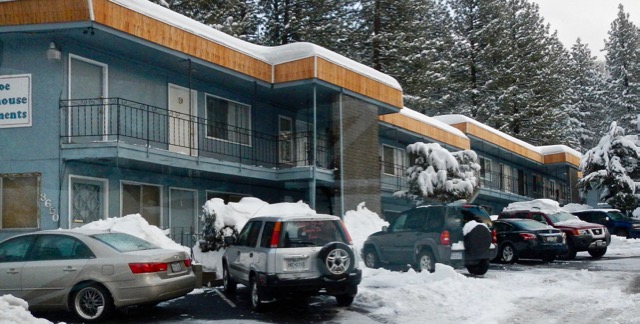
Affordable housing stock in South Lake Tahoe is lacking. Photo/LTN
The guts of the matter
Each housing element has the same basic parts. It reviews the immediately prior one to see what has worked and what hasn’t— what policies have been implemented and what goals have been reached. It then does a Needs Assessment to get an accurate picture of current housing needs. This includes an inventory of existing housing stock and its condition and the demographics of the city’s residents. It does a resource inventory that shows what land is available for residential construction, what public services are available and what city, state, county and federal housing programs and funding mechanisms exist. These analyses generates table after table of statistics measuring things like the percentage of rental- versus owner-occupied dwellings, the age and ethnic breakdown of residents, median incomes, residents’ employment by industry, median housing sales prices, and the parcel size and distribution of land.
It also looks at the current constraints on the city’s ability to meet its affordable housing numbers. These factors include governmental constraints such as city, county, state or Tahoe Regional Planning Agency land use regulations and fees, as well as non-governmental constraints such as changes in the national economy, the real estate market, prevailing wage scales, and the physical and topographical challenges of Lake Tahoe itself.
A look in the mirror
The November 1992 housing element noted that to reach its goal of providing affordable housing for low- and moderate-income residents, the city had set aside 30 percent of the residential allocations it received from TRPA in 1990 and 1991 for multi-family housing. From these 55 allocations, five moderate-income duplexes and one triplex were constructed but, “to this date there have been no affordable housing projects completed.” It found that since 1975, environmental restrictions had precluded construction of multi-family housing and raised development costs so high that predominantly upper-income housing had been built.
It also found that, “South Lake Tahoe has never had an articulated housing policy.” The failure to meet its affordable housing goals and objectives was partly because the city had no one individual or department dedicated to housing issues. The recent hiring of a housing coordinator was expected to help.
It also contained a blizzard of technical analyses, statistics and tables. The average home price had risen from $87,000 in 1980 to $133,603 in 1992, according to Board of Realtors’ statistics. Thirty-two percent of homeowners and 49 percent of renters were still “overpaying” for housing, now defined as total housing costs over 30 percent of total income. The only subsidized housing in the city was still at Chateau Bijou and Sierra Gardens. Overcrowding in existing units continued to be a problem as was an increase in illegal housing units.
It discussed homelessness and the growing use of low-end motel rooms as affordable housing. This was born from the difference between perceptions of Tahoe as a summer and winter paradise and the realities of living there. Many, it said, “… arrive with guaranteed jobs at the casinos, but are surprised at the high cost of rents compared to the low wages they receive.” Unable to afford upfront rental and utility deposits, they look to motel rooms as an alternative. However, in summer when rents are raised or the focus is on tourists, many are left homeless.
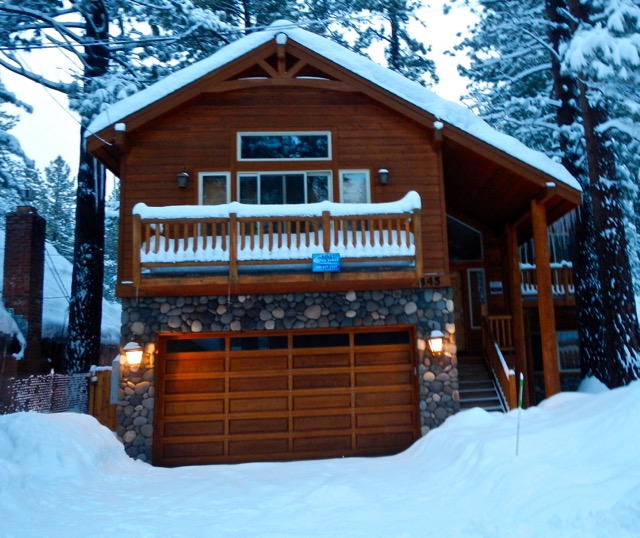
Vacation home rentals have been a documented concern in the city for years. Photo/LTN
More déjà vu views
The city’s housing element was subsequently updated in 1999, 2003, and 2008. The “philosophical environment” continued to play a big role in how much affordable housing was actually created. The city’s 1999 General Plan, of which the housing element was a part, felt it was important to, “provide the background from which the General Plan was developed.” It did this by beginning with excerpts from TRPA’s 1996 evaluation of the Tahoe basin. “The Tahoe Region was once a place of inestimable beauty … the progress of modern life has diminished the unique values that make the Tahoe region so extraordinary … ironically, the millions who enjoy the area simultaneously endanger it with their very presence.”
The 2003 housing element pointed to the growing trend of local low- and middle-income employees buying homes or renting in the Carson Valley and commuting. This could lead to two things. “The community could become more economically divided, with affluent and working poor residents but a shrinking middle class.” And the possibility that, “… within 10 years most people who work in South Lake Tahoe will not be living here.”
At the time of the city’s 2008 housing element update, TRPA was in the process of updating its own Regional Plan. The city was involved in this process and, “continuously voiced the need to balance the housing needs of local residents with the need to protect and improve the clarity of Lake Tahoe.”
Many workers still resided in older motel rooms; approximately 1,290 housing units were being used as vacation rentals; 62 percent of the estimated 12,000 employees in the Tahoe basin portion of Douglas County lived in South Lake Tahoe. The city was still predominantly white at 75.7 percent, but this was a significant drop from 92.2 percent in 1988. Young families continued to move down the hill. This led to declining school enrollment and the closure of Al Tahoe Elementary and Meyers Elementary schools in 2004. Fifty-seven percent of occupied housing units were rentals.
There were still no homeless shelters in the city. “Most of the current homeless population,” the city found, “is often using motel rooms or camping for their permanent residence.” Governmental services for the homeless in South Lake Tahoe were provided by El Dorado County. The only affordable housing development for seniors was Tahoe Senior Plaza.
The relatively new term, “workforce housing” had emerged. The 2008 housing element defined it as housing affordable to working households who don’t qualify for publicly subsidized housing but also can’t afford market-rate housing in the community. Middle-income members of the community like police officers, teachers, firefighters and nurses were also experiencing housing issues. The 2007 median home price in South Lake Tahoe was $425,000, but their “affordability” range was closer to $200,000. Many chose commuting from the Carson Valley or beyond.
The housing element today
The 2014 document finds the same “general disparity” between wages and the cost of housing in South Lake Tahoe. Renters occupy 61.1 percent of housing units. Rents continue to increase as does overcrowding in multi-unit rental complexes. South Lake Tahoe continues “to bear the brunt” of housing other jurisdictions’ low-income employees. Only a “limited number” of the area’s largest service-industry employers offer housing or housing assistance to their seasonal or permanent employees.
The housing element includes information from TRPA’s 1997 “Affordable Housing Needs Assessment Final ‘Fair Share’ Report.” It was created to addresses the general assumption that some jurisdictions at the lake housed employees that worked elsewhere. TRPA’s housing sub-element encouraged local governments to, “assume their fair share of the responsibility to provide lower and very low income housing,” but never quantified what that was.
The “Fair Share” report states that, “… each jurisdiction should assume responsibility for all of its low and very low income households created by their employment opportunities.” After data gathering and statistical analysis, it divided jurisdictions’ “fair shares” this way: South Lake Tahoe, 33 percent; Douglas County, 36 percent; El Dorado County, 2 percent; Placer County 11 percent; and Washoe County, 18 percent. It was a suggestion, not a mandate like the state’s RHNA numbers. It recognized that land availability and costs, environmental constraints and the real estate market would affect how realistic its projections were.
“There is a vast need for affordable housing independent of the fair share issue,” it acknowledged. “Unfortunately, at this time, more impediments seem to exist than incentives.” It also recognized that TRPA’s own regulations on land use, coverage, height restrictions and density limits were part of the impediments. “Each of these hinders, to some extent, affordable housing construction due to increased costs of projects.”
The 2014 housing element also discusses the phenomenon of “hot bedding. “This is where people working different shifts live in the same weekly motel room, but at different times of the day. Of motel living, the housing element says, “However, for many motel residents, motel living is a lifestyle choice. These residents may prefer to live in motels because of amenities such as maid service and the ease of paying a single bill each month.”
It notes that TRPA completed the update to its Regional Plan in 2012 and made changes affecting affordable housing by allowing mixed-use development, permitting 70 percent coverage in town and regional centers, and allowing transfer bonuses for residential transfers into town or regional centers. It also allowed jurisdictions to complete area plans to replace existing community plans and plan area statements. Still, the maximum densities allowed leave the city with, “limited sites where development at densities conducive to feasible housing projects can occur.”
Additionally, the dissolution of redevelopment agencies by Gov. Jerry Brown in 2011 eliminated this funding mechanism for future affordable housing and infrastructure development.
An increase in TRPA housing allocations, it finds, “does not necessarily correlate with ensuring that housing will be available to local residents of all income levels to purchase or rent.” It found that the Tahoe basin had, “an ample supply of housing stock—plenty to serve the regional population” but it was being used inefficiently.
One example is the use of motel rooms as affordable housing. “While some people allege that vacation home rentals ‘cut into’ the demand and market for motel rooms … many of the motels providing housing for some area residents would never appeal to the visitor market without substantial rehabilitation/investment.” At their 2014 level of use, vacation rentals were, “not considered by the City Council to be a constraint to providing, maintaining, and improving housing for people of all income levels in South Lake Tahoe.”
The city has recently made changes to its Vacation Rental Ordinance to increase enforcement and prohibit the future use of multi-unit complexes as vacation rentals. It is currently conducting a study to determine the citywide effects of vacation rentals.
The 2014 housing element also found that the mandated RHNA housing numbers are, “not an accurate assessment of the actual needs of the city’s residents by income group.” SACOG’s methodology is based on assumptions true in other jurisdictions, but not true for the Tahoe basin. The allocation, “underestimates the actual needs of city residents.”
The elephant in the housing element
The city’s 2014 housing element explains, “Development is a costly venture in the Lake Tahoe Basin.” There are the city’s own land use regulations and fees, but on top of that is the additional layer of TRPA regulations. The effect of these regulations has been a topic of concern in all the city’s housing elements.
Tom Lotshaw, TRPA spokesman, told Lake Tahoe News, “First, we don’t think it’s a matter of TRPA’s code and regulations being superior or inferior to the local governments and their housing elements. TRPA code is more regionally oriented in comparison to the details offered in the local government code. TRPA code and regulations are trying to facilitate implementation of the local governments’ housing elements, along with meeting TRPA’s many other objectives, such as environmental conservation and restoration and protection of the lake …. “
Lotshaw added that over time TRPA has “created various incentives for affordable and moderate workforce housing to help local governments meet needs identified in their housing elements.” The housing chapter in TRPA’s 2012 Regional Plan urges the use of area plans like the Tahoe Valley Area Plan. He listed some of TRPA’s incentives including no residential allocation needed for affordable housing projects, no-cost bonus units available for multi-family affordable housing projects, and a 25 percent increase in allowable density for multi-family affordable housing projects.
TRPA’s current strategic initiative on development rights will, “look at improving policies associated with development rights and evaluate different alternatives for their ability to support a range of housing opportunities and workforce housing ….” They are also working on a “welcome mat” initiative to streamline the permitting process. Lotshaw added that many of the available TRPA housing incentives are “only rarely being used. That suggests there are more systematic obstacles affecting the construction of affordable housing at Lake Tahoe.”
The million-dollar question
Fabino commended TRPA for looking at the development rights issue but felt it wasn’t the only thing at play here. When asked by Lake Tahoe News why the affordable housing issue in South Lake Tahoe remains unsolved today, he responded, “That’s the million-dollar question.” Answering it, he believes, requires a realization of the central role the marketplace plays. “When we are talking about creating affordable housing we come back to the same fundamental question that we have to ask when attracting businesses or industry here. It always comes back to the cost. It’s all about driving the market.”