STHS probationary accreditation appeal denied

Updated 10:30am

By Kathryn Reed

With South Tahoe High School losing its appeal regarding probationary accreditation, it likely means the school will have a new principal in the fall.

Last spring the Western Association of Schools and Colleges put the school on a two-year probationary status. Evaluators cited several deficiencies, including not implementing enough sections of Common Core.

Lake Tahoe Unified School District didn’t agree with much of the report so an appeal was made. Three WASC members came back last fall – two newbies, one from the original team. This time they met with the superintendent, something that was supposed to happen the first time.

Their decision to deny the appeal came last month. Lake Tahoe News requested a copy of the letter from the district office, but has yet to receive it.

Sources tell Lake Tahoe News the response from WASC did not delve into specifics this time. While the evaluation team looks at hard data, members also do a series of interviews. They try to get a feel for the atmosphere on the campus. They care about a lot more than athletics, which some people believe has been a growing priority at STHS to the detriment of academics.

STHS is effectively completing the first of two years of probationary accreditation. The school is accredited and this will not impact graduating seniors.

The WASC team will return in spring 2018 to begin a brand new evaluation process.

In previous evaluations STHS has received a six-year accreditation.

The process is time consuming. Internally, it will begin next school. What remains to be seen is who will be principal.

All LTUSD principals have a year-to-year contract. Unlike other staff members, principals do not have to be notified by March 15 that they will not have a job in the fall. However, LTUSD historically has listed principal positions on April 1.

STHS Principal Chad Houck deferred comment to Superintendent Jim Tarwater. Tarwater is not available because he is recovering from leg surgery, an injury sustained skiing. Only board member Bonnie Turnbull responded to LTN. She said to speak to board President Barbara Bannar.

At the Feb. 14 school board meeting teachers and parents spoke highly of Houck. They said he has been telling people he won’t be back as principal because he doesn’t get paid enough. He makes more than $100,000 a year.

Contractually, if the district were to ask him to step down, Houck would not have to be offered a teaching position because he did not start here as a teacher. If the board accepts his resignation, which some people have said could be on the March 14 agenda, Houck will be looking for a new job and the district for a new principal. Houck started at STHS in August 2014.

The board is expected to be updated on the accreditation issue at the March 14 or March 28 meeting – the agendas are not out yet.


Calif. storms: Wettest water year in 122 years

By Mark Gomez, Bay Area News Group

The first five months of California’s water year are the wettest in 122 years of record keeping, according to federal scientists.

Between October 2016 and February 2017, California averaged 27.81 inches of precipitation, the highest average since 1895, according to data released Wednesday by the National Centers for Environmental Information, part of the National Oceanic and Atmospheric Administration.

This current water season slightly outpaced 1968-69 (27.34 inches average), when a series of powerful storms in January and February resulted in widespread flooding in Central and Southern California, resulting in at least 60 deaths, according to a federal report. The third wettest October-February occurred in 1997-1998, according to the data.

Read the whole story


Senator: Passing ERA brings Nev. into 21st century

By Sean Whaley, Las Vegas Review Journal

CARSON CITY — Supporters of the Equal Rights Amendment on Tuesday disputed arguments that the time for the ratification of the amendment to the U.S. Constitutional is past, saying equality for women is long overdue.

Sen. Pat Spearman, D-North Las Vegas, who sponsored Senate Joint Resolution 2, told an Assembly committee that passage of the amendment 35 years after a congressional deadline will make a powerful statement that Nevada is ready to move from the 19th century to the 21st century.

While Gov. Brian Sandoval does not have to sign off on the resolution should it pass the Legislature, he said Tuesday that he supports the proposal.

Read the whole story


SLT’s No. 1 priority — improving roads

By Kathryn Reed

The 13 strategic initiatives that came out of the South Lake Tahoe City Council’s strategic planning session last month were whittled down March 7, with roads being the No. 1 priority.

It was agreed a survey will be taken soon, with the goal of having results presented to the council by May. The survey will gauge what voters think of raising the sales tax by one-half percent to be used strictly for roads. It could then be on a ballot this year. (The state sales tax rate went down 0.25 percent on Jan. 1.)

With requiring 66 percent of the voters to approve it, the money would be solely for roads and could not go anywhere else. While there was no proof given, Councilmember Austin Sass said 75 percent of the tax burden would be absorbed by tourists.

Sass also advocates for a toll fee; something the Tahoe Regional Planning Agency and Tahoe Transportation District are looking into. He is on both of those boards, though the council as a whole is not in agreement that is a good idea.

Another survey question would be asking people’s thoughts about creating a road authority. It would be similar to the now defunct Redevelopment Agency in that the council members would likely be the road authority members. However, the council could put community members on the authority’s board. The point of such an organization would be to make sure there is no question in residents’ minds about where the money is going. The authority could also have decision making responsibilities beyond just where that tax money is spent.

South Lake Tahoe City Manager Nancy Kerry on March 7 leads the strategy session workshop. Photo/LTN

South Lake Tahoe needs $3.2 million a year to maintain its roads. A dedicated program will bring jobs – internally and externally. The goal is to improve the pavement condition index. According to Jim Marino, deputy public works director, within three to four years the public would see a significant improvement with a dedicated funding source for roads. By year 15 the money would be for preservation and keeping the roads in good shape.

The city’s roads were never constructed correctly. Last week a plow took a huge chunk out of a street – not just a pot hole size section.

Even without a new revenue stream, the city will be spending at least $1.5 million on road repairs this season. The contract is signed and work will begin as soon as the weather allows. Plus, the city is trying to get as much money out of the state and feds from storm damage. That should at least fund pot holes as things dry out.

The council decided to combine Fixin 50 with business façade improvement and single room occupancy hotels into what will be a new program. Staff will bring back this yet to be named program to the council with achievable outcomes. This is when one-time funding would be used. The city would provide financial incentive for business owners to improve the aesthetics of their buildings to meet design standards, but those structures also must be up to code. The money will be for businesses fronting highways 50 and 89.

The Fixin 50 initiative was passed when Tony O’Rourke was city manager, but it didn’t go anywhere. The hope is it would be better received this go-round because the economy is better, the city is likely to put more money into the program – maybe $500,000, and a better marketing plan will be devised. With this, Police Chief Brain Uhler wants more enforcement of codes.

Vacation home rentals is not coming off the work plan, but because a study is under way on the subject there is nothing to decide at this moment. The study outcome should be released in May or June, and at that time decisions will be made.

Council wants to make sure VHR enforcement is happening. The 90-day extra enforcement ends mid-March. After that a report will be forthcoming. Uhler said few complaints are made about VHRs. Kevin Fabino, development services director, said the industry is beginning to change and be more compliant.

When it came to the idea of creating one Tahoe county, the council opted to make it a future workshop topic in order to delve deeper before making a decision about pursuing this. A positive is that it would reduce duplicate administrative services. For every dollar in property taxes sent to the county the city gets 40 cents back in services.

Councilmember Brooke Laine, who is spearheading the idea, wants to hire a consultant to gather financial data. Sass said because 51 percent of El Dorado County needs to approve this and that there has not been a new county in 100 years, he is skeptical of its ever becoming a reality and doesn’t see the reason to put money toward to it. Councilmember Tom Davis wants to know the costs and political process.

Regarding marijuana, in particular recreation use, the city needs to have a policy in place by the end of the year before the state starts allowing the use in 2018. State voters last year approved recreational marijuana.

Delivery services are one concern. According to Uhler, the district attorney will not prosecute those cases, but the city could still shut the operations down in other ways.

Community workshops will be forthcoming, then the council will decide what to do. If pot were taxed, there is the possibility that money could go to restore the narcotics task force. For taxation to happen, it could go to voters in June 2018.

The plan is to have a workshop and talk to folks in Colorado. Advice to date from others is to go slow with decision making.

Some call it marijuana tourism. At the one local medical pot shop there are 38,000 cards, which proves with only 55,000 people living in the entire basin that this isn’t just a medicinal business.

Everyone agreed housing is an issue; what needs to be decided is what the city’s role should be. Councilwoman Wendy David is the champion for this cause. Single room occupancy, vacation home rentals and affordable housing need to be talked about together. It was noted there is limited state money for affordable housing.

Coverage and commodity rights are the biggest obstacles, according to Marino.

City Manager Nancy Kerry mentioned the El Dorado County-led housing task force, spoke of how the city has created a lot of housing projects, and said the Tahoe Regional Planning Agency needs to change commodities.

With anyone allowed to buy here (or anywhere in the United States), the supply-demand issue cannot be resolved. But it’s possible to limit second homebuyers as other jurisdictions have done.

An issue is that old tourist hotels are becoming single residency occupancy lodging for locals because they are profitable.

Renewable energy goals are being deferred to the public, with those advocates asked to bring more information to the council. Creating a sustainability committee is being considered.

Fiber optics – Tahoe Prosperity Center is working on this. The plan is to keep funding TPC to work on this endeavor. Tied into this is the support of “dig once” policy. Ray Jarvis, public works director, said conduit should be put in the ground when someone cuts the road.

Regarding an outdoor events center, Marino believes this would be a huge money generator. Councilman Jason Collin said it should not be a priority.

Staff will bring back a work plan to the council, most likely in April. Other things on it will include airport improvements and possible rent hikes, relocation of the public works yard, negotiations with the county regarding the 56-acre site, changes to development services, financial policy stabilization initiative, CalPERS, communications infrastructure, storm water program and the recreation center.

Workshops are going to be part of this council’s future in order to delve deeper into topics and help determine where to go with specific issues.


Battle over ownership of public lands in Nevada

By Sean Whaley, Las Vegas Review Journal

CARSON CITY — The decadeslong battle over federal ownership of nearly 110,000 square miles of Nevada is about to be re-engaged at the Nevada Legislature.

With about 85 percent of those acres under control of a variety of federal agencies — primarily the U.S. Bureau of Land Management — some Nevada political leaders want a transfer of as many as 7 million acres to state control in a first phase that could eventually see large tracts of land become state lands.

Economic development is the primary driver for the introduction of Senate Joint Resolution 7, but some proponents see it as the first step in a state takeover of much of the federal public land in Nevada.

Read the whole story


Gaming industry steering clear of pot business

By Richard N. Velotta, Las Vegas Review-Journal

When Attorney General Jeff Sessions explained how and why the Justice Department would address pot smoking, for both medical and recreational purposes, it sent a wave of trepidation through Nevada, where voters in November approved legalizing marijuana consumption.

One place where it was business as usual after the announcement was within the office of the state Gaming Control Board, which in November reminded companies in the casino industry to stay away from the marijuana business because state gaming agents intend to continue to treat pot possession and distribution as a felony.

 A directive from Control Board member Terry Johnson in May 2014 essentially told licensees to make a choice: Either participate in gaming or in marijuana distribution because you can’t do both. In November, after Question 2 legalizing marijuana was passed, Nevada Gaming Commission Chairman Tony Alamo repeated Johnson’s message.

Read the whole story


Flood insurance a crapshoot for Tahoe homeowners

Water from flooded South Lake Tahoe streets entered several houses this year. Photo/LTN

By Bre McGee

At the far end of Christmas Valley, there are at least two members of Reds and Julie Regan’s household enjoying the detriments of flooding that recently effected many homes around Lake Tahoe. Having had to rip up flooded carpet and move furniture from the Regans’ dining and living rooms has left a new play area for the couple’s two dogs.

“They love running on the concrete floor. We’re trying to keep them out of there because of the debris, but it’s like they have a new race track,” Julie Regan said while talking about one small benefit of now living in a slowly progressing construction zone.

The Regans’ story is a familiar one around the Lake Tahoe Basin. Many residences and vacation rental properties were flooded due to a string of rain storms earlier this year that melted snow and obstructed sewer drains, resulting in water seeping into the lower levels of homes around the area. Even though the Regans carry homeowner’s insurance, their policy does not cover damage ensued by flooding.

According to Carson City-based AAA insurance agent Mike Johnson, the majority of homeowners opt-out of the voluntary flood insurance policy.

My home flooded. Now what?

1. Thoroughly read your flood insurance policy to find out the extent of the coverage.
2. Take photos of any damage to your home and belongings.
3. Begin writing a list of damaged property for the insurance claim’s adjuster.
4. Separate the damaged from the undamaged property; maintain control over the damaged property (keep it in the back yard or garage or shed if possible so thieves do not remove it).
5. If your carpet is damp, pull the carpet loose, remove the pad and dry the floor.
-or-
If your carpet and pad have been saturated by the floodwater, cut and remove the carpet and pad; save a small (2-feet by 2-feet square) piece of the carpet to show to the adjuster.
6. Keep air conditioner (or furnace in cold months) running, to aid in drying out of the property. Use fans (and open windows in warm months) to speed up the drying process.
7. Clean floors, walls, cabinets with mixture of 1-part bleach, 4-parts water. If removing water lines, take photos of interior and exterior water line depth.
8. Check any effected appliances for damage. If necessary, schedule a service technician to clean, service and provide repair estimate for flood-damaged appliances.
9. Call for heating company to have technician clean, service and provide repair estimate for flood-damaged heating/cooling equipment.
10. Decide if repairs need to be adjusted to avoided similar damage in future (swapping carpeted floors for tiled floors).
11. Even without an existing flood insurance policy, it’s good practice to inquire about the extent of your homeowner’s insurance policy. Sometimes clean-up may be covered.
Source: National Flood Insurance Program

“The majority that do carry it are forced into it by their lender. I would say maybe one in 10 carry a policy. With the requirement of a lender, maybe three of 10 carry it,” Johnson told Lake Tahoe News.

Homeowners insurance was originally developed as a policy to safeguard insureds against the financial burdens from fire damage. According to Tally Meek, vice president of Personal Insurance at Sierra Insurance Associates in Truckee, more pieces were added to the original type of homeowner’s policy.

“The insurance agencies then became unable to make enough money from premiums due to the rising amounts of damages insureds were seeking payments for,” Meek said. “In turn, separate policies were created for damages from natural disasters including floods, earthquakes, hail and hurricanes.”

In 1968, the National Flood Insurance Program (NFIP) was created by Congress to issue flood insurance protection to both homeowners and renters. All flood insurance policies are written through NFIP as an optional add-on to existing insurance. While it may seem like a costly addition, it can prove to be worthwhile.

Summit Partners Insurance Services agent and flood insurance specialist Jim DeGraffenreid, explains just how important flood insurance can be. “Next to nothing is covered without an existing flood insurance policy,” DeGraffenreid said. “Almost every regular homeowner’s insurance policy excludes flood insurance.”

Without a flood insurance policy, neither the structure of a home, nor the contents inside, are covered. However, not all water damage is covered equally. Depending upon the source of the water, you could be covered without a flood insurance policy.

“Did it escape from an interior plumbing device? Did it back up from a sewer drain? Or did it seep up from the ground water through the foundation? Is it coming from the street and coming into your house? It really depends where the source of the water happened,” Meek said. “Once they [the insurance company claims adjuster] find the source of the water, they interpret the policy to determine if there’s coverage in the policy.”

Each flood insurance policy is written on a case-by-case basis because there is not a one-size-fits-all policy. Similar to homeowner’s insurance, various elements affect the annual cost and deductible. The location of insured property is the biggest factor. There are several types of flood zones mapped out across the Lake Tahoe Basin by the Federal Emergency Management Agency (FEMA) which determine the amount of risk in any given location.

The Lake Tahoe area features special and non-special flood zone areas. In South and North Lake Tahoe, special flood hazard areas (SFHA) begin with the letter “A.” According to the NFIP, a Zone A is a high-risk area with at least a 25 percent chance of flooding during a 30-year mortgage. Most lenders require a flood insurance policy to cover the price of the home in order to write a mortgage to homeowners in this zone.

The next most common flood zone in Lake Tahoe, according to DeGraffenreid, is Zone X, a non-special flood hazard area (NSFHA), carries a moderate- to low-risk of flooding. The NFIP reports that homeowners in these areas submit more than 20 percent of flood insurance claims and receive one-third of federal disaster assistance for flooding. While flood insurance is not required in this zone, it is recommended to all homeowners and renters.

“For most properties in Zone X, a policy costs between $400 and $500 a year at the maximum amount of insurance ($250,000),” DeGraffenreid told Lake Tahoe News. Properties in Zone X are considered to be less expensive to insure than those in Zone A because it’s less likely to flood in NSFHAs.
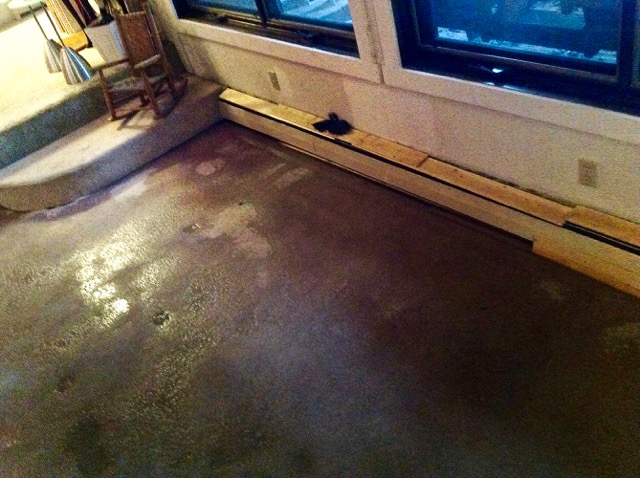
The carpet of Julie and Reds Regans’ living room was saturated with water during rain storms the second week of February. Photo/Provided

Though it’s recommended, the dilemma many homeowners and renters struggle with is deciding if flood insurance is worth the investment. Insurance agents around the area have seen a surge of flood insurance inquiries. Meek has had only one inquiry turned in a purchased policy this year. She believes this is associated with cost and a mandatory, 30-day waiting period required by the NFIP to ensure there are no preexisting damage at the insured property. The policy Meek wrote insures a high value home in a Zone D flood area, an undetermined flood hazard area, in Truckee at $2,100 annually. Though this particular home is valued at more than $1 million, the maximum amount of flood insurance coverage, as mandated by the NFIP, protects $250,000 of structural home damage and $100,000 of contents inside the home.

While an additional flood insurance policy may seem costly, NFIP’s website, floodsmart.gov, explains the expensive consequences of not having it. It states that California’s average flood insurance claim totaled $28,253 in 2014. An interactive flood cost estimate tool on NFIP’s website indicates that 1inch of water in a 2,000-square-foot home could cost an uninsured homeowner up to $20,000, depending on the extent of the damage.

Even though there are high-risk flood areas around Lake Tahoe, there are few flood insurance policies written for the area. According to FEMA, there are only 95 total policies written for South Lake Tahoe; 42 policies written for high-risk (A) zones and 53 policies written for low-risk (X) zones. There are even fewer policies written for Truckee; only 16 policies for high-risk zones and 28 in low-risk zones.

According to Johnson, between 20 and 30 percent of clients carry flood insurance, including those required to carry it by their lender.

“It’s just something that doesn’t come to mind. It’s not cheap. Up here where we live, there’s just not a lot of historic flooding. More people would say earthquake insurance would be more important than flood insurance,” Johnson said. “The majority of people think that flood insurance is going to be $50 or $100. Flood insurance is written though NFIP and it’s not an easy process. It takes me a couple of days to do one flood policy.”

Meek said, “Homeowners, in my experience, have only purchased it when there is a loan on the house and the lender is requiring flood insurance for the loan. It’s only been recently, with all the current flood threats that we’re having that I’ve had an increase in inquiries about flood insurance that were generated because the mortgage is requiring it.”

The Regans’ pre-flooding plan to update their home included removing the 1970s trademark sunken living room and updating the carpet to hardwood floors. Without an existing flood insurance policy prior to experiencing extensive water damage, the couple won’t be able to recoup any repair costs to their home.

“It was definitely on our homeowner’s ‘to-do’ list and now it’s moved to the top of the list, by matter of necessity,” Julie Regan said. “I think we’ve learned now. We were contemplating hardwood at one point but I think we’re going with ceramic tile just in case we end up in this situation again. I think we’re definitely going to look at it [flood insurance] in the future.”



McClintock hosts another raucous town hall

More than 1,700 people turned out Saturday morning at an El Dorado Hills high school to once again let Republican Rep. Tom McClintock know how they feel about GOP policies and his support of President Trump.


Calif. roads some of the poorest in the nation

By Kurt Snibbe, San Jose Mercury News

The governor’s office said damage to roads in the first two months of 2017 will cost $595 million to repair. That is a small portion of the more than $137 billion the state needs to repair its crumbling transportation infrastructure.

California is trying to climb out of a deep pothole regarding repairing its roads.

The gas tax that supports maintaining its roads is one of the highest in the nation, but California’s highways, freeways and city roads are constantly rated some of the worst in the nation.

Recent storms across the state have wrecked more than 350 roads.

Read the whole story


Northstar veteran at helm of ski resort

By Kathryn Reed

Even though Nadia Guerriero is well versed in event planning, a mega-winter pushing 600 inches of snow to date is one event she didn’t plan for.

“For so many years the conversation was how to keep our trails open, how to make sure we had enough snow. Now it is where do we put all the snow,” Guerriero told Lake Tahoe News.

Guerriero is in her first season as chief operating officer of Northstar. This Truckee resort averages 350 inches of snow a season. In 2014-15, 133 inches fell.

This season she and her crew are figuring out how to get it off roofs, how to dig down to access lifts, and how to maintain safety, as well provide a good experience for guests. All this snow doesn’t just affect life at work. Employees, like everyone in the greater Lake Tahoe area, have had their own struggles this winter, which in turn can have an impact on the workplace.

Guerriero said the massive amount of snow “has accelerated the learning process in a lot of ways.”

It helps that the 43-year-old is not new to the resort. She started at Northstar in 2007 as director of events and conference services. Four years later when Vail Resorts acquired the property she became general manager of the village.

While she didn’t work directly with everyone at the resort in her prior capacities, she at least had an awareness of who they were and what they did. That has helped ease the transition to being the leader.

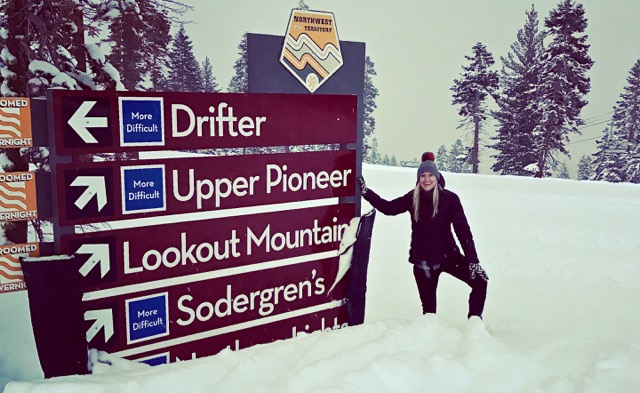
Nadia Guerriero in her first year as COO at Northstar has had to deal with more snow than she ever imagined. Photo/Provided

It is her leadership that helped get her the job.

“Nadia’s leadership and dedication to the Northstar community for nearly a decade prepared her well for the Northstar COO role – it was a natural fit. She executes on her day-to-day responsibilities exceptionally and also dedicates a huge portion of her time to developing high performing teams,” Pete Sonntag told Lake Tahoe News. He is Vail Resorts’ vice president in charge of the three Tahoe area resorts. “It’s this extraordinary leadership and commitment to excellence that is sought after in this industry and will help her raise the bar for Northstar and Truckee/Lake Tahoe.”

Guerriero’s immediate goal is to continue to have Northstar be the No. 1 place in California for families to ski.

She wants to fill in the midweek with more destination visitors. With the recently approved master plan, the resort will be expanding. This could attract more people, too. What the first project will be has not been determined.

Northstar has long struggled to be a year-round destination. Lake Tahoe locales take precedence in the summer. Guerriero knows the lake will always be a priority for summer visitors, but she thinks Northstar can still capture a larger segment of the market. This will in part be accomplished by keeping the village full, having plenty of shopping and dining options, as well as things for kids to do.

“We have available lodging here and need to promote that lodging. We need to make Northstar a real hub to spend a week or two,” Guerriero said. “Another big thing to do is be mindful and thoughtful about programming.”

She also wants to coordinate transit with the town of Truckee to bring people between the two locations.

Development in the region draws the ire of many when it comes to where workers will live and congestion on roads. Guerriero believes Northstar has a role to play in mitigating both issues.

“Regarding roads and traffic it’s been an extraordinary year from weather and visitation standpoint,” Guerriero said. Working on the inflow and outflow of traffic, and educating guests are other things the resort is doing. The resort also helps fund regional transit.

“I believe in affordable housing and workforce housing. We are part of the (Truckee North Tahoe) Regional Housing Council,” Guerriero said. The resort has pledged $30,000 to the Housing Solutions Fund.

While Guerriero’s job is never ending, she does get to spend time on the mountain. She been skiing since she was 10, having learned at Eldora Mountain Resort near Boulder, Colo. Her mom put her and her sister in lessons – at night – and from there she was hooked.

Today she skis with her husband and daughter.

For now, Guerriero is hoping to be in this position for years to come. Even though the last two Northstar head honchos got promoted to other resorts within the Vail Resorts family, she wants to stay put.

“There are a lot of people in the same role, at the same resort. I hope to get to be one of those,” Guerriero said. “I would love to stay at Northstar. I’m passionate about the resort.”