Calif. preparing for future full of extreme weather

By Michael Rios, PBS News Hour

Two straight months of heavy rainfall have effectively ended five straight years of drought in California. But with parts of the state reporting more than 100 inches of precipitation since last fall, the rain activity has also caused floods, road closures, infrastructure damage and evacuations in many areas.

As a result of the unpredictable nature of California’s climate, state officials have begun to prepare for what they expect to be continued extreme weather conditions. The Climate Prediction Center predicts lingering drought conditions will persist in parts of Southern California through June even after what it called a “phenomenal wet season.”

State officials also expect variable weather patterns to continue in the future, which could extend droughts, increase flood risks and threaten the sustainability of the Sacramento-San Joaquin Delta.

Read the whole story


Waterhouse provides lines for adventure seekers

A flat Grass Lake is the easy start and finish for Waterhouse. Photo/Kathryn Reed

By Kathryn Reed

With 1,800 vertical feet to ride and features built into the environment, no wonder Waterhouse is such a popular destination for skiers and snowboarders.

Even better for them it’s not much of a hike from the vehicle to where the climb begins.

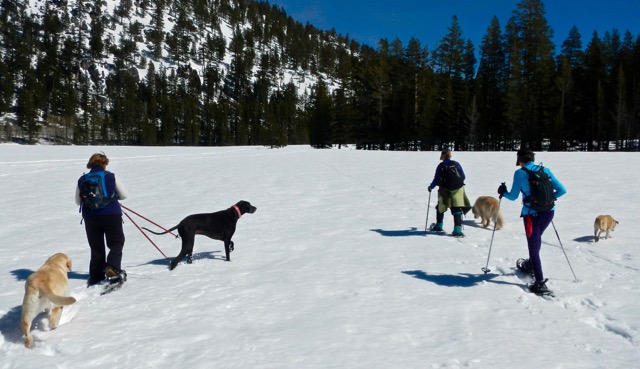
The eight of us (four humans, four canines) aren’t into back country adventures of that kind, but we did explore this terrain last weekend on snowshoes – a first for all of us.

After traipsing across Grass Lake it’s all uphill. Waterhouse (9,497 feet) and Powderhouse (9,380 feet) are next to each other. When facing the mountains from Grass Lake, Waterhouse is to the left – our desired destination. They are both popular with skiers/snowboarders.

Always be aware of snow conditions. The freeze, thaw, fresh layer cycle can create variable conditions in the Sierra. The Sierra Avalanche Center is a good resource for information.

A snowboarder finds natural jumps down Waterhouse. Photo/Kathryn Reed

It’s one of those routes without a route, so to speak. Plenty of people (snowmobilers, hikers, snowshoers, skiers with skins) had gone before us, but still we weren’t always sure which path to choose. Some lines went straight up, others zigged, and sometimes we chose to zag.

The beauty of being surrounded by all those pines in all of that snow was breathtaking — or maybe it was the steep terrain taking our breath way. Mother Nature’s splendor never gets old. And on this warm late winter day short sleeves could be worn.

A group of snowboarders crossed our path. When they told us it was probably another 90 minutes to the top we decided we’d had enough for one day. This was like a scouting mission to know how much time we’d need to complete the trek and see the conditions for ourselves. Maybe it would make a good summer hike.

Blue-green-white — the natural beauty of playing in the Tahoe area. Photo/Kathryn Reed

—–

Getting there:

From South Lake Tahoe, go west on Highway 50. Go left onto Highway 89 in Meyers. Park at the top of Luther Pass; there are several cut outs to make it safe. Walk across Grass Lake and start the climb.


Money key to closing last Nev. coal plant

By Scott Sonner, AP

Sierra Club lawyers who’ve preached against the environmental evils of coal-burning power plants for decades are trying to force the closure of the last significant one in renewable energy-rich Nevada with arguments based on a different sort of green: money.

“It used to be that we had to come in and say closing these plants might cost us a bit more, but it’s the right thing to do because of the social and environmental impacts — kids with asthma, dirty air and dirty water,” said Travis Ritchie, a lawyer for the club’s environmental law program in Oakland.

Critics of the Valmy coal plant scored a key victory last month when state regulators formally ordered Nevada’s largest utility to reassess its economic efficiency after experts projected it will cost ratepayers $30 million or more under current plans to keep it open until 2025.

Read the whole story


Nev. lawmakers pledge resistance to Yucca Mountain

By Gary Martin, Las Vegas Review-Journal

A $1.1 trillion budget blueprint by President Trump that includes a revival of Yucca Mountain as a repository for nuclear waste was declared “dead on arrival” Thursday by Nevada’s two U.S. senators.

And Nevada Gov. Brian Sandoval, a Republican, said opposition in the state to the proposal would be fierce.

The president’s budget proposal for the 2018 fiscal year includes spending hikes that could benefit Nevada veterans and military, but it also includes sharp spending cuts that could impact research at UNLV.

Read the whole story


Ultraviolet light to be used to kill Tahoe weeds

By Kathryn Reed

TAHOE CITY – Killing aquatic invasive weeds in Lake Tahoe with ultraviolet C light will be tried for the first time this summer.

The California Tahoe Conservancy board on March 16 agreed to spend $260,128 on the pilot project in South Lake Tahoe. The money was awarded to the Tahoe Resource Conservation District, which has been integral in working on ways to eradicate various invasive species from Lake Tahoe.

John J. Paoluccio of Inventive Resources Inc. has developed a system in which the plants are killed – almost like getting a lethal sun burn. The light damages the DNA and cell structure of the aquatic invasive weeds. This stops reproduction and eliminates the weed in a few days.

The CTC staff report says, “The project will help the Tahoe RCD determine the optimum intensity and duration of treatment necessary for eradication of AIS plants.”

Milfoil is choking about 20 locations in Lake Tahoe. Photo/LTN file

An area inside Lakeside Marina and then along its shore in South Lake Tahoe will be tested this summer. About one-quarter of an acre will be treated.

The light can be applied either by dropping a box like device that resembles how an umbrella works over the infested area or using a mat. The latter would be good to reach under docks.

Eurasian watermilfoil and Curlyleaf pond weed will be the targeted weeds. Leaving native plants alone is the other goal, as is protecting fish.

“What we are doing is pioneering,” Paoluccio told Lake Tahoe News.

While Paoluccio has been building the necessary apparatuses for this project at his home in the Central Valley, he also has a house in South Lake Tahoe. He has been watching the proliferation of the invasive weeds through the years and knows all too well the negative impacts they have on recreation, navigation and the ecosystem.

Tests have been conducted in his lab using Tahoe water and the two targeted weed species. A video at the CTC meeting on Thursday showed in a controlled environment the rapid decimation of the weeds.

Paoluccio wants to start the program at Lakeside when the water warms up a bit and plants are still young; probably in June. Pre- and post-treatment monitoring are covered in the costs. Data will be collected on how many plants are killed, if a second treatment is required, different durations for the application to see what works best, conditions of the lake when applied, and any other details about the two treatment locations. The entire process is expected to be completed in November 2018.

If it’s successful, the plan would be to use this method in a larger area.

Paoluccio built an 8-foot-by-16-foot boat just for this process. He has two units ready to kill the weeds. The devices can go to a depth of about 20 feet.

Eurasian milfoil first started to take hold in the warm canals of the Tahoe Keys in South Lake Tahoe in the 1970s. It has since spread to various parts of the lake. The Keys has tried a variety of methods to rid its waters, with the next step being an herbicide. The homeowners’ association is looking to use chemicals starting in 2018.  The Lahontan Regional Water Quality Control Board needs to approve this first. In December 2011 the state agency said on a case-by-case basis chemicals could be used in the lake.

The Keys also needs the money for the project. Ballots for a special assessment were mailed to Tahoe Keys Property Owners Association members this week.


Runoff should have Tahoe reaching capacity

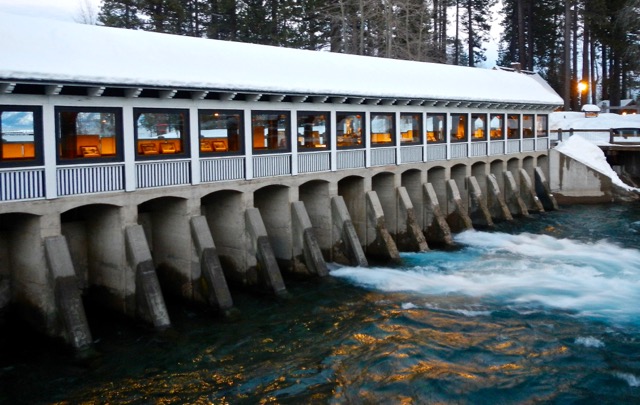
Water is flowing from Lake Tahoe through the dam in Tahoe into the Truckee River. Photo/LTN

By Amy Graff, San Francisco Chronicle

The depressing scene of boat docks sitting high and dry on wide beaches around Lake Tahoe will likely be a fleeting memory this summer.

Winter’s unrelenting storms built up a substantial Sierra snowpack and are expected to fill the lake for the first time in 11 years.

Lake Tahoe’s natural rim is at 6,223 feet above sea level. The lake can store an additional 6.1 feet in its reservoir and climbs up to 6,229 feet at full capacity, its legal maximum limit. Tahoe’s water level reached 6,226.84 feet on Wednesday; the lake needs about 88 billion gallons of water to jump up the 2.26 feet required to be completely full.

Read the whole story


U.S. budget cuts would be widely felt across Calif.

By Evan Halper and Sarah D. Wire, Tribune Washington Bureau
 
President Trump’s budget would deliver a painful financial blow to California, with the potential to push a state that has struggled for years to keep its books balanced back into the kind of red ink that consumed it after the housing market collapse a decade ago.

The only solace state and local officials are taking out of a White House budget plan that would cut most federal departments by about 10 percent to 12 percent is that even Republicans in Congress probably will find all the cuts on the table too hard to stomach.

The president’s blueprint would disrupt almost everything California does, in some cases quite brutally.

Read the whole story


Calif. eyes ending tax breaks for vacation homes

By Matt Levin, CalMatters

Lifelong Californian Lori Thompson is well aware of the state’s dire affordable housing problem. She’s just wondering why she’s the one who has to pay to fix it.

After her daughter moved to Reno to escape high rents in the Monterey Peninsula, Thompson and her husband decided last December to purchase a $360,000 cabin in South Lake Tahoe. It will allow them to spend summers where Thompson used to vacation as a child and to be closer to their grandchildren.

But now, as the state grapples with nearly 6 million California households struggling to afford housing, legislators are turning to people like the Thompsons as a logical source of revenue—owners of a second home who deduct the interest they pay on it from their state income taxes.

AB71 would eliminate that deduction and channel the gains—at least $220 million annually, according to initial estimates by the state Franchise Tax Board—to a state affordable housing program. Supporters say that would cover the cost of creating 3,000 new units of affordable housing, and it could leverage $600 million to $1 billion in additional federal housing dollars.

“During this housing crisis we have to be sure everyone has a roof over their heads before we provide tax breaks to people with two roofs,” said the bill’s sponsor, Democratic Assemblyman David Chiu of San Francisco.

California’s unmet housing needs

Thompson acknowledges California’s housing crisis needs attention—because of soaring Silicon Valley apartment rental rates, she and her husband invited a college student who attends their church to live rent-free in their San Jose home. But she’s adamant that taxing vacation homes is not the answer—and that without the mortgage interest deduction, she might not have ever bought a second property in the first place.

“There’s a lot of people I know who have second homes in California. They’re not wealthy but they’re comfortable,” said Thompson, a 61-year-old retiree. “My husband and I don’t drive expensive fancy cars. We chose a second home over traveling.”

AB71, which last week cleared the Assembly’s housing committee, would apply only to Californians who spend a significant amount of time in their second homes. Those who rent out second properties could continue to deduct mortgage interest from their state tax returns (the Internal Revenue Service defines a rental property as a property where the owner spends less than 10 percent of time compared to rental tenants.)

Currently, Californians can deduct interest from up to a million dollars in mortgage debt.

Given that Gov. Jerry Brown and Democratic lawmakers failed to reach a compromise on affordable housing funding last year, Assembly and Senate Democrats now are championing a fleet of bills to address California’s soaring housing costs. Legislators already have sent more than 100 housing-related bills to the Assembly Housing and Community Development Committee alone—well above the number introduced last year.

So just how many Californians own second homes, and who are they?

While traditionally considered an untouchable third rail of tax policy, the mortgage interest deduction has come under renewed scrutiny of late precisely because the deduction disproportionately benefits wealthy homeowners.

Nearly three-quarters of the tax benefit from mortgage interest deductions at the federal level go to households with cash incomes above $100,000, according to the Tax Policy Center. 

AB71 targets an affluent group of Californians—those wealthy enough to afford a second house and not use it primarily for rental income. But it wouldn’t necessarily affect the richest of the rich, who may not need to finance a second property. Over the past ten years, about 44 percent  of second homes not used for rentals were purchased without a mortgage, according to data from the California Association of Realtors.

Where are California’s second homes?

Based on data from the federal home lender Fannie Mae (and not their own internal tax data), the Franchise Tax Board estimates that 195,000 homeowners would be affected by AB71. On average, each of these second homeowners reduces his or her taxes by about $1,140 annually by taking advantage of the second mortgage interest deduction. That’s in addition to the sizable tax breaks they receive at the federal level on both their properties, which disproportionately benefit households with high incomes.

The state lacks a surprising amount of data on second homeowners, including their average income. So while it’s safe to assume that second homeowners are more wealthy than your average California taxpayer, by how much more remains unknown. The National Association of Realtors estimates that nationally, second home buyers have a median household income of about $91,000.

As for their location within California, certain regions contain high concentrations of second homes. In tiny Alpine County, home of the Kirkwood Mountain Resort, more than 70 percent of the housing stock is comprised of vacation homes, according to U.S. Census data analyzed by the National Association of Home Builders. More than half of the homes in Mono County, near Mammoth Mountain, are seasonal.

That has led to concern from some of these regions that the bill could exact a hefty toll of their local economies and housing markets.

“Local county assessors from my district have relayed their concerns regarding the removal of the (second mortgage interest deduction) and the potential impacts it could have for property values throughout California,” said Republican Assemblyman Frank Bigelow, whose district includes all of Alpine and Mono counties.

The revenue rub and the governor

Bigelow and legislators from both sides of the aisle supported a 2015 bill Chiu sponsored that increased funding for the state Low Income Housing Tax Credit program by $300 million, but it did not eliminate the mortgage interest deduction on second homes. After it won near-unanimous passage in both chambers, Brown vetoed the bill, noting that it lacked a way to pay for itself.

While Brown has not taken a position on the new bill, Chiu expressed confidence that eliminating the second mortgage interest deduction would appease the fiscally cautious governor. “I have received every indication that if we are successful in passing this, that the governor will consider it seriously,” he said.

But while attaching a new revenue source to affordable housing may satisfy the governor, it means the bill faces a precarious political path through the Legislature, where it needs a two-thirds approval vote in both chambers because it is a tax measure.

That means supporters can’t afford to lose moderate Democratic votes in the Assembly or Senate, and will need to deflect the potent lobbying influence of the California Association of Realtors, which opposes the bill.  The Realtors contributed $1.1 million to state legislative candidates in 2016, including $723,000 to Democrats, according to data from the National Institute on Money in Politics.

Realtors big spenders in legislative campaigns

Chiu “is trying to do the right thing,” said Stan Wieg, the association’s vice president. “He’s looking for a source of funding. We just think it’s misdirected.”

A spokesman for Assemblyman Jim Cooper of Elk Grove, co-chair of the Assembly moderate Democratic caucus, said that he had not yet had time to study the bill.

Trump complicates ‘dire need’ for housing dollars

Even with its designated new funding source, AB71 could face push back from the governor’s office on the amount of revenue the bill forecasts.

The state will be on the hook for $300 million in additional state housing funds regardless of how much money the elimination of the second mortgage interest deduction actually brings in. But the Franchise Tax Board did not incorporate into its initial revenue forecast any possible behavioral responses to the bill—such as a drop in the number of people buying second homes, or more second homeowners converting their properties to rentals.

Affordable housing advocates across the state argue that the $300 million would provide a small but critical boost to the state’s affordable housing supply, given the state’s urgent need and looming federal housing programs cuts.

The Trump administration is reportedly mulling a proposal to cut $6 billion from the U.S. Department of Housing and Urban Development, a dramatic rollback that could affect multiple affordable housing programs in California.

AB71 would direct $300 million to the state’s low-income housing tax credit program, which pairs state tax credits with federal tax credits to attract investors in low income housing projects.

While investor demand for affordable housing tax credits could be waning, the U.S. tax credit program is one of the few federal housing programs receiving significant bipartisan support and not on Trump’s chopping block. That makes affordable housing advocates all the more eager to tap one of the remaining reliable sources of federal funds. 

“In the face of greater cuts to federal funding through the HUD budget, California needs affordable housing investments at the state level now more than ever,” said Sarah Brundage, state and local policy director for the affordable housing developer and advocacy group Enterprise Community Partners, Inc.

“The (tax credit program) in California and nationally is currently the greatest investment we make in housing. So this bill would play a crucial role in ensuring developments can pencil out.”

Other pending California bills take a different approach to funding affordable housing. One by Democratic Sen. Toni Atkins of San Diego would levy a $75 recording fee on real estate documents, excluding property sales. The California Association of Realtors supports that bill, but it’s opposed by mortgage lenders and county recorders.

While maintaining that the governor has not taken any position on AB71, a spokeswoman for Brown said that the governor is generally supportive of the Atkins bill.


Knights Inn environmental gains in jeopardy

By Kathryn Reed

TAHOE CITY – Days after South Lake Tahoe officials were celebrating the acquisition of the Knights Inn property, the Champagne has gone flat thanks to the California Tahoe Conservancy board.

The city was back before the state board on March 16 to finalize its request to obtain grant dollars that would fund the environmental improvements at the site.

South Lake Tahoe was under the impression it was still in the running for these Proposition 1 dollars. It had never been given a deadline to provide the CTC with the requisite information.

The city will release the California Environmental Quality Act documents on Monday. Comments will be taken for 30 days. That was one requirement of the CTC. The CTC also sought more detailed information on the stream environmental zone restoration. The city provided documentation.

What got contentious at Thursday’s meeting in Tahoe City was whether the project presented was substantially different compared to the first application. Why this would matter is that the dollars being used are being awarded under a competitive bid process so there cannot be any sense of favoritism because that could trigger the threat of a lawsuit by parties that were denied funding. Clarifying information is legal, but amendments or resubmissions are not permissible.

Hal Cole, the city’s rep on the CTC board, as well as city staff, are adamant the project is the same, only with more detail as required by the CTC. The board was not convinced.

The board believed going from 2 acres to 1.1 acres of restoration is hugely different. Cole explained that overall the same acreage will be treated; it’s just the level of detail of restoration that is in question.

The definition of SEZ was also debated even though the Tahoe Regional Planning Agency has a definition for it.

What the board didn’t discuss even though it was stressed by the city is that the original request of $5.4 million had been reduced to $3 million. City staff tried to draw a parallel between the revised SEZ numbers and the dollar amount.

Cole proposed a motion that would have CTC staff members and whomever else they wanted to look at the current paperwork to deem if the project was the same. That vote failed 4-2, with Cole and Paula Frantz of El Dorado County in the minority. Board member Larry Sevison, who represents Placer County, was absent.

The motion that passed unanimously was to have the Conservancy open round two of the Proposition 1 funds, of which the city was encouraged to apply. This will occur on March 17. There will be $3.6 million total available. (In round one $9.5 million was awarded for nine projects.) Depending on the number of applications for the next round, funding would be awarded in September or December.

The external committee that originally ranked the 32 projects from round one called the city’s project “transformative.” That is one reason it was recommended for funding – that it would daylight a stream that has been paved over and would reduce the amount of sediment draining into Lake Tahoe by 20 percent.

Right now that gunk, as Cole called it, winds up at Ski Run Marina. The proposed project on an annual basis would reduce the silt reaching Lake Tahoe by 8,200 pounds, 77 pounds of nitrogen and 25 pounds of phosphorous would also no longer reach the lake.

The Knights Inn project will go forward. As of today it is a redevelopment project only.

“Without the CTC partnership, we will not have the environmental gains,” City Manager Nancy Kerry told the board before the vote.

Some city staff are wondering why they would apply again if the project has essentially been denied. But Conservancy board members after the vote said that isn’t exactly what the vote said. The vote, some said, was about fairness for the process and not about the project itself.

It will be up to city staff to determine the course of action going forward. Waiting six to nine months to know if there is funding for the environmental component for the Knights Inn project would delay the entire process. The plan earlier this week was for demolition to occur in early summer, construction to start in late summer and the Whole Foods 365 – and probably other retail entities – to open in spring 2019.

With the city discussing its mid-year budget in April, this could be a topic then.


The corporatization of Tahoe’s ski resorts

Squaw Valley is now part of the KSL group after being owned by the Cushing family for years. Photo/Kathryn Reed

By Sage Sauerbrey, Moonshine Ink

Ski communities seem to have an especially strong inclination for nostalgia. I grew up with my parents’ tales of my home mountain during the ’80s when the powder stayed fresh for days and getting duct-taped to the local bar was a common occurrence. Lift tickets were less than $50, and almost every resort was independently owned and operated, giving them all a unique flavor. Some might say the golden age of ski culture has long passed, while others claim that the new cheap season passes and resort collective deals have saved skiing, but the simple fact is that these aren’t your parents’ ski resorts any more.

“If you were to take a pic from 30,000 feet looking down, it hasn’t changed a hell of a lot, but on the ground, it is a different world than it was pre-1990, and it is constantly in transition,” said Michael Berry, president of the National Ski Areas Association (NSAA).

“Back then, nobody owned two resorts. Every single resort around the lake was privately owned, and it was independently owned,” said Tim Cohee, owner of China Peak Mountain Resorts in Lakeshore and ski business and resort management program director at Sierra Nevada College. “What everyone has seen is a business that has become largely dominated by corporations. It’s probably at least 40 percent of the national skier attendance that is being seen by probably five or six companies.”

Here in Tahoe the change began about 15 years ago, when Vail purchased Heavenly Mountain Resort and proved just how lucrative the business of skiing can be.

Read the whole story