Poetry and politics with the Indigo Girls

By Kim Wyatt

STATELINE – Indigo Girls Amy Ray and Emily Saliers played a tight 22-song set at Harrah’s Lake Tahoe showroom March 24 to a full, devoted house. Lyrically rich songs of self-discovery and political anthems spanning 30 years of songwriting punctuated the intermission-free 90-minute show, and by the end an inspired crowd was on its feet.

The Georgia-based duo showcased a mix of tunes old and new from their folk/rock catalog. Violinist Lyris Hung added spice to a full quiver of stringed instruments: acoustic and electric guitar, banjo, mandolin and dulcimer were switched up in between most songs by guitar wrangler Aron Michalski who seamlessly delivered the right tools at the right time.

The Indigo Girls play to an appreciative crowd March 24 at Harrah’s Lake Tahoe. Photo/Lotte Colbert

Almost 30 years after their eponymous breakout “Indigo Girls” Ray and Saliers are still working out their lives in song. There is something comforting about seeing a band that carries on, that shows up, that does its job and we are richer for it, the benefactors of life lessons and heartbreak. The world has been a rough place lately, and the Indigo Girls, wielding focus and sincerity, healed some Tahoe folks with their specific alchemy.

With Ray on the mandolin, the reflective toe-tapper “Yield” from their 2002 release “Become You” kicked off the show, followed by “It’s Alright” and “Three Hits,” featuring Ray’s powerful vocals. Ray’s tunes have a harder edge than Saliers’, but this only complements their body of work: Ray deals in injustice, Saliers in metaphor and unrequited love—together, they lay it all out there and then make us feel like we’re going to be OK.

The Indigo Girls are known for activism—they co-created the nonprofit Honor the Earth with Winona LaDuke—but rather than banter about their political causes they let the music speak for itself. Ray-penned songs “Go” and “Shame on You” packed spark and power, the latter featuring the crowd-pleasing line, “They say we be looking for illegal immigrants can we check your car/I say you know it’s funny I think we were on the same boat back in 1694.” From their latest album, “One Lost Day” they offered “The Rise of the Black Messiah,” a song Ray wrote about a member of the Angola 3 still in solitary confinement. Just as the weight of the world began to sink in, the Saliers’ tune “Power of Two” made it all a little less scary; although her voice was worn, the harmonies carried the night.

The show ended with “Galileo,” and the audience remained on its feet for a two-song encore of “Share the Moon” and “Closer to Fine.” The mixed crowd—women and men, young and old, and everyone in-between—knew all the words. After a week of political chaos, it was good to be at a singalong. Anytime you need a righteous pick-me-up, the Indigo Girls are there. 

Kim Wyatt is the owner of Bona Fide Books in Meyers.


Calif. setting up a full-out war with Trump

By Chris Megerian, Los Angeles Times

Wielding the same authority created decades ago to fight smog, California regulators on Friday moved forward with tough new pollution-reduction requirements for automakers selling cars in the state.

The rules set escalating targets for reducing greenhouse gas emissions from 2022 through 2025, and officials are planning tougher steps after that. There’s also a requirement for automakers to sell more zero-emission vehicles and plug-in hybrids in the state, with a goal of more than 1 million on the road by 2025.

The decision to push ahead with cuts to greenhouse gas emissions came even as President Trump has begun rolling back federal rules intended to battle global warming over the next several years.

California has a long history of pushing the envelope to reduce tailpipe pollution, and the latest move signals the state is prepared to do battle with Trump’s White House.

Read the whole story


First wolf sighting in Nevada in 95 years

At least one of the Shasta pack wolves has been seen in Nevada. Photo/ CDFWS

By Henry Brean, Las Vegas Review-Journal

State wildlife officials have confirmed the presence of a wolf in Nevada for the first time since 1922.

The Nevada Department of Wildlife announced Friday that a wolf from the Shasta Pack in Northern California crossed into the Silver State in early November, but there is no evidence that the animal was here to stay.

The wolf was caught on video near Fox Mountain, about 150 miles north of Reno, prompting an investigation by state wildlife officials.

Read the whole story


Lake Tahoe Airport noise monitoring to change

By Kathryn Reed

Military helicopters are the No. 1 noise problem at Lake Tahoe Airport and there is nothing city officials can do about it.

With the city having taken millions of dollars in grants from the Federal Aviation Administration, it is obligated to allow military aircraft to access the airport. It is often used as a high elevation training airport for the various branches.

Noise at the airport – specifically how to monitor it – was a topic at a council meeting this month. The five decided to push a decision to later this spring.

Things have been rather lackadaisical since the 20-year 1992 settlement agreement expired. That document was the result of a lawsuit against the city filed by TRPA and the League to Save Lake Tahoe. With commercial airliners no longer coming to Tahoe and jets becoming much quieter, the issue is barely an issue today.

The airport receives on average 12 noise complaints a year. It’s the military and planes associated with the celebrity golf tournament that generate the bulk of the calls.

Military aircraft are regularly flying into Lake Tahoe Airport. Photo/LTN

“Lake Tahoe Airport under federal and state regulations is not required to have noise requirements. It is strictly voluntary for our customers,” airport manager Mark Gibbs told the council.

Still, that does not mean monitoring can just go away. The Tahoe Regional Planning Agency is a huge player. The bi-state regulatory agency reviews its thresholds every four years and would like the city to be in alignment with its schedule.

This spring TRPA hopes to “identify priority threshold standards to work on and update.” The criteria are for them to be SMART – specific, measurable, agreed upon, realistic, time-related.

“The city’s proposed approach to the noise exposure contour mapping and validation will happen every four years, not annually. It’s my understanding the city agreed to recommend to move forward with a four-year mapping/validation cycle to help meet TRPA’s threshold evaluation reporting requirements,” Tom Lotshaw, spokesman for TRPA, told Lake Tahoe News.  While that was the recommendation in the original staff report, it could change next go-round.

What the council will have to decide at a future meeting is what if any standards it wants to abide by.

Gibbs told Lake Tahoe News one option “is to develop a noise exposure map showing cumulative noise impacts based on the state of California standard for calculating and producing an aviation noise impact metric for public consumption. The TRPA also has a CNEL (community noise equivalent level) cumulative impact standard for the airport impact on residential areas. This standard is 60 CNEL.”

CNEL measures decibels at a location over time.

Gibbs said the state and FAA have determined cumulative noise event reporting is “the best means of quantifying and reporting aviation noise to the public.”

If the city goes this route, in all likelihood data from single noise events would not be collected.

CNEL doesn’t address the problem of a plane flying over a person’s house at 85 decibels once a day because once those numbers are averaged in to show the CNEL level that one incident is just a blip.

The TRPA, though, is not completely on board with only having cumulative data.

“In regards to the single-event noise monitoring, we’re going to evaluate and determine how best to proceed on that front,” Lotshaw said. “In the past, we used noise monitoring equipment at Barton Beach to monitor both shore zone noise events and airport-related noise events in the flight path. So a situation like that might be the best way to monitor for multiple needs with one piece of equipment, given limited funding and resources.”

The agreement the city had with BridgeNet International to collect noise information from six monitoring locations and report the findings expired earlier this year. The agreement with Versadial Inc. also expired this year. That firm provided airport aviation radio recording services in regards to aircraft noise.

It is the ending of these contracts that is allowing the city to rethink how it monitors noise. Gibbs is proposing using a computer model developed by the FAA that is used in other resort locations like Aspen, Colo., and Jackson Hole, Wyo.


China embarking on a skiing revolution

By Kade Krichko, Powder

The sun hasn’t yet made it over the dusty city skyline, but human friction offsets the morning chill as businessmen, students, and errand-runners ebb and flow to the singsong commands drifting from the concrete rafters of the Beijing subway station. Three stops down Line 13, a ski bus waits to shuttle groups of giggling teenagers to Nanshan Ski, the closest ski resort to China’s capital city. On this platform, I’m struggling to find breathing room amid a city of 21 million.

Skiing is not a new phenomenon in China. The sport has been traced back over 10,000 years to semi-nomadic tribes in the country’s Tian Shan Range—the first skiers in the world, according to many historians.

Yet it took until two decades ago, and the start of China’s free market explosion, for the public to show interest in the sport. After years of poverty and oppression, Chinese skiing began as a symbol of prosperity and status, a Western practice in a country full of newfound wealth.

Read the whole story


National Guard helps Mammoth with its snow

By Los Angeles Times

Hey, Mammoth Lakes, add this group shot of the National Guard to your winter scrapbook.

Burdened with removing the 44 feet of snow that had fallen this season, the village of 8,200 called in the National Guard earlier this month to help cart 4,000 tons of it away. The five-day offensive, involving 17 air and Army troops, will be just one of the many memories in this winter of monster, record-setting snows.

The SOS — shovel our snow — was issued after the village and Mono County declared a state of emergency to seek help in handling the piles that lined homes and streets.

Read the whole story


Fire crews working to make Tahoe basin safe

By Kathryn Reed

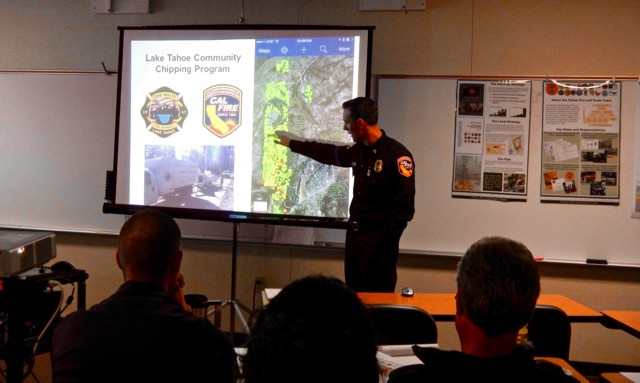
MEYERS – In an effort to get ahead of the fire season, crews from various fire agencies in the Lake Tahoe Basin have been gathering to talk about a united approach.

“Wildfires are becoming more problematic because of the changing landscape and more homes are where fires burn,” Forest Schafer with North Lake Tahoe Fire Protection District said. “We want human communities to co-exist with fire so it is not a disaster.”

Shafer was speaking at a meeting this month to fellow fire officials at the main Lake Valley station.

Creating fire adapted communities and working to thin the forest where it interfaces with developed areas are ways to achieve those goals.

A fire adapted community “can survive a wildfire with little or no assistance from firefighters. These communities are characterized by homes that are built of fire resistant materials and where vegetation and flammable items have been reduced around the home to provide good defensible space. They are buffered by fuel breaks where flammable vegetation has been modified to slow the spark of flames and provide a zone where firefighter can aggressively fight a fire.”

Chris Anthony with CalFire talks about fuel reduction in the Lake Tahoe Basin. Photo/LTN

Last fall’s Emerald Fire was used as an example of how fire behaves when the forest has been treated. It had similar characteristics to the devastating 2007 Angora fire that reduced 254 houses on the outskirts of South Lake Tahoe to ash. The winds and humidity were comparable. Both started in the forest and ran toward subdivisions.

The big difference is the amount of treated forest was much greater in the Emerald terrain. Firefighters just finished studying the effectiveness of fuels reduction in that area off Highway 89 between Camp Richardson and Emerald Bay.

“There is a big change in ember production if we can keep it on the ground,” CalFire Division Chief Chris Anthony said.

That’s not to say a thinned forest won’t have crown fires, but the likelihood decreases and the negative impact can be less.

Money is needed to keep the thinning going forward. (Since 2000 nearly 47,000 acres have been treated in the basin on private, local, state and federal lands.) Agencies continually apply for grants, with the Southern Nevada Public Lands Management Act being a primary source.

With June marking the 10-year anniversary of the devastating Angora Fire, the horrors of a wildfire are very much on the minds of fire officials.

The good that came out of that inferno was the creation of the Nevada Fire Safe Council. While it went bankrupt amid lots of controversy, in its place is the Tahoe Fire and Fuels Team (TFFT). It is comprised of 20 agencies and has more of a basinwide approach.

TFFT recognizes three distinct geographic regions in the basin – the South, West and North shores. The group looks to identify the areas in most need of fuels treatment regardless of ownership.

TFFT is able to cross state, county and city lines. Many grants can be used throughout the territory. The team aspect is very real and not in name only. This is important because a fire doesn’t see boundaries.

Van Sickle Bi-State Park and land owned by South Tahoe Public Utility District are two of the more troublesome locations that will be addressed this year.

There is also money ($150 million) in the recently passed Lake Tahoe Restoration Act for fuels reduction. The problem is Congress has not allocated the money.

Coming up on March 27 is the third annual Nevada Network of Fire Adapted Communities Conference in Reno. Participants will include stakeholders in Nevada’s wildland urban interface, including members of wildfire-prone communities; local, state and federal agencies; and Community Emergency Response Team volunteers from Carson City, Douglas and Washoe counties.


Flooded Black Rock may impact Burning Man

By Jenny Kane, Reno Gazette-Journal 

Renee Aldrich and several of her friends heard about the shallow lake that has been sitting out on the Black Rock Desert playa for the past month.  

So, naturally they grabbed their kayaks and headed north.

The playa is a giant mud puddle right now thanks to heavy rains that fell in Northern Nevada during January and February. At its deepest, the temporary lake is more than a foot deep, and someone has posted a hand-painted “Nude Beach” wooden sign at the shoreline.

Read the whole story


Nev. moves to join 11 other states in popular-vote effort

By Yvonne Gonzalez, Las Vegas Sun

Lawmakers are considering legislation to make Nevada the 12th state to become part of an interstate compact to elect the president and vice president based on the popular vote.

The compact says that once states with 270 electoral college votes sign on, those electors would be required to vote based on the popular vote for president and vice president.

Assemblyman Nelson Araujo, D-Las Vegas, sponsored Assembly Bill 274 and said during a legislative operations and elections committee hearing Tuesday that, if passed, the state would retain the ability to leave the compact.

Read the whole story


Tahoe Democrats taking action locally, beyond

By Kathryn Reed

MEYERS – Health care, immigration, human rights, climate change – these are some of the topics that have united a group of politically active South Shore residents.

It was a year ago this month that Susan Chandler hosted a meeting for Bob Derlet who was challenging Tom McClintock for the 4th Congressional seat. From there it was decided the area needed a Democratic Club. That is how the resurrection of the Lake Tahoe Democrats came about.

After the November election even more people wanted to be involved.

“I don’t consider us to be an anti-Trump group. We are pro human rights, working for the community and pushing our agendas forward,” Chandler told Lake Tahoe News. “We are definitely working to get progressive people in office and those people tend to be Democrats.”

Susan Chandler and Jody Dayberry talk to the Lake Tahoe Democrats. Photo/LTN

South Lake Tahoe’s Democratic Club petered out several years ago. This rebirth has required writing new bylaws, electing officers (Chandler is the president), creating committees, opening a bank account and being active. It encompasses the entire South Shore.

More than 400 people are on the email list and more than 60 are paid members.

“We are energized,” Chandler said.

This was obvious at last week’s meeting, which was attended by more than 50 people. Updates on Trumpcare, California health care initiatives, social plans, voter registration, what local governments are doing regarding immigration, and other issues were discussed.

Getting Democrats elected in 2018 is a main goal.

The group wants to be involved at all levels.

More immediate concerns are the responsibility of the rapid response committee. Members are tasked with getting information out to the group or acting on issues outside of the regular meetings. The problem could be legislation this group would oppose and getting people to contact their representatives, or it could be ICE being in the area threatening undocumented residents.

They meet once a month – the third Thursday of the month – at 6pm at Lake Tahoe Golf Course in Meyers. Meetings are open to non-members. A Facebook page has been established. A website will be forthcoming. A logo also needs to be created.

The group is also working with other clubs in the area as well as Central Committees.