Calif. city managers concerned pensions will be crippling

By Daniel Borenstein, Bay Area News Group

Lodi City Manager Steve Schwabauer worries about his town’s fiscal solvency — and estimates roughly a third of California’s municipalities are in the same position because of rising pension costs.

Nancy Kerry, city manager of South Lake Tahoe, says her community will avoid bankruptcy but will have to make severe cuts in services to do so.

Schwabauer and Kerry are among a small number of top administrators now publicly talking about the financial crisis ahead. They both say the only way to stave it off begins with reducing pension benefits for existing employees.

Read the whole story


Recycling is in trouble — and it might be your fault

By Paul Singer, USA Today

ELKRIDGE, Md. — If you are recycling at home, you are probably doing it wrong.

That is why a worker lunged to grab a garden hose off the conveyor belt at a Waste Management recycling facility here Wednesday before it got caught in a giant sorting machine. Such tangles frequently require the plant to stop the waste processing line and clean out the jaws by hand.

“Our contamination changes by the season,” said Mike Taylor, the company’s director of recycling operations here. Since it’s spring, the facility is getting a lot of garden hoses. Around the holidays, they get broken strands of Christmas lights, another choking hazard for the sorting line. And all day every day there are plastic shopping bags (recyclable at a grocery store but not from a household), chunks of styrofoam, diapers, syringes, food-contaminated containers … a nearly endless litany of things that residents throw into their curbside recycling carts figuring they are or ought to be recyclable. One worker grabs the remnants of a screen door off the sorting line while another snags a wire rack from a DIY shelving unit.

Many cities around the country will celebrate the 47th Earth Day on Saturday by highlighting their recycling programs, but the industry is grappling with a dual threat: The value of recovered waste products has plummeted over the past five years, and the amount of effort required to extract them has risen.

Read the whole story


Court sides with EDC residents, against chain store

This is a rendering of the Dollar General that would have faced Main Street in Georgetown, though there is no entrance here.

By Joann Eisenbrandt

The anti-Dollar General store advocates in El Dorado County won in court.

El Dorado County Superior Court Judge Warren Curt Stracener on April 14 ruled in favor of the Georgetown Preservation Society to stop construction of a 9,100-square-foot Dollar General store on Main Street in the historic mining town of Georgetown.

Stracener’s ruling requires the county to vacate its earlier approval of the project and its environmental documents, and take the steps needed to prepare a detailed environmental impact report. This is the latest development in a protracted David vs. Goliath battle playing out on the county’s West Slope since late 2015.

Dollar General is a well-known national chain of stores that offers a variety of discounted merchandise and grocery items. They frequently choose locations in smaller towns with lower-income and senior residents who need to travel relatively long distances to shop at box store retailers.

Georgetown is a former Gold Rush mining town on the county’s West Slope west of Placerville. The proposed site for the Dollar General store is on three parcels at the end of the central Main Street historic district. These parcels are zoned commercial but have been vacant for some time. In October 2015, the county approved the project put forth by Simon CRE Abbie, a commercial real estate company that applied on behalf of Dollar General and property owners Denton and Carolyn Beam.

Under the requirements of the California Environmental Quality Act (CEQA), the county prepared an initial study and issued a mitigated negative declaration (MND) identifying and providing mitigations for potential environmental impacts. An MND is at the lower end of possible environmental reviews under CEQA and says basically that any environmental impacts of the project are small and can be totally mitigated. This approval was appealed to the El Dorado County Planning Commission by Georgetown resident Dennis Smith. The Planning Commission denied the appeal and the issue was then appealed to the Board of Supervisors.

The April 5, 2016, board meeting brought out not only concerns from Georgetown-area residents about potential environmental issues, but made it clear that beyond that it was clearly a “quality of life” issue. The chamber was packed with visibly upset residents who had traveled from Georgetown to Placerville to show the depth of their concern by their large physical presence. 

Some did speak about environmental concerns, including impacts on the wetlands and biological resources on the properties, traffic, circulation and safety concerns, problems with the proposed septic system, water quality and the fact that an abandoned mine still remained underneath a portion of the proposed site. But the preponderance of comments focused on the impacts the out-of-proportion Dollar General store would have on the aesthetic and historical qualities of the small town. Some were very angry. Others were in tears. The board denied the appeal with Supervisor Shiva Frentzen dissenting.

On May 6, 2016, the Georgetown Preservation Society filed a lawsuit to force Dollar General and the county to do an EIR before proceeding further.

Of the court’s decision, Ron Sheckler of the Georgetown Preservation Society told Lake Tahoe News, “What was very obvious to me was that weight was given to the people who were not necessarily demonstrated experts. This is groundbreaking in that the judge took into consideration what many people who have lived there for their entire lives see and feel and love about Georgetown. He gave that the weight it was worthy of.”

Don Mooney, attorney for the Georgetown Preservation Society, agreed. “We are pleased with the ruling. It sends the message to Dollar General that you have to take into consideration and do an EIR if there is a real conflict (of the project) with the aesthetic values of these historic communities.”

From the beginning, the issue of the appropriateness of a single large building in an area of Georgetown comprised mainly of older historic buildings with Gold Rush era architecture, an historic bed and breakfast and residential properties was a key area of disagreement. The county’s own Historic Design Guidelines say that new buildings constructed in such areas need to “generally conform” to the types of architecture prevalent in California mining towns of the 1850s through 1910.

Interpreting those guidelines for this specific project proved challenging. In approving the project, the county found it did conform. When residents expressed concerns, project proponents made a number of design changes which they believed made it meet the intentions of the Historic Design Guidelines. For many Georgetown residents, nothing would make a Dollar General store on Main Street fit in. Sheckler put it simply when he pointed to the lyrics in the Joni Mitchell song, “Big Yellow Taxi” — “They paved paradise. And put up a parking lot.”

In his decision, Stracener referenced many similar comments made by residents at Planning Commission and Board of Supervisors meetings, and in a petition against the Dollar General store that many had signed.

“A resident on Main Street living across from the proposed store commented: the proposed 9,100 square foot, 26 foot high chain store is inappropriate for the historic downtown district.” Others noted that what would front on Main Street was not a period-compatible entrance but a blank stucco wall and a loading dock. It would have “no congruity” with the remainder of Main Street where each building had its own personal gold rush era character. The judge noted the project proponent’s very different view, “Respondents argue that the above cited comments are merely unsubstantiated opinions lacking any factual basis made by persons who are not experts in historic architecture.”

In CEQA-based lawsuits, the court’s decision is based on whether the petitioners have presented enough evidence in the record to conclude that there is a “fair argument” that the project will have significant effects on the environment that have not been adequately addressed and that the lead agency, in this case the county, had “abused their discretion” in approving the project. The Georgetown Preservation Society argued the county’s approval of the mitigated negative declaration was an “abuse of discretion” because it did not fully identify all potential environmental impacts or show how they could be successfully mitigated. They asked the court to require preparation of the more-detailed EIR.

The court concluded that, “the fact that the persons who commented did not set forth in the record a foundation of expertise in historic architecture does not bar the court from considering their comments ….”  “In summary,” the decision continues, “the court finds there is substantial evidence to support a fair argument that the project may have significant aesthetic and historic quality environmental impacts that have not been mitigated.” The petitioner’s other claim that the traffic and circulation issues had not been fully addressed was not found to be supported by the record.

During the April 5, 2016, board meeting, District 4 Supervisor Michael Ranalli, in whose district Georgetown is located, asked the proponent’s attorney if they would be willing to prepare an EIR to help diffuse the controversy. “No, we won’t voluntarily do one,” was the response.  Ranalli also asked Deputy County Counsel David Livingston if the county could require them to move the project to another location. The project, Livingston responded, was consistent with the county’s General Plan. It was a commercial building going on a commercially zoned site so they had the right to build it there.

Some Georgetown residents had indicated they were not necessarily opposed to Dollar General itself, but to the location, and would be happy if it were just moved outside the town’s historic central district.

In a conversation with Lake Tahoe News following the court’s recent decision, Ranalli said, “I was surprised by the judge’s ruling and felt the applicant had met their burden. The property was commercially zoned in a commercial district. But now I have some unsettled questions.”

One of these, he explained, was what would happen if the project site were actually moved.  Once they were outside the historic district, he noted, they would not have to follow those guidelines. He pointed to the fact that the applicant had, “already made about six revisions to the building design … I fear they would not invest that much in the style of the building if it were outside the historic district. There wouldn’t be any incentive for them to not just put up the concrete block building you see everywhere else.”

Ranalli also expressed concern at what other options there would be for the site that would fit in with existing buildings and “benefit the long-term health of the Georgetown community.” He pointed to the concerns raised by residents themselves about the “perc rate” of the soil on the parcels. The percolation rate is a test of how well water drains through soil. It is important in regard to septic system leach fields and could be a problem for site uses that included large restroom facilities.

This same question had been raised by Supervisor Ron Mikulaco at the April 5, 2016, board meeting. Sheckler told Lake Tahoe News that he believes the best use of that area would be as open space. “That particular property is not suitable for any type of development. It’s a wetland. It has a Swiss cheese of mines underneath it.” What he’d prefer seeing is, “horseshoe pit, a wetland and a nice open space in Georgetown where people can come and enjoy being in downtown.”

The other big unanswered question is what will the project proponents do following the court’s ruling. Will they appeal the court’s decision, agree to complete an EIR for the current location, look for another location in the Georgetown area, just give up, or even sue the county?

Attorney Don Mooney explained that they have 60 days from the date of the decision to appeal. The Georgetown Preservation Society will prepare, circulate and present to the court within 20 days of the decision a writ for the court’s signature outlining the steps now required of the project proponents.

While very pleased with the court’s decision, Sheckler told Lake Tahoe News that, “It’s very important to note that the war isn’t over. We may have won this battle, but until it is determined that the Dollar General store won’t be built there we haven’t won the war.”

The attorneys for the project proponents were contacted for comment but did not respond.


LT Humane Society chief fired; police involved

Lake Tahoe Humane Society intends to remain in business despite alleged internal embezzlement. Photo/LTN

By Kathryn Reed

Lake Tahoe Humane Society’s fired executive director is accused of stealing thousands of dollars from the organization and spending the bulk of the money at a Stateline casino.

Niki Congero was suspended by the three-member board of directors on March 14, with termination coming on March 31.

The board has gone to the South Lake Tahoe Police Department with documents showing that Congero withdrew money on a regular basis using the agency’s ATM card at Dotty’s Casino in Stateline, sometimes multiple times in a day and for as much as $1,000 at a time.

Police officers did not want to make a comment about an ongoing investigation. They have obtained a search warrant and are pursuing the embezzlement allegations.

What first alerted the Humane Society to there being financial issues was a number of overdraft charges from its bank in early March.

Congero had been with the South Lake Tahoe nonprofit since December 2013. It is believed the alleged embezzlement began the following summer and escalated as time went on.

When reached by phone Congero said she would call Lake Tahoe News back, but has yet to do so. She has started a new organization called Lake Tahoe SPCA. It claims to be a nonprofit, but is not registered as such with the IRS.

The Humane Society board issued the following statement to LTN, “In early March of this year during the routine course of internal checks and balances it came to the attention of the board of directors certain potential irregularities may have occurred concerning our financial status. The board took immediate action to secure the integrity of the organization and initiated an investigative process that included notifying the proper legal authorities. The board is confident that the proper steps have been taken to ensure the future wellbeing of the organization.”

The Humane Society believes that at least $100,000 is missing. That figure could be higher, sources told Lake Tahoe News, based on Congero allegedly paying for items at stores and then getting cash back for herself. The organization also has about $60,000 worth of unpaid veterinary bills, and owes other organizations another $15,000 or so.

Congero was allegedly using Humane Society funds to pay her own bills. And while at times Congero paid the nonprofit back some money, it was nothing compared to what she took, sources said.

The problem was the board never saw the actual bank statements. Congero would provide summaries. While there had been an outside organization paid to do the bookkeeping, Congero altered the practice to have it so she entered the numbers and categorized them, which she said would save the nonprofit money by spending less on bookkeeping.

The nonprofit has an annual operating budget of $160,000. Of that, $50,000 was Congero’s annual salary.

Liz Maul, the group’s education director, will be let go April 30 because there is no money to pay her. Judy Brown will stay on as the officer manager, and will essentially do the job of three people until the group becomes solvent again.

The Humane Society has had to suspend its spay and neuter program. It wants to get the vet bills paid before resuming that service. The group owns the building it operates out of on Emerald Bay Road, so there is a not a threat of being evicted. A loan was recently secured to help with immediate operating expenses.

The board hopes to get its financial house in order and intends to prosecute Congero to the full extent of the law.

This is the organization’s 50th anniversary. They are proceeding with a celebration on May 12 from 6-9:30pm at the Hard Rock Café at Harveys. Tickets are $60 – call 530.542.2857. Other events and activities will go on as well.


How the drought changed California forever

By Paul Rogers, San Jose Mercury News

California’s historic five-year drought is officially over, washed away with the relentlessly drenching rains, floods and snowstorms of this winter.

But just as tougher building codes and better emergency planning follow major earthquakes, the brutally dry years from 2012 to 2016 are already leaving a legacy, experts say, changing the way Californians use water for generations to come.

The drought’s legacy includes landmark new laws aimed at limiting farmers from over-pumping groundwater; homeowners removing thousands of suburban lawns; voters approving billions in funding for new reservoirs; and vast expanses of forests dying off across the Sierra Nevada.

Read the whole story


Why ski resorts close when there’s still snow

Even with plenty of snow, Heavenly will be closing this month. Photo Copyright 2017 Carolyn E. Wright

By Benjamin Spillman, Reno Gazette-Journal

The end of ski season is always a bummer.

But it stings even more when the season ends while there’s still tons of snow on your favorite ski area.

The West Coast winter of 2016-17 delivered historic levels of snow throughout the Lake Tahoe area and the Sierra Nevada. And much of that snow is still slathered several feet deep over the slopes of west coast ski resorts from Mammoth to Truckee and between.

So that means we’ll spend our mornings skiing and afternoons drinking beers on the deck of our favorite lodge well into the summer, right? Well, not exactly.

Read the whole story


Huge winter, hostile politics concern scientists

By Benjamin Spillman, Reno Gazette-Journal

The mountain snowpack is fat but funding to unravel what it means for western communities and the environment is thin.

That’s the dynamic facing scientists who study climate, snow and water in California and Nevada.

They gathered this month for the fifth Great Basin Climate Forum at the Desert Research Institute in Reno to watch presentations about the drought-busting winter season.

They also talked about how hostility from President Trump and a Republican-controlled Congress could undermine scientific research into climate, water and fire behavior that shape the environment of the Western United States.

Read the whole story


Most banks run away from marijuana cash

By Peter Hecht, Sacramento Bee

 The recent gathering at the Sheraton Grand hotel in Sacramento would have been improbable just a few years ago.

Marijuana farmers – clad in plaid shirts and jeans, and looking like, well, farmers – openly assembled for a meeting of the California Growers Association. But the trade group’s agenda topic – about banks refusing cannabis business – still spoke of doors closed and cash transactions made in the shadows.

Convening in the ballroom, CGA members shared stories about the problems they’ve had finding banks, credit unions or other institutions willing to take marijuana dollars, make loans to businesses and elevate the legal pot economy from a virtual cash-only industry to one with full access to the financial system.

Now California officials, led by state Treasurer John Chiang, are hosting an on-going series of “Cannabis Banking Working Group” meetings that look to identify policies under which “the cannabis industry may fully avail itself of banking services … that every other business in California enjoys,” Chiang said.

Read the whole story


Tahoe learning to attract international traveler

By Kathryn Reed

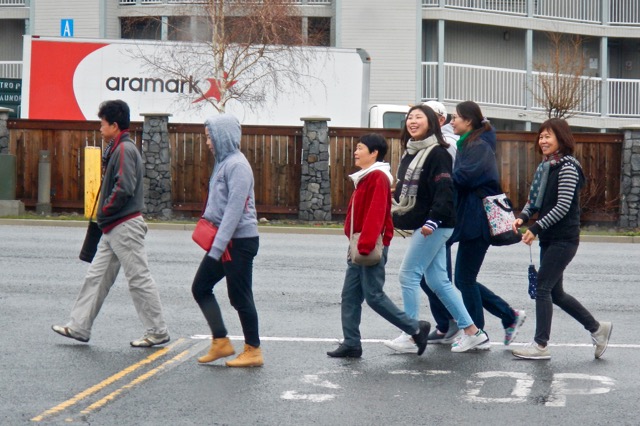
Catering to the international tourist means understanding their culture in order to show respect and to ensure they are not unintentionally insulted; it means being able to communicate with them via translation apps on phones or having an employee who speaks the language or material printed in their language; it means going a step beyond the day-to-day routines.

This was the message delivered April 18 by Daniel Crain, vice president of education and training at BRIC Marketing, a San Francisco-based strategy consulting firm.

Crain was the keynote speaker at Tuesday’s annual tourism breakfast put on by the Lake Tahoe Visitors Authority and Lake Tahoe South Shore Chamber of Commerce at Lake Tahoe Resort Hotel. Also speaking was Kristine Tsusaki-Reddick, Visit California’s director of client relations for Northern California.

Lake Tahoe is a big draw for foreign travelers. Photo/Kathryn Reed

Germany, Canada, United Kingdom and China represent the top countries where people are coming from to visit South Lake Tahoe.

California set a record in 2016 with 268 million visitors, a 2 percent increase from 2015.The forecast is for 287 million visitors in 2020 and to top 300 million in 2022. The economic impact was $125.7 billion in 2016, a 2.8 percent increase from the prior year.

Forty-two percent of Visit California’s budget focuses on the international traveler, with 13 countries being the main emphasis. This traveler stays longer and spends more.

Crain spent most of his time focused on China and its 1.4 billion inhabitants. And while only 7 percent of the population has a passport, more get them every day.

“The No. 1 complaint of the Chinese traveler is Wifi because in China it’s everywhere,” Crain said. Being connected is important to them. They are constantly taking selfies and sending photos home – electronically.

One thing Tahoe can market is its air – the quality of it, Crain said. This is something Oregon has started to do. Most parts of China are socked in day-after-day with smog. Fresh air is a reason to visit someplace.

Chinese are also big shoppers because goods are 30 to 40 percent less expensive here. They are interested in clothing, footwear, fragrances and electronics. Their favorite places to shop – outlet malls, boutique stores, Costco, Apple, and tax free shopping.

“The visitor expects to be treated with respect and politeness,” Crain said. Chinese are prideful people who don’t interact in the same bullish, confrontational way Americans do.

With so much of China awash in bad air, touting Tahoe’s clean air could be a selling point. Photo/Kathryn Reed

Having the ability to heat water and have tea in a room should be standard for Chinese guests.

Knowing that the number 8 is a sign of luck and number 4 is dreaded in Chinese culture can help with which floor to place them on in a hotel and how to price goods. Paying attention to red meaning happiness and good luck, gold a symbol of prosperity and luxury, and black and white funeral colors are ways to further cater to this clientele.

Crain mentioned how few Chinese travel with cash. They like to use WeChat to pay via their smart phones. It’s an application almost no one in the room had heard of. It’s a way Crain said his company functions globally.

It was noted with Beijing hosting the 2022 Winter Olympics the Chinese government has launched an outdoor initiative to get people involved in outdoor sports and trained. That would seem to be a natural draw for Tahoe – right along with the pristine mountain air.


SLT council votes for 100% renewable energy

By Patricia Sussman

South Lake Tahoe on Tuesday became the 26th city in the United States and the first city in the Sierra Nevada to commit to transition to 100 percent renewable electricity, citywide.

The City Council unanimously passed the resolution to achieve 100 percent renewable energy by 2032 in chambers overflowing with community supporters sporting 100 percent renewable stickers.

“I have attended many City Council meetings and I have never seen such unified support for an agenda item,” said Rebecca Bryson, representing the local Small World Parent Network. “This really demonstrates the importance of taking positive local action in an uncertain national political climate.”

Nick Exline, senior land use planner and chair of the South Lake Tahoe Climate Action Network, was among those who headed the coalition that brought the resolution before the council. Exline applauded the council for its leadership, and emphasized the marketing and branding potential associated with being among the first 30 cities in the United States to make such a commitment. He also noted its alignment with the city’s recently adopted vision statement: “We will reflect the national treasure in which we live.”

Support for the resolution was broad and included local residents associated with a variety of businesses and organizations. Among them, Joann Conner spoke on behalf of the South Tahoe Chamber of Commerce stating the chamber board voted unanimously to support the resolution.

Steve Teshara, representative of the Lake Tahoe South Shore Chamber of Commerce was, also present to express support of measure.

Arleen June Gordon spoke April 18 on behalf of the Senior Center and on the importance of this initiative to all generations.

Prior to the vote, the council was provided with a petition signed by nearly 1,000 individuals. The 100 percent South Lake Tahoe Coalition also organized letters of support from many local businesses and organizations.

Renewable energy proponents on April 18 surround the South Lake Tahoe City Council after the five unanimously approved the energy initiative. Photo/Provided

John Friedrich, recent participant in Tahoe’s “Dancing with the Stars”, wore his bright red stage jacket to the podium. In a speech reflective of the good humor of most presenters, Friedrich said, “I’ve never been more proud of or more excited about my hometown. I’m wearing this jacket today because I’m in the company of so many stars – here in the audience – and among council.”

Executive director of the Sierra Nevada Alliance, Jenny Hatch, spoke of the Alliance’s plan to promote South Lake Tahoe’s leadership on transitioning to renewable energy to other communities throughout the Sierra, hopeful of inspiring a regionwide trend. “If local communities are interested in joining this growing movement, we welcome them to contact us,” she said.

Council members were appreciative that the initiative originated from within the community and of the community’s commitment to stay engaged to make the goal a reality. Councilmember Tom Davis suggested that Coalition members more widely distribute the eye-catching 100 percent campaign stickers around town so that businesses can put them in their windows and people on their cars.

The Coalition that came together to create the 100 percent South Lake Tahoe campaign included multiple community residents as well as active engagement of the Sierra Nevada Alliance, Climate Reality Project’s I AM PRO SNOW, Tahoe Climate Change Action Network, the Lake Tahoe Sustainability Collaborative, Tahoe Regional Planning Agency, Mountain Pact, Small World, and Climate Parents.

Patricia Sussman is a local resident and 100% South Lake Tahoe campaign coalition member.