Heller bill aimed at attacking Endangered Species Act

By Henry Brean, Las Vegas Review-Journal

Citing Nevada’s long fight to keep the sage grouse from being listed, Sen. Dean Heller has introduced legislation that would significantly weaken the Endangered Species Act and give states almost unchecked control over how — or whether — certain animals and plants are protected.

The bill would require congressional approval before a species is listed as threatened or endangered by the U.S. Fish and Wildlife Service. Any listed species would automatically lose protection after five years without another vote of Congress in consultation with the states where the species is found.

Heller and fellow Republican Sen. Rand Paul of Kentucky unveiled their Endangered Species Management Self-Determination Act on Tuesday.

Conservationists are calling it something else: an all-out attack on the federal protections that saved the bald eagle and other once-threatened animals.

Read the whole story


LTCC not sure it wants SnowGlobe to return

By Kathryn Reed

Lake Tahoe Community College is so frustrated with how long it took SnowGlobe vendors to clean up their mess that a future contract is in jeopardy.

“For me, the board and staff we take pride in the fact that is our front door. We had to drive in by it every day,” LTCC President Jeff DeFranco told Lake Tahoe News. “We would give tours to perspective students and have to explain what that was all about. We can’t have that again.”

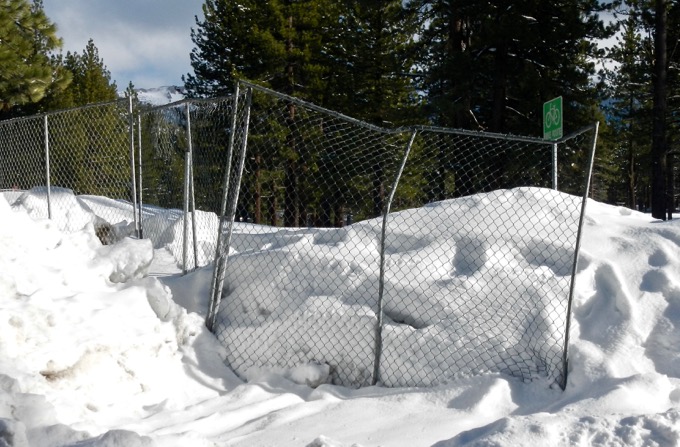
DeFranco was referring to the mangled chain link fencing, portable structures and other debris left for months after the three-day music festival had long ended. The crap left on college and city property made the area look like a junkyard.

The contract said everything was supposed to be removed by Jan. 3. The reality is things remained on site into April. It took the city sending a threatening letter for the promoter to finally do something. (The city’s contract say things must be removed as soon as possible, weather contingent.)

While South Lake Tahoe has a multi-year contract with promoter Chad Donnelly, which ends this year, the college has always been on a year-to-year contract. LTCC’s facilities are instrumental to a successful event. The parking lot is huge. The physical education building and food services are other key components.

Damaged chain link fences remained for months after SnowGlobe. Photo/LTN

The college board of trustees this week heard a presentation about how the 2016 event went. Normally the annual recap comes in February, but that was impossible with evidence of the event still visible.

While DeFranco said it was too early to know exactly what language might be in a future contract – if there is a contract – he said wording to ensure everything is removed before winter quarter starts would be a biggie.

“Our facility was ready to go, but access and parking wasn’t because of SnowGlobe remnants,” DeFranco said. “Another big issue is any blight from SnowGlobe and how it reflects on the campus and community.”

Much of the discussion on April 25 centered on the lack of demobilization. January snowstorms prevented the timely removal of the perimeter fencing and other items. Apparently, though, there was no contingency for this. It’s not like snow in Tahoe in winter should surprise anyone, especially in January.

Donnelly is expected to be at a future LTCC board meeting to plead his case. This could be as soon as May.

While DeFranco said the college wants to be a community partner and help with tourist related events that drive the local economy, he said those pursuits will always be secondary to the college’s main mission of being an institution of higher learning.

Ultimately it will be up to the five elected to decide if LTCC enters a contract of any kind with SnowGlobe. Things they are considering include:

·      A larger damage deposit;

·      Enhanced video surveillance;

·      Limiting how the parking lot is used;

·      Having the community play consortium have a contract for the use of the field;

·      Establishing a wristband entrance fee for the consortium to offset the cost of maintaining the field. (The college and city are members of the consortium.)


Centennial Dam project could affect 3 Sierra rivers

By Sage Sauerbrey, Moonshine Ink

Two of Truckee/North Lake Tahoe’s nearest west slope Sierra watersheds are on track for a profound change in the coming years, with the planned construction of a 275-foot dam about 45 miles down the road from Donner Summit.

The Centennial Dam project is an effort by the Nevada Irrigation District to create more water storage and combat climate change, and would dam the last 6 miles of publicly accessible, free flowing water on the Bear River.

The dam’s environmental and cultural aftereffects would not only be felt on the Bear River — where it would inundate 25 homes; many important cultural sites for the local Nisenan tribe; a popular campground; and habitat for more than 100 rare, threatened, and declining plant and wildlife species — but also on the South and Middle Forks of the Yuba, which currently lose up to 80 percent of their total volume to diversion canals that bring water into the Bear River watershed.

Read the whole story


Expansion of sports betting in Supreme Court’s hands

By Jay Caspian Kang, New York Times

In the early 1990s, Bill Bradley, the New Jersey senator and former New York Knick, argued several times in front of Congress that legalizing sports betting would dehumanize athletes and lead to the rampant corruption of children. This was no cynical political crusade; Bradley was a true believer.

Bradley helped push through the Professional and Amateur Sports Protection Act in 1992, all but banning sports betting outside Nevada and driving a growing industry that employed hundreds underground.

As it turned out, the country’s millions of sports gamblers didn’t share Bradley’s concern for the sanctity of athletes like Bill Bradley or the children who might grow up to be just like him. In practical terms, the Sports Protection Act has mostly failed, and gambling has effectively grown to be an inescapable part of big-time sports.

Sometime in the next four months, the Supreme Court is likely to decide whether to hear an appeal by Gov. Chris Christie and the state of New Jersey that would essentially let states determine whether to allow sports betting within their borders.

Read the whole story


TTD develops road map for functional transit

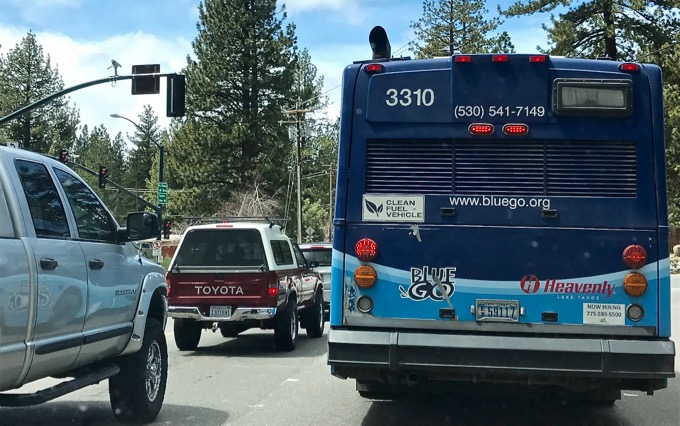
Reliable, coordinated transit is not something the Lake Tahoe Basin is known for. Photo/LTN

By Kathryn Reed

STATELINE – Transit is about getting people where they want to go, providing choices and creating connections.

That is what Tahoe Transportation District is striving for in the basin and beyond.

Carl Hasty, the bi-state agency’s leader, on April 26 talked to the Tahoe Regional Planning Agency’s Governing Board about the Lake Tahoe Basin Transit Master Plan. It is a multi-year plan with short- and long-term goals.

“The vision here really means we are going to see buses everywhere,” Hasty said.

Transit operators know that just putting buses into the mix and having them stopped in traffic is not solving the problem. Removing individual vehicles from the roads will lessen congestion. Those people, though, need to be able to rely on transit. Today, that is not possible.

The ultimate goal is bus service every 15 minutes.

Today 1.4 percent of road trips in the basin are via transit. The most aggressive planning scenario has the percentage growing to 20. That is projected to remove more than 7 million auto trips a year. Benefits would include having fewer vehicles on the road, and less emissions – a boon for air and water quality. The net operating cost to do is estimated to be more than $13.6 million a year.

Before all those new buses are ordered (once the money is in hand to do so) transit officials need to figure out where they will be housed, along with where to set up maintenance and fueling locations. Space is tight for the current operations in the basin.

The board appeared to be in consensus that the tourist should be footing the bulk of the transit bill. How exactly remains to be seen. Toll roads and taxes of some kind are potential outcomes.

Hasty said it’s likely federal transit dollars will be dramatically cut in the Trump administration’s “skinny” budget.

Layers of service are what’s needed to accommodate locals and the influx of tourists. And then it’s adapting to the different tourists – their activities and desired destinations. It also means keeping an eye on points west and east in regards to people coming to the basin in hopes that down the road an even broader public transit system could be coordinated with one that is focused on the Tahoe-Truckee areas.

“It needs to be seamless to the public. They don’t care as long as it gets them to where they want to go and it’s safe,” Hasty said.

Hasty didn’t mince words in stating it’s time to realize parking – the lack of it – is one of Tahoe’s major problems. People park on highways, clog trailheads and creates dangerous situations. Much of the parking in the basin is on private property. Public parking is what’s needed.

Mobility hubs is the newest catch phrase. It’s a place to connect people to transit, as well as bike-foot paths. TTD staff has plotted out where they might be located.


Full cost of Calif. drought still being tallied

By Dale Kasler, Sacramento Bee

Californians paid for the drought in many ways. Homeowners saw their water rates rise. Farmers sacrificed revenue when they idled fields.

And practically everyone spent more on electricity.

Californians’ electricity costs jumped by a combined $2.45 billion from 2012 to 2016 because of severe shortages of cheap hydroelectricity, according to an estimate released Wednesday by the Pacific Institute, an Oakland water policy think tank. The hydro shortage was one of the little-known effects of the just-concluded drought, said the study’s author and institute’s president emeritus, Peter Gleick.

Read the whole story


Wildfire season could be bad with healthy vegetation

By Michelle Robertson, San Francisco Chronicle
 
California emerged from its five-year drought after heavy winter rains filled reservoirs and turned our golden hills green. But don’t be fooled by the emerald hues. CalFire expects wildfires to burn just as fiercely as they did during drought years – if not more so.

The Eight-Station Index, a measure of Northern Sierra precipitation that helps determine statewide water levels, has deemed 2017 the wettest year on record at 92.8 inches. With all that rainfall, California’s wide open spaces are now covered with lush vegetation.

You’d think that would be good, but firefighters say you’d be wrong. More grass means more fuel for the flames. 

Read the whole story


Truckee grappling with dire housing situation

Publisher’s note: This is one in a series of stories about affordable housing in the Lake Tahoe-Truckee region. All articles may be accessed via the home page under Special Projects, 2017 Affordable Housing.

By Linda Fine Conaboy

TRUCKEE – Affordable living spaces, including single family homes, rooms, sheds, apartments, trailers and anything else deemed inhabitable in Truckee and its environs are now non-existent, leaving the area in a state of crisis affecting not only individuals, but also the region’s economy.

When one thinks about the immensity of this situation, it can be hard to digest the desperation of the countless numbers of people who are unable to satisfy one of the most basic of all human needs—a safe and affordable place to call home.

However, this phenomenon isn’t new; it’s a fact that the skids on these wheels have been in the greasing process for some time. The downward free fall is now full-blown reality, with the gap broadening between those who, for one reason or another enjoy the privilege that enough money brings, and those who find they must hand over up to half of their take-home pay, in some cases, simply to enjoy the security of a roof over their heads.

The national recommendation is that housing costs not exceed 30 percent of annual earnings, at the outside.

It’s important to keep in mind that the Sierra isn’t the only place where all forms of robust recreational opportunities are available; and it’s definitely not the only place where the gap between the rich and the not-so-rich is a problem.

A report generated by the town of Truckee notes that the housing puzzle is not new and has been under scrutiny since Truckee’s incorporation 24 years ago.

Nevertheless, the status quo does not seem to be improving; in fact, now, consensus has it the crisis is genuine. Valuable time has seemingly been frittered away with no concrete solutions.

In view of this, it was clear that the time was ripe for responsible leadership—a chore assumed by the Tahoe Truckee Community Foundation, which stepped up, embarking on a long-term study of the situation, with results becoming available in summer 2016. Since then, TTCF and other stakeholders have been at work to engender consensus and create a plan of action.

TTCF generated a report titled “Truckee North Lake Tahoe Regional Housing Needs Assessment,” which contained a comprehensive review of the area’s needs and demographics, with funding provided by Placer County, Truckee, Nevada County and the Workforce Housing Association of Truckee Tahoe.

In brief, the results of the poll showed:

·      55 percent of households have incomes classified as moderate or low

·      59 percent of workers commute to their jobs

·      47 percent commute out of the region to their jobs

·      4,000-plus new jobs are expected to be created in the region over the next 15 years

·      Almost half spend more than 30 percent of income on housing; 26 percent spend 50 percent

·      Rental rates are high, but there is little rental housing available

·      80 percent of the region’s 474 below-market housing units are in Truckee, all with waiting lists.

Housing in Truckee comes in a variety of sizes. Photos/Linda Fine Conaboy

Putting a face to the problem

With these facts in mind, meet Elvia Esparza, a hard-working ex-Truckee resident, who is the office manager at Family Resource Center of Truckee.

Esparza, born and raised in Truckee, and husband Jose, have three children, all of whom now commute from Reno, daily, to work and go to school in Truckee. She says the mobile home they lived in at a park in town became too small as their family grew.

“I was born and raised in Truckee and I have four brothers, one twin sister and my mom. We are all very involved in our community (Truckee),” Esparaza told Lake Tahoe News. “As our family expanded, we were running out of space so we decided to look into purchasing a home in Truckee. We applied for the first-time home buyers program. We qualified for 10 percent of the purchase price or up to $40,000. We started our house search and realized that homes under $400,000 were either way smaller than what we currently had or they were falling apart.”

After scouring Truckee for something to meet their needs, the Esparzas realized that they had to consider other options.

“My husband asked me if I would consider moving to Reno. I originally said no, but in all reality, this was going to be our only option. My husband told me that we have two options; we can stay in Truckee and get something that we will struggle to pay for and live stressed every day and not be able to do fun things with our children, or we move to Reno where we can afford a home and still have a great quality of life and enjoy activities with our kids.

“With no doubt I said yes. We sold our mobile home and purchased a home in Reno. We continue to commute to Truckee as I love this town; it is a great town to raise children in and I would love for my children to have the opportunity to be raised in this wonderful community. I hope in the future we will be able to move back.”

Although Jessica Gorton doesn’t live or work in Truckee (she works in Incline Village and lives and works her second job in Kings Beach), her story is representative of many younger people who reside in the area and are free-spirited, outdoor enthusiasts who struggle to be able to continue to live their dream in the region.

“Right now, I live in a shed. I know this probably shocks you, but it is true,” Groton told Lake Tahoe News. “And it’s still $600 a month plus a share of the utilities of the house its sits next to. The landlord converted it to a rentable room with heat and electricity, but I have to use the bathroom and kitchen in the main house, so the shed is really a bedroom.”

Groton said she was desperate, and no longer wanted to live in her car, which, she said, wasn’t so bad since she got to camp and climb four days a week and save a lot of money for “cool” trips and more climbing gear.

“This might sound like a series of unfortunate events, but to be honest, it has become a bit comical,” she said of her other housing adventures. “I now live very simply and all the things I own in Tahoe fit into a single carload. It’s OK to laugh about it. I do. Luckily, living in Tahoe is a pretty great life, so if this is the worst I deal with, I suppose I still have it pretty dang great.”

Truckee does not have enough housing, especially for the average worker. Photo/Linda Fine Conaboy

Looking for solutions

To date, there have been three public meetings in Truckee to discuss the housing crisis—one in January, another in February and a final meeting in mid-April. Lake Tahoe News attended all three, and in each meeting, to some degree, several of the same points were made and rehashed.

Tony Lashbrook, Truckee town manager, and others at these meetings have deliberated all sorts of ideas, including the merits of constructing some sort of housing on public lands, which, they said, would require voter approval. They talked about modification of fees as well as the implementation of new laws to allow second units to be built on some properties and then exempt them from some of the imposed fees.

However, to its credit, and as reported by Lashbrook, Truckee continues to address the situation. Some of the steps the town has taken or is considering include:

·      Plans for new housing—5,000 new homes since 1993

·      Advanced planning for affordable housing

·      Regulations modified to allow second units on properties

·      Allowed for residential units above businesses

·      Home buyers’ assistance programs

·      Set aside $2.5 million as a housing reserve to provide housing for locals.

Lashbrook also cited some of the lessons learned as the town continues to address the housing crisis. They are, in part:

·      Needed, 12,000 new housing units for locals

·      Truckee is 6,000 housing units away from build-out

·      Truckee must be careful to maintain its small town character

·      Affordable housing units struggle for success

·      Very few second units have been built, perhaps because of restrictions

·      Maybe fees are too high and can be modified—construction costs include almost $42,000 in building charges.

At the third and final public meeting, Lashbrook and others listened to input from various area businesses and interested parties and re-visited ideas put forth at previous gatherings.

They included modifying the impact fees with the intent to stimulate the construction of affordable housing; provide a fee amnesty program for the costs of building second units on some properties; approaching homeowners’ associations to soften restrictions on second units; create stock building plans for second units, and pay the building permit fees for new secondary living spaces.

Additionally, there was talk of restricting the number of short-term rentals or curbing the time a space can be rented on a short-term basis. Additionally, the merits of providing more incentives to homeowners to rent to locals rather than listing spare rooms on Airbnb was tossed around.

It is apparent the quest for affordable housing continues for large portions of the population, a fact that is not lost on TTCF or other stakeholders including Northstar ski resort, which recently ponied up $30,000 to help with the formation of the original Regional Housing Council and to offset the costs of the crisis.

According to Ashley Cooper, TTCF communications and grant manager, plans for the next steps will be rolled out at a meeting scheduled for this weekend. They include introduction of the Mountain Housing Council of Tahoe Truckee, the name chosen to replace the original Regional Housing Council.

Cooper told Lake Tahoe News, “Housing the people of our community is a top priority for the recently formed Mountain Housing Council of Tahoe Truckee. TTCF and other key stakeholders are committing time and resources to establishing a regional agenda to accelerate housing solutions.”

According to Cooper, the kickoff is scheduled for April 29 from 8-11am at Truckee High School and in addition to introducing the Mountain Housing Council of Tahoe Truckee’s members, the meeting represents the culmination of nearly two years of gatherings and discussions.

Reservations for the April 29 meeting are required and can be made by going online.


Nev. lawmakers line up against reviving Yucca Mountain

By Gary Martin, Las Vegas Review-Journal
 
 WASHINGTON — Nevada lawmakers will testify before a House hearing this week in opposition of revising Yucca Mountain as a permanent nuclear waste site, the Energy and Commerce Committee announced Monday.

In advance of the hearing, Nevada Gov. Brian Sandoval sent a letter to the committee noting the state’s opposition based on “scientific, technical and legal merits.”

Nevada’s two U.S. Sens., Dean Heller, a Republican, and Catherine Cortez Masto, a Democrat, and the state’s three congressional members from Las Vegas, also oppose restarting development at Yucca Mountain.

Read the whole story


Audit critical of UC system’s pay for employees

By Patrick McGreevy, Los Angeles Times
 
The administration of the University of California system pays top workers salaries significantly higher than that of similar state employees, has provided millions of dollars in benefits not typical to the public sector and failed to disclose to the Board of Regents and the public that it had $175 million in budget reserve funds, a state audit found Tuesday.

The audit triggered a dispute with UC President Janet Napolitano, who said charges of hidden funds were false, while two members of the UC Board of Regents charged recommendations to give the Legislature budget authority over the Office of the President encroached on UC’s constitutional powers.

The audit of the Office of the President also found that it failed to satisfactorily justify its spending on system-wide initiatives and “inappropriately” screened surveys submitted by auditors to campus officials.

Read the whole story