Water content near Echo Summit 190% of average

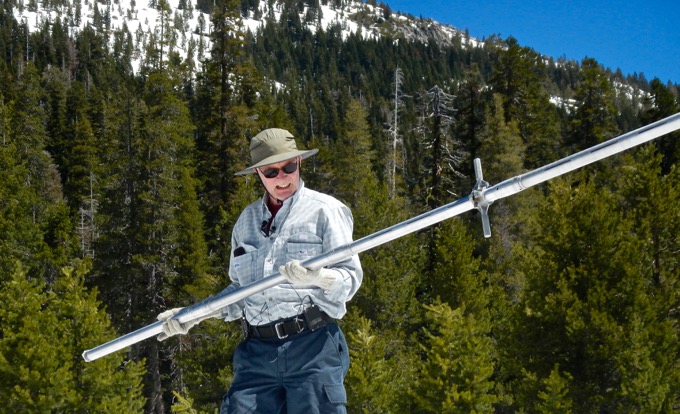
Frank Gehrke on May 1 measures the water content along Highway 50. Photo/Kathryn Reed

By Kathryn Reed

PHILLIPS STATION – Water is not going to be a problem in California this summer and fall.

At the final snow survey of the season near Echo Summit on Monday the numbers showed 27.8 inches of snow, with a water content of 14.6 inches. This is 190 percent of average.

The last reading along the snow field near the entrance to Sierra-at-Tahoe could not be obtained because it was under water. This isn’t unusual for the May reading. But the river of water flowing in the area was more widespread, a little deeper and flowing faster than most years.

During the drought there were times when there was no snow to measure in May.

Frank Gehrke, who does the manual readings for the Department of Water Resources, said the snow is melting at a rate of about one-tenth of an inch a day. At peak snowmelt, it will be about 1 inch a day. That should come later this month.

“The snowmelt is driven by the angle of the sun in the sky and how dirty the snow is,” Gehrke said.

With temperatures supposed to be in the 60s this week, the rate of melt will increase.

Statewide, the readings show the water content for May 1 being 42.5 inches, 196 percent of the average. The numbers compare to 2005 and 2011.

“It’s encouraging news in terms of surface water supply,” Gehrke said. With the abundance of water in reservoirs, it will give many areas the opportunity to allow the groundwater to recharge.

About one-third of Californians rely on this snowmelt for their drinking water or irrigation.

The important thing now is for water managers to monitor storage and flow to avoid flooding issues. Lake Oroville in Butte County is 91 percent of average for the date, Shasta Lake north of Redding is at 109 percent of average.


Craps champions swear it’s more mystique than math

By David Montero, Los Angeles Times
 
Richard Favela rested his hands over the wooden chip tray lining the craps table as the lights from above glinted off rings adorning his lithe, brown fingers.

Favela reached down for the dice and positioned them with great care. Turning them slowly. Methodically. Wholly unsatisfied until he had the white dots facing up the way he liked them. Six on one. Three on the other. They must add up to nine. Always nine. Otherwise the magic would surely end.

A dozen pairs of eyes fixated on him. The four dealers at the table were deferential toward the legend — identifiable to the trained eye by his blue shirt. He would not be rushed.

Read the whole story


Stringent boat program keeps new AIS from Tahoe

By Kathryn Reed

STATELINE – In the decade since Lake Tahoe started aggressively combating aquatic invasive species, the landscape has changed dramatically.

This region has become a leader in what to do to stop invasives. Water bodies far and near have scrambled to catch up as they contend with the detrimental impact of AIS. The boating industry has made advances to make it easier to hook up decontamination apparatuses. The public is more compliant and understanding.

Boating season officially opens today in the Lake Tahoe Basin, at least when it comes to the boat inspections and decontamination stations being operational.

The Tahoe Regional Planning Agency Governing Board last week received an update on the AIS program, which includes the boating inspection program.

It’s anticipated more boat ramps will be open this year because the lake level is so high. Public and private ramps are required to make sure boats have been inspected.

“Our focus is early detection and rapid response,” Dennis Zabaglo, TRPA’s aquatic resources manager, told the board.

The Tahoe Resource Conservation District manages the program for the TRPA. Lake Tahoe, Fallen Leaf Lake and Echo Lake are part of its oversight.

In 2016, there were 7,689 boat inspections, 2,689 decontaminations, with 39 boats intercepted. The last figure means a boat that had an AIS. Zabaglo said most boat owners are unaware of the AIS. Eight of 39 were mussel species.

Boat inspection info:
• Open now 8:30am-5:30pm., 7 days a week
Meyers: at the junction of highways 50 and 89
Spooner Summit: at the junction of highways 50 and 28
Alpine Meadows: Highway 89, off Alpine Meadows Road north of Tahoe City
• Opening May 17:
Truckee-Tahoe: Highway 267, off Truckee Airport Road, 8:3am-5:30pm, 7 days a week
• All motorized watercraft require inspection for aquatic invasive species prior to launching into Lake Tahoe, Fallen Leaf Lake and Echo Lake.
• Knowingly transporting AIS into Lake Tahoe is against the law, and violators may be subject to monetary penalties.
• There is no change in boating inspection fees this year. The “Tahoe In & Out” inspection ranges from $35 for personal watercraft and vessels up to 17 feet and $121 for vessels more than 39 feet. The “Tahoe Only” inspection sticker is $30. An additional fee of $35 is charged for any boat requiring decontamination and an additional $10 fee for the decontamination of ballast tanks or bags.

Between one-third and one-half of the inspections are boaters new to Tahoe.

Clean, drain, dry is the mantra boaters — motorized and paddlers — are asked to embrace. Boats are the largest transporters of AIS.

The goal of the TRPA program is to prevent any new AIS from entering local water bodies. AIS such as quagga mussels and New Zealand mudsnails (neither of which are in Tahoe) multiply quickly by colonizing on underwater surfaces, and can destroy infiltration systems. They obliterate fish habitat, ruin boat engines, and can negatively impact water quality and the local economy by impacting recreation and the ecosystem. 

The AIS program also deals with trying to remove, or at least reduce, the species that already exit – animal and plant.

Several board members applauded when TRPA staff made it known the Tahoe Keys Property Owners Association voted to pay for the use of herbicides in the South Lake Tahoe canals to attack invasive weeds. A member of the public challenged that reaction, wondering how they could think this was a good thing. Board Chairman Jim Lawrence said what he was really applauding was the Keys being willing to pay for the treatment, not necessarily the type of treatment. No other board member explained his or her applause.

The Governing Board will be asked to approve a permit for TKPOA to use the herbicide. A request for proposal has been released to find a firm to do the environmental impact statement for the Keys’ project.

TRPA/TRCD are also working with Fleur de Lac on a plan to work on AIS this summer. Both entities are working on the ultraviolet project at Lakeside. Getting rid of clams at Sand Harbor is another goal for this season.

Julie Regan, external affairs chief for TRPA, said congressional leaders are aware of the danger of AIS spreading. AIS are a threat to hydroelectric systems. Regan is hopeful with the new secretary of the Interior being from Montana that he will be a friend to the West and continue the funding for AIS projects here and elsewhere.


Record year for moisture? Depends on precip v. snow

By Melissa Siig, Moonshine Ink

It seemed like the snow would never stop falling this winter, and Tahoe/Truckee is just now, at the end of April, beginning to see the massive snowpack begin to melt, at least at lower elevations. Up high, that’s another story, and in January, February and March, if it wasn’t snowing, it was raining. So all this rain and snow in early 2017 begs the question — was this a record setting year?

The answer is yes and no, depending on whether you are looking at precipitation or snowpack.

In terms of precipitation, 2016-17 is shaping up to be the wettest year on record since the Federal Water Master’s Office in Reno started keeping track 118 years ago. According to U.S. District Court Water Master Chad Blanchard, while we are behind 1982-83 with regards to total precipitation, there are still five months to go in the water year (Oct. 1 to Sept. 30), and we are currently ahead of where we were in April 1983.

Read the whole story


Sandoval pleads Nev.’s case with federal officials

By Yvonne Gonzalez, Las Vegas Sun

The state is moving forward with its plans to implement recreational marijuana and push back against plans to store nuclear waste at Yucca Mountain, Gov. Brian Sandoval told federal officials in Washington, D.C.

Sandoval spent time this week with Energy Secretary Rick Perry, Attorney General Jeff Sessions, Interior Secretary Ryan Zinke and Environmental Protection Agency Administrator Scott Pruitt.

Sandoval told reporters Friday that he disagrees with the Trump administration’s stance on Yucca Mountain as well as a proposed $230 million reduction in funding for the Southern Nevada Public Land Management Act, which has allowed for the sale of land to protect other areas. His conversations with federal officials covered these issues as well as marijuana, mining, immigration and infrastructure.

Read the whole story


Tennis pro at ZCTC eager to raise the level of play

By Kathryn Reed

Knowing why to hit which stroke when and how to execute those strokes are important to becoming a better tennis player.

Dave Nostrant believes what sets his tennis program apart from others is teaching more than just strokes. He adds a bit of philosophy. It’s not just the “how to” but explaining the “why” that differentiates him from so many other pros.

Nostrant has been a tennis pro for decades, but it’s being a student of the sport that allows him to continue to grow. And that growth is then passed on to his students.

He will be bringing his brand of tennis to Tahoe starting in mid-May as he takes over as the head pro at Zephyr Cove Tennis Club.

Dave Nostrant will bring video analysis to Zephyr Cove Tennis Club. Photo/Provided

Nostrant will be offering a variety of lessons for all ages and abilities – from the newbie to veterans of the game.

“With private lessons, something more unique is that I will be able to offer video analysis. This will be for anyone who will work with me consistently over the summer,” Nostrant told Lake Tahoe News. “Video bridges that learning gap. It makes learning so much faster.”

He doesn’t have a set schedule yet, but foresees being at the courts possibly seven days a week, maybe 10 hours a day if there is the demand.

So many pros are like a human ball machine – feed the ball, make the player run and call it a day. This is a good way to stay at the same level. This isn’t what Nostrant is about.

Nostrant learned from one of the greats – Vic Braden. It was Braden who started the tennis college concept. Nostrant uses many of those same techniques.

“I worked for Vic in Germany. I wanted to keep learning. So often in this industry you just work,” Nostrant said. That job led him to St. George, Utah, where he started the Vic Braden Tennis Academy. He then branched out on his own with Court Think Tennis, still based in Southern Utah, but with camps all over the country. In the last week he has renamed it Dave Nostrant Tennis.

(This reporter has twice been to his Utah camps and is a member of Zephyr Cove Tennis Club.)

A welcome party is being thrown for Dave Nostrant on May 27 starting at noon at the Zephyr Cove courts. The Viva La Tennis doubles mixer and barbecue is the club’s season opener for all levels and ages. Match play is free for members, $10 for guests. Memberships are available online or available that day.

Nostrant said it’s having worked with several players from Zephyr Cove that led him to want to pursue working in Tahoe. His contract is for one year, which is a way for both sides to see if it’s a good fit.

“”Dave is passionate about helping adults and juniors improve their tennis. We are lucky to have someone of his caliber as our teaching pro,” Carolyn Wright, president of Zephyr Cove Tennis Club Foundation, told Lake Tahoe News. Wright has been to two of Nostrant’s camps in Utah.

The foundation is the nonprofit group that oversees the six courts in Zephyr Cove through a multi-year contract with Douglas Club.

Nostrant is still a pro in Utah, but with the indoor courts there having been turned into a basketball facility, the summer heat is not conducive to enjoyable tennis.

In addition to his daily job, Nostrant is hoping to put on multi-day camps at Zephyr Cove that would be for locals and out-of-towners. His goal is to resume having camps in multiple locations.

“I would like to train some pros, especially for the junior program. Some pros are accepting to new info and some aren’t,” Nostrant said.

Nostrant is still an avid player, having won the 2016 Huntsman World Senior Games in St. George, and the open doubles championship in the 60- to 64-year-old bracket. 


Founder: Burning Man’s evolution far from over

By Linda Fine Conaboy

INCLINE VILLAGE – Burning Man founding board member Michael Mikel told Lake Tahoe News that Nevada is the last American frontier. “It’s the last place where there’s so much freedom, people can be themselves.”

Mikel is also known by his playa name, Danger Ranger. This month he gave a historical overview of Burning Man at a talk at Sierra Nevada College.

History comes easy to Mikel. His bio says he’s a historian and a futurist. He’s also, for the last two years or so, a proud Nevadan, having migrated to his turn-of-the-century Reno home from the Bay Area.

Mikel and other founding Burners thought Nevada was the ideal place, which is why in 1990 they packed up The Man and trekked him, ensconced in a rented truck, to the Black Rock Dessert, far from his fog-shrouded Baker Beach origins in San Francisco.

The Man, Mikel said, simply outgrew his coastal origins and the desert turned out to be his destiny, a fact proven by the number of people, whether they have attended the desert event or not, know who the tall guy is.

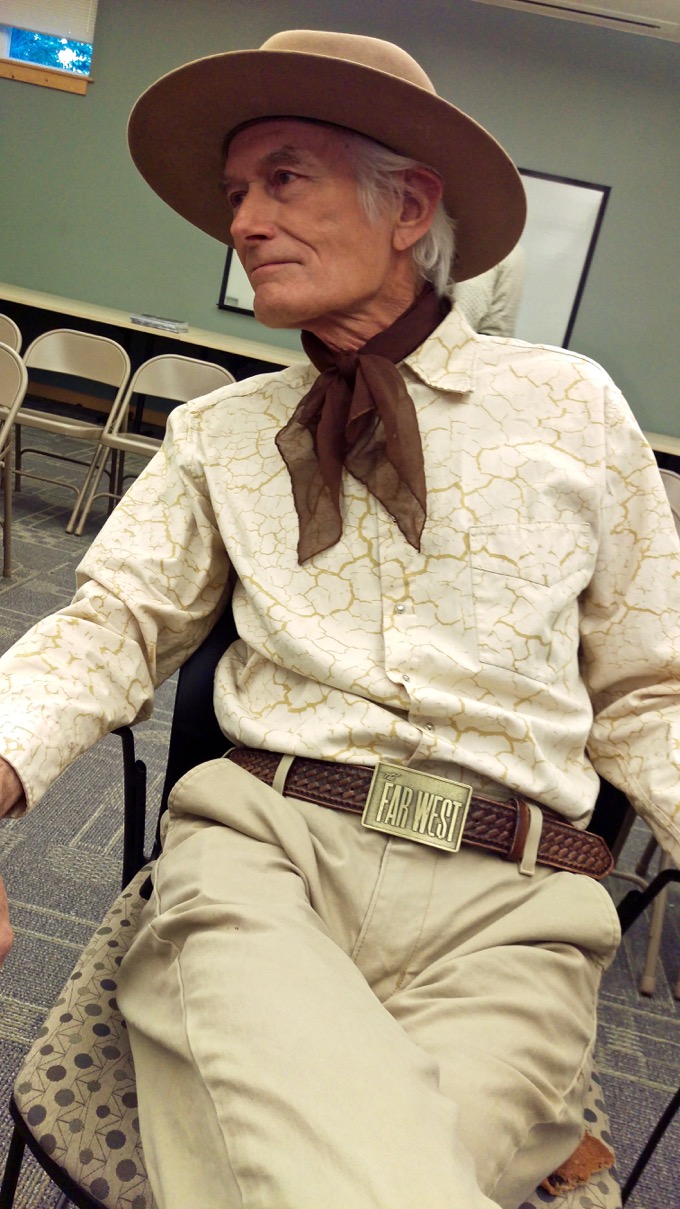
Mikel’s mission on this cold evening at SNC was to lay out for his audience what he calls the five ages of Burning Man. The evening was a most interesting trip through history related by Ranger Danger, who, true to his moniker, dressed as a ranger from his Mounties-style handsome hat to his brown boots, into which he tucked his trousers.

Around his neck, he tied a scarf, nattily offsetting his custom beige shirt with an imprinted pattern depicting the whorls of dry, parched clay that is the Black Rock desert.

Although others disagree with the evolution of Burning Man, according to Mikel, the story unfolds perfectly in five periods. They are: exploration; rapid growth; protectionism; outreach; and the age of scarcity.

The Age of Exploration, from 1986 to 1990, according to Mikel, was actually the precursor of today’s Burning Man, but nobody knew it. It became an underground event full of experimentation with a low barrier to entry—everybody was welcome—resulting in a high rate of participation.
Facts from Michael Mikel:
• Burning Man uses more propane than any other industry in the U.S.
• 6,000 portable toilets are emptied two times each day
• There are regional burns in 34 countries
• In July, Nevada Museum of Art opens a Burning Man exhibit. Upon closing in Reno, it heads to the Smithsonian Museum.
• 5,000 low-income tickets are sold annually at $195 each
• People sky dive in Burning Man, but so far, each has had a ticket
• 5,000 people volunteer at the event.

The first man was 8-feet-tall, doused in gasoline and pulled into place by humans before being set afire on Baker Beach during the summer solstice in 1986.

“It was like a family picnic,” Mikel said, “so the 20 or 30 of us there decided to do it again in 1987.” The following year, The Man was 30-feet -tall and more complicated, and in 1989, with a 40-foot-tall Man, the number of attendees quadrupled; in 1990, the authorities broke up the party and didn’t allow the beach burn.

The Age of Rapid Growth, from 1990 to 1996, saw Burning Man’s new beginnings at Black Rock. “It literally flew out of control,” Mikel said, although only 80 people participated in the first desert burn.

He said this enthusiastic group of desert neophytes had much to learn about life on the playa. For example, their first big lesson was that parachutes, which they erected for shade, are designed to catch the wind. And catching the first playa breeze, off they sailed.

That year (1990) saw people pulling the rope to raise The Man to his full height. In 1991 Crimson Rose, also a founding board member and board secretary, climbed The Man. Crimson Rose founded the Black Rock Arts Foundation as well as the Burning Man Project.

In 1992, there was music and the Black Rock Rangers were born. The group emulating the Texas Rangers, now numbers 800 people. This was also the year of government regulation—they were required to pull a permit. Today, Mikel said, it takes an entire staff to work with Burning Man’s federal landlords.

Subsequent years during this period, saw the first theme camp, which was inundated by extreme weather—lots of airborne dust followed by huge dumps of rain.

The population in 1993 was relatively small, leading to a mandated entry fee of $30 in 1994 to augment costs, the same year the lamplighter ceremony began, witnessed by a surge in population—2,000 people.

Other firsts during this period of rapid growth included the first café, the first communication with the outside world, the first art car and the first trash fence installed to snag garbage as it blew about the playa.

The population of Pershing County, the site of Burning Man, surged each September, making Black Rock City the county’s largest town. Unfortunately, disagreements grew during this era as did the number of auto accidents and resultant deaths.

Wired magazine featured Burning Man on its cover and serious art was becoming popular as was the flow of liquor. The founders decided at this point they needed to adjust the event’s course, shepherding in the Age of Protectionism from 1997 to 2000.

Attendance swelled to upward of 10,000 attendees. Protected boundaries became the norm, as did controlled access to the boundaries, which resulted in far fewer accidents.

Ticket prices increased again, this time to $50 in advance and $65 at the gate. County government became more involved, mandating street signs, fire protection system and numbered parking spaces.

To meet some of the restrictions, Black Rock City developed the now familiar semi-circle used for campers’ parking. A website was designed and even Google got into the act by developing a Burning Man Google Doodle. The leave- no-trace philosophy was implemented, one of the 10 tenets of Burning Man.

With 26,000 participants in year 2000 generating tons of trash, MOOP (matter out of place) patrols became the norm. Radar protecting the perimeter was installed and 2000 became the last year The Man was raised by ropes.

Succeeding ages included the Age of Outreach (2001-2010), which pretty much saw the event go on auto-pilot and the doubling of the population to include many mainstream folks, who perhaps formerly, eschewed the event.

The Age of Outreach also became the age of emergency services—medical and religious services were introduced. Talk about the largest city in Pershing County—2006 boasted a Burning Man population of more than 40,000.

Black Rock Solar, the first nonprofit solar company in the U.S. made its appearance during this age when a group of volunteers installed a 30 kilowatt array on the playa surface in Black Rock City, themed that year as The Green Man. Later, the team moved the array and installed it in Gerlach, donating the solar project to the town’s school system.

The final age, Scarcity, from 2011 to the present is certainly not the end of Burning Man, and certainly a sixth age awaits.

Now, according to Mikel, everybody wants to be a burner. The demand is huge with 70,000 tickets sold by computer via a lottery. “Scarcity raises the price of access,” he said, adding wryly, “sorry, the lifestyle you ordered is out of stock.”

As the founders of Burning Man age, Mikel confirmed that the old-timers are getting ready to turn over the reins to a younger cohort. “I believe the next generation will make us proud,” he said.

He added that although Burning Man has changed over the years, “It is still the most incredible thing on the planet, teaching people how to get along in peace and harmony.”


Brown signs mega-tax to fix Calif. roads, bridges

By Patrick McGreevy, Los Angeles Times
 
California motorists will start paying higher gas and diesel taxes on Nov. 1 under legislation signed Friday by Gov. Jerry Brown to provide $5.2 billion annually for road and bridge repairs and expanded mass transit in the state.

The plan, which also includes new fees when vehicles are registered, has sparked a significant backlash. Opponents have launched a recall campaign against one senator and are talking about a possible initiative to roll back and control the taxes and fees. Other lawmakers said they received harassing phone calls about their votes on the bill.

But state officials hope the sight of construction crews on long-neglected highways and roads will compensate for pain in the pocketbook.

Read the whole story


Truckee River flow expected to be high for months

Water from the Truckee River, which is to the left, covers part of the bike path connecting Tahoe City and Squaw Valley. Photo/Kathryn Reed

By Kathryn Reed

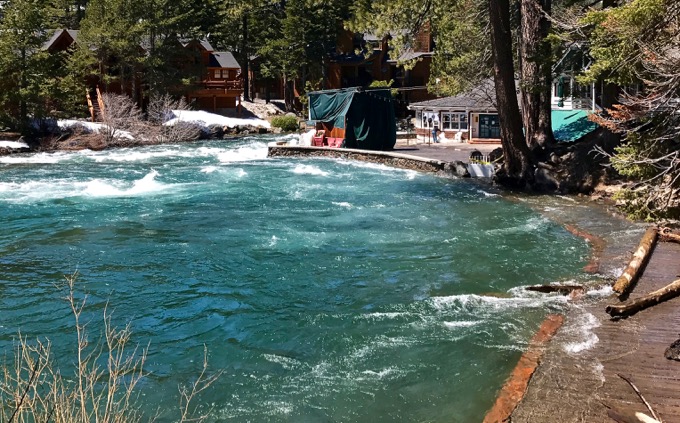
TAHOE CITY  — The Truckee River just outside Tahoe City is known for its placid pace for casual summer rafters. Today it looks like there might be some class IV rapids – it’s running that fast and high.

Rafting companies have had to deal with drought for the past few years, and at times didn’t open. Now there is too much water to speculate when to mark an opening date on the calendar.

The patio at the River Ranch restaurant near Alpine Meadows is closed. The water is swirling furiously and nearly reaches the top of the wall.

Water is touching the base of the bridge crossing the river leading to the ski resort.

Sections of the bike path between Tahoe City and Alpine are off limits because the river has overflowed. In some sections it has gone under Highway 89 so there is water on both sides.

This scenario could last well into summer as the water master regulates the level of Lake Tahoe. The lake is about 18 inches below the legal limit that was established in 1917 based on shoreline stability.

The record snowpack is beginning to melt, meaning the lake just keeps getting higher. Water officials say there is enough snow at higher elevations to cause the lake to rise another 3 feet in the next three months.

A raging Truckee River near the River Ranch’s patio on April 28. Photo/Kathryn Reed

With the water being so swift in Tahoe City and farther east in Reno, officials are cautioning people to stay away. It’s dangerous to be near it because people and animals could easily be swept away to their death.

Plus, there are a number of snags in the river that make it even more precarious for those in kayaks.

The National Weather Service in Reno said the Truckee River hasn’t experienced this high of flows since February 1999. A flood advisory is in effect in the Tahoe-Truckee areas until the afternoon of May 2.

With temperatures expected to be in the mid- to high 60s in Truckee and the Lake Tahoe Basin for much of next week, the snow will just start melting that much faster. That means more water will be released to accommodate all that runoff.

Unless there is a heat wave or rain on snow event, officials expect to handle the situation with only these minor flooding events.

Water coming out of the dam at Tahoe City flows at 2,600 cubic feet per second when the level is at the maximum allowed. Today, the flow is at 2,200 cfs.


Reno wants to host Outdoor Retailer, Interbike trade shows

By Jason Hidalgo, Reno Gazette-Journal

Reno’s bringing out the big guns as it makes its final push to land two major trade shows.

A delegation from the Biggest Little City is set to meet on May 1 with representatives of Emerald Expositions, which operates the Outdoor Retailer and Interbike trade shows.

Getting even just one of the events would be a major coup for Reno.

The Outdoor Retailer Winter Market 2017 that was held from Jan. 10-12, for example, attracted 1,075 brands and about 20,000 attendees, according to event organizers. Interbike, the largest bicycle trade show in North America, saw an attendance of 22,802 with more than 1,400 brands exhibiting at its 2015 event.

Read the whole story