Women pro cyclists breeze round Lake Tahoe
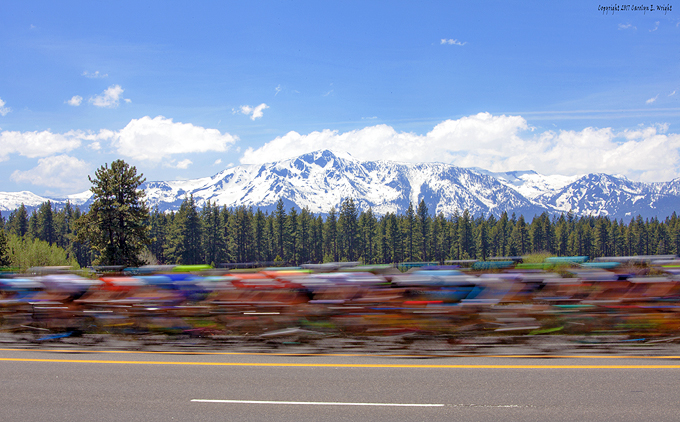
The peloton whizzes through Stateline on May 11. Photo Copyright 2017 Carolyn E. Wright

By Kathryn Reed

Those who were betting against Megan Guarnier lost in a big way on Thursday. The defending Amgen Tour of California women’s champion collected three jerseys in the opening stage.

The 31-year-old’s voice cracked on May 11 when she spoke to the crowd at Heavenly Mountain Resort about what the day meant to her.

“It’s been a tough year,” Guarnier, the U.S. cyclist who races for Boels-Dolmans, said.

In February she sustained a concussion at Omloop Het van Hageland in Belgium, and then in March had to withdraw from Strade Bianche in Italy with concussion symptoms.
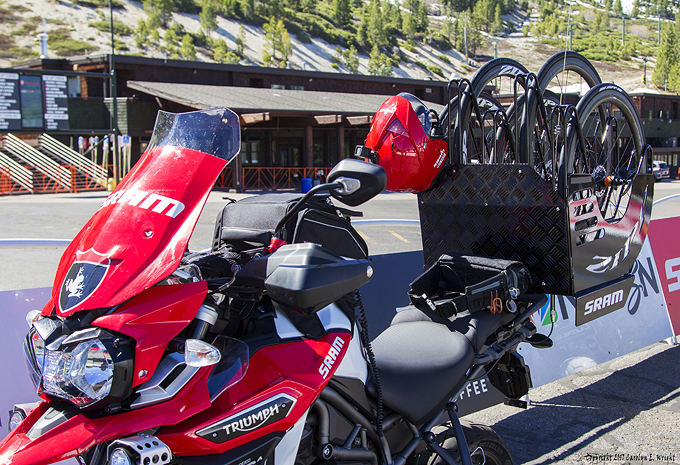
The pros don’t take the time to replace a tube; they change the whole wheel. Photo Copyright 2017 Carolyn E. Wright

Now she would like a do-over, hoping this 72-mile ride around the lake will launch her quest to be the overall Women’s WorldTour winner this year like she was in 2016.

“I think (Friday) will be telling. There will be a hard 12K climb right near the finish,” Guarnier said.

On May 12 the race starts at Heavenly’s Cal Lodge, goes over Luther Pass, through the Carson Valley, up Kingsbury Grade and back to Heavenly.

Amber Pierce, left, of the U.S. who rides for Colavita-Bianchi, said Kingsbury Grade on Friday will be a challenge. Photo Copyright 2017 Carolyn E. Wright

On Thursday, 94 racers set off around the lake, with 87 finishing.

With the sun out, weather-wise this was the best start of any Amgen race in Tahoe. The wind picked up just before the 10:40am start. The National Weather Service in Reno had issued an advisory for the basin, saying winds would be out of the southwest at 15 to 20 mph, with gusts up to 35 mph.
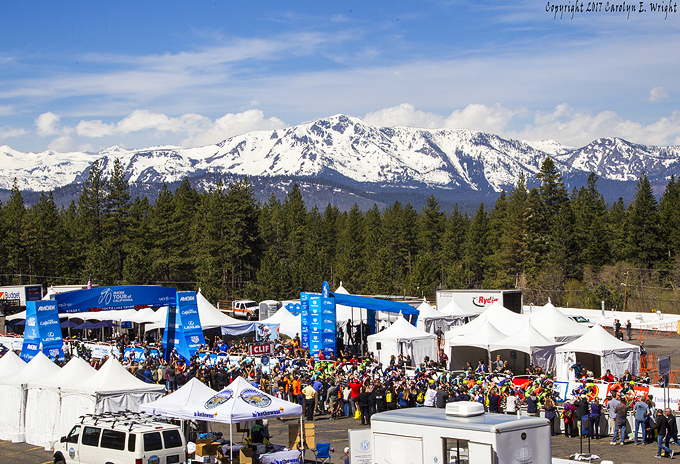
Mount Tallac looms large as the women start stage one from Heavenly on May 11. Photo Copyright 2017 Carolyn E. Wright

“It was more pleasant being a part of the Donner Party than what is going on here,” the announcer said as the women were making their final push to the end.

It was a sprint to the finish, with Guarnier crossing the line at 3 hours, 3 minutes and 48 seconds. Teammate Anna van der Breggen was four-hundredths of a second behind her. Arlenis Sierra, who rides for Astana Women’s Team, came in third at 3:03.55. Sierra earned the best young rider jersey.
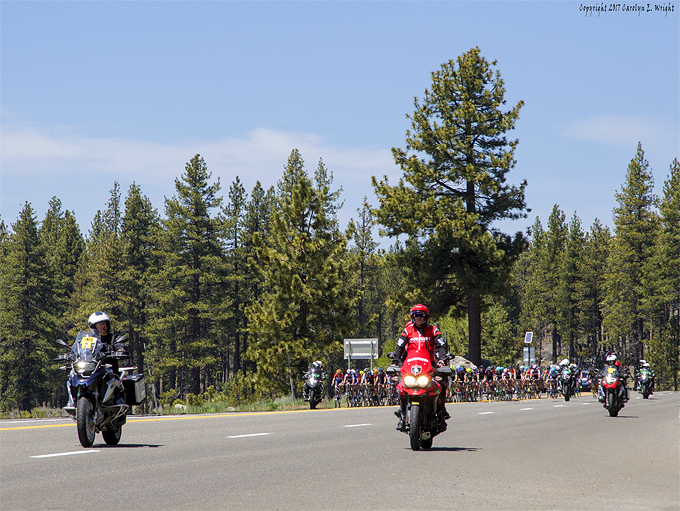
The women on Thursday take over Highway 50 on the South Shore. Photo Copyright 2017 Carolyn E. Wright

In addition to the race leader jersey, Guarnier earned the Queen of the Mountain jersey for being the fastest climber and the jersey for faster sprinter.

This is the third year in a row the women have raced in Tahoe. There are four stages for the women, with two being in Tahoe.

Jack and Jen Powless of Roseville are in town supporting their daughter, Shayna, and her team. Photo Copyright 2017 Carolyn E. Wright

While there were not many people at the start, two people who have a vested interest are Jack and Jen Powless of Roseville. Their daughter, Shayna, races for team Twenty20. She finished 48th on Thursday. Their son, Neilson, finished the 2016 Amgen race in ninth place and was named the Tour of California’s best young rider. He’s not competing this year because his team was not chosen to participate.

The Powless children have athletic pedigree – a mother who was an Olympic runner in 1992 and father who was a top triathlete. Both kids started riding bikes when they were toddlers. A healthy lifestyle is what their parents wanted to provide them. They did that and then some.


Brown unveils new state budget proposal

By Katy Murphy, Bay Area News Group

SACRAMENTO — Gov. Jerry Brown on Thursday unveiled a revised $124 billion general fund budget proposal that restored funding to child care subsidies and other social services, but does not include new money for key legislative priorities such as the Middle Class Scholarship or affordable housing.

The governor did not adjust the budget to reflect major uncertainties about federal health-care funding — a week after the U.S. House of Representatives heightened anxiety in California with its vote to repeal the Affordable Care Act and slash health care spending.

If the Affordable Care Act were repealed, Brown said, “What we’d have to do is ugly, and no one wants to take that up yet. So what we’re doing is we’re going to fight it as hard as we can so that doesn’t happen.”

Read the whole story


Diagnosis — mental illness a serious issue in Tahoe

By Kathryn Reed

Suicide. It’s on a lot of people’s minds. And that’s what worries those who want to prevent people from acting on those thoughts.

In a survey of South Tahoe Middle School students, 65 out of 509 youths have thought about suicide, while 45 out of 509 have tried to kill themselves in the last year. Of those, 55 percent were girls and 25 percent boys.

The others didn’t put a gender. It could be they are trans or gender neutral or use some other way to identify. Nationally, for the LGBTQ community, the suicide related numbers are triple those of the mainstream youth population.

These were some of the sobering facts that came out of the annual mental health forum organized by Barton Health. More than 50 people attended the May 9 gathering at South Tahoe High School. There were representatives from health care, law enforcement, businesses, nonprofits, social services, the general public and education.

A 2016 South Tahoe School graduate said it’s great that those in the know gather to talk about the services available and what they are finding in their sphere of influence, but what really needs to happen for this information to get to the people who need it. She has had mental health issues and recently received treatment in the Bay Area. She wishes while she were in school, she had known about many of the services that are available here.

She is now a peer counselor with NAMI – the National Alliance on Mental Health. The local NAMI chapter headed by Jeanne and Alan Nelson continues to expand its offerings.

What Jeanne Nelson shared with the group is that dealing with mental illness can be a lifelong issue – for the person and their loved ones.

Help is available and recovery is possible.

What was stressed is that mental illness comes in a variety of forms, none of which should be brushed aside. Depression is the most common issue and will likely affect everyone at some point.

It’s only been in the last few years that locally a greater emphasis has been placed on mental health. Part of this is the result of a 2012 community needs assessment by Barton Health that revealed the South Shore was lacking in mental health services. Since that time the pendulum has started to swing in the other direction. (Lake Tahoe News did a multi-part series on mental health in 2016, with the stories accessible from the Home Page under Special Projects.)

Being able to openly talk about mental health as easily as one would talk about cancer or a heart attack or any physical ailment is a goal. Erasing the stigma; that’s what needs to happen so people will treat mental health with the same seriousness and reverence accorded physical issues.

A multitude of events is going in May in recognition of this being Mental Health Awareness Month. More information is online.


2017 was wettest April for the U.S. in 60 years

By Greg Porter, Washington Post

“April showers bring May flowers” took on a whole new meaning this year: The United States just experienced its second-wettest April on record. Average precipitation across the Lower 48 was 3.43 inches. In other words, if you spread all of the rain and snow out across the continental United States, each location would have received nearly 3½ inches. That is a lot of water.

This record is second only to April 1957 and nearly a full inch more than the average April rainfall in the 20th century.

Above-normal precipitation has been an ongoing trend for the West Coast. In Seattle, a record 45.9 inches of rain have fallen since October. Meanwhile, Northern California officially had its wettest winter on record with several strong winter storms pushing the state’s water reservoirs to near-full capacity.

Read the whole story


Fighting compulsive gambling among women

By Tanya Mohn, New York Times

Blinking lights, the clicking sound of coins, and perks like free or inexpensive food, drinks and casino bus trips are enticing many older women to gamble.

For some people, that seductive environment can be extremely dangerous.

“Casinos are trained to make you feel welcome, while you lose your life,” said Sandra Adell, 70, a literature professor in the Department of Afro-American Studies at the University of Wisconsin-Madison, who recounted her experiences as a compulsive gambler in the book “Confessions of a Slot Machine Queen.” “What the industry is doing, the way it markets and keeps casinos filled with elderly people, is morally reprehensible.”

Hard numbers are difficult to find, but Keith Whyte, the executive director of the National Council on Problem Gambling, said that gambling addiction among older women near or in retirement appears to be increasing in scope and severity, with a devastating impact on personal finances.

Read the whole story


44-unit subdivision to break ground in Stateline

By Kathryn Reed

A new neighborhood is about to be erected on the South Shore.

With a severe housing shortage in Lake Tahoe, inane rules governing development and tourist accommodations usually what anyone wants to build, this is almost revolutionary.

Ten units will be four bedrooms and the remaining 34 will have three bedrooms. Fourteen will be standalone residences, the others will be townhomes. They will range in square footage from about 2,200 to 2,800.

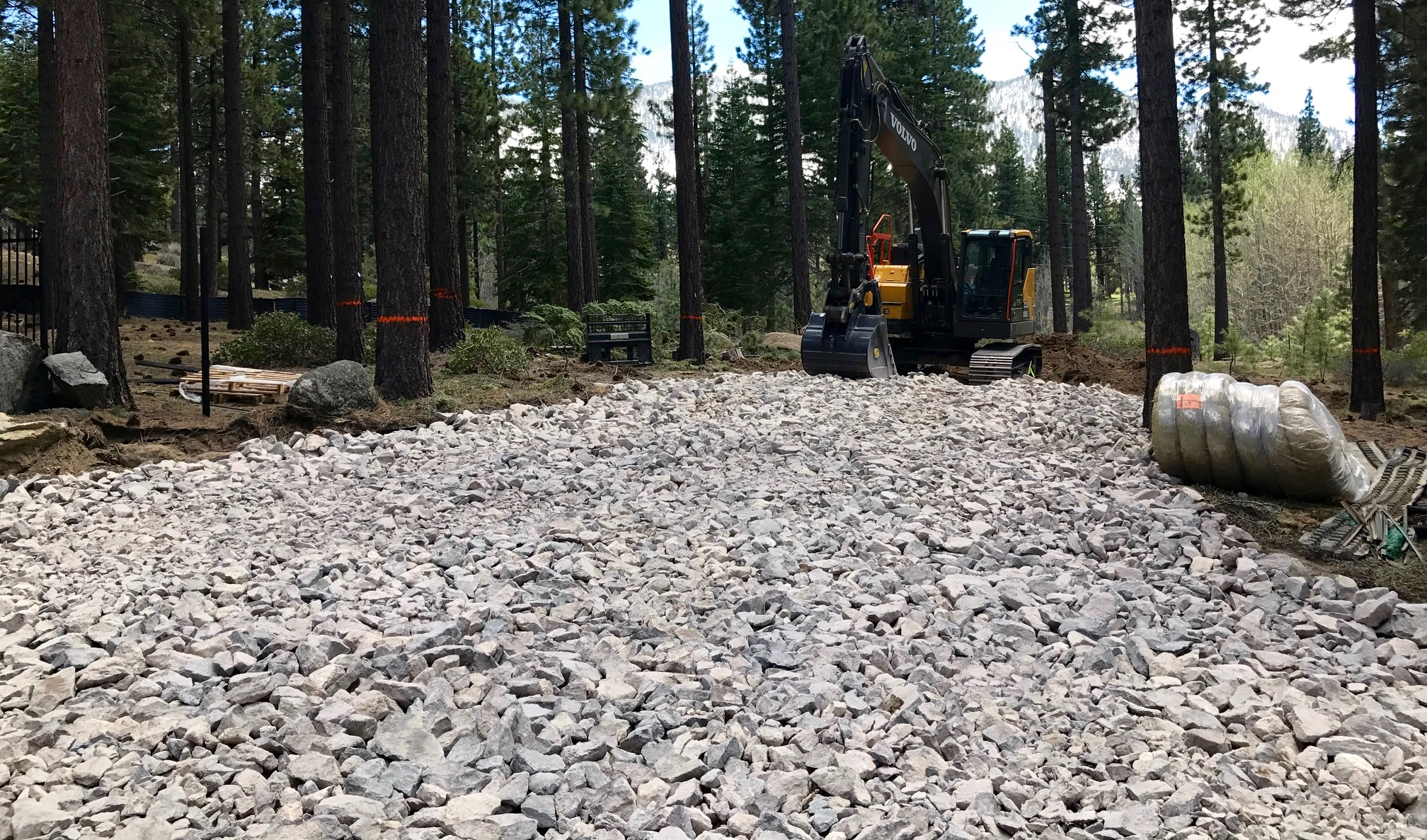
This housing project has gone through several incarnations – because of a lawsuit brought by the League to Save Lake Tahoe, market conditions, and a desire to have more open space. Twelve years after purchasing the 18-acre parcel in Stateline, Steve Kenninger and Gail Jaquish are starting to build what is known as Sierra Colina.

“Our big focus is we are trying to create a community or neighborhood that provides that feeling of being more like a local neighborhood. We expect a large portion of our owners to be full-time residents of the Tahoe basin,” Brian Helm, managing partner of Sierra Colina, told Lake Tahoe News.

This is the eastern entrance to Sierra Colina off Lake Village Drive. There will be a second entrance/exit down the hill to the west, closer to the office building. Photo/Kathryn Reed

Sierra Colina will be accessed off Lake Village Drive from Highway 50 in Stateline. A loop will connect the neighborhood.

The bulk of the work this building season will be putting in what will be private roads – not county owned – utilities, and other infrastructure. Final details on Highway 50 improvements are being ironed out.

This season 10 units will have their foundations laid, with anticipation people could be moving in in 2018. Seventeen units will be built in each of the following two years.

The exact price for the dwellings will be released this summer. That’s when sales will begin as well.

The original project called for nine moderate-income deed restricted single-family residences. Those fell by the wayside post-lawsuit, which the League won.

“The way we look at it market rate and affordable housing are part of a connected chain. As we add market rate housing, it frees up rentals,” Helm said.

It’s not expected that people will be able to see much of the neighborhood when they drive by on Highway 50 because everything will be set back at least 200 feet.

For the new residents, some will have partial views of Lake Tahoe, Rabe Meadow, Mount Tallac and Heavenly.

The goal is to leave as many of the large trees and boulders as possible so there is a sense of being in the mountains while being immersed in the neighborhood. Only 4 of the 18 acres will be touched. The rest will remain natural.

“We will be providing a little bit of an updated look with mountain architecture; something that feels very warm and relates to Lake Tahoe from an aesthetic and maintenance perspective,” Helm said. “It’s important to us to have timeless mountain architecture.”

Wood and rock will be used extensively.

Also being constructed this year is the commons building that will be a gathering spot for residents. A homeowners’ association will govern the property after build out.


Could states manage federally owned land?

By Daniel Rothberg, Las Vegas Sun

At a Lake Tahoe fundraiser in August, Elko County Commissioner Demar Dahl — a leader in the movement to transfer federal land to the states — met privately with then-candidate Donald Trump. According to a story Dahl has told many times since then, he asked Trump how he would feel operating a 10-floor hotel in which eight floors were owned by a bureaucracy 2,500 miles away.

“He caught right on,” Dahl said.

This is how Dahl sees Nevada’s position relative to the federal government, which owns more than 85 percent of the state. “So many of the rules and regulations we have to live by are made so far away in Washington by people who are not really familiar with our problems out here,” he said.

In late April, Dahl flew to Washington, D.C., to discuss the future of public lands with President Trump’s staff, after the administration invited him to a signing ceremony for an executive order on education. The political landscape around the land issue had changed since August. Trump’s administration had veered away from the pro-transfer position included in the Republican Party’s platform.

Read the whole story


Amgen women riders deal with sexism, inequities

By Blair Anthony Robertson, Sacramento Bee
 
When the Amgen Tour of California takes off Thursday in South Lake Tahoe, the speeding peloton will feature some of the most accomplished women in the sport, their heads down and hands gripping low on the bars as they race to the finish line.

These pros train long, grueling hours on the bike and, much like their male professional counterparts, put on an exciting and inspiring show for the fans. But the similarities end when you begin to dig into the details.

Women are paid less, get far less media attention, and, when invited to participate in high-profile events like the Tour of California, often don’t get to race on the same challenging routes as the men.

Read the whole story


USFS to study Meeks Bay’s future; marina closed

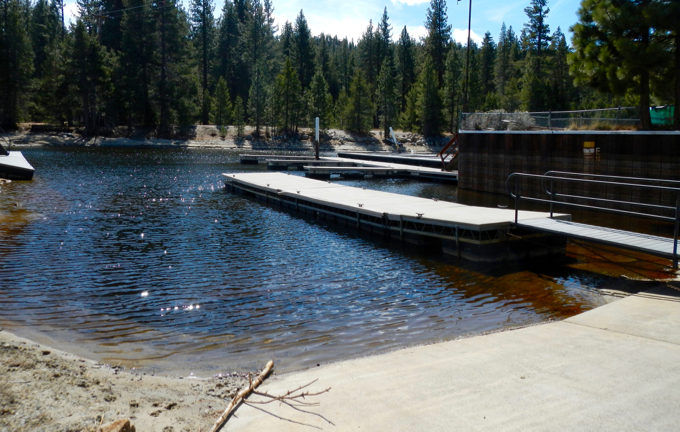
Meeks Bay Marina is closed indefinitely. Photo/LTN file

By Kathryn Reed

It’s possible Meeks Bay Marina will never see another boat launched there.

The rest of the operations at the resort remain open. But what the area will look like in eight years remains to be seen.

A settlement agreement is expected to be approved Wednesday by the Lahontan Regional Water Quality Control Board. The state agency went after the U.S. Forest Service – the landowner; Washoe Tribe – which has a 20-year contract that expires in two years to run all of the operations; and Action Water Sports owner Bob Hassett, the marina operator.

It has been an ongoing dilemma that finally has a resolution that includes long-term planning. Multiple citations had been issued and nothing changed. A dirt parking lot was dumping fine sediment into Lake Tahoe at a rapid rate.

Last year the marina was shut down. The Forest Service has removed it from the special use permit. Its future will likely be studied in forthcoming environmental and planning documents.

“It’s unfortunate the marina is at the mouth of the creek. I’m not sure if they have an opportunity to put the ramp somewhere else,” Cathe Pool, senior engineer with the water board, told Lake Tahoe News.

Heather Noel with the Lake Tahoe Basin Management Unit said, “I don’t have an idea of when it could open until we are through the planning process and a decision on the use and restoration of the marina is determined.”

No one from the tribe returned a call.

The Forest Service this summer intends to issue a notice of preparation, which is the prelude to environmental documents being initiated.

“We are looking forward to finalizing the proposed action this summer to get the public’s weigh-in on what they would prefer to see at Meeks Marina,” Noel told Lake Tahoe News. “The Forest Service developed a proposal using our existing appropriations budget, however we will need to identify the path forward on paying for planning and improvements.”

By November the feds are supposed to present to Lahontan “a first phase assessment for the project identifying expected environmental benefits, multi-benefit success criteria, and a five-year monitoring plan.”

Lahontan wants whatever the project is to be completed by 2025.

“I feel like we are getting more benefit to water quality than if they just paved the parking lot,” Pool said. That is what was initially asked of the USFS by Lahontan. Ultimately a more diverse project with enhanced environmental gains will be developed.

Temporary erosion control measures are in place, and according to Pool, held up well through this winter.

—–

Notes:

·      The Lahontan board meeting is May 10 at 7pm, 971 Silver Dollar Ave., South Lake Tahoe.


Heed warnings when exercising at altitude

By Sammy Caiola, Sacramento Bee

The thin dirt road to Round Top Peak lurched up toward the distant ridge line, teasing me with the promise of alpine lake views as I climbed the mountain’s face one heavy step at a time. I was physically fit – or so I thought – and I had lugged my 40-pound backpack up and down plenty of mountains. So why did I feel so utterly exhausted?

Altitude sickness, as I found out, can be a roadblock even for the most confident hikers. Having grown up at sea level and hiked mostly in the Sierra foothills, my only elevated fitness experiences involved gliding down the slopes of Lake Tahoe ski resorts. So when I set my eyes on the 10,400-foot Round Top Peak in the Carson Pass Management Area last spring, I didn’t know I’d be feeling light-headed and gasping for air like a dry fish just a few miles into the trip.

Fortunately I stopped my ascent before the point of collapse, but plenty of adventurers have paid the price for exercising above their limits. Altitude illness affects 25 percent to 85 percent of travelers to high altitudes, depending on their rate of ascent, home altitude and other risk factors, according to the American Academy of Family Physicians. Severe cases of altitude sickness can result in death.

Read the whole story