
Nev. peak still honors disgraced Confederate leader

Jeff Davis Peak in Great Basin National Park in Nevada. Photo/National Park Service

By Benjamin Spillman, Reno Gazette-Journal

Jefferson Davis is famous mostly because he presided over the Confederate government that sought to preserve the institution of slavery and tear the United States asunder in the Civil War.

His dark stint in power is the reason city leaders in New Orleans recently removed a statue of Davis from a position of prominence in the city’s central business district.

The removal knocked the legacy of slavery from a cultural pedestal in New Orleans but hasn’t wiped the Davis name from other positions of high honor, including a mountain peak in a remote corner of Nevada.

At 12,771 feet in elevation Jeff Davis Peak towers over Great Basin National Park in Baker. There’s also a Jeff Davis Peak in Alpine County.

Read the whole story


Almost 4-foot drop in Lake Tahoe’s clarity

By Kathryn Reed

It’s clear that things are getting murkier. Lake Tahoe’s clarity diminished by nearly 4 feet in 2016.

In 2016 the average depth of clarity was 69.2 feet, which is a 3.9-foot decrease from 2015. In 2015, clarity dropped 4.8 feet. The worst overall reading was in 1997 at 64.1 feet. Measurements have been taken since 1968, when the Secchi disk could be seen at 102.4 feet.

Researchers from UC Davis released the numbers May 18. Scientists use what looks like a white dinner plate to determine the lake’s clarity. It is dropped over the side of a boat at several locations throughout the year and then how far someone can see it is the measurement.

Climate change is being blamed for the brunt of the decline.

“In 2015, clarity was reduced by relatively warm layers of turbid water entering near the lake surface. In 2016, the clarity was reduced by the early onset of spring favoring the growth of light blocking blooms of very small algal cells,” Tahoe Environmental Research Center officials said in a press release.

The numbers were better in winter than summer. The best reading was 95.1 feet on Jan. 25, and the worst was 44.3 feet on June 7. The winter average of 83.3 feet was the highest since 2012. However, the summer numbers were alarming. There was a 16.7-foot decline in one year.

A large Cyclotella bloom is part of the reason for the summer problem. This single-cell algal species is able to thrive as Lake Tahoe’s waters warm. In 2016, the lake’s temperature was at record-high level.

“Climate change is impacting Lake Tahoe. TRPA and its partners are committed to working with researchers to better understand the threats a warming climate poses, and to promote solutions that will improve the resiliency of Lake Tahoe’s environment and communities,” Tahoe Regional Planning Agency spokesman Tom Lotshaw told Lake Tahoe News.

While experts point to the five-year clarity average of 73.1 feet surpassing the 2016 interim restoration target of 71 feet, that average will keep dropping if the trend of lower visibility continues.

Still, scientists are confident there has been a leveling off of sorts. The nearly $2 billion spent on environmental improvements in the Lake Tahoe Basin since the inaugural Lake Tahoe Summit in 1997 is credited with stemming what had been years of degrading clarity. Reducing fine sediment particles from the lake is the biggest change, and one that is ongoing.

“Storm water reductions are contributing to the improved winter clarity,” Tahoe Regional Planning Agency spokesman Tom Lotshaw told Lake Tahoe News. “From local, state, and federal governments reducing storm water pollution from roads and restoring natural areas like streams, marshes, and wetlands, to homeowners installing measures to capture and infiltrate storm water on their properties, this work is helping protect and restore Lake Tahoe’s famous water clarity.”

What all of these numbers don’t reflect is what goes on along the shore of Lake Tahoe where people have the most interaction with the water. The near shore, as scientists call it, with its algae and ever-increasing brown color is a whole different topic.


Lahontan demands solution to toxic plume in SLT

The circle represents the known area of the PCE plume in South Lake Tahoe. Image/LRWQCB

By Kathryn Reed

After decades of a toxic plume percolating underground near the Y in South Lake Tahoe, the state has set hard deadlines for the responsible parties to do something about the situation.

Tetrachloroethylene, or PCE, has adversely affected the drinking water in the area, necessitating that wells belonging to Tahoe Key Water Company and Lukins Brothers Water Company be taken off line. Lukins and the Keys water systems are building filtration units to treat their water so the inactive wells can be put back into service.

Research shows the chemicals were released from the Lake Tahoe Laundry Works, which was located at the Y in the Raley’s center. That is a known source for PCE contamination and had originally been thought to be the source of the plumes below TJ Maxx and Classic Cue. PCE at the Y was first detected in 1989. Since then more than one PCE plume has been found.

PCE was a commonly used chemical in dry cleaning and automotive businesses. California in 2008 banned new PCE machines. And all such machines are to be out of commission by 2023. However, PCE will still be able to be used.

A letter dated May 12 was sent by Lahontan to Seven Springs Limited Partnership, Fox Capital Management Corporation, Bobby Pages Inc., and Connolly Development Inc. Each has 75 days from that date to provide a work plan to Lahontan. There may be some back and forth to get to a work plan that is agreed to by the state agency and the four known responsible parties. Those four entities will then have 30 days to implement the plan.

“We are pleased to see that the cleanup and abatement order issued by the Lahontan Regional Water Quality Control Board now recognizes that there is insufficient evidence to attribute the regional PCE plume in the South Lake Tahoe area solely to the former dry cleaner. Fox welcomes the regional board’s desire to identify all of the contributing sources to the contamination, and to ask all responsible parties to address the associated environmental concerns,” Scott Reisch, attorney representing Fox, told Lake Tahoe News. “A Fox predecessor was the general partner of a now-dissolved entity that formerly owned the site in the 1970s and early 1980s, while a dry cleaner operated at the site. Fox never owned or operated the property.”

For the past eight years Fox has been working to remediate the PCE issue.

“What is new and different is they have never fully delineated the plume; where it begins and ends, that is their responsibility,” Patty Kouyoumdjian, executive director of the Lahontan Regional Water Quality Control Board, told Lake Tahoe News.

The depth and length of the plume will be determined in this new work plan that will be developed.

Kouyoumdjian said one outcome is to determine who is responsible for what. It may be that other parties not known today will be uncovered.

There has been disagreement among named parties and Lahontan about who is responsible, especially based on movement of the plume.

In an April 4 letter to Lahontan from PES Environmental, an engineering and environmental services firm representing Seven Springs and Fox, it criticizes the water board for dismissing studies without reason, and questions its findings. The two sides can’t even agree on which direction groundwater flows from the old laundry site. PES contends the data show there are multiple sources for PCE, not just the dry cleaners. 

Lahontan plans to have a public meeting, possibly in June, to gather more input on the topic.

Getting the work plan in place should also open doors to funding sources, including from the State Water Board.

“This is an important step forward to deal with the regional plume and finding a final cleanup plan for the entire plume and make sure we protect our drinking water resources that are precious,” Kouyoumdjian said.

Until further tests are done it’s not immediately known how the heavy winter snowfall and subsequent rising of the groundwater table may have impacted the plume.


A massive die-off coming for California fish?

By Ryan Sabalow, Sacramento Bee

Researchers have issued a dire warning for California’s native trout and salmon: Three-quarters of them will be extinct in the next 100 years unless urgent action is taken.

This bleak assessment came Tuesday from biologists at the UC Davis Center for Watershed Sciences and from California Trout, a nonprofit advocacy group. In a new report, the groups said nearly 75 percent of California’s 31 salmon, trout and steelhead will be extinct by 2117 unless critical habitat is protected and restored.

The report follows up on the groups’ 2008 assessment that established a baseline level of health for each type of native fish. The researchers said that almost all of the fish are worse off than they were a decade ago. California’s record-breaking drought that officially ended this winter wreaked havoc on many of the already-struggling fish, which depend on cold water.

Read the whole story


Climate change shrinking West’s water supply

By Emily Benson, High Country News

Picture a snowflake drifting down from a frigid February sky in western Colorado and settling high in the Rocky Mountains. By mid-April, the alpine snowpack is likely at its peak. Warming temperatures in May or June will then melt the snow, sending droplets rushing down a mountain stream or seeping into the soil to replenish an aquifer.

The West’s water supply depends on each of these interconnected sources: the frozen reservoir of snow atop mountain peaks, mighty rivers like the Colorado and groundwater reserves deep below the earth’s surface. But the snowpack is becoming less reliable, one of the region’s most important rivers is diminishing and in many places the groundwater level has dropped.

Three recent studies illuminate the magnitude of these declines, the role climate change has played and the outlook for the future.

Read the whole story


Action lacking to overhaul Calif. pension fund

                                                                                                                                                                       Source: CalPERS

By Kathryn Reed

“CalPERS is about people. It is about the dedicated individuals who serve, or have served, the state of California through a career in public service. For more than eight decades, CalPERS has built retirement and health security for these public servants. As the nation’s largest public pension fund, we ensure that our members’ benefits and earned retirements are as enduring as the state they maintain.”

That is how the California Public Employees’ Retirement System describes itself on its website. If one were to take the last sentence literally, everyone in California should be worried. This is because the earnings are dismal. And this is at a time when the stock market is soaring.

The Dow Jones Industrial Average on March 1 hit a record high of 21,115.55. On May 16 it closed at 20,979.75. The S&P 500 hit its record high on May 15 at 2,402.32. The Nasdaq hit record highs on Monday and Tuesday, with the latter finishing at 6,169.87.

The S&P 500 in the last five years has increased 15 percent, while CalPERS in that same period has averaged a 6 percent gain. CalPERS reported a 0.61 percent net return on investments for the 12-month period that ended June 30, 2016. CalPERS spends millions of dollars every year on investment management fees. Someone is getting wealthy at taxpayers’ expense.

Political and social issues play into what it will invest in. It divested from RJ Reynolds not for monetary reasons, but because of political pressure. And, yet, the only reason CalPERS exists is to make money.

This is a huge organization with nearly 3,000 employees.
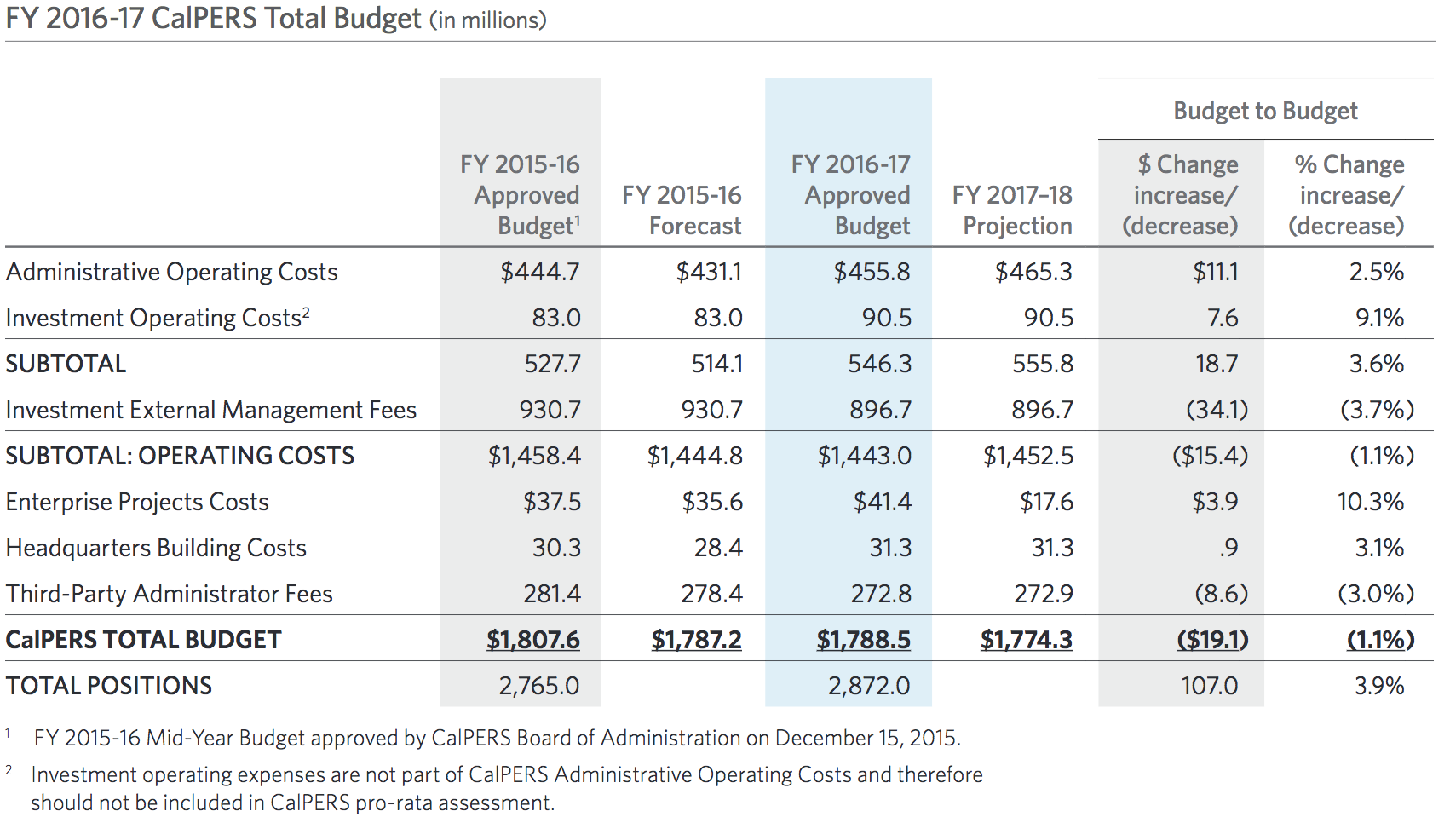
                                                                                                                                                                   Source: CalPERS

CalPERS with its current total market value of $321.83 billion isn’t making enough money to pay all of the retirees. It has a shortfall of more than $200 billion based on everyone in the system retiring at their retirement age.

The deficit isn’t completely the fault of poor investment choices. The agency along with state and local lawmakers share a tremendous amount of burden.

At what is now known as the apex of the funding level in 1997 CalPERS told everyone it was superfunded. This meant it had 120 percent of the money it needed to pay all the retirees/employees at that time. This was assuming nothing changed.

But things did change – some deliberate, some beyond most people’s control. The deliberate actions were to reduce the minimum age at which people could retire. Payments were even made retroactively. The percentage retirees would be paid also increased. Then investments went south with the dot com collapse. Also needing to be factored in is that people are living longer today compared to when CalPERS started in the 1930s, so those guaranteed paychecks keep being written.

History of CalPERS:
• 1932 – CalPERS was established as the State Employees’ Retirement System (SERS).
• 1939 – The state Legislature passed a bill that allowed counties, cities, and school districts to participate in SERS.
• 1962 – Health insurance began for SERS members with the passage of a law that was later amended to become the Public Employees’ Medical and Hospital Care Act.
• 1986 – The headquarters building now called Lincoln Plaza North was completed in Sacramento.
• 1992 – To avoid confusion with retirement systems in other states, the organization’s name was changed to California Public Employees’ Retirement System (CalPERS).
• 2005 – CalPERS expanded its headquarters to include the Lincoln Plaza East and West buildings, which achieved a gold LEED rating.
• 2013 – CalPERS board adopted set of Investment Beliefs to help guide investment strategy.
• 2014 – CalPERS surpassed $300 billion in total fund market value.
• 2014 – CalPERS board adopted set of Pension Beliefs to guide pension fund practices and decisions.
                                                             Source: CalPERS

The above combination was a recipe for disaster. It’s as though these factors have been percolating on some back burner and it’s just now that the pot is boiling over to the point no one is immune from the blistering effects.

According to the California Department of Finance, in 2016 taxpayers paid $5.4 billion for state employee pensions. CalPERS says this is 30 times more than what was paid before the pension law changes took effect in 2000.

It’s not the retirees or current employees’ fault this is happening. But it’s also not the taxpayers’ fault either, and they are the ones left footing the bill, which in turn means fewer tangible benefits – like improved roads, better facilities and lower fees.

The retirement agency likes to paint itself as this great organization. It sends out mailers to members about how everything is rosy. Those who pay into CalPERS or are drawing on their retirement all got a letter this spring saying things are just fine. What wasn’t included was a copy of the letter sent to their employers with the forecast saying that their contribution is going to double in five years.

Corruption is part of CalPERS’ legacy. It wasn’t that many years ago that the headlines were all about the financial scandal within the organization. One-time Stateline resident Alfred Villalobos conveniently killed himself in January 2015 just weeks before his federal trial on bribery and fraud charges was to start. He had been a deputy mayor in Los Angeles, and then was a CalPERS board member from 1993-95. Villalobos reportedly earned $50 million between 2005-09 as a middleman between CalPERS and private equity clients.

In May 2016, Federico Buenrostro Jr. was sentenced to 4½ years in prison for accepting more than $200,000 in bribes and trying to steer investments to help an associate. He did so while he was CEO of CalPERS from 2002-08.

CalPERS at the May 16 South Lake Tahoe City Council meeting was called “inept” by Austin Sass. And while the council as a whole is not thrilled with the bleak financial picture, only Brooke Laine said it might be time to get their butts down to Sacramento and give CalPERS an earful.

After the meeting Lake Tahoe News asked Sass and Wendy David: “Does the council intend to engage CalPERS in any way or any elected officials who might have some ability to address the CalPERS dilemma?” No response.

CalPERS says the responsibilities of its 13-member board “include setting employer contribution rates, determining investment asset allocations, providing actuarial valuations, and much more. However, the board does not have the authority to add, change, or delete benefits without the concurrence of the Legislature.”

The South Lake Tahoe council hasn’t written any letters to its state representatives or tried to engage them in any manner.

Why any member agency would enter into a contract it can’t change or back out of can only be answered by those who made the decision at that time.

CalPERS for the most part is run by former government employees who collect a CalPERS check. They have zero incentive to make changes even though their member agencies could eventually go bankrupt. It’s like the fox is protecting the hen house.

CalPERS issues a bill that has to be paid or else pensions are cut. It’s a non-negotiable contract. CalPERS would come collecting even if it meant a lawsuit.


1 in 3 can afford median-priced California home

By Mark Glover, Sacramento Bee
 
Only 32 percent of California households could afford to purchase the $496,620 median-priced Golden State home in the first quarter of 2017, according to a report issued Monday by the Los Angeles-based California Association of Realtors.

That marked the 16th consecutive quarter that the index has been below 40 percent and is near the mid-2008 low level of 29 percent.

In this year’s first quarter, CAR said a minimum annual income of $102,050 was needed to make monthly payments of $2,550 – including principal, interest and taxes – on a 30-year fixed-rate mortgage at a 4.36 percent interest rate for a median-priced home in the state.

Read the whole story


Is it good to be a woman in Nevada?

By Las Vegas Sun

A giant step backward. A declaration of war. The worst legislation for women’s health in a generation.

These were among reactions to the May 4 passage of the American Health Care Act through the U.S. House of Representatives, from the American Civil Liberties Union, advocacy group UltraViolet and health care provider Planned Parenthood, which will lose all federal grants and reimbursements for a year if the bill were to clear the Senate.

“This disastrous legislation once again makes being a woman a pre-existing condition,” Planned Parenthood President Cecile Richards said in a news release, referring to the Republican bill’s callback to an era when insurers could treat pregnancy, C-sections, postpartum depression, domestic violence and sexual assault as pre-existing conditions, charging affected women more or denying coverage. The AHCA would allow states to opt out of the Affordable Care Act’s provision for pre-existing conditions, and it would block private plans from covering abortion and limit options for low-income women on Medicaid.

The GOP’s website asserts that “praise has poured in” for the party’s plan, rounding up op-eds from Forbes, Fortune, Wall Street Journal, Washington Post and some smaller outlets, as well as statements from the National Federation of Independent Business and other trade groups, mostly lauding fiscal aspects such as cutting industry taxes and lifting regulations imposed by the Affordable Care Act. Polls show some support for its intended replacement, though a majority stands in opposition. Quinnipiac University Polling revealed that out of more than 1,000 Americans surveyed, only 22 percent of men and 13 percent of women were in favor of “Trumpcare.” Nearly a quarter of respondents who identified as Republicans were not among them.

The Status of Women in the States is an ongoing national data project of the Institute for Women’s Policy Research, a think tank launched in 1987 to analyze public policy through the lens of gender. “Women in Nevada have made considerable advances in recent years but still face inequities that often prevent them from reaching their full potential,” IWPR reported in 2015.

Read the whole story


TRPA toys with linking building allocations to VHRs

By Kathryn Reed

STATELINE – Residential building allocations and vacation home rentals may one day be linked, but it won’t be this year if the Tahoe Regional Planning Agency’s Governing Board listens to its Local Government Committee.

The committee is made up of representatives from South Lake Tahoe, El Dorado County, Placer County, Douglas County, Washoe County and Carson City. They all agreed last week that it is imperative the allocations, which are released every two years, go forward as scheduled. The Governing Board at its May 24 meeting is expected to release the allocations.

The bi-state regulatory agency doles out these allocations based on whether the jurisdictions meet certain environmental criteria.

“You can’t change the rules in the middle of the process,” Shelley Aldean, who represents Carson City, said.

Some on the 15-member Governing Board – the ones who don’t live here and don’t have to deal with the impacts of their decisions – are advocating for regulations that would prohibit a residential allocation to end up being used as a vacation rental and not for a full-time resident.

Residential allocations:
South Lake Tahoe, 33 for 2017, 33 for 2018
El Dorado County, 30 for 2017, 30 for 2018
Placer County, 37 for 2017, 37 for 2018
Douglas County, 10 for 2017, 10 for 2018
Washoe County, 10 for 2017, 10 for 2018
                                                                                      Source: TRPA

There are 46,962 residential units in the Lake Tahoe Basin today. The Regional Plan allows for up to 130 residential allocations per year. The total residential units will be 50,637.

Some of the discussion on May 11 centered on whether people intending to build a house to be used exclusively as a VHR should be denied an allocation. TRPA code already says a residence used exclusively as a VHR must have a tourist accommodation unit assigned to it.

Committee members questioned why this was being discussed. The answer – because other board members want TRPA to be in the driver’s seat on the VHR issue. Allowing local control on any issue has always be an issue for the Governing Board as a whole.

Austin Sass, who represents South Lake Tahoe, said for a science-based organization he is not seeing any science behind making changes to allocation distributions and VHRs.

Enforcement is another issue that really wasn’t touched upon. And exclusively can be slippery; an owner can stay there or have friends be there for free for a couple nights. Then it’s no longer exclusively rented to tourists. And what happens when the dwelling is sold?

The committee members all recognize housing – or the lack of it – is an issue in the basin. They acknowledge vacation rentals may be impacting availability. However, those in the industry say owners won’t turn their property into a long-term rental if VHR rules change. That’s the conundrum.

Exploring how many VHRs can be in a neighborhood was brought up.

Douglas County has a VHR policy for the lake, and is now looking to expand it to the valley. A special use permit might also be required.

Local TRPA members are all in favor of discussing the matter further. First, though, they’d like to see the outcome of South Lake Tahoe’s VHR economic study that is expected to be released in June. Current VHR numbers supplied by South Lake Tahoe for just the city 1,287 single-family VHRs, 58 multiple family VHRs and 376 tourist accommodations for a total of 1,721.


Sportsbook regulations would target money launderers

By Richard N. Velotta, Las Vegas Review-Journal

When the Nevada Gaming Commission meets Thursday, members will consider tinkering with Regulation 22, the state’s rules governing race and sportsbook wagers.

Under scrutiny will be a section that would require new record-keeping requirements on all wagers that pay out more than $10,000.

Most sportsbook players won’t be affected by the changes proposed because there’s already a mechanism in place for books that generate more than $1 million in annual gross gaming revenue to file paperwork with the Internal Revenue Service whenever someone wins more than $10,000 on a sports bet.

Read the whole story