EDC school population declining fastest in state

By Phillip Reese, Sacramento Bee

Schools in the El Dorado County community of Georgetown thrived a decade ago, with close to 2,000 students enrolled in classes. Today, barely 1,250 students attend Georgetown schools – a number that will likely continue to fall.

New enrollment projections from the California Department of Finance predict El Dorado will lose another 4,000 students in the next decade, a 15 percent decline. No other California county will lose a higher percentage of its students, the state predicts.

School funding is directly tied to enrollment. Fewer children means less dollars, which can mean staff layoffs, service cuts, school consolidation and even school closures.

Read the whole story


Additional cameras on lookout for wildland fires

By Mike Wolterbeek

With a record mountain snowpack changing to a “robust,” above normal, significant fire potential, wildland firefighting agencies are gearing up for another fire season – and UNR is ramping up its AlertTahoe HD/4K fire camera system, which overlooks and helps protect dozens of western mountain ranges and hundreds of square miles of Nevada’s Great Basin.

The university’s Nevada Seismological Laboratory hasn’t waited for the record Sierra snowpack to melt. They’ve already added two new mountaintop fire cameras to the 29-camera system, on 9,700-foot Slide Mountain on the east side of Lake Tahoe, giving wildland firefighting managers a panoramic view of the Truckee Meadows, parts of Washoe Valley, Lake Tahoe and the surrounding mountain ranges.

One camera will spin 360 degrees continuously, and one will have manual direct monitoring.

The AlertTahoe project, is in its third year.

The Tahoe-Incline, Incline Village, Tahoe City, Rotary Club of Truckee, Truckee Sunrise and Tahoe-Douglas Rotary clubs participated in the Slide Mountain installation.

“The Rotary clubs didn’t just write a check; they actually came with us to the site on Slide Mountain, rode up in our over-snow vehicle and shoveled snow to dig out our building that had been buried in a 20-foot-deep snowpack,” Graham Kent, geosciences professor and director of the Nevada Seismological Laboratory, said. “Coming off a successful season of spotting fires last year, it’s great to get more support. We’re able to start filling in the gaps of coverage. Tahoe Prosperity Center has been critical in finding funding for us to fill those gaps.”

In the weeks following the Slide Mountain install, the Nevada Seismological Laboratory crew installed two more cameras, one on Bald Mountain in the lower reaches of the Sierra Nevada to the west of Tahoe near Georgetown and one on TV Hill near Hawthorne in central Nevada. Both cameras are live and ready for wildland fire managers to use.

The network is built on the backbone of the Seismological Lab’s statewide earthquake network communication system, discovered seven wildland fires in the Tahoe basin in a two-year period and provided discovery, early intel and/or monitoring of 133 others, allowing wildland firefighting managers to move quickly and efficiently assign appropriate resources to each incident.

“2017 is an exciting year to build upon 2016 successes,” Kent said. “In addition to new, continuously rotating cameras, we’ll be working with ITforNature to deploy their machine-vision auto-detect software that is designed to automatically detect and report smoke. We’ll install the software suite on most of our cameras this summer as a trial run.”

The installation is the first of as many as 18 more cameras for the 2017 fire season, including some planned in Oregon and Idaho, as the successful, proven technology is adopted by forest and rangeland fire managers in other states. UNR’s fire camera system is the only one of its kind in the nation using a private high-speed internet microwave communications system for real-time fire-spotting and monitoring. It covers the Lake Tahoe Basin and surrounding mountains, hundreds of square miles of Northern Nevada’s Great Basin and as far south as Bishop in the Eastern Sierra.
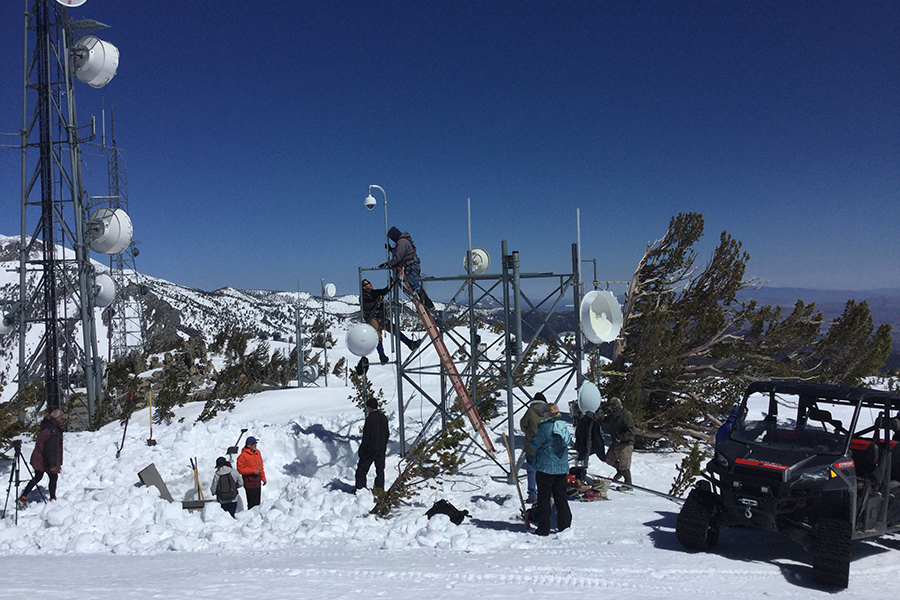
Local Rotary clubs helped fund and install two mountaintop fire cameras in the AlertTahoe network. Photo/UNR

The cameras are used by wildland firefighting agencies for early detection, to spot and track fires, and for quicker, cheaper and more tactical response and suppression. Traditionally, fire managers would send planes to spot and monitor fires, which takes time and resources. They can now use the cameras in the areas of coverage to do the same, as if they were sitting on the mountaintop overlooking the fires.

Last fall, the fast moving Emerald Fire near South Lake Tahoe started at 1:16am. Though no one was watching, the cameras picked up the first signs of the fire 14 minutes before the first 911 call came in, highlighting the need for an auto-detect capability.

“The cameras have to be monitored for them to be most effective,” Kent said. “The on-demand time-lapse video we produce is a useful first step, but we’re excited for the auto-detect software to capture critical intel even earlier. And on the Emerald Fire video you can also see a smaller fire break out in the foreground 1 minute, 45 seconds later. Crews were able to get a jump on that smaller one and put it out before it caused any damage, and the camera played a critical role.” 

There are dozens of examples of the success of the system. The system is monitored by firefighting agencies during fire season. They can manually rotate, tilt, pan and zoom the camera. YouTube channel, nvseismolab, has a library of videos captured from the network.

“Public lands managers are seeing the value in having the rapid look at a fire, as soon as a whiff of smoke is spotted or the near-IR picks up the glare of flames at night,” Kent said. “We can even track lighting strikes, then aim the cameras to see if a fire has started. We’ve been fortunate to have great partners, the BLM, U.S Forest Service and local agency support for land, tower access and funding.”

The Seismological Lab, a public service department in the university’s College of Science, continues to work with the Bureau of Land Management to expand its footprint of fire coverage in northern and central Nevada planning to add up to four more cameras this year to the current nine. Last year, the system helped fire managers get a rapid deployment of resources by being able to show the explosive nature of the Hot Pot wildland fire that at one point was burning at 10,000 acres an hour.

With the private, high-speed internet communications network in place, these sites easily adapt to earthquake early warning detection systems that can provide public notification of expected, potentially damaging ground shaking. The sites can also be used for environmental monitoring research and as extreme weather stations. The university is in a lead position nationwide developing the inexpensive, multi-use, high-throughput, research-grade Internet Protocol networks and expanding their use for all-hazard monitoring.  

“No other system worldwide could actually compete to these standards, as far as we know,” Kent said. “While we’re helping other areas in the West adopt the system, we’ve also had interest from other countries.”

The Tahoe Prosperity Center, a regional collaborative organization, has raised about $150,000 from donors for the system so far. Other areas slated for new TPC-funded cameras at Lake Tahoe this year are Zephyr Cove, Alpine Meadows and Martis Peak.

Mike Wolterbeek works for UNR.


TRPA floating ideas for pier regulations

By Kathryn Reed

STATELINE – No longer is the number of piers at Lake Tahoe being disputed. Now the debate is about all the strings attached to build one.

The latest plan calls for 10 public piers and 128 private piers, with a maximum of 12 every two years.

The shorezone plan that was adopted in October 2008 also called for 128 piers. That month the League to Save Lake Tahoe and the Sierra Club filed a lawsuit in U.S. District Court in Sacramento to block the plan, citing inadequate science. In September 2010 the decision by U.S. District Judge Lawrence Karlton that struck down the TRPA’s shorezone ordinance was appealed by the bi-state regulatory agency. In February 2012 the Ninth Circuit Court of Appeal gave a ruling that had both sides claiming a partial victory.

For the past 18 months a committee put together by the TRPA, which includes the League and affected property owners, has been working to come up with what is now called a shoreline plan. (The League helped create the 2008 plan and still sued.) The committee’s latest iteration was brought before the Regional Plan Implementation Committee of the TRPA on May 24.

Not everyone is going to get a private dock considering there are more than 700 parcels in the basin without a pier that might want one.

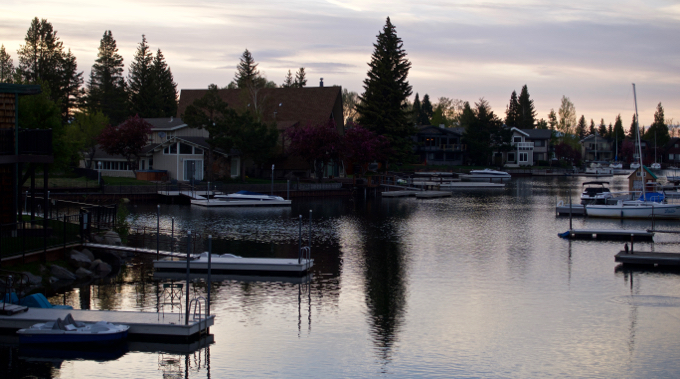
Not much room for more docks in the Tahoe Keys in South Lake Tahoe. Photo/Kathryn Reed

The latest proposal calls for 28 new piers in El Dorado County, 21 in Douglas County, 21 in Washoe County and 58 in Placer County.

Today there are about 800 piers and 4,000 buoys on Lake Tahoe. The 2008 plan allowed for an additional 1,822 buoys. The current plan calls for 1,430 more moorings, which are defined as buoys, slips, or boat lifts.

Density issues will also preclude everyone who wants a dock from getting one. Scenic quality is a top criterion. The goal is not to allow them all to be built in one area, but to spread them out.

How to make it equitable, well, that hasn’t been worked out. There will inevitably be people who lose out on having a pier.

One goal is to have more shared piers. This is intended to reduce clutter and density. A problem, though, could be getting buy-in from neighbors.

“The whole point here is delicate harmonization,” said Gina Bartlett with Consensus Building Institute. CBI was hired by TRPA to work with the shoreline stakeholders to build consensus.

The current plan calls for the pier owner to retire development rights. This was the biggest hurdle for several of the RPIC members. They didn’t see the nexus between the two.

And for those with nothing to retire nor the means to buy other property and have it retired notches up the pier issue to something only the uber-wealthy are likely to be able to afford. Not every lakefront parcel comes with a ton of land.

“We might be creating a situation where only those who can afford to can play,” RPIC member Jim Lawrence acknowledged.

The lack of outreach to those affected is another concern of RPIC. TRPA staff assured the committee they intend to try to connect with property owners.

Obviously there is still work to be done before the environmental document process can begin. The RPIC group is expected to get another update in June.


Nevada braces for booming wildfire season

By Benjamin Spillman, Reno Gazette-Journal

Nevada’s peak wildfire season could be late but it won’t be meek, if history is any guide.

That’s because the record-busting winter snow and rain that soaked the state will leave behind a bumper crop rangeland grasses that will serve as fuel for late-summer fires.

The northern and central areas of the state, in fact, are among the three spots in the U.S. with the highest potential for significant wildland fires, the others are in Northern California and a region from southern Georgia to central Florida.

Read the whole story


Drought’s end doesn’t eradicate tree-killing insect

By Kathryn Reed

One incredibly wet winter will not rid the West of the beetle infestation that has devastated forests, especially in California where more than 102 million trees have died since 2010.

“Bark beetles are still there. They will hatch and fly in early summer. Then we’ll expect to see additional mortality, but at what rate is anyone’s guess,” Chris Anthony, CalFire division chief, told Lake Tahoe News.

What to do with all that fuel remains an unknown. Leaving it in the forests creates a fire hazard. Removing it is a financial conundrum. Even the wood that can be harvested doesn’t necessarily then have a home. Trees that come off federal or state land cannot be sold oversees unless they have been milled to a certain dimension prior to exporting. That in itself can be cost prohibitive.

According to the regional U.S. Forest Service office, lots of people in California have looked into the export issue and potential legislation, but the agency could not provide any new information. This is a federal issue. No one from Rep. Tom McClintock’s office responded to an inquiry. He is the Republican congressman representing Lake Tahoe and a large swath of the Sierra in the House.

The U.S. is the world leader in the production of timber for industrial products, accounting for approximately 25 percent of world production, according to the U.S. Forest Service. China is a big consumer of wood from the U.S.

While the law was set up to protect the domestic market, it is now a hindrance. There are no limits from private property when it comes to being able to export wood.

This dead wood doesn’t have an unlimited shelf life in terms of having monetary value. Once it starts rotting, no one wants it. If it has been stained blue by the beetles, it’s value is also diminished, sometimes to the point of being worthless.

“When you look at the massive amount of wood there is still not enough markets to utilize all of the dead material,” Anthony said.

Biomass, while effective, is also not financially feasible. It’s cheaper to generate energy other ways or to just use natural gas. That is one reason the plant between Tahoe City and Truckee never got built

“They’ve done some experimenting to cut down trees and burn them on site. It’s not efficient and it’s dangerous,” South Lake Tahoe Fire Chief Jeff Meston told Lake Tahoe News.

The state has had a tree mortality task force since October 2015, which Anthony was on from November 2015-July 2016. It was set up as the beetles became prolific during the drought. It is comprised of state and federal agencies, local governments, utilities, and various stakeholders. The Lake Tahoe Basin has a task force regarding beetles, too.

Three types of bark beetles are indigenous to the Sierra Nevada: mountain pine beetles, Jeffrey pine beetles, and fir engraver beetles. The mountain pine beetle is the most aggressive.

A healthy tree is able to use pitch to stop beetles from burrowing under the bark. Drought weakens trees and they become defenseless. Eventually the beetle wins and the tree dies.

“It’s hard to predict what level of mortality we will continue to see,” Anthony said. “Overall, I expect to see the mortality rates decline over what they were the last five years, but there is this tremendous population of bark beetle. It takes trees time to get the vigor and strength to fend off bark beets. One good winter is not enough.”


Rare foxes spotted in Ore. may help Calif. population

By Kyle Spurr, Bend (Ore.) Bulletin

Little is known about the Sierra Nevada red fox, a rare subspecies of the small mammal of which there are fewer than 50 living in Northern California.

But a recently discovered population roaming the Oregon Cascades has excited wildlife biologists, who believe they have found a larger population.

The biologists hope to learn more about the foxes after capturing and radio-collaring two this month in a high-elevation forest near Mount Bachelor.

The Oregon Department of Fish and Wildlife and Tim Hiller, a wildlife biologist and founder of the Wildlife Ecology Institute, began studying the Sierra Nevada red fox in 2012.

Read the whole story


Ganong recaps downhill season, eager for 2018

By International Ski Federation

Downhiller Travis Ganong of Truckee has been racing on the most impressive World Cup courses for the past eight years, claiming two victories, one of them this season in Garmisch-Partenkirchen. We took the time to catch up with him and talk about his season, his career, but also the specificities of downhill ski racing.

Your 7th World Cup season concluded with a 12th place in the downhill standings and a 15th place in super G. It looks like there have been lot of up and downs, how would you rate your season? Are you satisfied with your performances?

Yeah it has been a season of highs and lows for me for sure, but I am really happy to end the season ranked in the top 15 in two events for the first time in my career. I had some really great performances and some other races where I pushed hard and took some chances that didn’t end up working out. This season in downhill and super G the margins were so close that you had to push hard and take risk and when everything worked out, like in Garmisch-Partenkirchen, it was nice to stand on the top of the podium!

You mention it, one of the highlights was indubitably your second career win in the downhill in Garmisch-Partenkirchen. Can you describe that special day?

Yeah, Garmisch-Partenkichen was for sure a bittersweet day for me. I think for me this was the best downhill performance of my career, where I skied exactly how I wanted to and it all worked out, but also I started right after my teammate Steve Nyman who crashed and had a season ending injury. It was hard having such an amazing result for me and then going back to the hotel and seeing Nyman’s condition, as well as watching all of the other crashes that day. The conditions of the downhill on that day were for sure on the limit of what is safe, and it was really tough to see all the injuries that day, but that’s downhill ski racing and we have to push hard and ride that thin line to be competitive with a field that is so stacked right now. I wish the best to all the injured athletes and hope they all make successful returns to the World Cup downhill tour.

This win gave you confidence for the World Championships in St. Moritz, but things didn’t go as planned or hoped there, as you finished 25th. What happened? Was the pressure higher as you were defending a silver medal from Vail/Beaver Creek?

Yeah, St. Moritz really didn’t work out for me, and I was really hopping to follow up the World Cup win with something special, but that is downhill ski racing, where any given day, anyone can win or lose. All the guys on tour right now are skiing so fast and it was tough all season being only four-tenths of a second behind the winner and barley making it into the top 10. I don’t put any pressure on myself ever, but try to just focus on the little things that I can control, and then other than that, I just try to have fun and enjoy every moment that I get to spend in the mountains with a pair of skis on my feet. Also, it really was a tough week in St. Moritz with the weather and canceled training runs and races, and lowered starts, and I didn’t handle the changing conditions very well, and that is something that I can really learn while moving forward. The downhill really did change completely when we couldn’t start from the top, having no real speed for the top flat section of the course.

There is another special event coming up next year: the 2018 Olympic Winter Games in PyeongChang. How are you preparing for this event? What are your goals?

Yeah, I am really excited to head back to South Korea and represent the USA again at the Olympics. I have great memories from Sochi where I had an amazing performance in the downhill and I hope to again try and fight for a medal. I have learned a lot about racing downhill and super G over the last few years on tour and now that I have that experience, I know how to better prepare to be more consistent on a weekly basis, and my goals are to try and stay healthy and strong all season long, and go into the games with as little knee pain as possible so I can push hard and ski how I want to. It has been really hard over the last few seasons managing my knee pain, but I am approaching my training and preparations a little differently this summer and hopefully it will work for next season.

In downhill, the density of the field is very high, with 11 different winners in the last 16 races. What makes the difference at the end of the day? What does it take to be the fastest?

Yeah, it’s crazy how competitive downhill ski racing has become over the last years. There are so many top level skiers and anyone of them can win on any given day. This is really good for the sport I think, and it’s making us athletes work harder than ever and ski on the limit to try and win, and that is elevating the sport and bringing ski racing to new levels. At the end of the day, since the margins are so small and since we are all pushing so hard, it is the athlete that makes the least amount of mistakes, while also taking the most risk that is going to win. It takes a very special performance, and that is why I think there have been so many different winners.

So taking risks is an inherent part of downhill. How do you deal with this? Is the danger always present in your mind?

Yes, downhill ski racing is a dangerous sport and I think that risk management is a very important part of finding success. Since it’s an individual sport, no one is going to tell you when and where to take chance or to hold back, and that is why gaining experience is a huge key to learning how to manage the risk and find success. For my entire career on the World Cup, I have always tried to ski at an 80 percent level of risk or attack. Every year while doing this I try and gain more experience and stay healthy, and then the next season all of a sudden my new 80 percent risk level is at last seasons 100 percent level or higher. Over the seasons I have learned and been able to push harder and harder while still staying in a relatively safe range of risk, and now when I have a good performance while skiing in my comfort zone, I know that I can be faster than anyone. I hope to keep building on this through my career and continue to learn how to manage the risk.

During your time off the World Cup circuit, we often see you shredding the mountain free riding. Do you enjoy it so much for its similarities or its differences to alpine skiing?

I love to ski off piste as much as I can to get a break from skiing on ice and to bring some perspective to my life, realizing how lucky I am to travel the world being a skier. I mean don’t get me wrong, racing a classic downhill course going as fast as you can from top to bottom and sending it off of jumps is still the most fun thing I have found to do on a pair of skis, but I still love the difference that free riding brings, and think that it really compliments my ski racing. Going back to the risk management, I think that backcountry skiing relates to downhill ski racing in many ways as where you always have to manage the risk and dangers associated and ski within your comfort zone to manage the apparent danger and in the case of backcountry skiing, stay alive. It was really tough this winter being in Europe from December through February when the hills were green and watching all my buddies have day after day of bottomless powder skiing. I had serious FOMO scrolling through my Instagram feed every morning and seeing how good it was back home at Squaw Valley.

Squaw Valley is where you grew up and the World Cup returned to the Californian venue this season. What does it mean to you and how was the atmosphere? You had the chance to race and win the U.S. Championship there in 2013. How would it feel to be able to race a World Cup in your home yard?

It was so cool to bring the World Cup back to California and to show off my home ski area of Squaw Valley. There is so much skiing history in Lake Tahoe and the Sierra Nevada Mountains, and so much passion for the sport, and it’s a shame that World Cup ski racing has been absent from the region for so long. Ski racing is growing as a sport in California where the Squaw Valley Ski Team alone has over 1,200 kids in the program, and it was so cool for all those kids and others to see firsthand what ski racing on the World Cup level really is. I am sure that this one race inspired so many of these kids, and it will really help fuel the fire of the next generation of racers from California. The atmosphere was off the charts as well. I have been to a lot of women’s World Cup races to support my girlfriend Marie-Michele Gagnon, and this was by far the biggest and loudest crowd that I have seen at a women’s race. When Mikaela Shiffrin came down and won, everyone was on their feet and screaming as loud as they could, and it was a really special moment. I really hope that the FIS took note at how successful the Squaw Valley and Killington races where and that this will lead to a more fair World Cup Tour where the races are spread out evenly around the World.


Wet winter could create memorable EDC vintage

By Kathryn Reed

PLACERVILLE – With the sudden heat wave, it can seem like last winter’s deluge was in some other decade. For El Dorado County vintners, it’s all in a day’s work to contend with whatever Mother Nature brings.

Growing grapes is farming. And all farmers know they are at the whim of the weather.

Coming out of multiple years of drought, though, is bringing a bit of optimism to many in the foothills.

El Dorado County winemakers are thrilled with the moisture that fell this past winter. Photo/Kathryn Reed

Elliot and Sherrie Graham, owners of Busby Cellars, dry farm 7 of the 15 acres that are planted. That acreage without irrigation yielded 4 tons of grapes last year. This compares to 14 tons in 2012.

They are hoping this year will be similar to 2006 which followed two dry years. That vintage saw 40 tons of grapes from the whole 15 acres.

Grape vines can have roots that are 20-feet deep, so it takes a bit of water to reach that depth.

While many vineyards were sitting in several inches of water during the winter, this was no big deal because the vines are dormant. Trouble would come if that same ponding were to occur between now and harvest in late summer/early fall.

The abundance of winter moisture is expected to bring in yields that have not been recorded for years. And while robust harvests can actually mean the quality is less, the opposite tends to be true when the higher tonnage comes after a year or two of dry conditions.

Vaughn Jodar respects Mother Nature, knowing she always has another lesson to teach. Photo/Kathryn Reed

At Jodar Vineyard and Winery the rocky mountain side makes it near impossible to keep any moisture in the ground by the vines. Five wells on the 40-acre parcel provide water to the vineyard and the family house.

“Two years ago we were really frightened,” owner Vaughn Jodar told Lake Tahoe News. “We were surprised we still had water.”

Vineyard managers would draw on the wells early in the morning to irrigate, then overnight the aquifer was refreshed. The drought that finally came to an end this winter tested those wells more than they had been in the last 30 years.

“There are many lessons you don’t want to learn, but Mother Nature will teach you,” Jodar said.

The Placerville area received about 80 inches of rain this past winter. Bud-break was normal, coming in April. But a frost last month damaged vines in the region. At Madrona it hit some of the Chardonnay and Cabernet grapes.

“In 2015, a lot of berries didn’t mature, though the quality was off the charts,” Paul Bush, Madrona owner, told Lake Tahoe News. “I think this could be a bumper crop and exceptional quality this year. It will depend on the summertime temperatures.”


Virtual reality could give more people access to outdoors

By Shane Downing, Sierra

As you’ve probably heard by now, virtual reality technology—or VR—is shaking up industries as disparate as gaming and real estate, filmmaking and journalism, tourism and (no surprise there) pornography. The 360-degree video presentation, which sometimes is also rendered as 3D, has the power to create immersive experiences that seem remarkably real. Now, some media producers and conservation organizations are experimenting with using VR to capture and communicate the experience of outdoor recreation.

Imagine: Someday soon you could scuba dive the Great Barrier Reef, canoe through the Everglades, or hike Half Dome in your bathrobe and slippers, from the comfort of your home.

Those who are experimenting with VR as a conservation tool acknowledge that the visceral experience of being outdoors can’t be replicated easily. The intoxicating mountain air, dizzying heights, and sense of adventure of a mountain ascent are one-of-a-kind. “There’s nothing that takes the place of actually being outside,” says Connie Dassinger, a member of the Centennial Group of the Sierra Club’s Georgia Chapter.

Read the whole story


Signs point to robust year for travel industry

By Jamie Biesiada, Travel Weekly

From a projected increase in Americans traveling this Memorial Day weekend to a steady growth in air travel, all signs are pointing to a very healthy industry, one of the most robust that some executives say they have seen.

“If I look at this historically, I think we are currently at one of the healthiest times we have ever been at on the leisure side of the business.” said Scott Koepf, senior vice president of sales at Avoya Travel.

Consumer confidence, an end to uncertainty surrounding the 2016 election and pent-up demand for travel are among the factors contributing to that health.

Read the whole story