Short-term rentals can’t hide in Truckee

By Sage Sauerbrey, Moonshine Ink

Short-term rentals have become a linchpin component in the housing conversation, and communities across the West have had very different ways of facing the issue.

Jackson Hole, Wyo., recently banned short-term rentals, San Francisco has adopted a series of different regulations, and Mammoth Lakes only allows short-term rentals in specifically zoned areas. Last year, Truckee searched for a solution and reached out to Ulrik Binzer and his newly founded company Host Compliance, and Placer County followed suit shortly after.

Host Compliance analyzes a set of 17 different public data sources to investigate where properties are being used as short-term rentals so that the town can contact them and bring them into compliance.

Read the whole story


Endangered Species Act can’t save whitebark pines

By Maya L. Kapoor, High Country News

U.S. Forest Service research ecologist Bob Keane has studied whitebark pine, a coniferous tree of the high country, for more than thirty years. Still, when asked to describe a whitebark to someone who’s never seen one, he takes a breath and pauses for a moment. “Gosh,” he says.

The shape of the tree is very distinctive, Keane says. Instead of growing cone-shaped like other conifers, whitebarks branch like hardwoods. “A lot of the undergrowth is very small, so you see these open park-like stands of beautiful spreading trees,” he says. This shape is an adaptation that shows Clark’s nutcrackers flying past that a tree below has many nutritious cones and might be worth a travel stop.

Clark’s nutcrackers cache thousands of whitebark seeds, dispersing the pine across the high country, where the tree is a keystone species. Whitebark pine is one of the first trees to break ground after a fire, thanks to those nutcrackers, and it stabilizes soil and snowpacks at timberline. Living a millennium or more, whitebarks shape the West’s high mountain ecology in countless ways.

Read the whole story


Lessons from the devastating Angora Fire

Publisher’s note: Lake Tahoe News this month will be running several stories leading up to the 10th anniversary of the Angora Fire on June 24, 2007.

By Kathryn Reed

It will happen again – another devastating fire in the Lake Tahoe Basin.

But next time could be different based on the lessons learned from the destructive 2007 Angora Fire, as well as the changes that have taken place in the last 10 years.

“Really, there was nothing that could have been done differently to change the outcome based on the conditions we faced that day,” Kit Bailey, with the U.S. Forest Service, told Lake Tahoe News. Bailey was the initial incident commander for Angora.
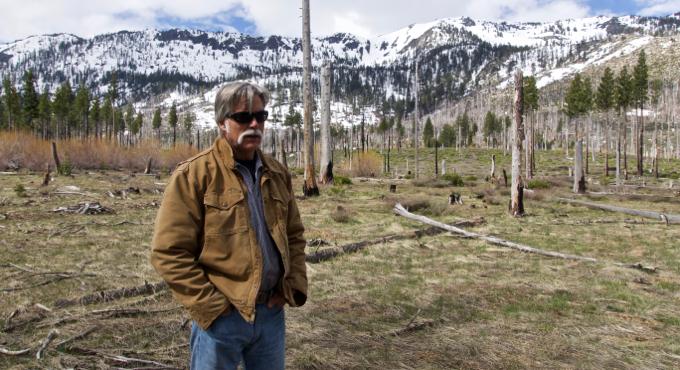
Kit Bailey, LTBMU’s fire chief, surveys what the landscape looks like today. Photo/Kathryn Reed

The humidity, temperature and wind created a perfect scenario for a wildland fire. Fuels treatment were not as robust then. “Extreme fire behavior” is a common refrain when fire officials talk about Angora.

Walking near where the fire started at Seneca Pond, the landscape looks like two worlds. It’s clear to see where the forest had been treated and where it wasn’t. To this day the scar on the forest is prominent and will be for decades to come.

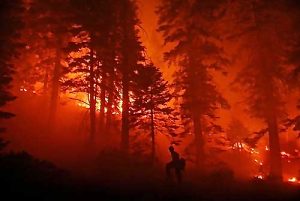
It was a hot, fast fire. Flames were in the canopy, jumping from one tree to the next as though it were a race to destroy as much as possible.

“You can almost draw a line where it was treated,” Bailey said as he looked out onto the forest. “It gave the firefighters an opportunity to engage and retreat when they needed to.”
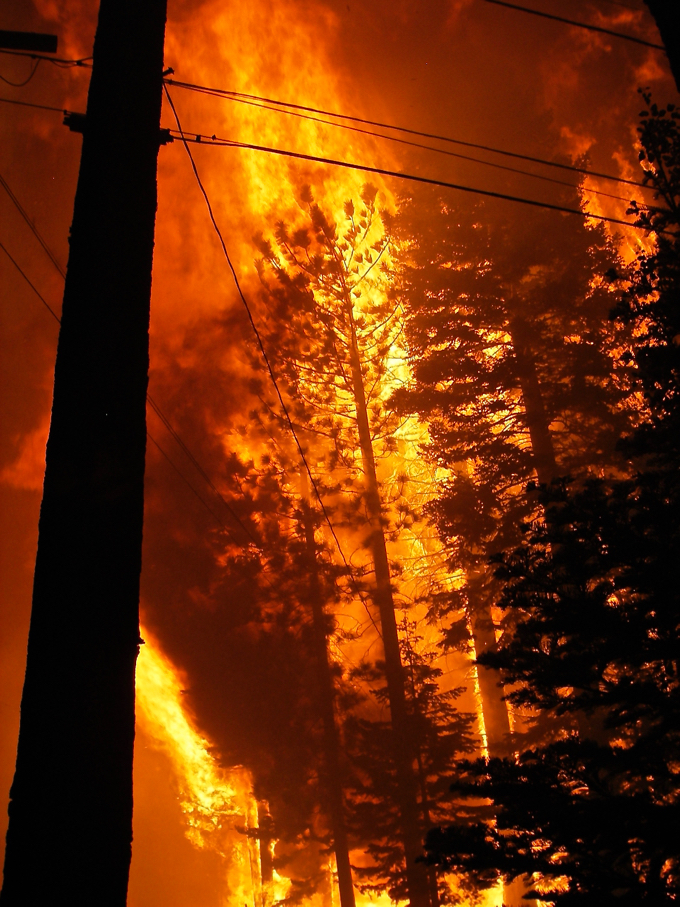
The Angora Fire burned hot and intense in the tree canopy. Photo/LVFPD

Fire behavior is very different between treated and untreated terrain. If it’s been thinned, then the fire tends to say in the understory where it is more easily suppressed. Fighting a running crown fire, even with air support, is a difficult, near impossible endeavor.

The fuels work on Tahoe Mountain and below Angora Highlands prior to that fateful day contributed enormously to only one house in that area being lost.

It has been proven that more prescribed fire means fewer wildland fires.
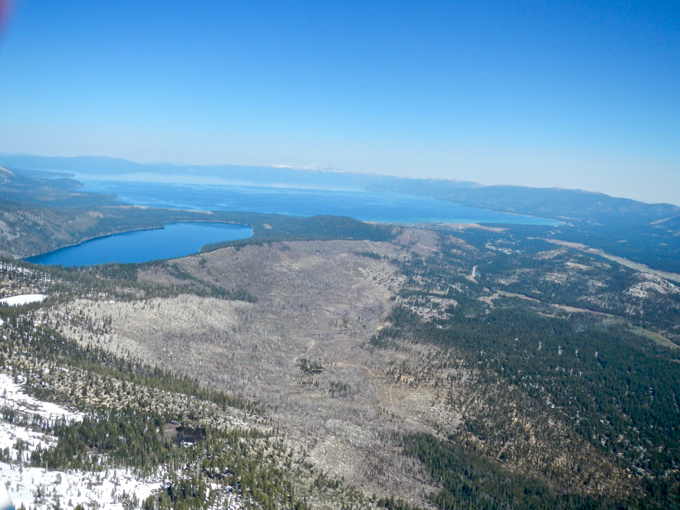
The scar from the Angora Fire will be visible for years to come. Photo/LTN file

“Some post fire studies showed homes with better defensible space had a better likelihood to survive. This was not new news, but it helped solidify that need in the Lake Tahoe Basin,” CalFire Division Chief Chris Anthony told Lake Tahoe News.

Equipment and manpower were quick to arrive that Sunday afternoon. But not before 254 houses were reduced to ash. Most of the damage to structures and land happened in the first eight hours.

Three significant tools are now available that weren’t during Angora. Lake Tahoe Basin Management Unit now has a hot shot crew. The Super Scooper plane is another tool that is new. Alert Tahoe, the camera system, is quick to spot puffs of smoke.

Another change since Angora is that CalFire now has a year-round presence in the basin. Personnel had always been here, but not equipment. Now there are engines at Lake Valley and North Tahoe fire stations. Then-Gov. Arnold Schwarzenegger’s emergency funding for the rigs became a permanent line item in the budget.
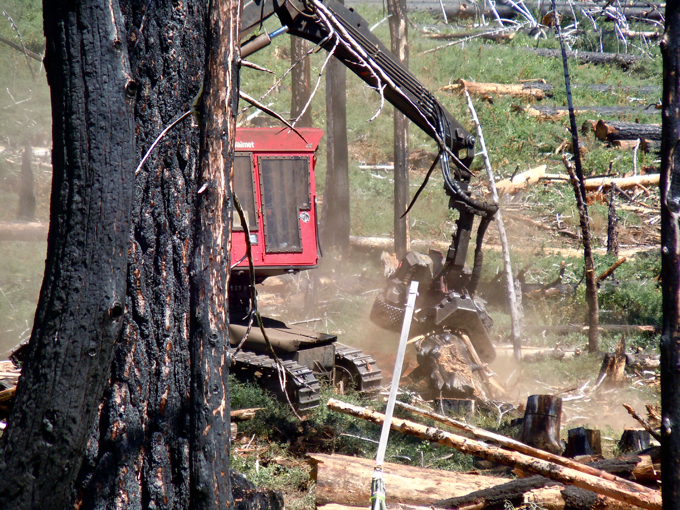
It was four years after the Angora Fire before many of the charred trees were removed. Photo/LTN file

Anthony, who was here for Angora, says the relationship between the fire agencies has been a significant change.

“One of the biggest lessons was the need for the increased collaboration between different agencies in the Lake Tahoe Basin,” Anthony said. “It’s very clear in the commission report that the local fire protection districts, land managers and regulatory agencies needed to do a better job working together.”

The report he speaks of is the bi-state Blue Ribbon Commission that was tasked with analyzing what needed to change to help prevent another Angora.

It is still a tool. Both states and TRPA annually monitor progress being made based on recommendations in the report.

“There was a lot of work that went into the commission hearings and lot of public input. It’s important we continue that legacy established by the commission,” Anthony said.
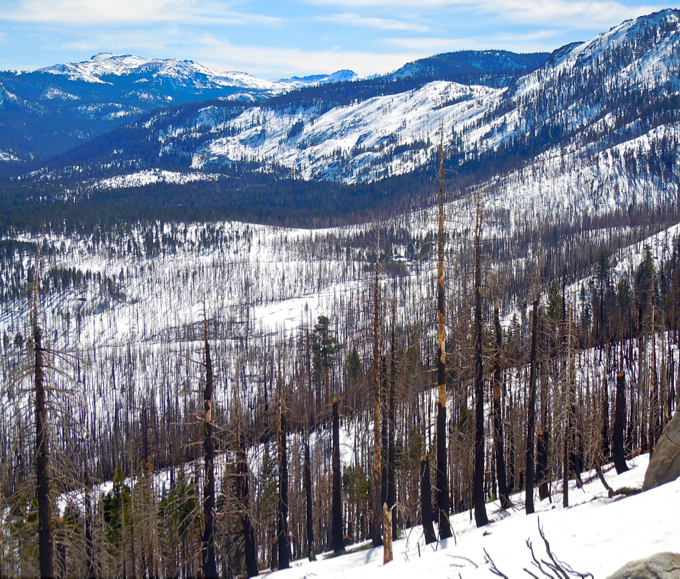
Looking toward the neighborhood off North Upper Truckee Road from Angora Ridge. Photo/LTN file

A formal, comprehensive report detailing the last 10 years is expected to be completed by the end of the month.

The Tahoe Fire and Fuels Team came out of Angora. It includes all the fire departments in the basin and other agencies. They work on getting grants for fuels reduction projects for the greater good of the community. They essentially have each other’s back in a more formalized structure when an emergency occurs. The wildland protection plan, which encompasses the basin, has been developed. A multi-jurisdictional approach to managing public lands is in place.

A sub-geographical operating plan has been established that goes into more detail when it comes to moving local, state and federal resources.

“I think there are a lot of lessons, not on suppression, but on the land regulations side of the house,” Bailey said. “We’ve streamlined the permit process with TRPA and somewhat with Lahontan. Lahontan has the biggest impact on what we can do on the ground and the timeliness. It’s like pulling teeth to get a permit. It costs a lot of time and money.”
Angora Fire facts:
• June 24, 2007, Angora Fire started at Seneca Pond
• Cause: Illegal campfire
• No arrests ever made; investigation considered cold case
• July 2, 2007, fire fully contained
• More than 3,100 acres burned; mostly U.S. Forest Service land
• 80 percent of the terrain burned in the first eight hours
• 254 houses destroyed
• Fire caused more than $150 million in damage
• It cost about $23 million to fight the fire
• July 5, 2007, bi-state commission formed
• 56,317 tons of ash and rubble were removed and transported for disposal (2,823 truckloads); 6,134 tons of concrete (352 truckloads) and 2,001 tons of metal were recycled (90 truckloads); and 8,511 tons of trees were recycled for lumber (405 truckloads)
• May 27, 2008, governors declare state of emergency in Lake Tahoe Basin. Fire commission’s 247-page report’s six categories are: Environmental Protection, Issues of Governance, Community and Homeowner Fire Prevention, Forest and Fuels Management, Fire Suppression, and Funding.
• June 2008, 63 percent of the homeowners had filed building plans with the county
• June 2017, 63 lots remain vacant.
Photo/Dennis Cocking

Shortly after the fire there was a community meeting at South Tahoe Middle School where it was almost a mob mentality. The audience shouted down John Singlaub who was the director of the Tahoe Regional Planning Agency. While TRPA has some arbitrary rules in place that affect homeowners, they were not a huge impediment to what large landowners wanted to do in regards to fire safety.

The same cannot be said for the Lahontan Regional Water Quality Control Board. To this day it is still a stumbling block for the U.S. Forest Service and others on the California side. The difference with Lahontan and TRPA is that the former doesn’t have much to do with individual residents, so the anger toward that state agency has never risen to the level that it still can with the federal regulatory organization.

TRPA now allows the fire agencies to decide if trees should be removed from an individual parcel. People may cut trees of 14 diameters or less without a permit; it was 6 inches pre-Angora. And no longer are piles of pine needles recommended as mulch or for erosion prevention.

“When you look at fire statistics since 1990, California has had 15 of its 20 largest fires. We are seeing more damaging fires,” Anthony said. “We can’t totally prevent large and damaging fires in the state, but we can change the landscape where they burn. Again, out of the commission report was the need to accelerate the pace of fuels reduction work in wildland urban interface, to increase the number of defensible space inspections around the lake and to prioritize where those are going to occur based on the greatest need.”

Fire officials worry that people have become complacent in the last 10 years and don’t necessarily take the threat of fire as seriously as they did immediately after Angora.


What will happen to medical marijuana in Nevada?

By Chris Kudialis, Las Vegas Sun

The Denver dispensary is called Medicine Man and was founded on serving medical marijuana patients. Yet, since Colorado legalized recreational marijuana sales three years ago, few of the store’s patrons have been making medicinal purchases.

“There’s less need for medical inventory because we have less medical customers,” said Andy Williams, owner and CEO of Medicine Man, one of Colorado’s largest legal marijuana stores selling both recreational and medical marijuana. “People don’t want to go through the hurdles to get their cards anymore.”

A similar scenario will likely play out for Nevada’s pot dispensaries when recreational marijuana sales begin July 1. The first four states to legalize recreational marijuana sales — Oregon, Alaska, Washington and Colorado — have all seen a dip in the number of active medical card-holding patients.

For nearly two years since Nevada’s first dispensary opened in July 2015, medical marijuana has been the only source of legal weed. Nearly 28,000 Nevadans currently have medical cards, and thousands of other purchases come from out-of-state buyers through the state’s reciprocity program, which honors medical cards from other weed legal states.

Read the whole story


Wet winter creates hazards on Tahoe trails

By Ryan Canaday, KTVN-TV

A record-breaking winter has damaged many trails in Lake Tahoe. As a result, experts are working to repair the beaten path.

Chris Binder, director with the Tahoe Rim Trail Association, says there’s no hiding the fact that Tahoe’s hiking paths need some care.

“We’re seeing some evidence of erosion on the trails particularly steep sections where the rapid snow melt has put more water on the trail than we’re used to seeing,” says Binder. “Some tripping hazards and some other things that aren’t conducive to hiking, biking and riding on the trails, so that’s something that we’re going to have to address and fix this year.”

Read the whole story


Squaw redefines ski season with summer schussing

So much snow remains at Squaw Valley that the ski season may never end. Photo/Kathryn Reed

By Kathryn Reed

OLYMPIC VALLEY – Warmth and skiing are seldom two words that go together. But these are not ordinary times.

The abundance of available terrain at Squaw Valley is astounding. There is so much snow that resort officials hope the 2016-17 ski season blends into the 2017-18 season without interruption. If this happens, it could be the first time anywhere for a resort to never close.

With a high of 69 degrees last Monday, one might think it would be more slush than snow. Not true. It was spring skiing, for sure. Soft, with patches that grab and a few slick spots. No corn snow, though.

From two wheels to a mono ski. Photo/Kathryn Reed

What was most impressive about the runs off Siberia, Shirley Lake, and Gold Coast was the coverage. No rocks, no obstacles of any kind.

It was shocking on May 29 to be able to ski from the top of Siberia Ridge to the village. With the mountain run open, no need to down lift – at least for now. There are spots on the lower part where dirt is visible, and even a section where it’s about 8 feet wide. But, still, the coverage is better than it was at times at other resorts in the middle of winter during the drought.

“Through the strategic movement of snow using grooming machines, Squaw Valley mountain operations team members will transport snow from areas with ample snow to areas with lower amounts of snow, effectively maximizing the snowpack long into summer,” Liesl Kenney of Squaw Valley told Lake Tahoe News. “The Shirley zone also benefits from a northwest aspect, limiting sun exposure and snow loss due to melting.”

Squaw is redefining spring skiing – especially with summer just days away.

And people are dressed for the weather – with varying degrees of undress.

The terrain crew at Squaw is ready to keep the features in pristine condition. Photo/Kathryn Reed

On Memorial Day the base was about 192 inches. This is what’s left after the resort received a record 724 inches of snow. Depending on what Mother Nature does, those numbers could increase and there might even be a summer powder day.

There is so much snow that the resort has a half pipe and terrain park open. The park crew is busy even during the day keeping the features up to par. One guy is known as the salt monkey. He has what resembles a leaf blower on his back. It’s really a salt blower, which helps keep things slick. Rakes and other tools are employed by the rest of the gang.

Skiers and snowboarders are appreciative of their efforts as they fly over the ramps, doing tricks in the air.

For Tim DeGraff of San Francisco he is more interested in the moguls off Siberia Express.

“I skied here last year on July 3. It was nothing like this,” DeGraff told Lake Tahoe News. That’s because there is so much more snow and the conditions dramatically better.

Adjacent to what DeGraff is on is a mogul course constructed for the junior ski team. Their agility looks like they could be ready for PyeongChang, South Korea, in 2018.

Top to bottom skiing is made possible by the grooming team. Photo/Kathryn Reed

This will be the fourth time Squaw has been open on July 4, but it will be the first time it has been open beyond that date. Mother Nature will help dictate if and when the resort closes.

“It will all depend on how the snow pack holds up. It’s typically a week to week decision,” Kenney said of deciding if and when to close.

While the upper mountain is awash in the white stuff, it really does seem like spring-summer at the base.

Through June, Squaw will be open on weekends. The resort will be open July 1-4. After that it, it’s all unchartered terrain and snow-weather dependent. What will be open remains to be seen. The plan is for the Shirley Lake area to be open, even if it means having to walk there from High Camp.

It is possible to create a Tahoe-Squaw triathlon of sorts by skiing/snowboarding, then adding on swimming, hiking, roller skating, snowshoeing, or cross country skiing.

The pool at High Camp opens this month, with the hot tub having opened in May.

“We are planning to renovate High Camp this summer. Snow is not impacting those plans yet,” Kenney said.

Check the resort’s website for up-to-date info, as well as special events like the Freedom Festival from July 1-4.


Law changes could mean more local Nev. beer, wine

By Mike Higdon, Reno Gazette-Journal

Nevada’s craft brewpubs will be able to make more than twice as much beer starting in July if Gov. Brian Sandoval signs an omnibus liquor bill.

Nevada is one of the top beer consuming states but one of the most restrictive on production, according to 24/7 Wall Street. Most of that consumption comes from Las Vegas tourism and most of that beer is large-scale domestic beers with no limits to the amount they can import and sell in the state, according to Nevada Department of Taxation numbers.

The local craft brewers would like to change that in their favor so that tourists seek out local beer on tap at the casinos instead. This new bill might give them that opportunity.

Read the whole story


Brown joins other governors backing Paris accord

By Kathleen Ronayne, AP

Three Democratic governors said Thursday they won’t let the U.S. back away from a commitment to reduce greenhouse gas emissions, despite President  Trump decision to withdraw from an international pact.

“This is an insane move by this president,” Gov. Jerry Brown said, blasting the decision as “deviant behavior from the highest office in the land.”

 Brown joined Gov. Jay Inslee of Washington state and Gov. Andrew Cuomo of New York to form the U.S. Climate Alliance to uphold the Paris climate agreement, a pact involving nearly 200 nations aimed at slowing the warming of the planet.

Read the whole story


Coasties hope to avoid deadly Tahoe boating season

Safety is a concern for motorized and non-motorized boat users at Lake Tahoe. Photos/Kathryn Reed

By Terra Breeden

Summer weather has finally arrived in Lake Tahoe and with it, recreational users are heading to the lake, rivers and beaches to enjoy the water. But this past winter, with its record-breaking snow accumulation, has caused extremely low water temperatures, high water levels and hazards where previously there was none. Users of motorized and non-motorized vessels should be extra cautious this season.

“Lake conditions change quickly and that’s something to understand. Water temperatures are rather bracing and altitude also plays a part in how people feel in the water,” Carol Chaplin, president-CEO of Lake Tahoe Visitors Authority, told Lake Tahoe News.

It is important to exercise caution on the water whether conditions are different or not. But this summer, cold water temperatures may last longer due to the vast amount of snow lingering in the upper elevations.

“Recreational users such as boaters, rafters and beach-users should remember that snow melt water is very cold and hypothermia can develop quickly if exposed to it for even short periods of time,” Lisa Herron, with the USFS Lake Tahoe Basin Management Unit, said.

According to the U.S. Coast Guard, the water temperature in Lake Tahoe will remain frigid until late July, making it dangerous for recreationalists. Last year, there were nine boating fatalities on Lake Tahoe. Seven of those victims were on kayaks or paddleboards.

Nationwide from 2015 to 2016, deaths increased 12 percent from 626 to 701, injuries increased 11.1 percent from 2,613 to 2,903, and the total number of accidents increased 7.3 percent from 4,158 to 4,463, according to the Coast Guard.

“The No. 1 cause of fatality was water-shock and hypothermia,” Luke Berghuis, petty officer first class of the Tahoe City Coast Guard, told Lake Tahoe News. “Most of the fatalities last year were in less than 10 feet of water, and the water temperature is going to remain colder this year due to snow melt. It’s going to take a long time for this snow to melt off.”

According to Berghuis, paddleboarders are a main concern of the Coast Guard because often they don’t wear life jackets or leashes.

“Paddleboarders are our highest fatality rate on the lake,” Berghuis said.

Safety and advice
Beach users
· Plan ahead – Check out beaches ahead of time so you know what to expect and whether or not your favorite area is open. If you can’t get to your favorite place, think of it as an opportunity to explore new areas.
· Arrive early – In order to secure a spot for your outing, you may want to arrive early, particularly on busy weekends. Have a backup location in mind in case some areas are too crowded.
· Check out – California State Parks and Lake Tahoe Nevada State Parks for advice about what to expect when visiting their locations.
Boaters
· If you are on a kayak or paddleboard, always wear a lifejacket.
· Have a float plan.
· Know where you are going and where you are on the lake. If you need to be rescued, it is important to know where you are and have familiarization with the area.
· Make sure your radio or cellphone is charged. For cellphones, put in a dry bag to keep it operable in case you do fall in or capsize.

High wind and choppy waves can knock a person off of a paddleboard and make it nearly impossible to get out of the freezing water. Lake Tahoe is well-known for its windy afternoons, and when the wind picks up, the Coast Guard receives a high volume of emergency calls, usually between 4 and 6pm.

According to Berghuis, watercraft-borne authorities such as the El Dorado County Sheriff’s Department will be issuing tickets to paddleboarders and kayakers who don’t have a life vest. The fine can be up to $350. They don’t have to be wearing it, but in needs to be close at hand, easy to reach.

“The sheriff’s office will be pushing that this year because of the high number of paddleboard fatalities last year,” Berghuis said.

Another danger boaters should be aware of are obscured boulders in the water. The water level of the lake is currently at 6,228 feet, that’s 5 feet above the natural rim. While high water levels are great for a lake recovering from a four-year drought, huge boulders which were once exposed in places like Sand Harbor and Logan Shoals are now completely under water, some just inches below the surface. Boaters can easily run into rocks in many areas and should scan the water carefully when boating near the shoreline.

The rising water has also diminished Tahoe’s beaches, eating up the shoreline and everything on it. Logs that were previously on the shore are now bobbing in the water, creating more hazards for boaters to be wary of.

“All of the dead trees that used to be on the beach are now floating, so there’s a lot of debris in the water,” Berghuis said.

But there is some good news for Lake Tahoe boaters: every one of the launches and marinas on the lake will be open this summer. Last year, only three launches were fully operating.

However, the Coast Guard anticipates that there will be less boating activity on the lake than in previous years.

Lake Tahoe isn’t the only lake in California with high water levels, all of the lakes and reservoirs are overflowing with water, and brimming lakes such as Folsom Lake are expected to draw visitors away from Lake Tahoe.

“Because all of the lakes are full, people will stay down in the valleys and recreate in reservoirs. We hope that will cut down on Lake Tahoe visitors this year,” Berghuis said.

Whitewater is a danger for river rafters and hikers exploring the backcountry. This year, Lake Tahoe’s rivers and streams are swollen and flooded with high water moving at breakneck speed. Recreationalists should exercise care when rafting or crossing the rivers.

“Avoid areas that are flooded, especially if the water is flowing fast, and try not to cross swift-moving rivers and streams. Water levels can fluctuate rapidly, so a stream crossed earlier in the day may not be able to be crossed later in the afternoon as the temperature rises,” Herron said. “In the backcountry, hikers may encounter snow bridges across rivers. Be sure to test them thoroughly before crossing as they might collapse under you weight.”

But for adventure-seekers, the rushing water in Lake Tahoe’s rivers and streams adds fun and spectacle to their experience.

“On a positive note, waterfalls are impressive right now and the rafting season may be extended longer than in previous years,” Herron said.


Why fighting wildfires often fails

By Steve Inskeep, 60 Minutes

Fighting wildfires in America cost federal agencies almost $2 billion last year including more than half the budget of the U.S. Forest Service. Wildland fires are growing worse in a time of drought and climate change, and the biggest and most destructive fires can’t be stopped.

They are a force of nature: imagine trying to stop a hurricane. Yet the government has to try, because more than a 100 million Americans now live in — or near — forests and grasslands that can erupt in flames.

Much of the Kern River Valley near Bakeersfield burned in a wildfire that swept across 75 square miles.  It killed two people and destroyed 285 homes. The wildlands that fed this fire are the same wildlands that attracted residents like Fred Roach.

It kept burning despite the efforts of firefighters who spent $22 million trying to stop it.

Read the whole story