Edgewood takes lodging at Tahoe to a new level
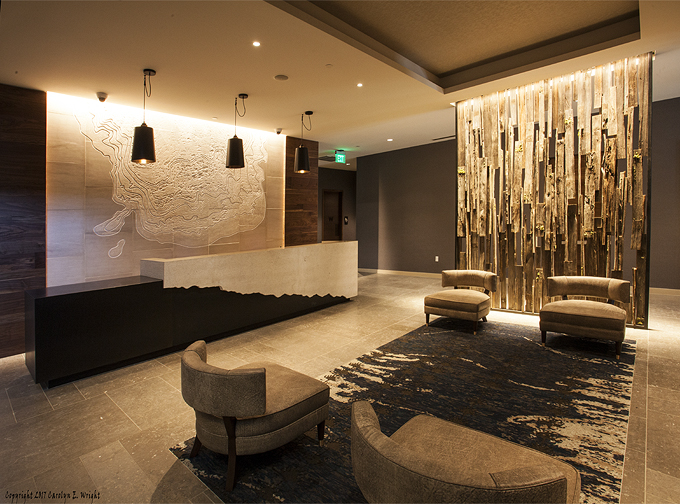
The reception area at Edgewood Lodge is contemporary with a Tahoe flavor. Photo Copyright 2017 Carolyn E. Wright

By Kathryn Reed

STATELINE – Like most backyards, Edgewood Lodge has been designed to be where people will want to hang out.

It’s where the infinity-like pool and hot tub are. Monday the pool furniture was being assembled. On the deck between the pool and lodge are multiple fire pits and an array of seating options. Just beyond the pool is a grassy area that looks like an oversized back lawn. Next comes the beach and the icy waters of Lake Tahoe. These are all terraced, creating a better visual.

While the pool, hot tub and fitness center will only be available to hotel guests, much of the property will be open to the public. That means this backyard can be a playground of sorts for everyone.
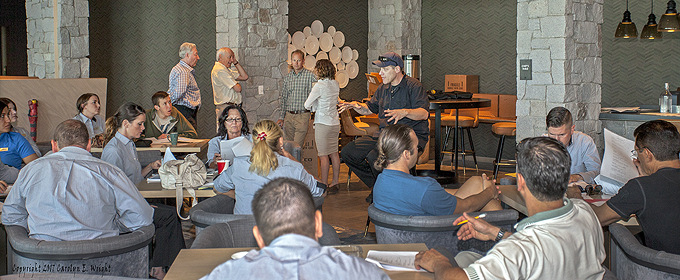
Chef Dave Lofgren preps his staff prior to the June 14 opening. Photo Copyright 2017 Carolyn E. Wright

And if people are inside, the outside is so close.

With what appears to be a wall of windows across the “back porch,” the outdoors is still right there. Mount Tallac is a constant presence.

The Bistro restaurant will spill out onto the outdoor patio with the ability to seat 80. It will serve three meals a day. The kitchen is designed so diners will be able to see their meal being prepared. A chef’s table is off to the side for special events.

With total seating being about 200, this is the largest of the three restaurants at Edgewood. (The other two are in the clubhouse.) Part of the seating includes a large, ornate wooden table that will be for communal dining.

The bar flows right into the restaurant – and outside.

A small café is near the front of the lodge where to-go items may be purchased.
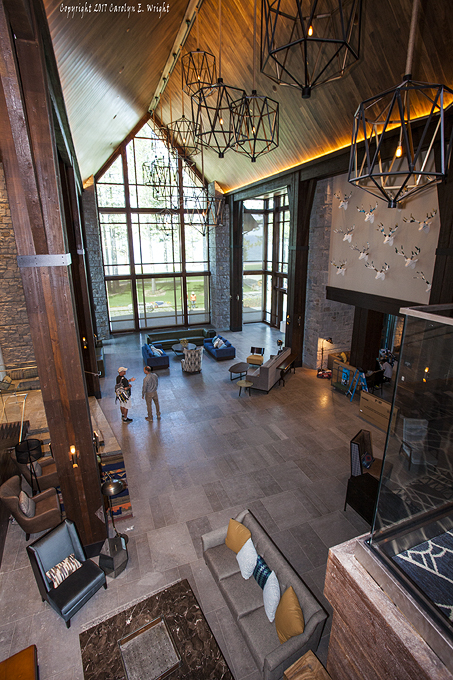
From the second floor looking into the “living room.” Photo Copyright 2017 Carolyn E. Wright

Owners and designers of Edgewood Lodge set out to redefine the tourist experience. Even with contractors and landscapers making last-minute finishing touches before the resort opens June 14, it’s obvious there is nothing else like this in the Lake Tahoe Basin. (Not all of the hotel rooms will be available next week.)

Inside it is intimate, spacious, inviting and warm. The living room, as it’s called, is grand. Styled like a western lodge along the lines of a national park, the grandeur is evident from the moment one sets foot inside. It is destined to be a congregating place to enjoy the view, sit by the fire and decompress. The 42-foot vaulted walnut ceilings add to the majesty.
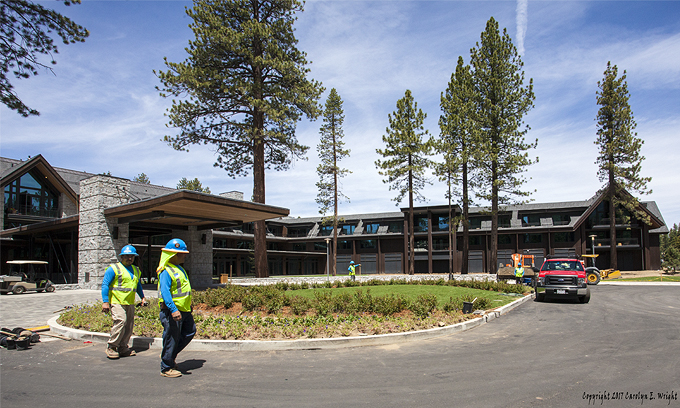
Finishing touches are being made to the front landscaping. Photo Copyright 2017 Carolyn E. Wright

Granite on the walls and elsewhere, along with the stone floor, muted greys and blues, and various uses of wood give the 169,000-square-foot hotel a mountain feel, while still being elegant. The goal was to be relaxed and refined at the same time.

In the living room is a large stone sculpture; each 2-foot by 2-foot section weighing 60 pounds. An artist from the Bay Area carved the piece on site. Another relief out of limestone is at the reception desk. It looks like a topo map of the southern end of Lake Tahoe with the lines going deeper with the depth of the water.

In the same area is a divider, with the wood coming from the property. The moss on it is authentic.
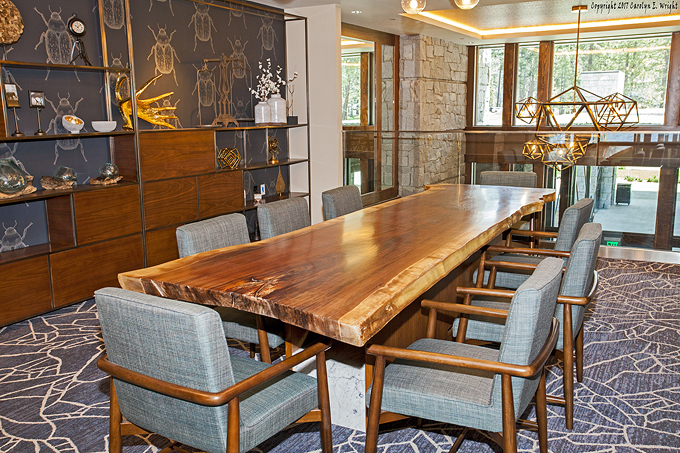
A long table like this one on the second floor will be in the Bistro restaurant for a shared dining experience. Photo Copyright 2017 Carolyn E. Wright

“A number of local contractors did an amazing job on this project,” Patrick Rhamey, executive vice president of Edgewood Companies, told Lake Tahoe News.

While SMC out of Reno was the general contractor on the $100-plus million lodge, Rhamey singled out subs like Jim Eliot who put in the rough timbers made of fir and the exterior wood siding; Bernard Creegan who did the finished carpentry and helped with furniture installation; and Kemper Masonry which mined the rock from Markleeville.

The goal is to attain LEED silver green building designation.

Little artwork adorns the walls in the hotel rooms. The focus instead is on the views out the window. Each king room has the bed oriented to look out the window. A mix of king, double queen and suites fill the top two floors. There is one presidential suite. A standard room, of which there are 127, is about 500-square-feet. Every room has a balcony from which to see the lake, the mountains, the golf course or Round Hill. Sixty-five percent of the hotel rooms have a view of Lake Tahoe.

While there are more than 170 gas fireplaces throughout the structure – one in every hotel room and then some – air conditioning is also important. Edgewood is using lake water to cool the entire building. 
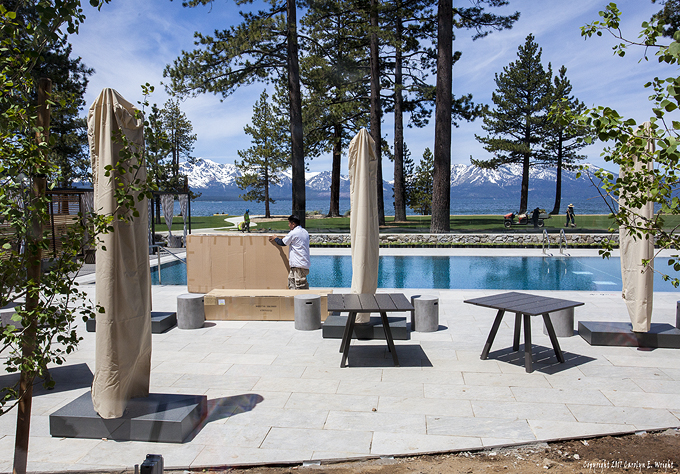
The pool and hot tub are exclusively for hotel guests. Photo Copyright 2017 Carolyn E. Wright

Minden-based Edgewood Companies is operating the 154-hotel instead of having an outside entity run it. It means the need to hire about 200 people to operate the entire facility. Several employees have been promoted from within the company.

Like many businesses in the region, Edgewood has had some difficulty finding workers. Housekeeping in particular has been problematic. Most workers, though, have been hired locally.

Benefits to working for Edgewood include having a meal provided and not having to clock out for breaks.

The only third party entity will be supplying equipment like bikes, skis and kayaks. These will all be available through the on-site adventure center. For those who bring their toys, storage in this area will be available.

Two retail outlets are on the first floor. Photo Copyright 2017 Carolyn E. Wright

On the bottom level of the three-story building are two clothing stores – one more resort wear, the other athletic apparel.

A full service spa with eight treatment rooms is on the second floor. The hair and nail salon is on one side, the massage-facial area on the other. A steam room is in each of the locker rooms. Then there is a shared quiet-relaxation space. A coed outdoor hot tub looks out to the front of the property and beyond to the slopes of Heavenly.

Free valet parking will be available to anyone visiting the lodge. Another 100-space self-parking area is between the clubhouse and north wing of the lodge. Gone is the old parking lot that fronted the lake.

Once parked there will be little need for guests to drive again. Edgewood will have a shuttle to take people various places.

A 3,000-square-foot banquet area can be divided into three sections for events. Doors off the hallway can open to the front of the building to expand the actual usable space. If the need arises, Edgewood can build another 5,000-square-feet on the main level for meetings and the like.

The goal is to be a five-star complex. Rhamey said it’s more important to have five-star reviews on Yelp and TripAdvisor than to worry about what Forbes or AAA say. Guest service is a huge piece in the ratings war.

“Edgewood Lodge is not going to be a stuffy place,” Rhamey said. “We want to provide exceptional service, be engaging, but not be stuffy or snooty.”

Money an issue for temporary SLT control tower

By Kathryn Reed

Safety is the No. 1 reason South Lake Tahoe officials are looking to have a temporary air traffic control tower at Lake Tahoe Airport during the annual celebrity golf tournament.

This is the busiest week of the year for the airport. According to the FAA, in 2014 there were 362 aircraft at the airport for the golf tournament. That’s an average of 52 planes a day. More than 60 percent were larger jet aircraft. 

The cost, though, for controllers is more than the city wants to incur. That is why City Manager Nancy Kerry on June 8 will be asking the Lake Tahoe Visitors Authority board to help defer the costs.

“In the past the costs for providing a temporary air traffic control tower was borne primarily by the FAA because it did not trigger a $10,000 threshold to establish a reimbursable agreement. This year the FAA has relocated its temporary air traffic control tower facility from Reno to Boise, Idaho, and costs to bring the facility here was quoted at $16,000 for the five-day period,” Airport Manager Mark Gibbs explained. “This is above the $10,000 trigger requiring the city to pay for the costs associated with the tower per FAA policy.”

Per the FAA’s suggestion the city looked into having a private air traffic control firm do the job for the July 11-16 event. Tower Tech Inc., which provided air traffic control services here during the 2007 Angora Fire, would cost $13,500. That fee covers equipment, personnel and insurance.

These people have the same certifications as controllers who work for the FAA. Three people would work from 8am-5pm each day.

The tower would be on a trailer behind a truck, and would be on the airport ramp near the terminal.

“When you have no air traffic controller managing the airport terminal airspace, aircraft radio traffic becomes congested. Without a ‘moderator’, pilots will try to talk over one another making for a confusing situation for all,” Gibbs told Lake Tahoe News. “Radio messages could be missed and pilots rely on one another to report where they are at all times. If the radio traffic becomes too congested to report properly, a dangerous situation results as pilots try to keep situational awareness of all other air traffic in the vicinity and fly the airplane.”

A bonus to having the controllers is they can “ensure aircraft use the noise abatement flight path into/out from the airport.” This means there should be fewer planes circling over neighborhoods.

According to Gibbs, it was complaints about safety by Caesars Entertainment and Edgewood Tahoe in 2013 that led the city to contract with the FAA. However, not every year has there been a temporary tower.

Harrah’s Lake Tahoe, whose parent company is Caesars, is the host hotel. Edgewood leases the golf course to NBC/American Century – owners of the American Century Championship tournament. Edgewood told Lake Tahoe News it would not contribute to the tower.

To date for this year, Mountain West Aviation, Tahoe Beach Retreat, Lakeside Inn and Caesars Entertainment have agreed to help underwrite the temporary tower.

Phil Weidinger, who handles publicity for the tournament, never got back to Lake Tahoe News in regards to whether NBC and/or American Century would step up to cover the costs since they are the ones making the bulk of the money on the tournament.

Most of the people in those planes are players.


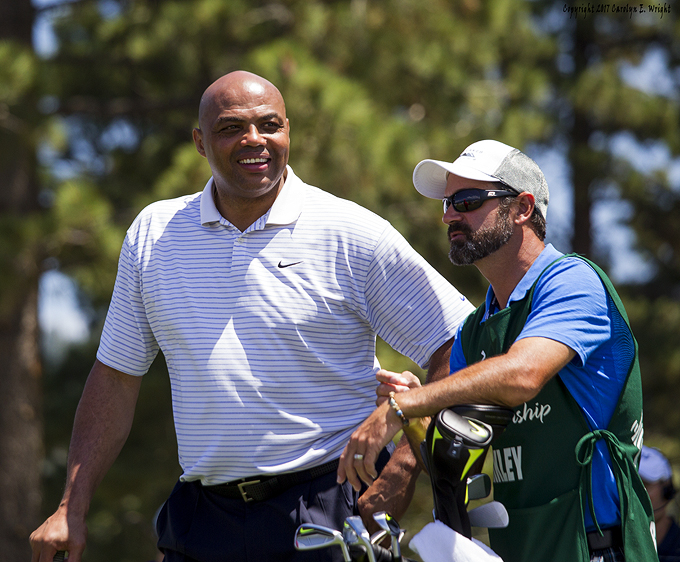
Still not a golfer, Barkley relishes time at Tahoe

Charles Barkley is a fan favorite at the annual celebrity golf tournament in Tahoe. Photo Copyright 2017 Carolyn E. Wright

By Jim Krajewski, Reno Gazette-Journal

Charkles Barkley is not much of a golfer, and he readily admits that.

He relishes it actually and is not afraid to poke fun of himself.

Barkley remains one of the more popular celebrities each summer at the American Century Championship celebrity golf tournament at Edgewood Tahoe.

Barkley has become the event’s unofficial spokesman.

Read the whole story


Lake Tahoe Airport solidifies its future

In the future planes will get fuel at a self-serve station at Lake Tahoe Airport. Photo/Kathryn

By Kathryn Reed

The tower will be demolished, electric vehicle charging stations installed, commercial hangars built, and pavement removed from Lake Tahoe Airport.

These are all included in the master plan for the South Lake Tahoe facility. This is a designed to be a 20-year blueprint.

The final component of the plan was approved by the City Council on June 6. The electeds unanimously OK’d the mitigated negative declaration. No written comments were submitted regarding the document.

Environmental Science Associates prepared the initial study. It identified biological resources, cultural resources, hazards and hazardous materials, and noise as items that would need to be mitigated.

One hazardous item on the 348 acres that will be removed is the tower. Since the facility was abandoned by the FAA in 2004 water has seeped in. The end result is toxic mold.

“It’s not suitable for human habitation,” Mark Gibbs, airport director, told the council Tuesday.

An 80-foot communications tower will be built before the control tower is deconstructed.

It is up to the FAA to dismantle the old tower because that agency owns it. That could occur this year.

Nothing in the master plan expands the airport, but that doesn’t mean there won’t be improvements.

A self-serve gas station will be installed. This will eliminate the need for trucks to transport the fuel to each aircraft. The projected date for this is in 2027.

A partial list of future improvements includes reconstructing the aircraft parking apron, drainage ditch improvements, relocating taxiway H, removing excess pavement, getting rid of the bypass taxiway, installing a new automated weather observation station, improving the fixed base operations facility, and building a commercial hangar.

The Federal Aviation Administration pays for the bulk of improvements at this airport.

Another piece of the master plan is the release of 45 acres on the western edge of the airport for future non-aeronautical use. A couple years ago this undeveloped land had been talked about being converted into an outdoor concert venue. Since then it has been determined to be an inadequate site.


Inland bridges too low to cope with climate change

By Scott McFetridge, AP

DES MOINES, Iowa — A century-old train trestle stands as one of the trophies of Des Moines’ push to spruce up its downtown. Bicyclists and pedestrians pose for pictures beside the brightly painted beams of the Red Bridge and gather on viewing platforms overlooking the Des Moines River.

But little more than a decade after it was restored, crews went back to the site with a crane to hoist the span 4½ feet higher, at a cost of $3 million, after experts concluded that the river’s flooding risk was nearly double earlier estimates. Climate change was likely to blame.

Climate change is often seen as posing the greatest risk to coastal areas. But the nation’s inland cities face perils of their own, including more intense storms and more frequent flooding. Even as President  Trump has announced his intention for the U.S. to withdraw from a global climate agreement, many of the nation’s river communities are responding to climate change by raising or replacing bridges that suddenly seem too low to stay safely above water.

In Reno, officials spent about $18 million to replace a bridge over the Truckee River last year and plan to replace three more after flood-danger projections were increased by up to 15 percent.

Read the whole story


Nevada Legislature wraps up ‘great session’

By Sandra Chereb, Las Vegas Review-Journal

CARSON CITY — Nevada lawmakers gave final legislative approval Monday to a package of bills that resolved a stalemate over the budget and signaled the 2017 Legislature would end without chaos by midnight.

The Assembly’s approval of three key bills needed to bring the session to a close came swiftly and without discussion Monday afternoon, about 12 hours after they were voted upon in the Senate.

Republicans and Democrats came to terms to pass Senate Bill 546, a key budget bill that was held hostage over a Republican push for education savings accounts — a voucher-like program pushed by the GOP and opposed by the Democratic majority.

Read the whole story


TRPA going after owners of illegal fences in water

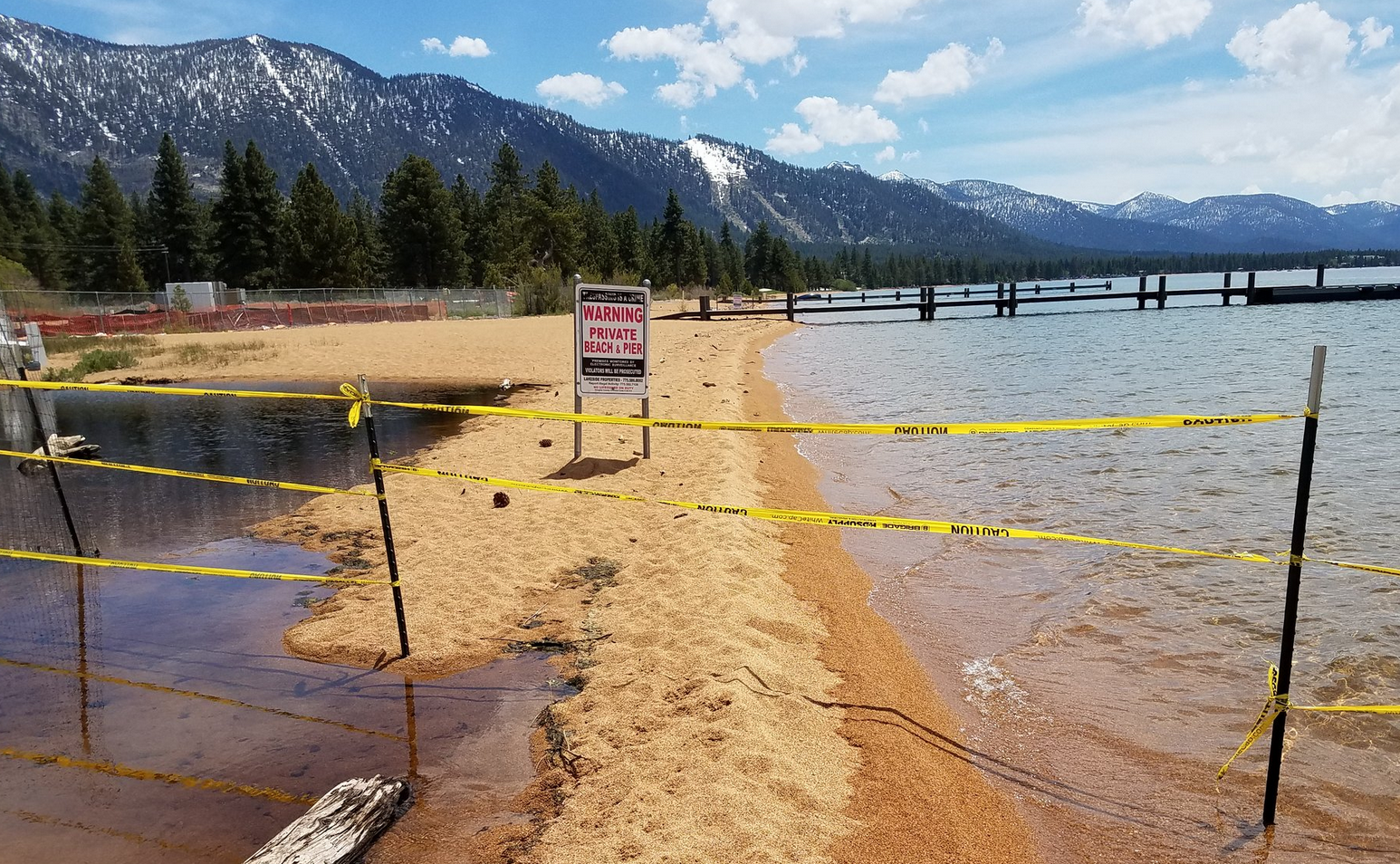
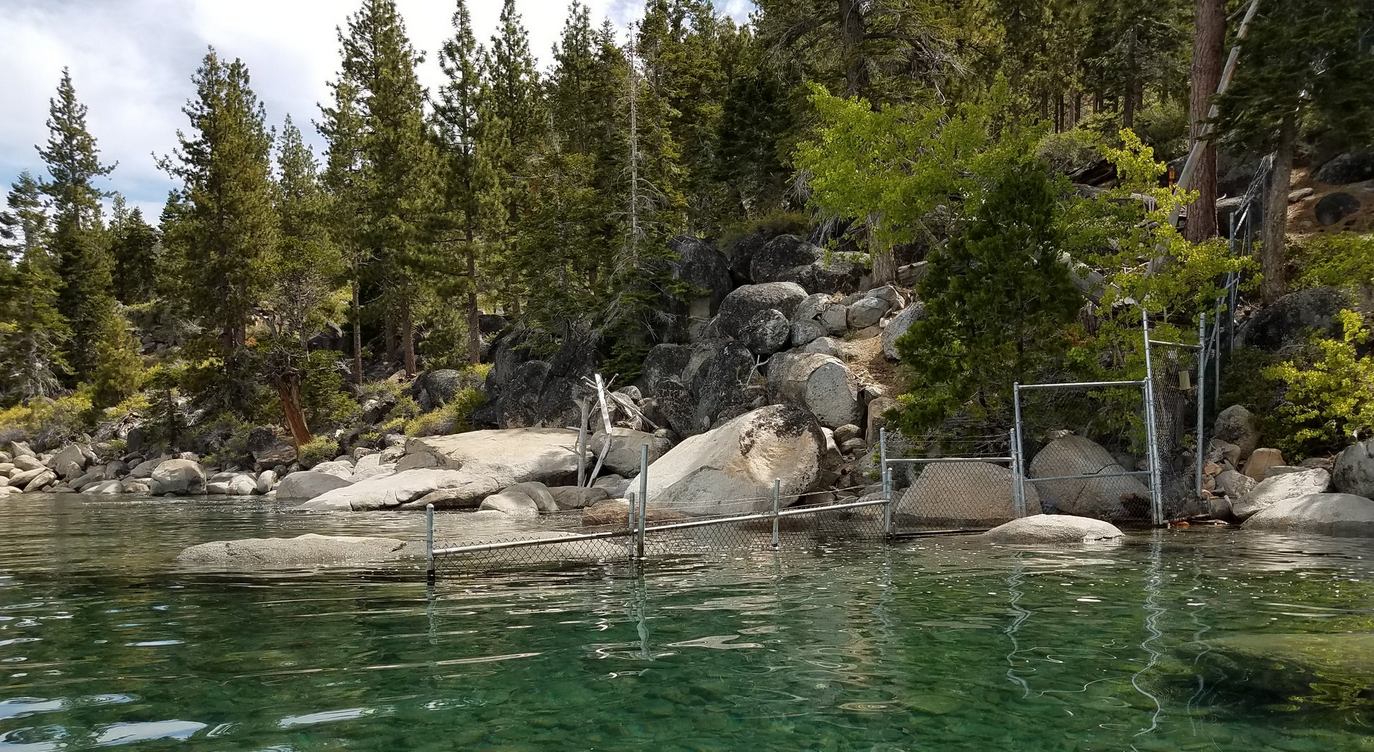
The high-end Tahoe Beach Club development in Stateline has an illegal fence. Photo/Anthony Spatucci

By Kathryn Reed

Illegal fences going into Lake Tahoe have caught the attention of the Tahoe Regional Planning Agency.

Property owners must get a permit from the bi-state regulatory agency before construction. This was not done.

A TRPA inspector was at the Tahoe Beach Club on June 2 to talk to the Stateline property owner.

“The fencing is not allowed, but if you look you will see some sort of metal material buried in the sand in the water on the other side,” Tom Lotshaw, spokesman for TRPA, told Lake Tahoe News. “The TRPA inspector asked the property owner to come up with a timely plan to remove that buried metal material and to remove the temporary fencing, but allowed them to leave the temporary fencing in place for now since the buried material on the other side could be a safety risk.”

Just north of Cave Rock a chain link fence is extending into the lake. It starts from the land, with several sections extending into the water. It looks like it could have been out of the water during the drought. Now it just looks like trash.

A chain link fence has become a water hazard near Cave Rock. Photo/Anthony Spatucci

TRPA on June 5 contacted that property owner. According to Lotshaw, the landowner intends to let TRPA know this week how he plans to remove the fence. 

California and Nevada have different rules regarding the public’s access to the shore. This is why there tend to be more fences on the Nevada side to keep people out.

California owns a public trust easement that allows access for the public year-round between the high water mark (6,229 feet) to low water mark and below. In a drought, this can be a large swath of land, aka beach.

Such an easement does not exist in Nevada. This means it would be trespassing to walk along private property or to dock a boat there.

While it may be private property, owners still must abide by the law when it comes to putting up fences at the lake.


Gaming stocks outperforming tech in 2017

By Todd Prince, Las Vegas Review-Journal
 
Wall Street is placing its chips on Las Vegas.

Gaming industry stocks such as Wynn Resorts and MGM Resorts International have been on a roll this year amid solid revenue growth at home and on Macau. And the Raiders move to Las Vegas has helped draw investor attention to the city.

The Dow Jones U.S. Gaming Index is up 22.2 percent this year through Friday — triple the rise of the Dow Jones Industrial Average and surpassing the 21.5 percent gain for the Dow’s red-hot technology index.

Read the whole story


Battle brewing over national monuments

By Gary Martin, Las Vegas Review-Journal

WASHINGTON — A battle is brewing among activists across the political spectrum over a Trump administration review of recently established national monuments, including Gold Butte in Nevada, and a 1906 law that permits presidential protection of public lands.

In the most recent salvo, 71 environmental and natural resource lawyers sent a letter to the administration saying a White House executive order that authorized the review incorrectly implied that President Trump has the authority to rescind or modify national monuments created by previous presidents.

It does not, the lawyers insisted: “Congress retained that power for itself.”

Read the whole story


New Upper Truckee River channel being tested

By Kathryn Reed

With the Upper Truckee River being about two weeks out from reaching its peak flow and the river well beyond its banks, it is too soon to completely assess what worked and what didn’t in regards to the new channel near Lake Tahoe Airport.

It will likely be mid-July before officials are able to access all areas, with work not being able to start until mid-August.

The river hit 979 cubic feet per second on June 4. The channel was designed to handle 375 cfs. The winter storms and subsequent runoff are equivalent to a 10-year storm – as in, this amount of water will occur once every 10 years.

“For the most part the project has been a success. Part of the goal was to increase floodplain inundation and frequency,” Theresa Cody, restoration hydrologist with the U.S. Forest Service, told Lake Tahoe News. “The project was meant to overbank, to do so about every year or two.”

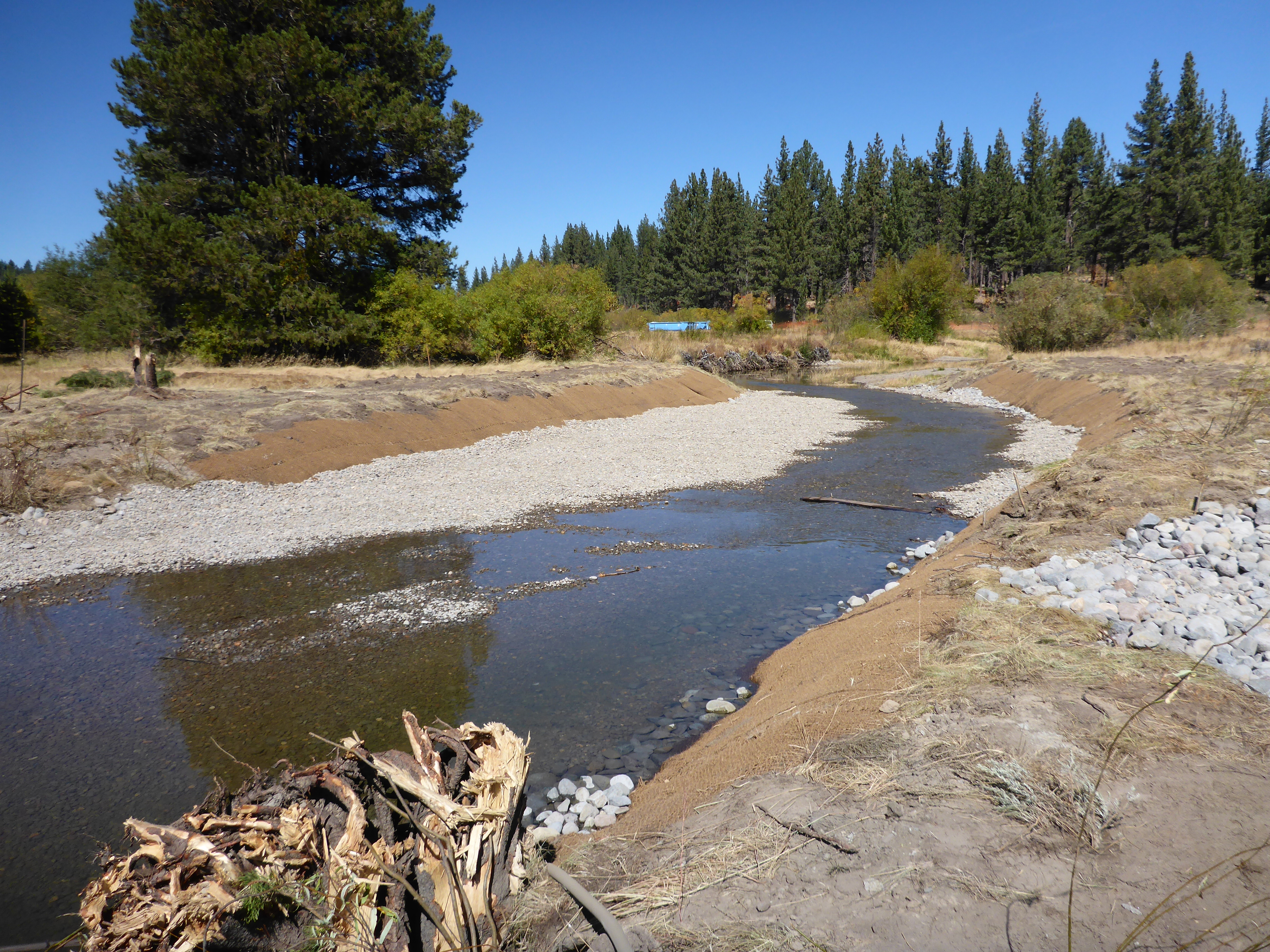
This is a view of the northern tie-in of the new channel of the Upper Truckee River in August 2016 after construction was completed. Photo/USFS

In a perfect situation, restoration work like what the U.S. Forest Service did would have a couple years to settle in and for vegetation to grow to stabilize the bank before being tested by massive water flows.

Mother Nature, though, doesn’t always cooperate.

Lahontan Regional Water Quality Control Board is the main overseer of the project because this state agency is tasked with maintaining water quality for the public.

“The storm water runoff really changed things out there, but we don’t have a good handle on what changed,” Doug Smith, supervising engineering geologist with the Lahontan Water Quality Control Board, said. “We don’t know the full extent (of damage) because it is flooded. I’ve sent them a couple letters saying that things didn’t go as planned and to get them to work on some plans. Last (month) I sent a lengthy technical comment letter on the interim plan. It was just a comment letter, not a fine or citation.”

With the water everywhere, even looking like it might reach the runways at Lake Tahoe Airport, in some ways it appears like the project failed. Just the opposite is true; the bank breaching is a good thing and is what would occur if humans never messed with the river.

To reach the runways the river would have to rise at least another foot; this would likely happen in a 50-year storm.

This is what the new channel of the Upper Truckee River looks like now from nearly the same spot as the above photo. Photo/USFS

The purpose of the project was to restore the river channel to what it was like before it had been straightened in places decades ago and meadows degraded by years of grazing.

Two-thirds of the work is on USFS land, while one-third is owned by the California Tahoe Conservancy.

The banks were eroding, carrying unwanted sediment to Lake Tahoe. The steepness of the banks was not allowing the river’s water to overflow into the meadows. This then affected plant and animal life.

Last summer the last 1,000 feet of the 7,340-foot channel was built. What is known is that between 50 and 100 feet of bank in that section has eroded. Rock armoring will be put there this construction season to stabilize the area. In some spots the vegetation did not survive, so that will be replanted as well.

This summer the Forest Service plans to do more monitoring than originally planned. Geomorphic, wildlife and geological assessments will be done. Seeing how the mussel relocation worked will also be analyzed. Aerial images will be taken to get a different perspective.

The multi-year project was supposed to be completed last fall, but October storms prevented that from happening. The upstream portion of the former channel did not get completely filled in.

“We underestimated the amount of dirt we would need to backfill the full former channel. The largest lesson learned is we should have included a larger contingency to make sure we had enough dirt. At the end of the season we ran short on backfill material,” Cody said.

This means there is water collecting in the back channel.

“The bottom line is they were not able to finish as planned,” Smith told Lake Tahoe News. “We need to see if the original permitted design or a different design needs to be implemented out there. That will be determined down the road. The Forest Service and us agreed the restoration project on the Upper Truckee River is very important and it needs to be done for the long haul and it needs to be done right.”

The price tag was $7 million for this project. That was before the winter storms. Most of the money came from the Southern Nevada Public Lands Management Act.