Heavenly’s leader leaves permanent tracks

By Kathryn Reed

STATELINE – Heavenly Mountain Resort is nothing like it was seven years ago when Pete Sonntag came to town. And that’s a good thing.

“I did come in knowing there were challenges,” Sonntag told Lake Tahoe News in 2010.

As he packs his bags to head north to take over the management of Whistler Blackcomb, Sonntag will leave behind a different mountain than what he inherited.

The local resort is a bigger player in the community. In part this has to do with Sonntag and his family living here and not off the hill like his predecessor. His kids (they were 6, 8 and 10 when he and his wife moved here from Vail) helped get the family enmeshed into the fabric of the South Shore.

The community mattered to him and soon it mattered to his employer. He is on the boards of the Tahoe Fund and Lake Tahoe Visitors Authority. Through his children he has been incredibly active in the hockey community.

Charitable contributions are now common from Vail Resorts; employees give back with time and money, as well.

Pete Sonntag is leaving Tahoe this summer to run Whistler ski resort. Photo/Kathryn Reed

On the mountain, well more than $100 million has been invested during Sonntag’s tenure. Summer activities keep growing; something that didn’t exist when he started. Though, they pale in comparison to what Whistler has to offer – that will be a substantive change to get used to.

Sonntag has literally weathered multiple years of drought and record snowfall. This will be good experience because Whistler can have its challenges with snow and weather in general.

When Sonntag came to Tahoe, Heavenly was still struggling in the guest services arena. Not so much anymore.

It’s not that he really wanted to leave Tahoe; it’s just that a unique opportunity presented itself. Dave Brownlie, after 30 years as chief operating officer at Whistler, gave notice. Three weeks later Vail Resorts announced Sonntag’s ascension to run North America’s largest ski resort, at 8,171 acres, with 16 bowls, three glaciers and an Olympic history.

The Broomfield, Colo.-based ski behemoth bought the Canadian resort in 2016 for $1.1 billion. (This will be the first season the epic pass will be valid at the Vancouver mountain.)

Sonntag actually oversees Northstar and Kirkwood resorts, too. He had the title of senior vice president of the Tahoe region. Mike Goar, current vice president and chief operating officer of Keystone Resort in Colorado, will be replacing Sonntag.

The three Tahoe area mountains combined are about the size of Whistler.

“It’s arguably one of the greatest ski resorts in the world,” Sonntag said of his new mountain. And he considers it the flagship of the parent company. He calls this opportunity “a once in a lifetime chance.”

Taking over a resort that hasn’t had a top leadership change in three decades is a bit daunting. Sonntag has been up there meeting the team, getting familiarized with the operation. He doesn’t plan to make major changes at the get-go because he said, “Nothing is broken that needs to be fixed.”

He knows it will take time to build trust and respect.

Sonntag built a strong team in Tahoe. That is why what he will miss most is the people, along with those vistas.

“I will miss being on top of the mountain and the views – that never gets old,” Sonntag said. “This has been the best seven years of my career. I’m lucky to have spent it in Tahoe.”


How extreme heat could spread across the world

By Brad Plumer and Nadja Popovich, New York Times

Extremely hot days, when temperatures soar to 95 degrees Fahrenheit or higher, can be miserable. Crops wilt in the fields. Electric grids strain to keep pace with demand. People are at greater risk of dying. And those hot temperatures are expected to be much more frequent in the coming decades.

Based on analysis from the Climate Impact Lab, 95-degree days are expected to multiply this century if countries take moderate climate action. In this scenario, countries would take some measures, but not drastic ones, to curb emissions — roughly the trajectory of the current pledges under the Paris climate agreement.

The resulting global warming would still cause significant shifts for many cities. In Washington, from 1986 to 2005, an average of seven days each year had temperatures of at least 95 degrees. By the end of the century, the city can expect 29 of these extremely hot days per year, on average. (The likely range is 14 to 46 hot days per year.)

Read the whole story


Calif. bill would impose storm water fees

By Daniel Potter, Capital Public Radio
 
A bill in the California state Assembly could make it easier for local governments to charge fees to manage and collect storm water, but critics argue it’s a way to get money from property owners without a vote.

Really, it all comes down to how you define the word “sewer.”

Cities and counties in California can’t charge new fees for property without voter approval. Water and sewer services are exempt.

Read the whole story


Paul Simon takes audience on nostalgic journey

By Susan Wood

STATELINE – You could almost hear a pin drop when singer Paul Simon launched “Sound of Silence,” one of the musician-songwriter’s most beloved songs and one of a handful of encores he performed Sunday night for a receptive crowd at Harveys Lake Tahoe to lead off the Outdoor Summer Concert Series.

Simon, who played beyond 10:30pm, provided a music anthology ranging from the tunes of the 1960s with his singing partner Art Garfunkel to a storied solo career in which he reinvented himself in the following decades through African beats and varying culture immersions such as meeting a medicine man in the Amazon of Brazil.

Paul Simon kicks off the 2017 Harveys Outdoor Concert Series on June 25 with a sold-out show. Photo/Julie Campbell

But it was Lake Tahoe with its people and natural setting that embraced the artist June 25.

“There couldn’t be more of a beautiful setting,” said Simon, who came out on stage clad with an understated “Aloha” T-shirt and jeans, along with a hat mostly hanging on the microphone stand that was marked with the letter “e.” The letter is the logo standing for the Half-Earth project as highlighted in Edward Wilson’s eco-conscious book of how to save the planet.

“That book had a profound effect on me,” he told the crowd. So much so that Simon said he pledged all the proceeds from his tour to Wilson’s efforts.

Simon hinted at subtle social activism at various times, including the time he relieved his nine-member band of accomplished percussion, keyboard, bass, string and brass musicians to grab his acoustic guitar for “Sound of Silence.”

“Before I play this song, I’d like to leave you with one thought: ‘Anger is addictive, and we have all become a nation of addicts’,” he said, beckoning the audience to when they hear something to: “Ask yourself: who’s making a profit from this?”

While in agreement with the argument, the audience looked stunned during the 1966 No. 1 blockbuster tune that stayed on Billboard’s top 100 for 143 weeks. It seemed to complement the message.

The singer’s mood appeared to fluctuate – enjoying the rocking out and dancing during the whimsical numbers “You Can Call Me Al” and “50 Ways to Leave Your Lover” as well as the perfectly harmonious “Diamonds on the Souls of Her Shoes” and melodic “Graceland” off the so-named album.

Then, in a change in pace that can turn on a dime, he seemed visibly moved by the crowd reaction to the sentimental, open-road ballads. “The Boxer” off the 1969 “Bridge Over Troubled Water” album and “America” from the 1968 “Bookends” ensemble defined a generation of seekers in the late ’60s.

Paul Simon dazzles an appreciative Tahoe crowd. Photo/Julie Campbell

Anyone listening to “America” could have imagined being young and “hopping a Greyhound” to anywhere in search of a utopian nation filled with characters as referenced with “be careful his bow tie is really a camera.” The poetry of the song is what makes the artistry of music so important to generations of citizens.

Thanks to the artists like Simon, we have a creative chronicle of our soul.

Take from the self-titled album the 1972 lead single “Mother and Child Reunion,” which had members of the crowd bobbing up and down. The lyrics were played with equal treatment to the upbeat melody.

And while Simon doesn’t move a lot on stage aside from heavy string-strumming at times, he brings out the songs that perpetuate movement in the audience. It’s almost as if he proves he’s “Still Crazy After All These Years,” as his 1975 number dictates.

“I like it when you dance,” he reminded the audience.

What he doesn’t respond to is the crowd calling out songs as the Tahoe crowd yelled a number of them.

“I don’t do requests,” he said, half kidding.

But he does give the audience what it came to hear, as cited by Bill Pincus of Phoenix.

Pincus told Lake Tahoe News he hoped to hear “Me and Julio Down by the Schoolyard” – the jumpy 1972 hit spawned from a Time magazine article about alleged radical priests.

“I got what I wanted,” the Arizona man said later.

This wasn’t bad for a last minute event for him and his companion Lorah Neville. The couple drove up from Sacramento. Pincus recalled making a music request to her that he wanted to hear “anything Simon and Garfunkel” without knowing Simon was making a rare appearance where they were vacationing at Lake Tahoe.

“What are the chances of that?” Pincus posed the question.

The Harveys Summer Outdoor Concert Series continues June 30 with Rebelution; July 2 with Sammy Hagar; July 9 with Train joined by Natasha Bedingfield and OAR; July 14 with Lenny Kravitz; July 16 with Third Eye Blind; July 28 and 29 with Jack Johnson; Aug. 4 with Slightly Stoopid; Aug. 16 with The Who; Sept. 1 with Linkin Park; and Sept. 2 and 3 with Eric Church.


Calif. gun owners may be breaking law on July 1

By Ryan Sabalow, Sacramento Bee
 
Sweeping new gun laws passed last year by California voters and legislators require those with magazines capable of holding more than 10 rounds of ammunition to get rid of them by July 1.

The question is: how many of California’s 6 million-plus gun owners are actually going to comply, even though violators face potential jail time if they’re caught?

Talk to gun owners, retailers and pro-gun sheriffs across California and you’ll get something akin to an eye roll when they’re asked if gun owners are going to voluntarily part with their property because Democratic politicians and voters who favor gun control outnumber them and changed the law.

Read the whole story


Backcountry skiing in Nev. far from Tahoe

By Benjamin Spillman, Reno Gazette-Journal

Both physically and spiritually, Wheeler Peak is about as far as you can get from a Tahoe ski resort without leaving Nevada.

The 13,065-foot peak near the border with Utah towers over a bro-free desert landscape of cattle ranches, windmills and wildlife.

It’s what makes Wheeler a practically perfect destination for people looking for an authentic Nevada ski experience without frills.

Read the whole story


Truckee airport services grow with demand

By Carole Jablon-Bernardi

TRUCKEE – Truckee Tahoe Airport District doesn’t fall short when living up to its slogan, “Connected by more than a runway.”

Between 2012-16, there was a steady uptick in the economy and the airport authority noticed demand became greater. In 2016 the airport had 32,524 flight operations (landings and take offs) which was an increase of 5,000 operations from the previous year. This equates to an average of 89 operations per day, with heaviest aircraft traffic over holiday weekends and heavy tourist periods.

In order to manage this increase, the airport is building 10 “new” executive box hangars to accommodate larger twin engine planes with bigger wing spans. The hangars can’t get built fast enough as there is an 11-year wait list of approximately 27 people. Presently, there are 220 hangars.

Building more hangars isn’t the only solution to meeting a greater demand. The airport’s board realized its first priority was enhancing aviation safety.

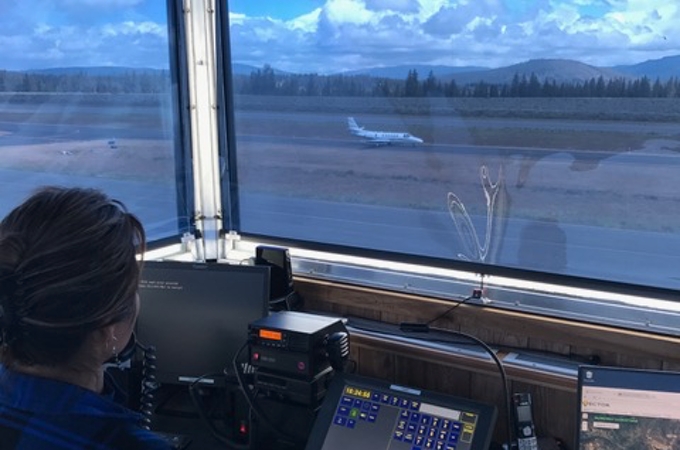
Air traffic controllers work at the Truckee airport during the summer months. Photo/Carole Bernardi

Marc Lamb, aviation and community services manager at the airport, is prideful when describing the reasoning behind Truckee’s first temporary tower.

“The primary purpose of the new temporary seasonal tower, which started operations June 1, is to enhance aviation safety and to reduce neighborhood overhead flight annoyance. The pilot community feedback that we’ve been getting to date has been overwhelmingly in favor of the tower at KTRK,” Lamb said.

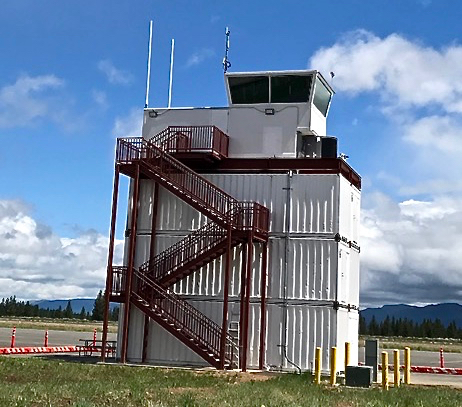
Why a seasonal tower? It’s based purely on volume. After setting things in motion back in 2014 with plans and FAA permit approval, KTRK – the call letters for the airport – started working with Midwest ATC based in Kansas. Midwest ATC moved ahead with building a pre-fabricated, modular, custom built military cab which is frequently used for temporary airport tower setups in extreme locations. The interior occupies radio transmission, recorder, automated weather observing systems, airfield light control, navigational monitoring, airfield surveillance and approach radar, and a complete suite of air traffic controller equipment. It was hoisted onto six shipping containers. A metal stairway leads up to the entrance.

“The idea of using shipping containers to form the main body of the tower, which would house the tower cab was well researched and fulfilled with Midwest ATC. We were assured the structure would meet all stringent building permit code requirements and that it could be erected relatively quickly and fit into our budget constraints,” Lamb told Lake Tahoe News.

The Truckee airport traffic control tower looks like stacked cargo trailers. Photo/Carole Bernardi

The tower is owned outright by the airport. It will be operational from June 1-Sept. 15. The structure will remain standing year round.

Midwest ATC staffs the tower with a floating reservoir of certified FAA air traffic controllers. Staffed with never less than two controllers (one air, one ground), from 7am-9pm; the maximum staff moves up to six controllers during peak hours.

There is a voluntary, but strongly requested flying curfew between 10pm and 7am as part of the airport’s good neighbor policy. When the tower ceases to operate come September, it will not be dismantled. The cost of the structure was $500,000, which included the hiring of FAA controllers. Because the tower is already assembled, the cost to operate next year will be at least half this amount.

In October, staff will report to the airport board and present the metrics based on the success and/or failure of the tower’s presence. They will be looking for fewer incursions (range of error) and reduction in noise and annoyance complaints.

Before the temporary tower was built, flight operations were run out of the universal communication viewing bay in the main airport building. Through radio frequency all air traffic control took place. Besides small aircraft flight the airport also deals with the glider operations, sky diving and flight instruction school on the property.

The airport serves 35,000 full-time residents and 60,000 peak period visitors, covers 1,200 acres at an elevation of 5,900 feet above sea level in the Martis Valley region (7 miles north of Lake Tahoe), straddling the Nevada and Placer county lines.

Classified as a general aviation airport (no TSA), it services charter and private aircraft only (less than 30 seats) and no commercial flights. The popularity of member airline travel companies such as Net Jet, Wheels Up, Red Stripe and Surf Air (Surf Air has a reception space in the airport lobby) have shown enormous growth reflecting the demand.

—–

Note:

·      The Truckee Tahoe Airport invites the community to come learn about the new temporary tower every Friday from 4-5pm through June. These Q&A opportunities will take place in the administration building.


Many in U.S. can’t afford a summer vacation

By Beth J. Harpaz and Emity Swanson, AP

Forget frequent flier miles, last-minute getaways and even road trips. Nearly half of Americans say they won’t be taking a vacation this summer, mostly because they can’t afford it, according to a poll by the Associated Press-NORC Center for Public Affairs Research.

The new AP-NORC survey, conducted in May, said 43 percent of Americans won’t be taking a summer vacation. The top reason for skipping a trip was the cost, cited by 49 percent of non-vacationers. Another 11 percent said they can’t take the time off from work, while 3 percent said they don’t like to be away from work.

About half of Americans living in households making less than $50,000 a year don’t plan to take any summer vacation this year, and they’re especially likely to cite costs as a reason.

Read the whole story


Slowdown in travel industry could be worse

By Micah Madenberg, New York Times

The travel industry is voicing a common refrain: President Trump’s travel ban, terror attacks in Europe and a laptop ban represent a recipe for a potential sharp decline in visitors to and from the United States.

“When you hear words like ‘travel ban,’ it puts a big chill” on travel and tourism, James J. Murren, chairman and chief executive of MGM Resorts, said at an industry conference in New York.

Some data is backing up those concerns. Nearly 20 percent fewer people are visiting this summer from the Middle East, the focus of Trump’s travel ban, even though the policy has been blocked by American courts. As of early June, overall advance airline bookings to the United States were down 3.4 percent for this year’s summer travel season compared with the same time last year, according to ForwardKeys, a Spanish company that tracks air travel.

Read the whole story


Heat wave adds 12B gallons to Lake Tahoe

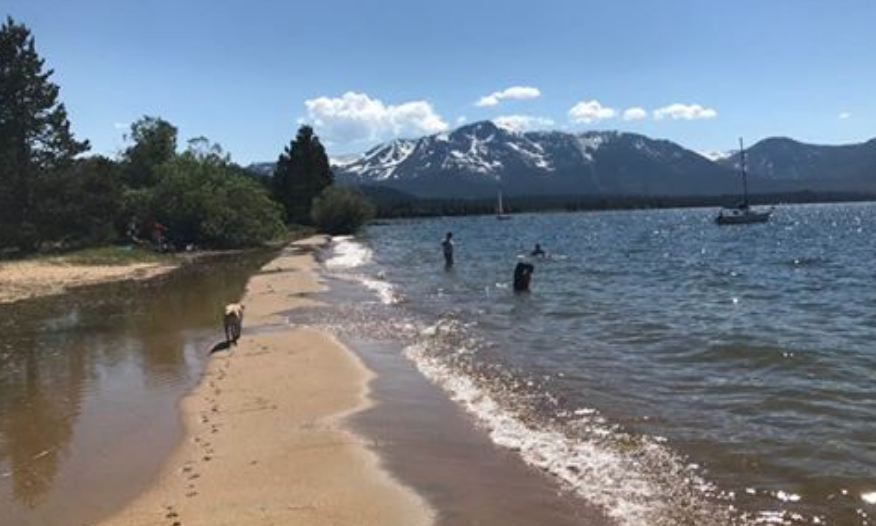
Beaches are hard to find with all the water in Lake Tahoe. Photo/Kathryn Reed

By Amy Graff, San Francisco Chronicle

The process of the Sierra Nevada spring snow melt sped up last week as a heat wave brought triple-digit temperatures to parts of the Western United States.

More than 12 billion gallons of water poured into Lake Tahoe over the past week. That staggering amount of water resulted in the lake level rising 4 inches since June 16.

With all this water, the lake is now only three inches from filling — and will likely reach full capacity in mid-July.

Read the whole story