Women say McClintock’s office threatened them

By Anita Chabria, Sacramento Bee
 
Alisa Holleron and her group of political activists were calling Rep. Tom McClintock’s offices every day for months when they started receiving what she describes as a “chilling” greeting from his staff a few weeks ago.

“They started saying that we were impeding … the functioning of a federal office and that we were in violation of a federal law,” said Holleron. “I felt like it was threatening. I felt like they were telling me I was breaking a law and if you break a law you can get in trouble.”

Annie Mascorro, another caller and a McClintock constituent, said she had a similar experience when she dialed in and spoke with a female intern.

The Garden Valley-based Republican represents Truckee and the California side of Lake Tahoe.

Read the whole story


LTCC graduation — the ultimate Coyote howl

LTCC class of 2017 graduates throw their mortar boards in celebration June 30. Photo/Kathryn Reed

By Kathryn Reed

While graduations are a time to celebrate accomplishments, they are also the demarcation of new beginnings.

And so today begins a new chapter in the lives of 151 students who on June 30 said farewell to Lake Tahoe Community College.

“Take a piece of Tahoe love and spread it across the planet and the planet will be better for it,” Lake Tahoe Community College President Jeff DeFranco told the graduates Friday night.

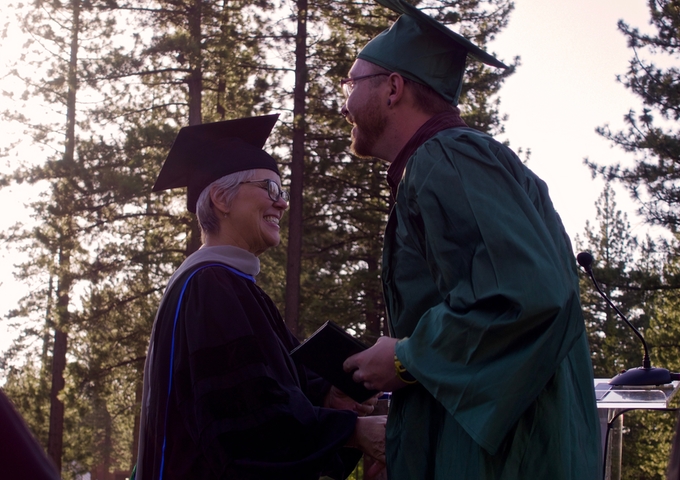
Steve Leer says, “I’m very excited about this moment” as LTCC board President Karen Borges hands him his diploma. Photo/Kathryn Reed

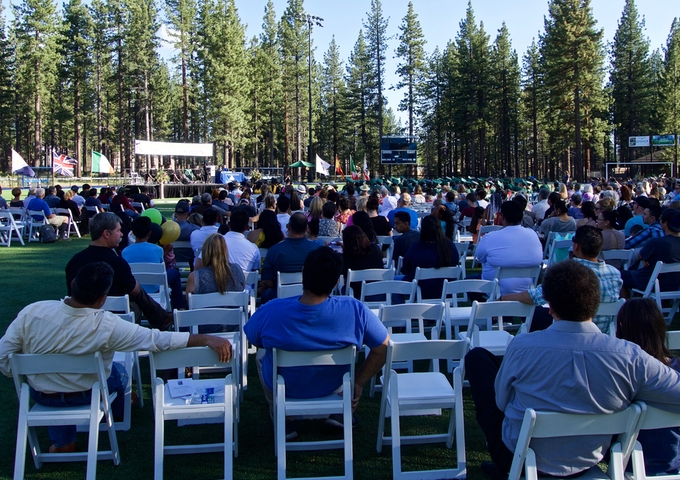
Sitting on the soccer field under a setting sun, it was mostly a time to look forward – not back; to think about the future, of pursuing dreams, tackling challenges and being true to themselves.

Family and friends show support with cameras and signs. Photo/Kathryn Reed

“Passion plus purpose equals success,” DeFranco said.

Keynote speaker Jamie Anderson spoke of how it can be difficult to be your best when there is so much chaos going on.

Jamie Anderson, center, enters the stadium flanked by Vice President of Academic Affairs Michelle Risdon and President Jeff DeFranco. Photo/Kathryn Reed

“Don’t be afraid of outside judgment,” the snowboarding Olympic gold medalist said.

Anderson grew up with her eight siblings in Meyers and is still very much part of the community. Her younger sister, Summer, was among the graduates.

Maura Jones and son Ryder accomplished a lot together. Photo/Kathryn Reed

Mark Williams, faculty senate president and music instructor, said he had struggled to find anything new to say that hadn’t been said at some other graduation. So, he broke into song – and at the end it was the students who gave him a standing ovation.

A few hundred people listen to the graduation speakers June 30. Photo/Kathryn Reed

Ten of those receiving associate of arts degrees had a 4.0 gpa. Twenty-six had grade point averages between 3.65 and 3.99. Seventy-eight of these AA degree earners also received a transfer degree, which guarantees them entry as a junior at a California State University this fall.

Jose Martinez approaches board President Karen Borges and college President Jeff DeFranco. Photo/Kathryn Reed

Also honored at the graduation were the 38 students who completed a vocational certificate program.

Diversity was evident with the reading of each student’s name as they crossed the stage to receive their diploma. Not all were of traditional college age. One woman held her young son. Four who could not attend were part of LTCC’s incarceration program. Six flags from countries other than the United States flew in recognition of the international students graduating.


USFS fire guru retires after 38 years

Kit Bailey has been the face and voice of all things fire for LTBMU for years. Photo/LTN file

By Kit Bailey

After 38 years, I can retire knowing I’ve been a part of change and growth in the wildland fire community.

Starting out as a seasonal firefighter for California Department of Forestry and Fire Protection and working my way up in the Forest Service, I set out to become a forest fire management officer within California, fulfilling that goal 15 years ago by accepting the position here in the Lake Tahoe Basin. This job, my time as a smokejumper, and then serving as a Type I operations chief have been some my greatest career successes.

Today, on my last day, I know it’s time to pass the torch to the professionals we’ve brought up.

Over the years, I’ve traveled to incidents across the nation, getting the opportunity to work alongside some amazing people on difficult and dangerous wildfires. My greatest appreciation is for the efforts done by the firefighters on the ground. Even when we work to get it right, people can still get hurt in this job. By ensuring they have necessary equipment, solid direction, and are performing their duties safely, I have put them first in every decision, every situation.

To this day, I’ve taken the duty of guardian and defender of the Lake Tahoe Basin very seriously. I have tremendous respect and appreciation for the chiefs and fire agencies around the lake. Our time together has created a strong bond of trust and protection we feel for the other, and know we will support when called. Success is truly about those relationships and collaboration with the fire, land management and regulatory agencies. When I got here, we all had areas to improve on, but we’ve come a long way and are now a national model for coordination and cooperation.

My wife, Shelly, son, Carson, and daughter, Josie, have graciously supported me through all of this. I couldn’t have had the career I have with the Forest Service without them and their understanding, selflessness and sacrifice.

Though I am retiring from the Forest Service, I will continue to serve the Tahoe basin in a new role, protecting the communities in and around California for years to come.

Kit Bailey retired June 30 as the fire chief for the Lake Tahoe Basin Management Unit.


People still don’t believe shooting causes wildfires

By Benjamin Spillman, Reno Gazette-Journal

Fire investigator Ryan Elliott is happy to talk about how shooting targets can lead to wildfires.

Unfortunately, the conversation often happens after the fire has already started.

“Almost every individual that has started a fire shooting has said to us, ‘I didn’t think I could start a fire shooting’,” said Elliott, an investigator for the Bureau of Land Management. “Most people don’t think it can happen until it happens to them.”

Read the whole story


Parking battle at SLT shopping venues escalates

Poaching parking at the Village Center will no longer be tolerated. Photo/LTN

By Kathryn Reed

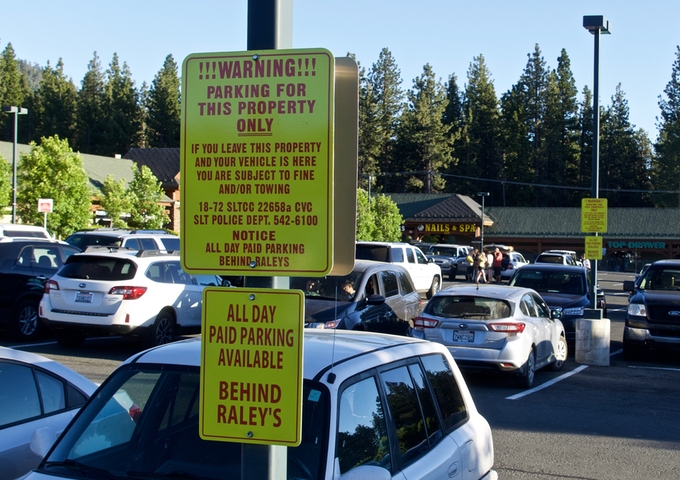
Yellow and red signs went up this week in the Village Center in South Lake Tahoe warning people if they leave the premises, their car will be ticketed or towed.

“What has happened is my tenants have been taken advantage of by the general public and employees of the (Heavenly) Village. In the winter we can have skiers and snowboarders parking in our lot,” Terry Hackett, owner of the center, told Lake Tahoe News.

All of this means less parking for people who actually want to patronize businesses in what was the old Crescent V Center.

Hackett said workers from across the street will park at his lot all day to avoid having to pay at the city-owned garage in Heavenly Village. Some employers reportedly allow their staff time to move their vehicles every two-hours to avoid a ticket.

Hackett is having the two-hour signs removed and replacing them with the brighter, more threatening signs.

“The two-hour limit will still be invoked, but the key is you will not be able to use my lot to walk across the street to the gondola or village,” Hackett said.

Because this is private property he has a right to make these kinds of rules. What he or those he pays cannot do is harass or accost someone who chooses to violate those rules. People have a right to come and go as they please. But there are consequences for doing so.

The fine is $55. Towing would be more. The signs say violators will be fined and/or towed.

This is not a new problem. The issue seems to escalate about every 18 months. (The gondola opened in 2000, the Marriott properties in 2002, and Heavenly Village just keeps getting busier — as does Hackett’s center.)

“Stateline is a victim of its own success,” Hackett said.

When the Heavenly Village area was redeveloped the agreement was that each side of the street would provide parking for its respective patrons. The city garage costs money, Hackett’s place doesn’t. People tend to go for the freebie.

The first parking agreement was signed in August 2000. At that time there was supposed to be attendant controlled access to then called Crescent V Center, with the city responsible for oversight of the 478 spots.

The agreement was amended in 2002. The 2011 revision calls for a two-hour parking limit at Crescent V, with the city getting revenue from fines and Hackett responsible for cost of enforcement. It says, “No citations shall be issued for any other reason.”

Part of the 2017 agreement between the city and Hackett is for the South Lake Tahoe parking authority to subsidize the parking enforcement. The latest iteration of the contract that the City Council agreed to this month gives Hackett $50,000 for enforcement; that money comes from the parking authority. At one time the city paid  $100,000/year out of the General Fund to enforce parking there.

These payments are ongoing until the city pays off the debt on the parking garage in about a dozen years.

The garage is bringing in about $800,000 a year, with roughly half going to pay the debt. (The other half is set aside for maintenance, improvements and Hackett. All money collected from parking issues has to be reinvested into parking related matters in that area. The city technically does not own the garage.)

Revenue from any tickets issued by the private enforcement firm Hackett hires goes to the city’s parking authority. Less than 100 tickets have been written in the last six months. If the parking gurus were to truly enforce the parking rules and based on the size of problem Hackett says there is, that many tickets could probably be written in a day.

Tires will still be chalked to mark two hours. Businesses have placards patrons can put in their vehicle if they are staying longer. This will ensure they don’t get a ticket.

Paid parking is available in the same center behind Raley’s. The price changes with demand. There is also the parking garage at Heavenly Village. The casinos are a possibility, but they are starting to charge on select days/nights.



Rural Nev. to lose all Obamacare plans next year

By Anjeanette Damon, Reno Gazette-Journal

Blaming the uncertainty over health care reform in the U.S. Senate, insurance carriers will stop offering plans under the Affordable Care Act in nearly all of Nevada’s rural counties, including Carson City and Douglas County.

In total, about 8,000 Nevadans will lose their insurance, with no options to buy a different subsidized plan on the federal health exchange. More than 5,000 of the people affected live in Carson City, Douglas, Storey and Lyon counties.

“My administration is working diligently to identify solutions to ensure there is, at the very least, a safety net available to rural Nevada residents who will be left without any options for coverage in the wake of these devastating and unfortunate decisions,” Gov. Brian Sandoval said in a written statement. “The reduced footprint of carriers on the exchange will leave more than 8,000 Nevadans with no coverage, and that is unacceptable.”

Read the whole story


CTC banning public from select SLT beaches

By Kathryn Reed

As if Mother Nature hadn’t taken away most of the sand in Tahoe via a full lake, now the state of California is cutting off what little access remains in parts of the South Shore.

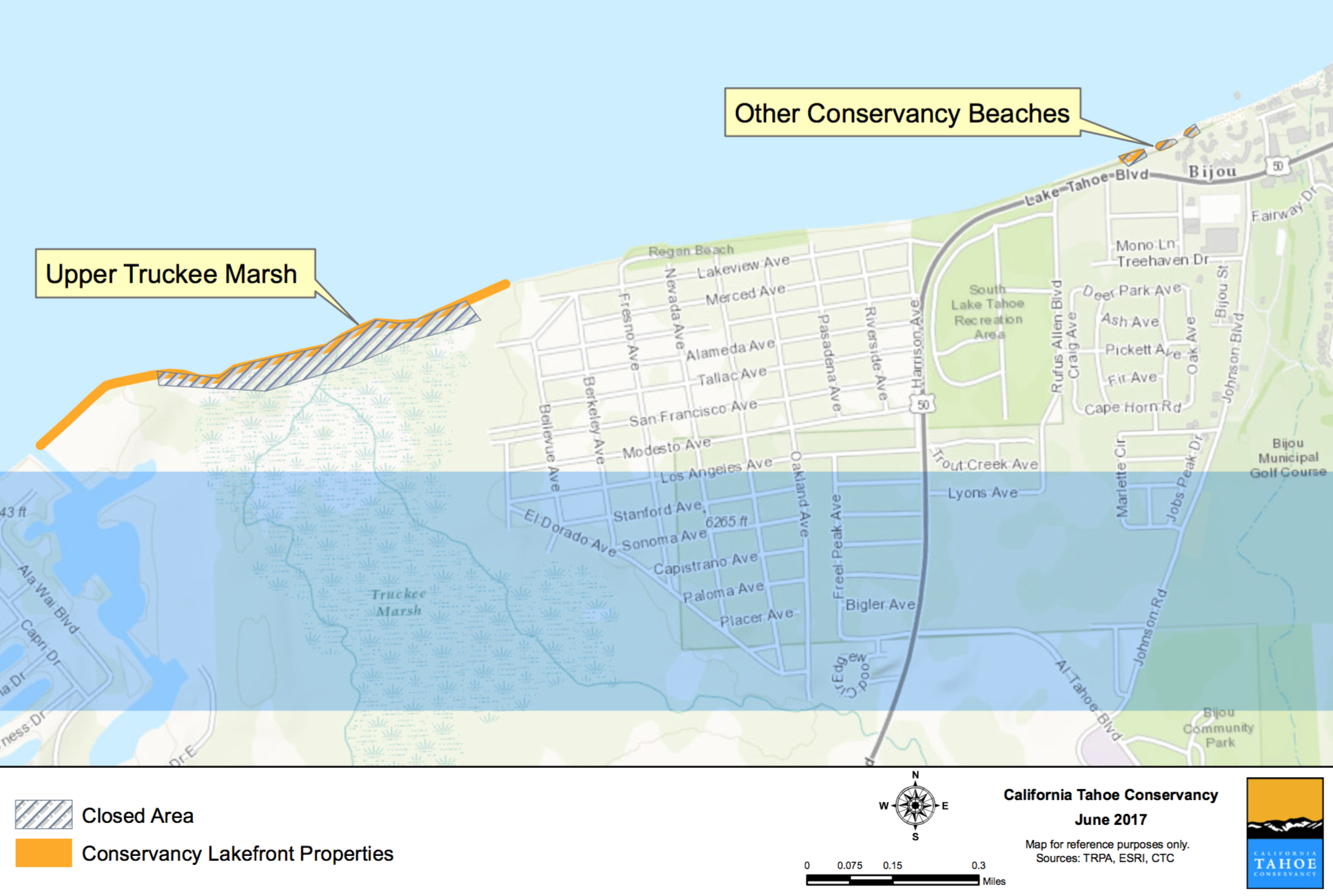
The Upper Truckee Marsh and the beach below where the Alta Mira building used to be adjacent to Lakeview Commons became off-limits effective June 28. When that policy might be lifted is anyone’s guess.

It’s all about protecting sensitive habitat and erosion concerns.

The new rules are happening days before the basin’s busiest week of the year. The California Tahoe Conservancy, which owns the land, is laying down these rules – not the city of South of Lake Tahoe.

“Generally, people will need to get wet to access the closed areas and they are not the most desirable beach locations,” Nick Meyer with the California Tahoe Conservancy told Lake Tahoe News. “There isn’t really much beach to access, especially near the Alta Mira site. The stretches where the beaches are largest will still be open to access.”

The Upper Truckee Marsh area is not entirely cordoned off, but a large swath is no longer open to the public.

“The Upper Truckee Marsh is the largest remaining wetland in Lake Tahoe. It hosts several special status bird species and the largest remaining population of Tahoe yellow cress in the world. The habitat for this endemic plant has become very limited as a result of the high lake level,” Meyer said.

If people don’t comply, consequences will be handled on a case-by-case basis. The CTC board at its meeting earlier this month entered into an agreement for the California Highway Patrol to work its properties.

“We will use temporary fencing, signage, staff patrols, education, and law enforcement patrols,” Meyer said of how the agency plans to enforce this new edict.

According to Meyer, the following are potential laws people would violate if they disregard the signs:

·      California Penal Code involving damaging plants on state property;

·      South Lake Tahoe code dealing with closed park areas;

·      City code involving tampering with signs and landscaping;

·      City code banning removal of natural resources;

·      City code about injury to or removal of plants.

However, according to city officials, the city ordinances are not applicable on state property.


Second act for LTCC theater up to board

By Kathryn Reed

The drama surrounding the future of Lake Tahoe Community College’s theater department is like an improv production where the ending is anyone’s guess.

Another scene was staged with week at the board meeting with the task force presenting its recommendations. However, two-fifths of the board was gone – members Kerry David and Jeff Cowen were absent.

Ultimately, it will be up to the five electeds to write the final act.

In October, it came to light that the administration was going down the road of eliminating the department because of lack of enrollment and finances. A month later the public came out to say not so fast and expressed how important the theater is to the community.

From there a community task force was formed with two goals – delve into the for-credit program and look into how best to serve the community outside the college.

On June 27, Michael Ward, who facilitated the six two-hour meetings of the task force, along with members of the committee talked about their recommendations. It was a rather full house for an LTCC board meeting, mostly with theater supporters filling the seats.

In the wake of this turmoil the nonprofit Tahoe Arts Alliance has formed. It could be a production partner with the college.

For credit suggestions:

·      Retain the program for two years to work on increasing enrollment.

·      Merge theater with speech-communications.

·      Develop dual enrollment program with South Tahoe High School.

·      Create a summer theater program like the Spanish ISSI.

·      Diversify offerings.

·      Increase marketing.

Community partnership ideas:

·      A four-partnership approach with separate entities for production, promotion, LTCC as facilities manager, and a future resident company.

·      Establish a production calendar so other entities are using the theater.

·      Work with South Lake Tahoe and El Dorado County for marketing and financial support.

·      Evolve into a repertory or conservatory model.

After the presentation, college President Jeff DeFranco told Lake Tahoe News, “For now we are narrowing the offerings and they will culminate with a spring production.”

Talks are under way with Valhalla for that arts organization to put on a play at LTCC in the fall. There is also a TedX event planned for September.

“We need to make sure the theater doesn’t sit empty for 11 months. We need to make this great asset available to the community,” DeFranco said.


Nev. rural Airbnb operators earned $5M in 2016

By Jason Hidalgo and Nancy Trejos, Reno Gazette-Journal 
 
Nevada’s rural Airbnb hosts posted the fifth-highest average income in the nation for the home-rental service’s non-urban locations.

A report released Tuesday by Airbnb found that rural host income in Nevada averaged $9,000 in 2016. Only California, Hawaii, Delaware and Oregon reported higher host incomes last year, with California’s $11,900 leading the nation.

Nevada was also one of a select number of states where rural hosts earned more on average than their urban counterparts. In 2016, Nevada Airbnb hosts in urban areas reported an average income of $7,400. Part of this could be attributed to the Tahoe effect, said Jasmine Mora, a spokeswoman for Airbnb.

Read the whole story


Pollen not hurting Lake Tahoe’s clarity

Pine pollen on the surface of Lake Tahoe. Photo/TERC

It is the time of year when the big blue turns yellow. Pine pollen can be seen blowing out of the forest in great clouds with much of it landing on Lake Tahoe’s surface.

When viewed from the air great swirls of yellow more than a mile long look like a giant hand finger painted on the surface. Despite the vast quantities, pollen does little to change Tahoe’s water clarity. Pine pollen grains (50-80 microns) are relatively large compared to the <10 micron particles primarily responsible for clarity loss.

In the water, the pollen grains stick together and settle to depth quickly. Once on the bottom they add to the historical record. Pollen grains recovered from sediment cores have been used by scientists to determine historic vegetation and provide clues to climate conditions thousands of years in the past.

— UC Davis, Tahoe Environmental Research Center