Torrid pace of wildfires likely to linger

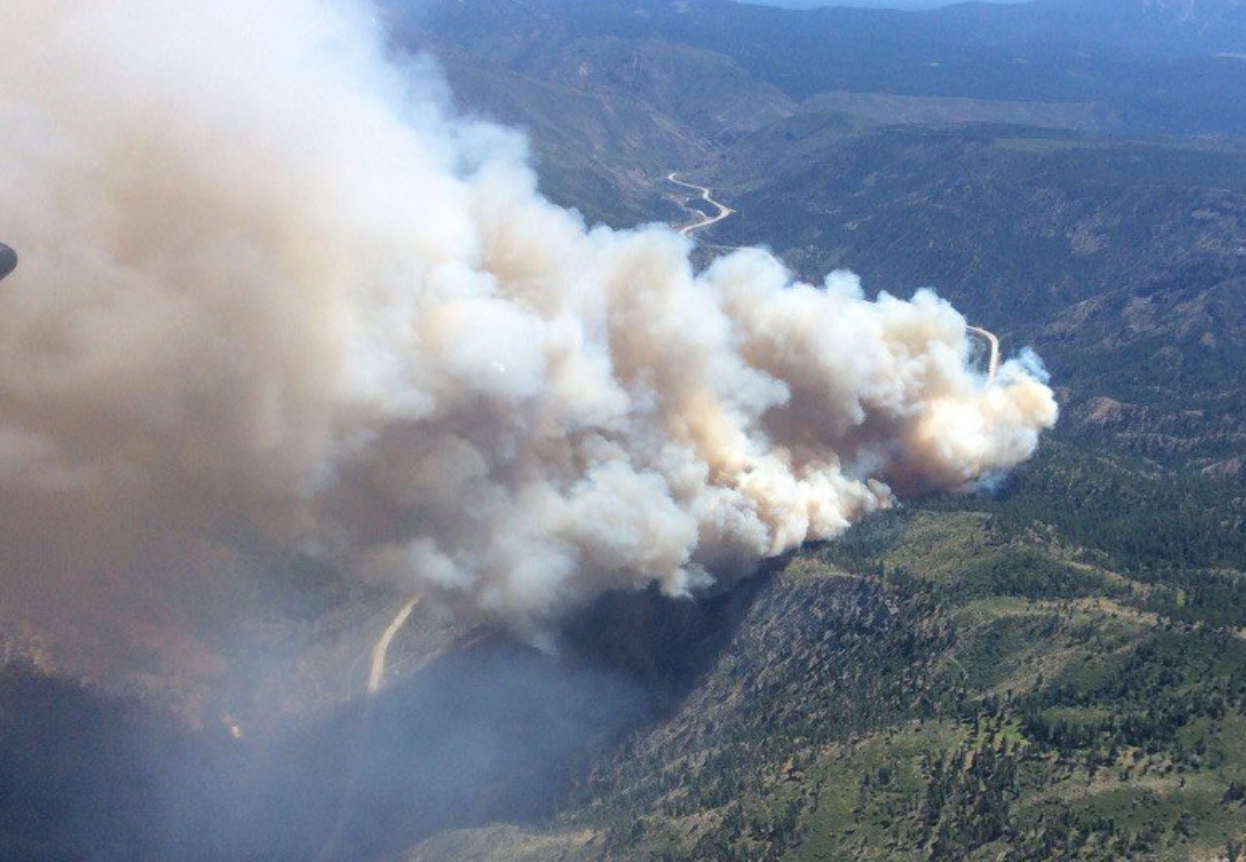
The Farad Fire in Northern California started July 10 near the state line. Photo/USFS

By Kevin Fagan and Filipa Ioannou, San Francisco Chronicle

After a hot weekend that saw wind-fanned wildfires lurch out of control and gobble up thousands of acres of trees and dozens of homes from Santa Barbara to Butte County, Monday’s respite in the weather was just that — a respite.

California is now far ahead of last year’s pace for forest and grassland fires, and conditions are ripe for it to stay nasty all summer long, said CalFire Chief Ken Pimlott.

Much of Northern Nevada is burning as well.

Last year’s downpours may have ended the five-year drought and eased its tinder-dry conditions a bit, but the heavy grasses sprouted by the rain now present frightening fuel, he said. So which condition is worse — drought or heavy new brush?

Read the whole story


Train rolls out old and new at Tahoe concert

Pat Monahan, lead singer for Train, takes a selfie for a fan. Photo/Kathryn Reed

By Susan Wood

STATELINE – Train’s lead singer Pat Monahan and company continued its special connection with Lake Tahoe Sunday night, adding the Harveys Outdoor Summer Concert Series on its latest tour – A Girl, A Bottle and A Boat.

With Natasha Bedingfield and O.A.R. opening on the warm summer night, this was one of the last stops on a tour named after the Grammy award-winning band’s 10th album written to exemplify life on a boat with your favorite person and a bottle of wine. The ensemble showed the seven-member Americana group hasn’t lost its touch with a packed and engaged audience.

“Lake Tahoe, you look amazing,” Monahan screamed out to the dedicated, adoring fans on July 9.

The San Francisco-based band has somewhat transformed from its earlier days with former front-man guitarist Jimmy Stafford, but its music’s catchy style lives on. Most recently, the sentimental “Play That Song” had the crowd belting out the words set to the melody of the 1938 classic “Heart and Soul.” The accomplishment speaks volumes for a rock band that stands the test of time and reaches generation after generation.

People were standing and dancing as Train played hit after hit on July 9. Photo/Kathryn Reed

Anna Denis from Alaska turned a visit to see her daughter Rachael in Reno into a mother-daughter Train excursion.

“I love Pat Monahan, especially his (vocal) range,” the mother said.

Amber Little of Carson City rocked out with both her daughters and fiancé while most of the night on her feet like the majority of concertgoers.

“I thought this would be a good concert as their first concert,” she said of her two teenage girls.

Monahan has always maintained a unique appeal with fans young and old. Following “50 Ways to Say Goodbye,” the third number of the night – “If It’s Love” – prompted about a dozen fans to toss their cellular phones up on stage for Monahan to take selfies with the fans in the background.

Even though the band is on tour with new material, the older smash hits are what got the audience swaying, bobbing, punching beach balls and dancing all night.

“Tahoe, how do you like it so far?” Monahan yelled out to check in with “Angel in Blue Jeans” from 2014’s “Bulletproof Picasso” album.

For Train’s 2009 signature hit “Save Me, San Francisco,” the entire capacity crowd joined in on the lyrics.

The love fest continued with its 2003 blockbuster tune “Calling All Angels,” which the audience dominated with its high-energy singalong.

“Think of all the people who need our love right now,” Monahan told the crowd, as he placed his clenched fist at his chest.

The heartfelt tribute to humanity carried on when he brought Bedingfield back on stage to join the band in “Bruises,” a tune off the 2012 album “California 37” – which was named after the popular North Bay highway that runs west of Vallejo.

Bedingfield, an English singer known for her mega hit “Pocketful of Sunshine,” represented a fitting opening act in terms of engaging the audience.

She was followed by O.A.R. (which stands for “Of A Revolution”). The Maryland-based rock band is known for and also delivered on its Top 40 number “Shattered” and most recently its touching tune “Peace.” The latter tribute to choosing love versus arguments prompted many to raise their hands with peace signs.

In turn, Monahan sat down with his solo guitar to vocally caress the audience with his own song about relationships, “Marry Me” – a popular wedding song.

“That’s what I like,” Vernon Sallaz of San Luis Obispo said. “My wife and I got married here in Tahoe 35 years ago.”

The connection between Monahan, his band and the Tahoe audience was unmistakable – even if the younger set barely remembers the old tunes.

“Does anybody even remember this song?” Monahan said, interrupting his 1996 early hit “Meet Virginia.” The crowd reciprocated with a roar, and that notion was put to rest.

Pat Monahan has a way with connecting with the audience. Photo/Kathryn Reed

Off the new album, Train backed up “Working Girl” with video images of superstar icons such as tennis greats Serena and Venus Williams with Billie Jean King as well as television personalities Oprah Winfrey, Ellen Degeneres and Tina Fey.

Most of the concert was spent honoring and playing the old, recognizable favorites – from the ever-jumpy “Drive By” and sing-along tune “Hey, Soul Sister” to two encores. One was a perfect rendition of Queen’s top hit with David Bowie’s “Under Pressure,” which featured a video clip in the background of Queen lead man Freddie Mercury.

The last segment represented the most inner poignant tribute to Monahan’s mother who died of cancer – “Drops of Jupiter,” which came to the singer in a dream.

Genuine and versatile, Monahan showed his songwriting prowess on several occasions including during “When I Look to the Sky,” a tribute for anyone who has ever lost someone they love. He sat down on the stage with his band during this acoustical number for a moment of tranquility and togetherness.

Monahan even brought out O.A.R. with lead singer Marc Roberge in a white dinner jacket to help out with Paul Simon’s hit “You Can Call Me Al.” Simon opened the concert series a few weeks ago.

The Harveys concerts continue with Lenny Kravitz taking the stage on July 14, July 16 with Third Eye Blind; July 28 and 29 with Jack Johnson; Aug. 4 with Slightly Stoopid; Aug. 16 with The Who; Sept. 1 with Linkin Park; and Sept. 2 and 3 with Eric Church.


Intensity of wildfires a challenge to officials

By Joshua Emerson Smith, San Diego Union-Tribune
 
Wildfire season is getting longer and more intense, and both scientific and forestry experts foresee hotter and drier conditions that would significantly exacerbate the situation.

State and local officials have in the last decade updated efforts to keep people and property safe from out-of-control conflagrations. This includes everything from updated building codes, requirements on defensible space around homes and various forest management techniques.

However, many fear these tactics won’t be enough to keep pace with the worst consequences of powerful blazes, which have ripped through the state’s forests with growing frequency and size over the last few decades.

Read the whole story


Study: Sierra meadows being overtaken by forest

By Jason Alvarez, UC Merced

Subalpine meadows are among the Sierra Nevada’s most enchantingly picturesque landscapes. These sparsely wooded, grassy expanses are home to plants and animals found nowhere else, and they play an important role in regulating the flow of water from the Sierra snowpack to the rest of the state.

But these ecosystems may soon disappear.

A UC Merced study authored by former doctoral student Kaitlin Lubetkin, Professor Leroy Westerling and Sierra Nevada Research Institute  scientist Lara Kueppers found that these meadows are being increasingly overrun by forest as changing conditions allow the offspring of nearby trees to take hold in meadow environments that previously favored shrubs and grasses over saplings. For the many species that depend on meadows, this change may force them to find new habitats.

Read the whole story


South Lake Tahoe council to vet future of VHRs

By Kathryn Reed

The much anticipated vacation home rental study commissioned by South Lake Tahoe doesn’t say much that people didn’t already know.

On July 11 the study titled Socioeconomic Impacts of Vacation Home Rentals in South Lake Tahoe will be the subject of a workshop by the City Council.

The council will likely discuss whether a cap should be placed on the number of vacation home rentals allowed throughout the city or in particular neighborhoods, if the permitting process should change, enforcement procedures, fines, and other related topics.

The public will have an opportunity to offer comments, suggestions and feedback. The workshop will follow the regular meeting which starts at 9am, but it is not time certain when the VHR discussion will commence.

                                                                                                                            Source: South Lake Tahoe VHR study

The report, which cost taxpayers $77,000, had its first public airing on June 13 when the consultants who put it together gave an overview for the council.

The purpose, as stated in the report, was “to examine the wide range of factors that may be influenced by the growth of the sharing economy, and evaluate the socioeconomic impacts of those factors.” This study was a partnership between faculty at California State University, Sacramento and Michael Baker International.

The report acknowledges that the city’s data on VHRs was “incomplete or inconsistent and required a great deal of processing.” Recent data was abundant, long-term wasn’t.

This led the researchers to use public data such as the Census, American Community Survey, multiple listing service, and economic and tourism reports.

Surveys and public meetings provided other content. Twenty-three percent of respondents to the resident survey identified themselves as VHR owners or operators.

In the report is an alarming admission by the consultants: “To the extent possible, data was verified for correctness and completeness; however, none of the data is guaranteed for accuracy, and the study team makes no warranties or guarantees on the validity of the data used in this report.”

Researchers also analyzed VHR related studies done in other locales.
South Lake Tahoe is not unique in losing long-term rentals when owners start using the property for short-term rentals. One study showed when restrictions were placed on where VHRs were allowed, the value of the property went up somewhat in VHR-allowable areas, while the decrease in value was greater where VHRs were not allowed.

This is what the data shows for South Lake Tahoe regarding the effects of VHRs on home values:

·      A VHR with an average allowed maximum occupancy of nine sells for about 8.5 percent more than a similar house not licensed to be a vacation home rental.

·      The presence of the average number of VHRs within a zero to a tenth mile of a home, and a tenth to quarter mile of a home, respectively raise the home’s selling price by 2.9 and 3.6 percent.

·      The presence of the average number of VHRs with a quarter to half mile of a home, and a half to one mile of a home, respectively lower the home’s selling price by -5.3 and -9.1 percent.

To the question of what would happen if VHRs were to go away, the research found, “The most dramatic impacts that phasing out VHRs in the city will have is the significant loss of TOT, and a shrinking of the city’s tourist economy. Occupations that support the VHR industry will follow the VHR market, and move into neighboring jurisdictions where VHRs are still allowed. While the city will still be the primary location for much of the region’s entertainment and recreation, there will likely be less diversity in the tourist economy as tourists staying in VHR accommodations outside the city look for recreation options closer to their VHRs.”

Many people claim if VHRs were reduced this would help locals with having more choices to live. Not true, says the study.

“VHRs make up less than 25 percent of the city’s vacant housing stock. Addressing problems with the currently operating VHRs treats only a part of the problem facing the city in regard to the lack of affordable housing and the mismatch between incomes and housing costs experienced by residents employed in the tourist industry,” the report states.

One potential way to loosen up the housing market would be to assess a fee on vacant houses.

Researchers looked at hybrid policy ideas such as:

·      Property transfer fee for properties that are not primary residences or intended for long- term rental.

·      Vacant property impact fees for properties that are left unoccupied for more than a certain number of days each year.

·      Regulatory relief or other incentives for absentee property owners who elect to offer their property as a long-term rental.

·      Partnership with the TRPA to explore opportunities for creating a new commodity market that addresses the environmental impacts resulting from tourists moving out of hotels/motels and into the neighborhoods.

·      Establishing a means for motel owners to convert units to permanent housing.

When it comes to finances transient occupancy taxes have long been one of the city’s top three revenue sources. This tax assessed to hotel rooms as well as VHR units equated to $8.67 million in 2011 and $15.686 million in 2016.

In that same time span, TOT from property-managed VHRs increased by 90 percent, from $1 million in 2011 to $1.9 million in 2016.

“The most dramatic increase, however, is in owner-managed VHRs, which increased 210 percent over the same time frame, from $299,146 to $927,238,” the report says.
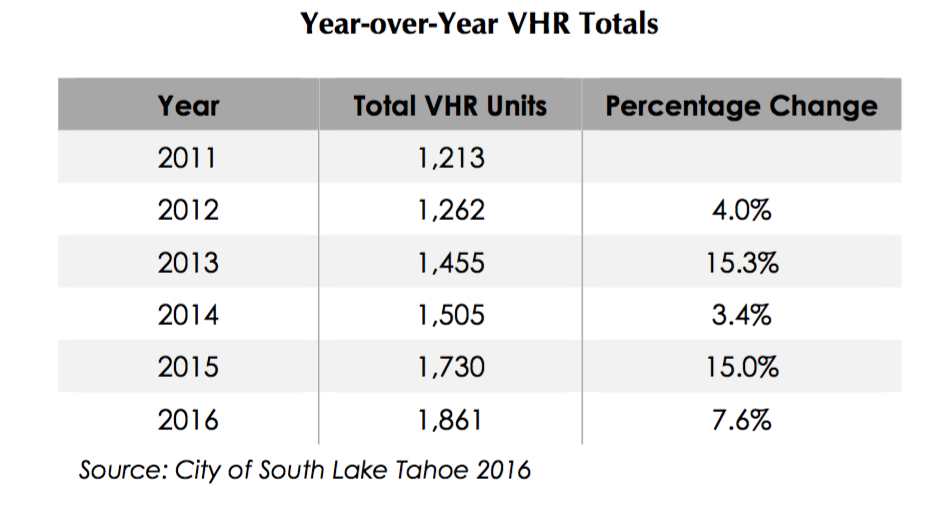
The report used data from the 2015-16 Lake Tahoe Visitor’s Authority Visitor Profile Study, that says 19 percent of tourists stay in VHRs. Of all the lodging units available throughout the South Shore, VHRs in the city limits account for 12.8 percent of the market.

The report says almost half of the housing stock in the city is owned by people who don’t live here full time. At one time that figure was more than 70 percent. The shared economy is increasing the numbers, especially as platforms like VRBO and Airbnb make it easier for the owner to rent their home without a middle manager.

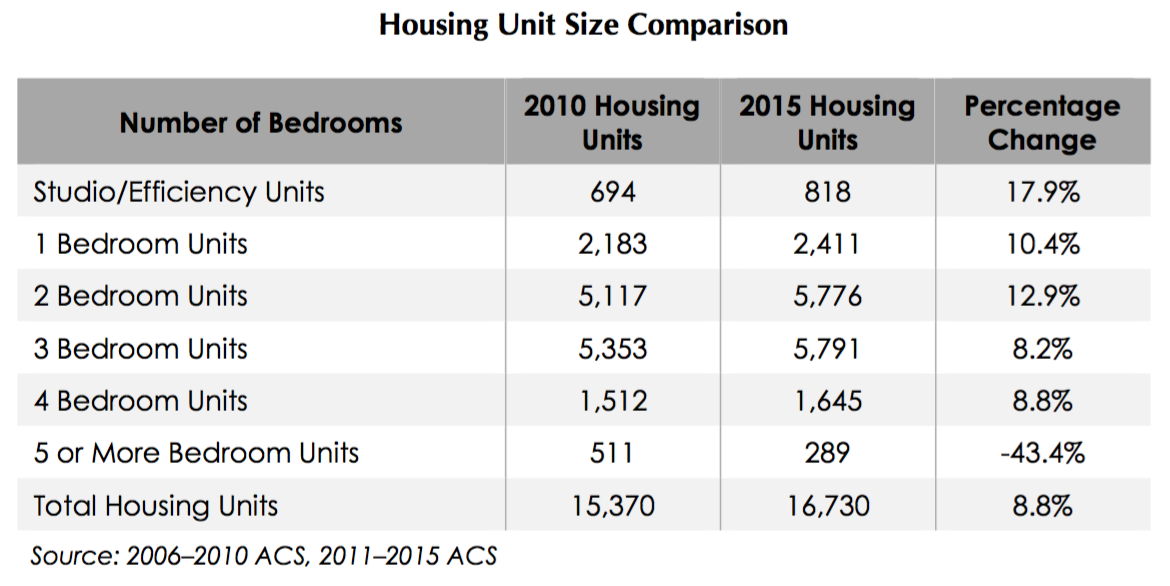
The city lost about 400 rental units for full-time residents between 2010 and 2015, the report states.

The report says, “About 44 percent of housing is owner occupied in the city, while the remaining 56 percent is renter occupied. … there has been a shift from occupied units to vacant units in the city. Between 2010 and 2015, about 6.2 percent of the city’s occupied housing was converted to vacant. Approximately 5.3 percent of these lost units were rental units and 7.3 percent were owner-occupied units. The conversion of housing units from occupied to vacant has predominantly occurred in the city’s single-family units.”

When residents were asked where VHRs should be permitted, 43 percent said commercial zones and 40 percent said single-family zones. The owners of VHRs predictably (60 percent) want them in residential areas, with 11 percent saying they should be allowed everywhere.

Here is a copy of the VHR study.


Weather gets weird throughout the U.S.

By Brian K. Sullivan, Bloomberg

Texas struggled through its driest year in history in 2011. Four years later was its wettest ever.

The Mississippi River rose to all-time-high flood levels in 2011. In 2012, its second-lowest.

After a five-year drought that made agricultural irrigation a political hot potato, Northern California experienced nearly double the normal rainfall this year, beating the old mark set in 1983.

As the planet warms, a less ballyhooed new normal is emerging in weather extremes. With deluge following dust, the record book is becoming increasingly difficult to rely on for those who study the weather. The seesaw from one record to its opposite also has problematic implications for water management, storm preparedness and even national security.

Read the whole story


Interior’s inbox fills with comments on national monuments review

By Henry Brean, Las Vegas Review-Journal

More than 1.1 million public comments have poured in so far on the Trump administration’s review and possible rollback of national monuments in Nevada and elsewhere.

Conservationists in the Silver State hope to push that number even higher in the closing days of the comment period.

The Department of Interior will accept public input through Monday as part of its review of 22 national monuments created or expanded by presidential decree since Jan. 1, 1996.

Read the whole story


Illusionist defies logic with magic at Harrah’s

Rob Lake is able to keep a woman suspended in air at Harrah’s Lake Tahoe. Photo/Kathryn Reed

By Kathryn Reed

STATELINE – Little girls don’t often dream of being on stage cut in half, or into nine pieces, or having their head on one side of the stage and their body on the other.

This isn’t some macabre scene; it’s magic. Specifically, it’s the illusion of Rob Lake.

He couldn’t do it without Katy Veneris, Diana Osborn, Rosie White and Natalie Osborne.

“This is the first time I’ve worked with a magician. I still have no idea what is going on,” Veneris told Lake Tahoe News.

The audience at Harrah’s Lake Tahoe on July 8 seemed to echo Veneris’ sentiment. Instead of a resounding round of applause it was a delayed reaction after most of his acts. People were in disbelief. They were left scratching their heads trying to figure out what just happened. Were their eyes playing tricks?

Rob Lake’s helper appears to be split in two; her head on the table to the left, and body to the right. Photo/Kathryn Reed

Lake watches the audience’s reactions and feeds off of that. Confusion on their faces can be a really good thing in his line of work.

Lake is an illusionist who is able to seemingly dismember people and then put them back together; start on one side of the showroom and end up on another; plus, he seems to have super powers when it comes to knowing things.

Audience participation is huge – and from all ages. (This is a kid friendly show.)

The 34-year-old from Norman, Okla., will be at the Stateline venue through Sept. 4, Thursday-Monday.

It’s not uncommon for Harrah’s to book the showroom with a long-running act. Last summer it was Alex Ramon’s magic show.

“We want to have something family oriented during the summer months for vacationers, in addition to the outdoor concerts at Harveys,” John Packer, with Harrah’s, told Lake Tahoe News.

Rob Lake’s performance is fast paced and engaging. Photo/Kathryn Reed

Lake was 10 when he saw his first magic show. He was hooked. Even though he spent two years in college studying health and exercise science, he knew he had to follow his dream. And so he hit the road.

Sometimes the four semi-trucks and 20-person ensemble are in a town for a night, other times they have the luxury of an extended stay. Lake was in Tahoe last winter as well. He is loving the scenery; and staying in a condo allows him more freedom with his new dog Roger, who has a bit part in the show.

Inspiration for new illusions can strike at any time – watching a movie, from music, even a store display. It’s not unusual for a full act to come to him in the middle of the night; that’s why Lake keeps a notebook next to his bed.

What he has going on at the South Shore Room is remarkable and stunning. The hour-plus show is fast paced, with some dancing from the four women in between sets, a great deal of interaction with the crowd and an incredible energy that flows from Lake to the audience.


Nev. pension system abuses cost taxpayers $23M a year

By Arthur Kane, Las Vegas Review-Journal

Nevada governments are using the underfunded state pension system to boost the income of public employees.

The practice, which is legal but often based on decades-old or misused exemptions to the law, costs taxpayers at least $23 million a year in pension and salary, a Las Vegas Review-Journal investigation found.

Two dozen elected officials collect salaries and pensions at the same time, including eight politicians who use the arrangement to make more than $250,000 a year.

There is little accountability or transparency in the system.

Read the whole story


Fiery rhetoric from Calif. to feds over fire debt

By Associated Press

California’s emergency services director fired off a sharply worded letter to the U.S. Forest Service this week that said the agency had stiffed local governments $18 million for fighting wildfires on federal lands last year and raised the prospect the state may stop protecting national forests during blazes.

“I cannot continue to support the deployment of resources to protect federal land that ultimately may bankrupt our local governments,” Emergency Services Director Mark Ghilarducci said in the letter sent Monday to Forest Service Chief Thomas Tidwell.

The dispute stems from longstanding commitments that coordinate and reimburse firefighters for work on federal lands. Nearly half the land in California is federally owned, and the greatest percentage of that is in National Forests.

Read the whole story