Nev. PERS board doesn’t know investing basics

By Victor Joecks, Las Vegas Review-Journal

If you own more than $10 billion in bonds, you should know what a bond is.

That’s why Nevada Public Employees Retirement System board members heard a presentation last week on bonds before their regular meeting.

This is like Nike’s board of directors attending a seminar called “Introduction to Shoes.”

You’d expect the seven people who are in charge of a $38.5 billion portfolio, including $10.6 billion in bonds, to have investing basics down. Especially when that portfolio is funded by taxpayers. Especially when that fund provides guaranteed retirement income to thousands upon thousands of former and current Nevada government employees decades into the future.

But you’d be wrong.

Read the whole story


Marijuana’s future in SLT to be decided

By Kathryn Reed

South Lake Tahoe’s relationship with marijuana is about to be redefined.

The City Council has scheduled a special workshop for Aug. 29. Medicinal and recreational pot will be on the agenda.

“We need to vet out what we think best management practices are,” City Attorney Tom Watson said. “There are potentially significant impacts.”

The council briefly touched on the subject this month; which is when the workshop idea was agreed upon.

With the state’s voters approving recreational use last fall, it is up to local jurisdictions to decide if they want to allow sales of the drug. State law dictates the use and growing of plants.

A big problem for cities and counties is that the state has not come up with all the parameters for legalization of this product. Edibles is one area that is slow to be resolved. Three state agencies are working on ironing out the details, with a draft likely this fall. Jan. 1 is still the start date for recreational marijuana to be allowed in California.

The council must have an ordinance in place by the end of the year regarding recreational marijuana. It could be an interim ordinance that would ban the sale, with a reconsideration of that ruling down the road.

El Dorado County has not taken a stance yet. Nevada started recreational sales on July 1. Douglas County has said it will not permit the recreational sale of pot. Incline Village may see its first shop on Aug. 4.

California has taken action to align medicinal marijuana regulations with those of recreational.

“I’m a big supporter of medicinal marijuana. It does help,” Councilman Tom Davis said. “I’m not opposed to opening a second one. I do think competition is good.”

The medicinal marijuana ordinance limits those facilities to three. The city is down to one. For another shop to open it must have the council’s approval.


Health care thrusts Sandoval into national spotlight

By Ben Botkin, Las Vegas Review-Journal
 
 CARSON CITY — Brian Sandoval is having a good year.

Nevada’s Republican governor has seen his national profile grow in prominence, highlighted by his role influencing Sen. Dean Heller on the health care debate, and his new role as chairman of the National Governors Association.

Last month, Sandoval became part of the national conversation on health care when Heller, a Republican, declared he would not support a bill to repeal and replace the Affordable Care Act.

The announcement showed how influential Sandoval can be on a fellow Republican and propelled Nevada’s chief executive onto a bigger stage.

Read the whole story


Study highlights economic impacts of ‘quiet’ recreation

By Amy Joi O’Donoghue, Deserest News

SALT LAKE CITY — Some quiet time in the great outdoors in a portion of Utah delivered a sizeable chunk of change to local economies, with an estimated $17 million in impacts logged in one year alone.

A first-ever study devoted to an exclusive analysis of “quiet recreational activities,” looked at what was taking place on 2.1 million acres of Bureau of Land Management lands in Iron and Beaver counties, or those lands within the purview of the agency’s Cedar City field office.

 The report released Thursday details that out of 492,000 recreation visits logged in 2015 by the BLM, 364,000 — or 74 percent — were for quiet recreation that includes hiking, hunting, biking, fishing, camping or wildlife viewing.

Quiet recreation is generally nonmotorized activity that excludes off-highway vehicle use, power boating, snowmobiling or driving for sightseeing.

Read the whole story


Carson bypass opens to human-powered transport

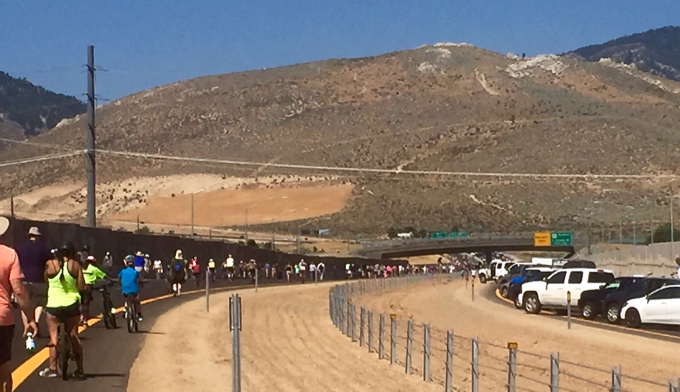
Swarms of people on July 22 break in the 1-580 connector in Carson City. Photo/Susan Wood

By Susan Wood

CARSON CITY – Americans love the open road.

That sentiment is not reserved to travel on four wheels – as evidenced July 22 in Nevada’s capital city to commemorate the completion of the last leg of the Interstate 580 Carson City Freeway.

Travelers of all sorts and all ages took the invitation from the Nevada Department of Transportation on Saturday morning to zoom up and down the 2-plus mile stretch between the Highway 50-Spooner Junction and Fairview Avenue.

With a majority from Carson City, more than 1,000 people showed up on road, mountain, cruiser, BMX and vintage bikes, accompanying walkers, runners, skateboarders, Rollerbladers, roller skaters as well as pedestrians with baby carriages and scooters. Drones and Ultralights even flew overhead.
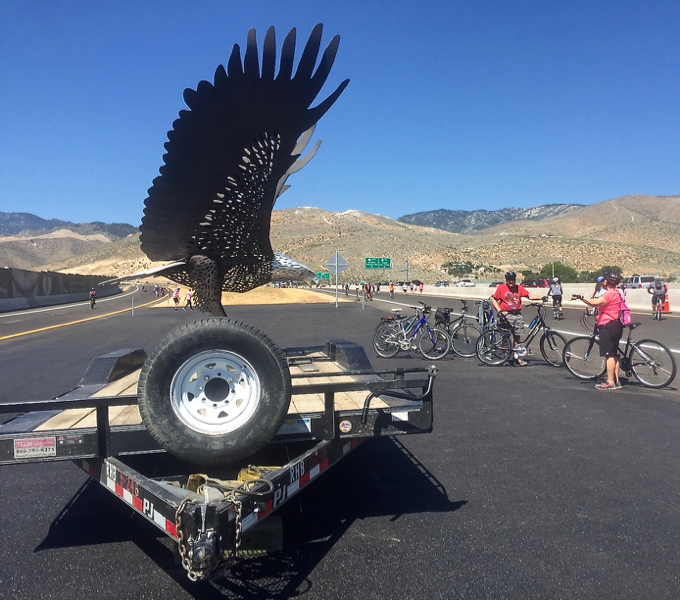
Artwork is part of the freeway, with the eagle to be near the Spooner intersection. Photo/Susan Wood

Many locals expressed relief and exhilaration that the day had come, considering the long, hard-fought process. The freeway is expected to open in early August, according NDOT — which celebrated its centennial last March.

The interstate completion allows one to drive from the south side of Carson City to the San Francisco Bay Bridge without a stoplight. This means going to Reno first.

Doing so was no easy task over the last few decades. The $42 million project – which includes an accompanying trail and décor — underwent at least seven contracts to accommodate the funding stream that included additional sales tax. The construction that started in June 2015 required 1 million cubic yards of earth excavated, 97,000 tons of asphalt paving and 950,000 pounds of reinforcing steel installed.

“We’ve waited a long time for this,” Carson City Mayor Robert Crowell said, recalling the milestones of progress amid the challenges.
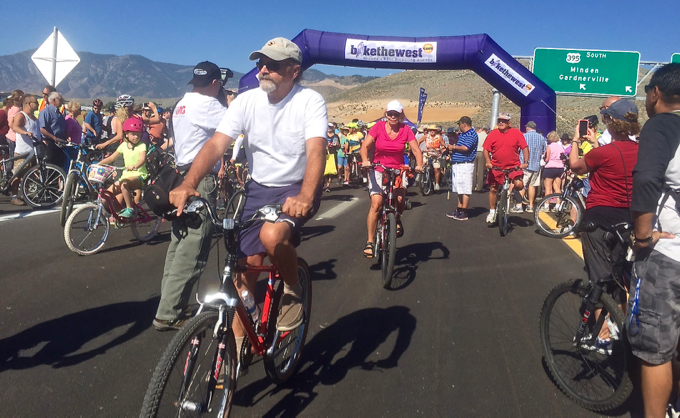
Cyclists would love for this smooth pavement to be the norm everywhere. Photo/Susan Wood

He remembered the late Nevada Gov. Kenny Guinn driving a black Cadillac over the first freeway section from the north end of town to Fairview Avenue in 2006. With overpass crossings at Koontz, Snyder and Clearview, the new leg links Fairview with the Highway 50 connection to South Lake Tahoe.

“I-580 allows us to showcase the state Capitol that will be the envy of all,” Crowell told the cheering crowd.

He acknowledged the tough road in getting to the day of opening given criticism the bypass would “kill downtown” – as declared by his own father. The mayor also tipped his hat to nearby businesses enduring dust.

“This is a turning point we must embrace with vigor,” Crowell said.

For one person in particular, the morning was an emotional one.

“My heart beats a little faster thinking about this,” the mayor said.

The freeway was dedicated to the late Carson City Sheriff’s Deputy Carl Howell, who was shot and killed in August 2015 on a domestic battery call on the east side of town.

“The family doesn’t have enough words to explain the wonderment about this. The honor and accolades are over the top,” his father Kevin Howell said, while wearing his son’s badge No. 5466. “I never stop thinking about him.”

Now he’ll be reminded of the community’s gratitude when he drives the freeway around town.
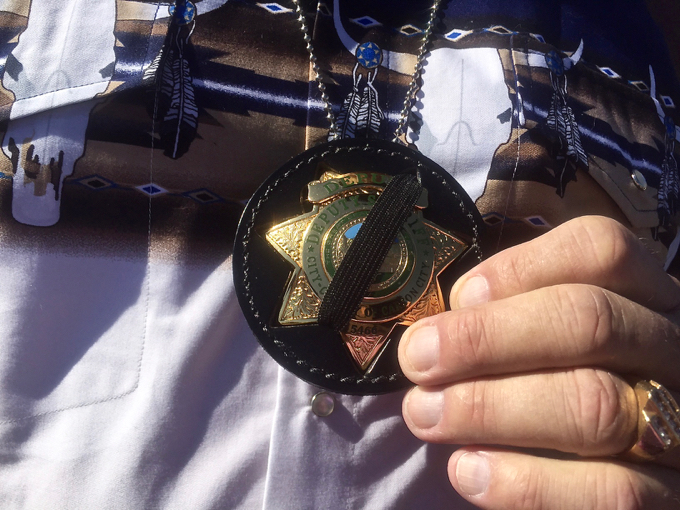
Kevin Howell with his son, Carl’s, badge. The freeway honors the fallen sheriff’s deputy. Photo/Susan Wood

Once it opens, NDOT estimates 43,000 vehicles daily will use the section of freeway by 2035.

But on Saturday it was all about human power – in its many forms.

“It’s nice to have this crowd. Look at all these cyclists,” Alta Alpina Bike Club member Michael Bayer said, while visiting with friends under the overpass. The freeway turned into a giant social hour.

Mayer guessed that over half of the bike club’s 200 members came out to support the free event.

The avid cyclist contends the public only needs a nudge such as this to get them to see the beauty and benefits of using a bicycle as a means of transit.

The removal of the “freeway ends” sign will happen in August. Photo/Susan Wood

A Carson City retail worker on roller skates had another idea.

“I’m doing shameless self-promotion,” Danielle Friend said.

She used the opportunity to hand out fliers highlighting Eyemart, a new business on the south side of town.

Like so many others who covered the short stretch, Friend was geared up for a workout that morning.

A workout is what Carl and Leanne Heard were going for too. The doctor-nurse duo, who work at Carson Tahoe Hospital, decided he would place a bungee cord between them. He was on Rollerblades and she tugged him on her mountain bike.

“I’ve said he almost brought a whip,” she said, laughing.

And with that, the couple took off.

William Frederick admitted to having his hands full trying to round up his 4-year-son, James, who ran into the mayor on his bicycle.

“This is great. I never thought it was going to be,” Frederick said, calling the event an historic milestone experience for Carson City.

Gardnerville resident Scott Doerr agreed, while taking a break on his vintage New Belgium bicycle with a basket up front. He appeared content leisurely sauntering up the road on his Fat Tire bike.
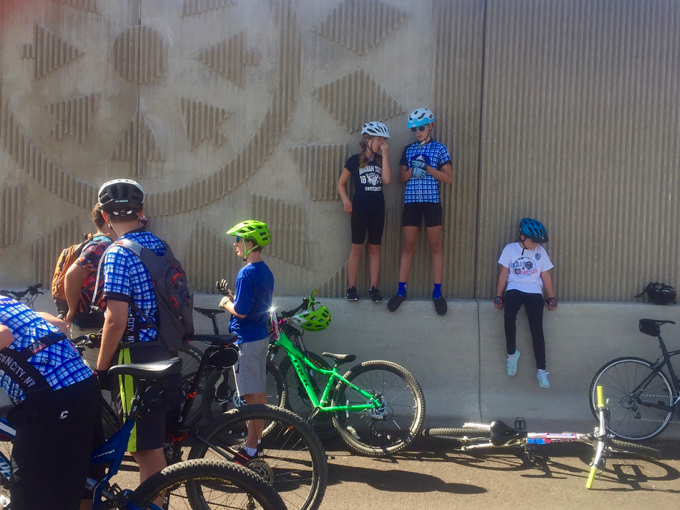
All ages enjoy the rare opportunity to be on the freeway before it opens to cars. Photo/Susan Wood

Skateboarders Robbie Rupp and Devon Fulmer were a little more serious about the endeavor, sizzling in 80-plus degree heat on the smooth asphalt at about 20 mph.

The members of the Wheelhouse Club had been looking forward to the event to ride their skateboards where no vehicle dares to go just yet. Apparently, they’re not alone. Fulmer, who works at the Wheelhouse skateboard shop, said he knew of an Arizona woman who flew into town with her bicycle to ride the new freeway section.

Nevada Highway Patrol officers Greg Moore and Erik Lee turned their Saturday duty into a community event. Some attendees saw the opportunity to look into hitching a ride with a cop.

“Everybody asks,” Lee said, while standing next to his shiny, fully-equipped motorcycle. Ironically, the officers were out there to keep an eye on the traffic with its varying speeds people were traveling. They were tasked with rounding up the public at 11:45am.

No traffic is allowed on the road until it officially opens to vehicles.


Mini gold rush in N. California

By Michelle Robertson, San Francisco Chronicle
 
When asking seasoned miners about this year’s so-called gold rush in Northern California, it can be a challenge to obtain trustworthy information. 

“People who are smart don’t advertise what they’ve found,” said Bob Van Camp, better known as “Digger Bob.” “If you’re finding nuggets in an area, you don’t tell anyone about it; I’ve made that mistake before.”

Northern California was pelted with record rainfall this winter, and miners predicted that once all the water washed away, gold would be left in its wake. It appears that their predictions are panning out.

Read the whole story


Wildfires surge in Western United States

By Benjamin Spillman, Reno Gazette-Journal
 
Wildfires are surging across the Western U.S. with more than 4 million acres charred this year.

That’s almost double the rate from last season and more than 40 percent above the five-year average for mid-July. 

While fire is part of healthy forest and rangeland regeneration it can also be dangerous for communities in its path and expensive to fight. Wildfires can spew unhealthy levels of air pollution hundreds of miles and deplete the budgets of federal agencies charged with preserving the land. 

In general, about 80 percent of wildfires are human caused. 

Read the whole story


‘Flushable’ wipes a problem for Tahoe sewers

By Kurt Althof

Although the sewer systems around Lake Tahoe are all carefully engineered and designed to export waste from the Tahoe basin, the complex process can be dramatically affected when certain materials are flushed down the toilet.

These materials include so-called “flushable wipes,” paper towels, cotton swabs, feminine hygiene products, condoms, facial tissues (Kleenex), dental floss, or anything other than toilet paper and human waste.

In fact, toilet paper is the only “product” that is designed to break down quickly and pass harmlessly through the sewer system. The sewer system is not designed to be a garbage disposal. The consequences of using it that way are sometimes harmful, particularly in such an environmentally sensitive area as Lake Tahoe.

There is nothing pleasant about a sewer backup, but a sewer backup in your home is not only stomach

churning, it can also be costly and a significant health concern. If that sewer backup makes its way into Lake Tahoe, or any part of the environment, it creates significant challenges and harm.

Most of the time a sewer “spill” is preventable and caused by the misuse of the sewer system.

Wipes clog sewer systems, even ones that say “flushable” on the container. Photo/TCPUD

The sewer system’s No. 1 enemy is the misnamed “flushable wipe.” Many wipe products are marketed as “flushable,” and although they do go down the toilet, they cause tens of thousands of dollars in damage and numerous sewer back-ups each year. To make matters worse, the concept of flushable wipes has established a perception that wipes in general are flushable and subtly encourages customers to flush any and all wipes.

Although makers of these so called “flushable wipes” contend their products break down appropriately in the sewer system, test after test proves this is not the case.

When you or your neighbors flush non-flushable items, the risk of a sewer backup increases significantly, not only in the lateral that connects your house to the main, but in the main system and in sewer pumps. Regular routine maintenance and inspections of sewer mains are performed throughout the region, but this cannot catch every problem before it causes a backup and damages homes, businesses, and the environment.

The best approach is to keep it simple: nothing but human waste and toilet paper should go down the toilet. Flushing anything else will damage your household plumbing, the environment, and the wastewater system.

Kurt Althof is the grants and community information administrator for the Tahoe City Public Utility District. This article is republished from the summer 2017 edition of Tahoe In Depth.


Human noise pollution disrupting wild places

By Rachel Buxton, Colorado State University

As transportation networks expand and urban areas grow, noise from sources such as vehicle engines is spreading into remote places. Human-caused noise has consequences for wildlife, entire ecosystems and people. It reduces the ability to hear natural sounds, which can mean the difference between life and death for many animals, and degrade the calming effect that we feel when we spend time in wild places.

Protected areas in the United States, such as national parks and wildlife refuges, provide places for respite and recreation, and are essential for natural resource conservation. To understand how noise may be affecting these places, we need to measure all sounds and determine what fraction come from human activities.

In a recent study, our team used millions of hours of acoustic recordings and sophisticated models to measure human-caused noise in protected areas. We found that noise pollution doubled sound energy in many U.S. protected areas, and that noise was encroaching into the furthest reaches of remote areas.

Read the whole story


Inspection is not the end to responsible boating

By Brant Allen

If you are one of the many recreational boaters who enjoys wake sport activities, you may be unwittingly contributing to the spread of aquatic invasive species (AIS). Be sure to fill and empty your boat’s ballast tanks at least a mile offshore over deep water.

The first line of defense against aquatic invasive species is preventing them from arriving in new water bodies. Once established, it is difficult to prevent their spread and nearly impossible to totally eradicate them. This reality is why the Lake Tahoe Basin enacted mandatory boat inspections for all motorized watercraft recreating on the basin’s pristine water bodies. The strategy is to prevent the spread before boaters launch.

This strategy accepts the common, and often true, belief that once a new species is in a lake it will naturally migrate to, and populate all suitable habitat. However, some water bodies have natural barriers that prevent the movement of certain species within their aquatic realm.

Asian clams began to spread around the Lake Tahoe shoreline in the early 2000s. By casting their offspring (veligers) loose on lake currents, the clam population was able to expand. Soon bright white patches of clam shells could be seen on the sandy bottom along the southeast portion of the lake. Over the following four years the density of clams increased, but their range had approached its natural limit. After 15 years in the lake, the clams remained isolated in the southeast.

Lake Tahoe is unique. Its underwater topography (bathymetry), cold temperature, and large-scale lake currents create a natural deterrent to the lake-wide distribution of organisms unable to propel themselves through its clear water. Steep canyons separate its shallow shelves, and its currents form three counter rotating gyres that turn alongshore motion toward the center of the lake.  It is believed the combination of great depth nearshore and Tahoe’s prevailing currents create a natural barrier to Asian clam migration to the north and west shores.

Asian clam veligers need to settle on suitable habitat shallower than 60-feet deep to experience warm enough summer water temperatures to grow and eventually reproduce. Those settling in deeper water will live a long and happy life, but will never enjoy the pleasures of parenthood as the water temperatures are too cold to permit reproduction.

Given that, how did satellite populations of Asian clams end up at the mouth of Emerald Bay and the Sand Harbor State Park boat launch? Recreational boating may inadvertently be the culprit. How is this possible when all boats are inspected prior to entering the lake?

It is believed recreational boats equipped with ballast tanks are responsible for the in-lake transport of Asian clam veligers beyond their natural distribution. About five years ago there was a large increase in wake surfing. The surge in interest was partially due to new boats designed with ballast tanks. After launching, the ballast tanks are filled with as much as 375 gallons of lake water. With this extra weight, a large wake is created, allowing hands free surfing on an endless wave for skilled riders. Once the surf session is complete, the ballast tanks are emptied, rarely in the location where they were filled. It is easy to see how boat ballast tanks may be responsible for moving clam veligers to the satellite locations of Emerald Bay and immediately in front of the Sand Harbor State Park launch ramp, two of the most popular boating destinations on the lake.

While long-established boat inspections are doing their job preventing new species from populating waters of the Tahoe basin, boaters need to be cognizant of in-lake transport and take simple precautionary measures.

Remove and dispose of any aquatic vegetation from your prop, engine intake or keel before exiting the launch or marina. Ballast tanks should only be filled and emptied in the same location or at least one mile offshore. This will keep any hitchhikers over deep water, away from warm shallow habitat. Additionally, the installation of commercially available filters on ballast tank pumps is highly recommended. A joint study by UNR and the Tahoe Regional Planning Agency found the filters to be an effective measure against the transport of aquatic species.

So, enjoy the recreational opportunities Tahoe summers afford, but be a responsible boater. Prevent further spread of the aquatic invasive species already in the lake by filling and dumping ballast tanks at least a mile offshore and removing plant material before leaving marina.

Brant Allen is with the UC Davis Tahoe Environmental Research Center.