What you eat with changes food’s flavor profile

By Maria Godoy, NPR

Being “born with a silver spoon in your mouth” has long been known to have advantages. Apparently, eating off a silver spoon also has its perks — it seems to make your food taste better.

That’s the word from a group of researchers who’ve been studying how cutlery, dishes and other inedible accoutrements to a meal can alter our perceptions of taste. Their latest work, published in the journal Flavour, looks at how spoons, knives and other utensils we put in our mouths can provide their own kind of “mental seasoning” for a meal.

“Some of my wine-drinking colleagues would have me believe that flavor is really out there on the bottle, in the glass or on the plate,” says Charles Spence, a professor of experimental psychology at Oxford University. “But I think it is much more something that we … understand better through looking at what’s happening inside the brain, and not just the mouth of the person eating or drinking.”

Alterations in taste perceptions aren’t necessarily the result of the cutlery itself, he says, but of the mental associations we bring to a meal. “Silver spoons and other silver cutlery, I’m guessing, are more commonly associated with high-quality food in our prior eating experiences,” Spence says.

In recent years, psychologists have found that the color and shape of plates and other dishes can have an impact on the eating experience. Studies have found, for example, that people tend to eat less when their dishes are in sharp color contrast in their food, that the color of a mug can alter a drinker’s perception of how sweet and aromatic hot cocoa is, and that drinks can seem more thrist-quenching when consumed from a glass with a “cold” color like blue.

So why study cutlery? For starters, there wasn’t any real scientific literature on the topic, Spence tells Linda Wertheimer on “Weekend Edition Sunday”.

Cheese might take on a whole new flavor when you use a plastic utensil.

Or, as he put it to the Salt, cutlery is “one of the few things we stick in our mouth that others have stuck in their mouths. So it’s a peculiar thing.”

Among Spence’s findings so far:

People will rate the very same yogurt 15 percent tastier and more expensive when sampled with a silver spoon rather than a plastic spoon or a lighter (by weight) option.

Combining a heavier bowl with a heavier spoon will tend to make yogurt taste better.

Plastic packaging or plate ware that’s more rounded will tend to emphasize sweetness.

Angular plates tend to bring out the bitterness in food, which works well for dishes like dark chocolate or coffee-based desserts, Spence says.

People will rate cheeses as tasting saltier when eaten off a knife, compared to a toothpick, spoon or fork.

In general, foods tend to be perceived as more enjoyable when eaten off heavier plates and with heavier cutlery – perhaps because heft is equated with expense.

Such research isn’t merely academic, Spence says. Food companies use these kinds of studies to inform how they package their products. And in a world where modernist chefs already pay lots of attention to how foods are arranged visually on the plate, cutlery, he suggests, presents a new frontier for fine dining.

Spence has already teamed up with some of the world’s top modernist chefs, using their restaurants as real-world settings to test findings from the lab. Working with Ferran Adria, the culinary superstar behind Barcelona’s now-shuttered elBulli, Spence tells us, he learned that strawberry mousse tastes “10 percent sweeter and 15 percent more flavorful on a white plate than on a black plate.”

Take a bite of the “Sound of the Sea” dish and listen while you chomp.

And this summer, Spence says, he’ll explore how ridged spoons impact the dining experience at the Fat Duck, the restaurant run by British celebrity chef Heston Blumenthal. A previous collaboration between the two resulted in The Sound of the Sea, in which diners eat oysters while listening to an iPod playing the sounds of crashing waves. It’s become a signature dish on Fat Duck’s tasting menu.

“Maybe in a year or two,” Spence tells The Salt, “we will have signature cutlery associated with this chef or that.”


Crafting specialty beers one bottle at a time

By Kathryn Reed

Beer. It’s one four-letter word that can help make this heat wave tolerable.

And Ray Loehrer has plenty of it right now. The South Lake Tahoe home brewer bottled a couple cases on Friday. And the mugs were already chilling in the freezer.

His kitchen and laundry room look a little like makeshift science labs. Water is boiling on the stove to sterilize the caps. The dishwasher is whirring as the bottles get one last hot rinse and dry.

Two 5-gallon containers sit in the laundry room. Yeast needs to be in a dark room to ferment – and that’s the darkest place in the house that has room to move around in.

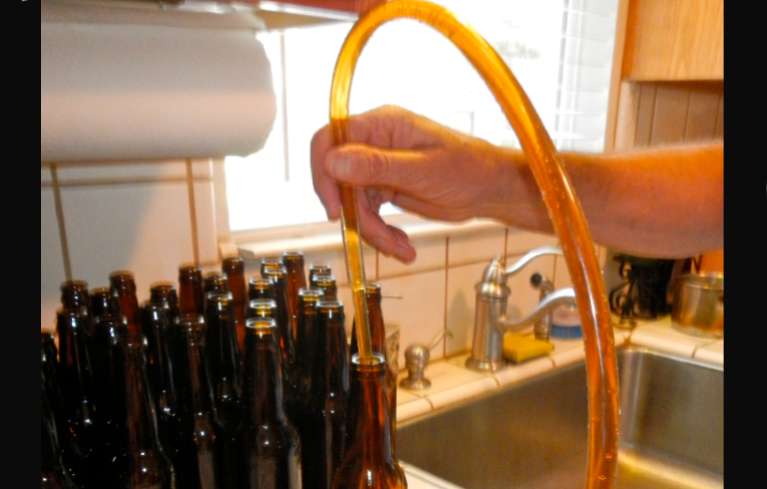
A stopper allows for the perfect amount of beer to fill each bottle. Photos/Kathryn Reed

A stopper allows for the perfect amount of beer to fill each bottle. Photos/Kathryn Reed

The fermentation process takes two weeks – one week to ferment, one to settle. At the bottom of the glass container is what looks an inch worth of yeast. It’s important none of that ends up in the bottles that will be consumed.

Those large containers are soon drained into another bucket where corn sugar that has been dissolved in hot water is added. This has to do with the carbonation process.

The brewing part he does outside with a propane tank. He said it smells too much to do it inside. It can take four to five hours to brew.

Loehrer has been brewing his own beer for more than 20 years. He admits they weren’t that great to begin with. But experience makes a difference.

In 2009, he entered his first and only competition – the California State Fair. He entered three beers. The Belgian Ale earned a second place and the Amber Ale third place.

The water, yeast and hops all can make a difference in the end product. He refuses to use tap water because most water companies add chlorine – South Tahoe PUD included. This is why he insists on purified water.

When Loehrer first started he was using dry yeast. Now he swears by liquid yeast.

He whips up a batch of beer a few times a year. The busy season is Christmas because his hobby has turned into a gift for others.

While he likes his Honey Ale, Porter and Belgian Ale the best, he does drink beers that he hasn’t made.

A raspberry wheat he made was a big hit with friends. Some people have asked to buy a six-pack or case, but he wants to stay away from the legal issues of doing that. He’s good with sharing.

One thing Loehrer says is important is sterilization. From the caps to the bottles to the tubes that transfer that liquid amber – they all go through at least one sterilization process.

He can buy a case of bottles for about $7. The theory of using the brown bottles is that they let less sunlight in.

While Loehrer created labels, he quickly realized that getting them off for the next batch was time consuming. Now he puts a tiny sticker on each bottle cap so people will know what they are about to ingest. Those all get thrown away, while bottles can be reused.

The capping process, while a bit labor intensive, is still easier than what he first used. This is more like a hand press.

In about a month the beer will be great for consuming. The 3-week-old Honey Ale was tasting pretty darn good on this bottling day. Loehrer said a brewer must imbibe while brewing and that those in the room must do so too – it’s all about tradition.

ngg_shortcode_0_placeholder (Click on photos to enlarge.)


El Dorado County Sangiovese scores at State Fair

Sierra Foothill wines were judged among some of the best in the California State Fair’s commercial wine competition.

Judges had 2,625 wines to rate.

Tying for best Sangiovese in the state were El Dorado County wineries Boeger Winery and Windwalker Winery.

Crystal Basin Cellars, also in El Dorado County, was rewarded for being the best Syrah.

While Macchia Winery is in Lodi, it used grapes from Amador County to create California’s No. 1 Zinfandel.


Placerville winery transports guests to Italy

By Kathryn Reed

PLACERVILLE – Pam is back in Tuscany. Sue is in heaven. And I don’t want to leave.

Wine glasses keep being filled and plates of divine food are continually placed in front of us.

To set the mood even more, our sommelier, Orietta Gianjorio, has an Italian accent. It was only five years ago that she moved to the States from Rome. She educates us about the wines we are drinking and how they are bound to complement the food.

Our chef for the day comes across more of a free spirit who could be at home in Tahoe. After all, he spent some time as a ski bum in Breckenridge. But Damon Barham’s cooking pedigree is more prestigious, having attended the California Culinary Academy Le Cordon Bleu. He is now an instructor at the San Francisco school and chef at their Technique Restaurant.

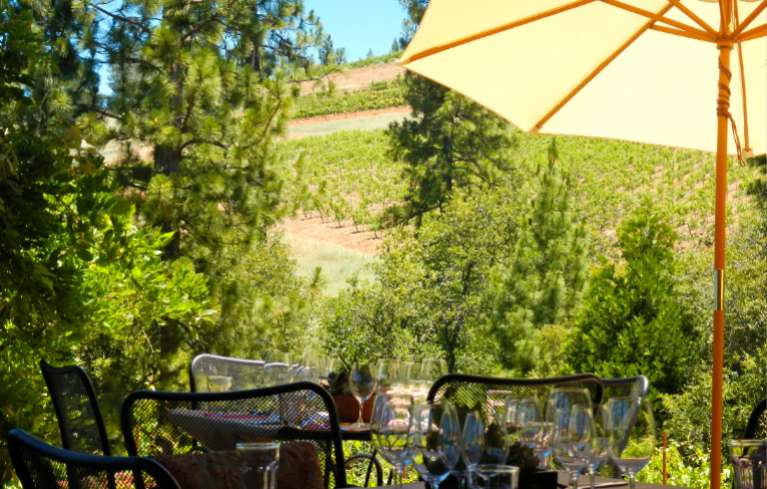
Miraflores Winery allows guests to dine among the vines on summer weekends. Photos/Kathryn Reed

Miraflores Winery allows guests to dine among the vines on summer weekends. Photos/Kathryn Reed

Pam was our tablemate last Saturday afternoon at Miraflores Winery. She came up from the Bay Area for this four-course lunch and wine pairing.

Sitting outside on the terrace with the vineyards a stone’s throw away reminds Pam of her recent trip to Tuscany where the villa she stayed at was on a working winery.

This is the third summer the Placerville winery has put together a chef and sommelier to plan a weekend lunch. The duo does the lunch Saturday and Sunday, with each weekend through October being a different pair.

“It’s becoming a bit of a competition,” Miraflores General Manager Matricia Haigood says in how she goes about selecting the chefs. “We let them cook anything they want.”

With each weekend being a new event, Haigood said it’s common for people to attend more than one lunch throughout the summer.

It’s up to the sommelier to pick whatever Miraflores wine she wants to go with each course.

“My first and main inspiration is what is in season,” Barham tells Lake Tahoe News.

He sent Gianjorio his menu and from there she decided what to pour.

“Damon is a young chef and likes to try things. I wanted the attention to last to the last bite,” Gianjorio explained. “That is why I try to keep the wines light.”

This was the menu on June 22:

• First Course:

2012 Barbera Rosé

Asparagus soup shot with dry jack puff

• Second Course:

2012 Pinot Grigio

Miraflores estate “smoked” trout salad with arugula, brioche, cherries and almonds

• Third Course:

2007 Syrah

Late spring lamb stew with artichokes, polenta fries and caponata

• Fourth Course:

2009 Botricelli

Strawberry-rhubarb and frangipane tartlet with lavender-white chocolate mousse.

Vegetarians are welcome with advance notice. I was served the salad without the trout – which Pam and Sue said was a shame because it was the highlight of the salad.

Pam said the cherry dressing brought out the flavor of the trout.

The chef said he made his own brine to make it taste like it was smoked.

I was still wishing the soup had been more than a shot. A big bowl – not even a cup – would have been more to my liking.

But the presentation made it fun and whimsical. Barham comes out of the kitchen to each table with a pitcher full of the chilled soup that he pours into tall shot glasses that each have two asparagus tips in them. It’s served with a cheese stick that can be used as a spoon or dipping utensil before one throws back the soup like a shot.

One of the things Miraflores owner Victor Alvarez likes about these lunches is the chefs “talk to the people. They don’t hide in the kitchen.”

The caponata with the entrée has the three of us in search of yet another superlative.

The chef tells us he used a pressure cooker for the tomatoes. It is their natural sweetness that makes this relish of sorts that is dominated by eggplant have such a sweet flavor.

The Syrah is a fabulous choice for this dish. Pam and Sue agree – especially with the lamb.

While I’m not one to usually like sweet wines, the Botricelli has me thinking otherwise. Some of the strawberries used in the dessert were soaked in the wine.

There is no rush to eat or drink. We have the table for the afternoon if we want. Miraflores has learned a second seating isn’t possible because some people make the lunch a daylong event.

—-

Notes:

• More info about the pairings may be found online.

• Lunches go through Oct. 27.

• Cost is $40.

ngg_shortcode_1_placeholder (Click on photos to enlarge.)


Athletes rethinking what to eat

By Aaron Gulley, Outside

There’s a trend in some cycling circles away from drink mixes and back toward real, whole foods. Osmo Nutrition puts it succinctly with their catchy tag line, “Hydration in the bottle, food in the pocket.”

That might sound ridiculously basic, but it’s actually unorthodox thinking compared to the all-in-a-bottle strategies that many athletes have adopted.

bookIt’s also not as easy as it sounds. Finding foods that are nourishing, palatable while going hard, compact, and easy to carry and eat while riding can be surprisingly difficult. Sports physiologist Allen Lim, owner of Skratch Labs and a proponent of whole foods for athletes, recognizes this obstacle. His first book, “The Feed Zone Cookbook: Fast and Flavorful Food for Athletes”, co-authored with chef Biju Thomas, included 12 recipes for homemade energy bars. The book was chock full of things to eat before and after exercise, but Lim’s variations on the rice cake were the true sensations.

Now Lim is back with a second edition that’s devoted entirely to homemade foods for eating while exercising. Released in late May, “Feed Zone Portables: A Cookbook Of On The Go Food For Athletes” has 75 recipes, including lots of vegetarian gluten-free options.

In addition to a new set of rice cake variants, Lim fills out the table with nutritious recipes for baked cakes, two-bite pies, waffle sandwiches, baked eggs and soufflés, rice balls, and cookies.

The recipes are simple, with generally eight ingredients or fewer, and take little time to prepare. There’s great advice for wrapping and packing the little treats for easy consumption on the bike, and, having tried a number of the new portables, we can say that they are as delicious as the previous iterations.

Convenience is probably the No. 1 reason athletes choose pre-packaged bars, gels, and liquid fuel, and while Lim acknowledges that his recipes require more time and energy than just cracking a PowerBar, he puts forward a strong argument for making the effort.

Here are a couple of our favorite portable recipes from Lim’s new book. For a full menu of bars and cakes, purchase Feed Zone Portables here.


K’s Kitchen: A salsa without tomatoes

By Kathryn Reed

When the family gathered last weekend we were all asked to bring an appetizer to share. My sister, Jann, made the recipe below.

I would not have thought of turning cherries into a salsa. It was so yummy I tried to keep the bowl in front of me.

k's kitchenCherries are one of those fruits I didn’t like much growing up. I barely could just eat a plain cherry, and I would always turn away ones that were cooked. It amazes me how our taste buds change – evolve? – through the years. That’s why I always like to try foods again that in the past I knew I didn’t like.

And cherries are still at the Tahoe farmers’ markets. The Ski Run market in South Lake Tahoe opens this Friday. It runs from about 3pm to 8pm.

While I have not made this recipe, I can recommend it. It comes from Kathy Morrison at the Sacramento Bee who created it by adapting several others.

Jann served it with pita chips.


Cherry Salsa

2 C sweet cherries, stemmed, pitted and chopped

¼ C red onion, finely chopped

½ C chopped fresh cilantro leaves

Zest from 1 lime

Juice from 1 lime

1 jalapeño pepper, seeds removed, minced

1 clove garlic, minced

Salt and pepper to taste

Mix all ingredients in a medium bowl until well combined.

For best flavor, chill for an hour. Stir again before serving.


Study: Red meat linked to diabetes

By Allison Aubrey, NPR

You’ve likely heard about the link between sugar consumption and Type 2 diabetes. But fresh research ties another dietary pattern to increased risk of the disease, too: eating too much red meat.

It’s not that we are trying to pick on meat (I’m a meat-eater, in moderation), but the recent studies linking carnivorous habits to health problems seem to be piling up. We’ve had Salami Suicide and Death by Bacon. Now, there’s a new study that links red meat consumption to an increased risk of Type 2 diabetes.

The researchers tracked what happens after people changed their meat-eating habits, using data from the Health Professionals Follow-up Study and the Nurses’ Health Study, which include about 100,000 people. Diet was assessed by food frequency questionnaires.

“Some people [in the study] increased their red meat consumption and other people decreased their consumption,” says Dr. Frank Hu of the Harvard School of Public Health, one of the co-authors of the paper, which appears in JAMA Internal Medicine.

The study found that among those who started eating more red meat, about 3.5 servings more per week, the risk of developing Type 2 diabetes during four years of follow-up increased by almost 50 percent, which Hu describes as “a really large increase.”

As with previous studies linking red meat to health concerns, the researchers found that processed red meats such as hot dogs and bacon were more strongly associated with the risk of diabetes.

Among those who starting eating less red meat, the risk of developing diabetes dropped by about 14 percent during a 10-year follow-up period.

Now, to put this study in context, it’s important to point out that the most significant driver of Type 2 diabetes is body weight. People who are overweight and obese are much more likely to develop the condition.

Since red meat is typically high in calories and fat, some experts say that it’s likely these factors that create the link between heavy red meat consumption and and increased risk of diabetes.

But in this study, the link held up even after the researchers controlled for the role of weight gain. And this suggests that there’s an independent effect of red meat consumption increasing the risk of diabetes.

It’s not clear what’s happening in the body, but there are a few theories. It’s possible that heavy red meat consumption can lead to iron overload, which sets the stage for insulin resistance.

It’s also possible that compounds called nitrosamines play a role.

“Our understanding is that, especially [when they occur in] processed meats, these nitrosamines can cause inflammation,” explains Dr. David Nathan, who directs the diabetes center at Massachusetts General Hospital.

And there’s also some evidence that nitrosamines can damage the cells in the pancreas that make insulin. But experts say more research is needed to understand these connections.

In the meantime, Nathan says his advice is to pay attention to the big picture. If you like the occasional hot dog, that’s OK. It’s the overall pattern of eating and maintaining a healthy weight that’s most important.

“Red meat should be considered in the setting of a balanced diet,” says Nathan.


K’s Kitchen: Serving up a winning appetizer

By Kathryn Reed

Sports psychologists have made a living trying to figure out why people win or lose and the speed and consistency at which they do so.

But I have never read about food being a motivator.

k's kitchenI think it must be for the Zephyr Cove 3.5 women’s team. They dominate at home, having won the last two matches 5-0. And it is the home team that provides the food and beverages after a match. (OK, there is a whole lot of talent on that team, too!)

I have played on USTA teams in Las Vegas and the Bay Area – the food is nothing like what these women serve. While I started the season on the Zephyr team known as Lake Aces, I am no longer a member because the USTA thinks I’m really a 4.0 – but that’s another story.

I am still an eating and drinking member of the team.

Below is a recipe for a dish that Suzy brought to one of the matches. Her teammates and the opposition devoured it. She originally got it from her friend Heather.

 Pesto Pistachio Cheese Torte

Pesto

2 cloves garlic

1 C fresh basil

1 C grated Parmesan

½ C olive oil

Blend pesto ingredients in food processor. (Can be made in advance and refrigerated.)

Garlic Cream

8 ounces cream cheese (softened)

2 T butter

1 clove garlic (minced)

2/3 cup shelled and roasted pistachios (chopped; reserve 2 T for sprinkling on top.)

Black pepper (pinch)

Blend garlic cream ingredients either by hand or in food processor.

Other

1 lb provolone (deli thin sliced)

¾ C sun dried tomatoes packed in oil (not drained/chopped)

Select two bowls or one loaf pan for the mold. (Ideally nothing with an inverted lip.) Generously grease inside with olive oil. (It’s nice to make two versus one … your choice!) Line the bowls/pan with half provolone. Leave about ½ inch excess to fold over sides. Press edges together to seal. Spread half pesto on provolone. Add a layer of provolone. Spread half of the tomatoes. Spread all of the garlic cream. Spread remaining tomatoes. Add another layer of provolone. Spread remaining pesto. Top with final layer of provolone. Fold excess provolone from sides over top and place in fridge to set for about an hour. (It can be kept in a cold part of fridge for up to a week.)

Serving suggestions:

Invert on to a plate or platter. Slice in half to reveal layers and wedge open. Sprinkle reserved pistachios over top and on platter for effect. Add pretty basil leaves for a nice presentation. Best served with crustini but may use crackers in a pinch.

Crustini:

1 sourdough loaf (good quality such as Truckee Sourdough or bakery fresh)

Spray can olive oil.

Slice thin slices on baking sheet, spray with olive oil. Broil until golden. Turnover and spray other side, broil until golden.


South Lake Tahoe restaurateur judges State Fair wine competition

By Evan Williams

SACRAMENTO – The announcements, introductions and instructions have been dispensed with. You wait patiently at your table and the sound of faintly tinkling glassware grows louder as carts laden with wine glasses, each filled with 2 ounces and labeled with a numerical code, begin to parade into the hall. The glasses are lined up in front of you with great care by the stewards. Your panel assistants have provided you with pencils, water, palate cleansers, and a large spit bucket because there is no swallowing. Your clerk provides you with the scoring sheets and now your job begins.

You, and the other three judges on your panel, combined with the other 68 judges in attendance now must determine the good, the bad and the ugly from the nearly 3,000 wines submitted to the California State Fair Wine Competition.

Let the fun begin!

South Lake Tahoe's Evan Williams at the 2013 California State Fair wine judging. Photo/Provided

South Lake Tahoe’s Evan Williams at the 2013 California State Fair wine judging. Photo/Provided

Well, actually, we try to make it fun and lighthearted, but it really is pretty serious business, and surprisingly taxing – not physically, but mentally.

I am always mindful that some very hardworking winemaker has poured their blood, sweat and tears into the wine I am about to examine. But I must try to fairly and objectively evaluate this wine and, to the best of my ability, score it in a way that will hopefully aid the retail purchaser looking for good quality and value in their wine purchase.

I’ve been judging wines since the late 1980s and have worked this competition since 2001. In that time I’ve seen an evolution in the process from the old “retain or eliminate” format through the “Peterson Method” (named for Dr. Richard Peterson, this is an evaluation process I personally favored, but which could result in the daunting prospect of having as many as 80 to 100 wines on the table at once) and now back to lower volume flights. New this year were computerized entries with a wireless terminal at each panel; greatly helping the clerks in their jobs and expediting the scoring process.

It is the nature of wine competitions that, with few exceptions, the super-premium producers do not submit their wines for judging, nor would it make any sense for them to do so. First, they sell out every vintage, so they really have no need to promote any further. Secondly, they are in a no-win situation. If they win a gold medal, people would say, “Sure they won a gold, look at the price they charge!” And if they don’t win a gold, even harsher criticism befalls them, “Look at the price they charge for those wines and they can’t even get a gold!”

So what you have at these events are primarily two categories of producers. The high-volume vintners hope they can benefit from having their less expensive wines favorably scored so they are able to market them as good quality wines and a great value. Then there are the smaller and/or newer producers who have limited marketing dollars and staff, but are able to capitalize on good competition results in press releases and in their tasting rooms, and don’t all those pretty ribbons and medals look nice on the wall?

Becoming a judge

What does it take to become a wine judge? Well, you need to taste a great deal of wine! As a buyer for the last 35 years, I am fortunate to have wine show up at my door on a frequent basis. And I do try to taste everything. But it’s important also to know what you are tasting, as well, and to be able to identify faults, flaws and additives. And that’s where experience, and the UC Davis Advanced Tasting Seminar, comes in.

This is a fundamental, yet fairly intensive wine class that will give you a sound basis for evaluating wines, covering most of the more common defects you might encounter in wines and allow you to test your sensory evaluation capabilities. Then a prospective judge must pass the Sensory Evaluation Exam, as administered by UC Davis, after which the fair officials will accept your application to be a judge.

The California State Fair Wine Competition is the only one that requires all judges to be credentialed.

Starting the process

In professional wine judging (and in the restaurant business, too), there is the problem of inherent differences in individual palates, a phenomenon which was documented in some groundbreaking work by Tim Hanni, MW, who was invariably puzzled as to how two people could taste the same wine and have such remarkably divergent opinions about it (and how this leads to sometimes emotional disagreements on judging panels). In his research, Hanni discovered that it really just boils down to genetics.

Some people are born with significantly more papillae on their tongues than other people, and there’s not a thing to be done about it. Those with the most papillae are referred to as “hyper-sensitive” and comprise roughly 25 percent of the population. (There is actually a small subset of this group called “sweet tasters” who are quite literally are the proverbial “sweet tooths”.) Then there are the approximately 50 percent in the middle who are called “sensitive” and then there are the remaining 25 percent who have the least amount of papillae on their tongues and are known as “tolerant” tasters.

The tolerant tasters typically enjoy hot and spicy foods, big, tannic red wines, martinis and single malt scotches along with IPA beers and cigars. The hyper-sensitive tasters are always trying to mask bitter; bitter is their mortal enemy. They drink their cream “with a little coffee in it”, usually sweetened heavily. They cannot tolerate grapefruit or artificial sweeteners such as may be found in diet sodas, and given their preference, will gravitate toward white and even dessert style wines. They also are big on salty snacks, and you might think that a contradiction for the “hyper-sensitive” to be salt hounds but again, it is all in the effort to mask bitterness.

Typically, the “hyper-sensitive” will have a more heightened olfactory (and even auditory) sense, as well. The nose is really where most of the heavy lifting of wine appreciation takes place. The tongue is a relatively crude instrument, detecting sweet, sour, salty and bitter, as well as “umami”, another discovery for which Hanni is credited.

“Umami” is a term used to describe the savory sensation of most meat proteins. In the aforementioned “Peterson Method” a taster could evaluate larger flights of wines by first relying purely on the nose to begin to differentiate and then rank the wines into groupings, again based solely on the bouquet and aroma of the wine. (I found this to work well for me.) In a large flight you might spend an hour or more establishing a ranking based on the nose before you even begin to taste a single wine. With rare exceptions, an attractive smelling wine will be pleasant in the mouth as well, but evaluation obviously requires wines be tasted for acidity, sweetness, flavors, mouth-feel and finish.

Then the rankings are further adjusted after tasting to allow to best wines to ascend to the top.

It’s no great surprise that most chefs are “hyper-sensitive”, as am I, and I have a nose like a bloodhound, which can be a curse at times. My wife, on the other hand, is “tolerant” (some may say she would have to be to live with me) so we complement each other nicely. She eats all the hot food and drinks the Grey Goose and I eat the M&Ms and drink the Chardonnay. (I am still able to evaluate and score big, reds but it’s not what I would generally choose to do. Given my druthers I usually opt for whites and frequently end up judging Chardonnays, something a great many judges find boring and tedious, but a long day of Petite Sirahs and Zinfandels will absolutely scorch my palate).

Working together

This year my gracious panel mates were Carol Shelton, owner-winemaker of Carol Shelton Wines and the “Queen of Zinfandel”; Chris Macias, food and wine writer for the Sacramento Bee; and David Crippen, director of winemaking for Renwood Wines, right in our own backyard of Amador.

We enjoyed fairly good consensus and more than our share of laughs. It really helps if things don’t get too tense on a panel. But what happens when you get a “hyper-sensitive”, two “sensitives” and a “tolerant” on a panel? You end up all over the map and it can get to be a very trying scenario. There’s a certain amount of “horse trading” which goes on in every panel, and you just have to give up some ground sometimes in hopes of getting some back later. Everyone will push for their favorite wines and if you don’t help out a little, you won’t get any love back when it’s your turn to push your favorites. So you have to go along to get along. Usually it’s a pretty equitable process.

It was a time of change for the California State Fair Wine Competition this year as longtime (26 years) chief judge G.M. “Pooch” Pucilowski has moved on and was replaced by Sacramento Bee food and wine writers and venerable judges, Mike Dunne and Rick Kushman.

Many new judges appeared this year as well. Transitions are always fraught with little glitches and this was no exception. But it seems the event is in capable hands and will go forward fairly seamlessly. Kem Pence keeps a steady hand on the proceedings and the staff and volunteers (over 100). They always go above and beyond the call of duty to see to it that things go smoothly. It is a big event with a lot of moving parts, and I am always impressed with the fluidity with which it runs.

The “Continuing Education” Judge’s Seminar this year was an outstanding presentation on oak flavoring products as produced by Oak Solutions Group, and how this is such a remarkable asset for the winemaker to have in their “tool kit” to not only save money on very expensive oak barrels, but customize flavors and toast levels with more than 100 different oak profiles from which to choose. As a self-confessed “oak whore” this is really cool stuff, and perhaps a topic for another piece.

Evan Williams is the owner of Evan’s American Gourmet Cafe and Cantina restaurants in South Lake Tahoe.


Glut of coffee beans on market

By Alexandra Wexler and Leslie Josephs, Wall Street Journal

When coffee prices climbed to multi-year highs in 2011 on a scarcity of high-quality beans, farmers revved up investments in their plants, adding fertilizer, pruning trees and planting more productive varieties.

But the buzz didn’t last long. The result was a glut of beans that has sent prices to the lowest level in nearly four years.

Welcome to the coffee bust.

Cycles of boom and bust have long defined the coffee market, with Brazil, which at present supplies one-third of the world’s beans, at the epicenter.

When coffee prices plunged during the Great Depression, Brazilians burned it on land and threw some of it out to sea.

“They tried to make roads out of coffee beans, make it into asphalt,” said Mark Pendergrast, author of Uncommon Grounds: The History of Coffee and How It Transformed Our World, referring to other coffee busts. Brazilians even “tried to make plastic out of it.”

While prices for other agricultural commodities like corn and cotton also rise and fall based on supply and demand, arabica-coffee trees take at least three years to grow, so the production response to high prices is often more gradual.

The last coffee bust was in 2001, when prices dropped to almost 40 cents a pound, about a third of the current price. It was so bad that it is still known in the coffee world as “The Crisis.” Farmers ripped trees out of the ground and skipped applications of pesticides and fertilizer on those left standing.

But this time, the coffee bust has come in the wake of rapid economic growth in Latin America, where most of the world’s arabica beans are grown. That has proved both a blessing and a curse for farmers.

Much of that decade-long growth was fueled by rising global demand from China for the region’s rich mineral and agricultural resources. The inflow of cash has enabled big coffee-growing countries in Latin America, like Brazil and Colombia, to support farmers when prices are low and control supplies that hit international markets.

“The (Colombian) government has never had the revenue it has had today,” said Mauricio Galindo, head of research at the International Coffee Organization.

But economic growth has also spurred inflation, and the cost of production has climbed as well.

“It’s worse than ever,” said Christian Wolthers, president of Fort Lauderdale, Fla.-based coffee importer Wolthers America. Wolthers started his career in Brazilian coffee four decades ago. “It becomes worse because you have inflation and you have increased prices for all coffee management tools and products,” including fertilizer, he said.

But prices may soon find a low point, investors and analysts say.

“While harvest pressure will likely weigh on prices in the short term, we continue to expect a rebound in the space in the second half of 2013,” Chris Narayanan, head of agricultural commodities research at Societe Generale GLE.FR +1.08%, said in a note. He sees expectations for lower supplies in the coming season boosting the price of arabica coffee to $1.57 a pound in the fourth quarter of the year.