Raspberry bars good enough for athletes

By Kathryn Reed

Refueling is always a good thing to do after an athletic endeavor. The tennis team I was on earlier this season had no problem doing this – at least at home matches.

It is the home team’s responsibility to provide the food after the match.

k's kitchenIn previous leagues I played in it was oranges, bananas and water. Not so with the bunch.

While fruit and water are available, what this group puts out is almost like a gourmet buffet.

I have not made the recipe below, so I don’t know the difficulty, if any, involved, but I can tell you they are yummy. Maybe they should be served at Wimbledon instead of strawberries and cream.

Carel brought these raspberry bars twice. They were devoured. The original recipe is from Scott Peacock, contributing editor to Better Homes and Gardens.

Fresh Raspberry Bars

1 C unsalted butter (2 sticks) cut into 1-inch chunks

¼ C packed light brown sugar

½ tsp kosher salt

2 C unbleached all-purpose flour

softened butter (for brushing sides of foil)

¾ C seedless raspberry jam or preserves

1 pint (2 cups) fresh raspberries

Half 8 ounce package cream cheese, softened

4 ounces goat cheese (chevre) or 4 oz. cream cheese

½ C granulated sugar

1 T unbleached all-purpose flour

1 large egg

1 egg yolk

2 T finely shredded lemon peel (zest)

2 T freshly squeezed lemon juice

½ tsp pure vanilla

Powdered sugar

Preheat oven to 350 degrees. Line a 13x9x2-inch baking pan with a 24-inch-long sheet of aluminum foil, leaving extra foil extending over ends (use these later to lift bars from pan); set aside. In a large bowl beat the butter with an electric mixer on medium to high speed until it just begins to blend and soften slightly, about 30 seconds.

Add brown sugar and salt, beat on low speed until incorporated, 30 seconds to 1 minute. You’re not trying to cream it, you’re just mixing it in. With mixer off, add the 2 cups flour. Beat on low speed until flour is incorporated. Increase speed to medium, mix until ingredients form an even, cohesive dough.

Break dough into small chunks and distribute in prepared pan; with your fingers press dough into an even layer. Bake 20 minutes or until dough has begun to puff and is just set. Cool on wire rack 5 minutes.

Lightly brush exposed sides of foil with softened butter to keep filling from sticking. Spread jam evenly over crust.

Sprinkle evenly with raspberries.

With a lemon zester, remove peel from lemon, making sure to avoid bitter white pith.

In a large bowl beat cream cheese and goat cheese with an electric mixer on medium to high speed for 30 seconds. Mix in granulated sugar and 1 tablespoon flour until blended. With mixer running, add egg, egg yolk, lemon zest, lemon juice, and vanilla. Beat until smooth.

Pour custard batter evenly over berries. Tilt pan back and forth to distribute evenly. Bake at 350 degrees F for 25 to 30 minutes or until barely set. Transfer to a wire rack until completely cool, about 1 hour; cover and transfer to refrigerator. Chill 2 hours. Top will crack slightly as it cools.

Use foil to lift the bars from pan. With a knife or metal spatula, support the sides of the bars while you gently peel the foil downward and away from sides of the bars.

Cut into long bars, peel foil from bottom, and transfer to cutting boars using side of a long knife or spatula. Cut into 24 squares

Sprinkle very lightly with powdered sugar.


Inmates cleanup in county fair culinary categories

Since 2007, El Dorado County inmates in the South Lake Tahoe Jail have amassed more than 70 first, second, and third place ribbons at the county fair. This year was no exception.

The inmates in the culinary arts program earned 31 ribbons: 12 firsts, 11 seconds, and six thirds.

In 2007 the El Dorado Sheriff’s Department formed a partnership with the Lake Tahoe Community College to expand the college’s existing culinary arts program to the sheriff’s Tahoe jail. Every year the inmates test their quality by entering the El Dorado County Fair in the Baking and Fiery Fair categories.

The inmates develop not only cooking and baking skills, but pride and life skills as well, which leads to an improved chance of not returning to jail. Many of the inmates quickly find jobs, not only in restaurants, but also gain employment due to the work ethic and skills learned in the program.

Some of the inmate County Fair winners for 2013 were:

Justin Bozarth: Third Place Cranberry Orange Bread, Macaroons

Joseph Genobaga: Third Place Cinnamon Rolls, Pros & Cons Cake

Robert Nieri: Third Place Grandma’s Cookies, Golden Honey Granola Bar

David Martinez: First Place Raspberry Swirl Coffee Cake

Agripino Meza: First Place Fibulas Fig Preserves

Derek Bond: First Place Banana Nut Bread, Chocolate Cream Pie, Second Place Spicy cookie

Chris Hunter: First Place Pumpkin Bread, and Second Place Bundt Cake

Hollee Johnson: First Place Lemon Bread, and Second Place Cinnamon Rolls, Coffee Cake, Meringue Mushrooms, with Third Place- Caramel Popcorn

Ben Sharp: First Place Florentine Cookies, and Second Place Zucchini Bread Pecan Bars.


Wine event benefits library chapter

The eighth annual Wine For Words fundraiser for the Friends of the Library Placerville Chapter is Aug. 25 from 4-8pm at the Placerville Library, 345 Fair Lane.

Kevin Smokler, author of the book “Practical Classics—50 Reasons to Reread 50 Books You Haven’t Touched Since High School,” will be the guest speaker.

Tickets are $50 per person with limited seating available. Buy tickets at the Placerville Library at 345 Fair Lane, Placerville, or from Face in a Book bookstore in the El Dorado Hills Town Center.

For more info, call (530) 621.5540.


Pepsi slow to remove carcinogen from soda

By Allison Aubrey, NPR

In 2011, California created a problem for the soda industry.

The caramel color that Coke and Pepsi used to give colas that distinctive brown hue contained a chemical, 4-methylimidazole — 4-MEI — that is listed as a carcinogen by the state.

And in accordance with California’s Proposition 65 law, the levels of 4-MEI found in sodas would have warranted a cancer warning label on every can sold in the state.

So, as I reported last year, Coke and Pepsi both said they would switch to a reformulated caramel color, one that did not contain 4-MEI.

Now, it appears that both companies have managed to complete this transition for sodas sold in California.

But a new analysis by the Center for Environmental Health found that 10 of 10 samples of Pepsi products purchased nationwide during the month of June (in locations outside California) contained levels of 4-MEI that were about four to eight times higher than the safety thresholds set by California. The testing was conducted by Eurofins Analytical laboratory in Metairie, La.

In contrast, nine of the 10 samples of Coke products purchased in locations outside California contained little or no trace of 4-MEI.

“We applaud Coke,” wrote Michael Green, executive director of the Center for Environmental Health, in a release announcing the findings.

“Pepsi’s delay is inexplicable,” Green added. “We urge the company to take swift action.”

A Pepsi spokesperson tells NPR that sodas sold throughout the U.S. should complete the transition to the new caramel coloring by February 2014. The company says efforts are also under way to switch the color formulation for sodas distributed globally.

“The FDA and other regulatory agencies around the world, including the European Food Safety Authority and Health Canada, consider our caramel coloring safe for use in foods and beverages,” Pepsi Co. wrote in an email to NPR.

So, are the higher levels of 4-MEI found in sodas using the old formulation a threat to human health? Well, consider the dose.

The FDA issued a statement last year, before the formulation of caramel coloring was changed, stating that a consumer would have to drink more than 1,000 cans of soda a day to reach the doses that have been shown to lead to cancer in rodents.

And the American Beverage Association wrote in a statement last year that “the science simply does not show that 4-MEI in foods or beverages is a threat to human health.”


Tahoe is all about the outdoors — including eating

By Susan Wood

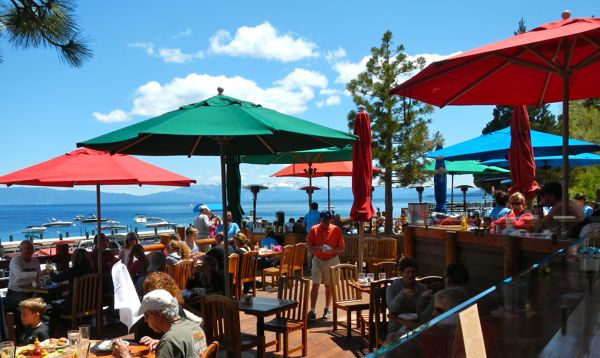
If Belgium can allow France to claim its fries, then maybe Spain will surrender its honorary al fresco dining niche to the United States – if only for a day.

After all, it’s the Fourth of July – America’s signature holiday that marks a summer fun of eating, drinking, schmoozing, relaxing and taking in one’s outdoor surroundings.

Al fresco is the Spanish derivative of “outside at a fresh temperature.” It’s a type of dining that’s popular in the summer and is designed to promote pedestrian activity. Think Paris, then transport yourself.
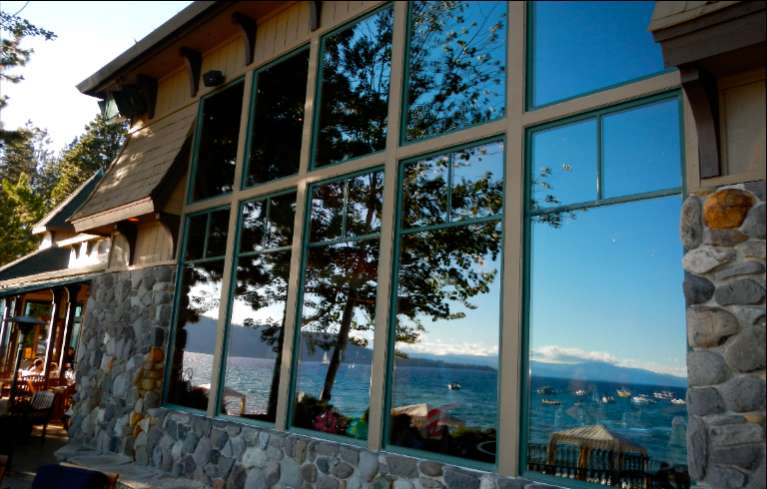
Lake Tahoe reflected in the windows of Lone Eagle Grill in Incline. Photos/Kathryn Reed

Lake Tahoe reflected in the windows of Lone Eagle Grill in Incline. Photos/Kathryn Reed

Flanked by the Sierra Nevada mountain range, the Lake Tahoe region has no shortage of such places to take your dining party outdoors. The options on each shore range from the very childlike and biker babe-like to beach party-ish and elegant settings steps from a fine dining restaurant.

Some places scream tourist. Others are known as local hangouts. Several mix them up.

A few offer mountain scenery. Many provide lake views.

High marks go to the Lone Eagle Bar and Grill in Incline Village. Its patio seating, albeit limited, provides the epitome of relaxation outside its indoor bar and restaurant. Cushy, padded seating on the wooden chairs and chaise lounges let you settle in next to the beach. Don’t be surprised to see chairs set up for a wedding on the shoreline. Order a concoction from its creative cocktail list and the mushroom pizza off the appetizer menu.

Music that’s not overbearing is piped in to add to the ambiance. Watch the boats go by as the sun sets across the wide swath of lake. If you find you’re just not close enough, there’s always the pier bar where a patron may sit inches from the water.

“I feel like I’m on the water,” one woman said, enjoying the lakefront view with her friend.

Even the employees like being there.

“This is definitely the best job for the view,” bartender Shane said.

Looking west, over the water

Few places can lay claim to being at a bar so close to Lake Tahoe. One of my past favorites that made me a no show twice was the West Shore Café in Homewood across from the ski resort. First, it wasn’t open in early June, then it was closed for a wedding last Saturday. Their loss.
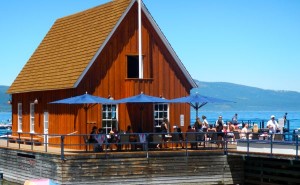
Chamber's Landing

Chamber’s Landing

Chamber’s Landing may be an alternative for some, but not for those seeking more of a local connection to Tahoe. The pier bar seems all about the tourist – without the service. Get your own so-so drink that tries to be a knock-off of the Rum Runner of the Beacon fame.

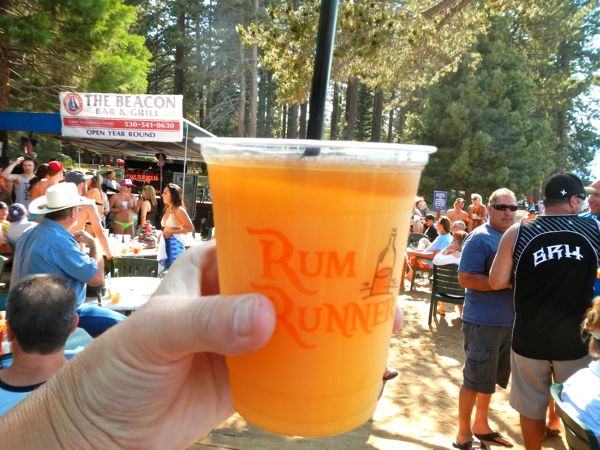
The Beacon near Camp Richardson on the South Shore is the proverbial beach-bar-party scene on hot summer weekends. Live bands crank out the rock ‘n’ roll outside where you can sink your toes in the sand and people watch for hours. Expect lots of skin. The seating is closely guarded by security on busy days, but the staff is
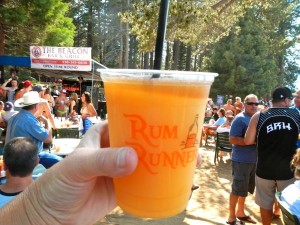
Beacon at Camp Rich

Beacon at Camp Rich

friendly about their jobs. No dogs and no taking your drinks out of the restaurant domain.

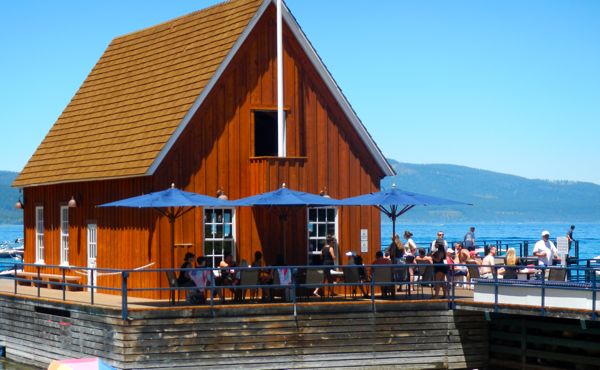
South Lake Tahoe’s version of al fresco on a pier has made a painful transformation from the late Blue Water Bistro. The Boathouse says cheap all over it the minute one arrives and leaves on what looks like an oil pan for a parking lot. The picnic tables are funky, the signs are nonexistent, the food is incredibly limited and the service is remarkably slow, which is too bad. (I will always love walking on that pier.)

Down Highway 50, the Riva Grill at the Ski Run Marina is set back from the shoreline but gives the diner a sense of being there. The seating is a bit crammed outside, but maybe after a few Wet Woodys it’s not as noticeable. (Here’s a hint: Either sit high on the wooden bench and not in the cheap plastic chairs in the aisle or sit inside next to the large picture windows.)

Another marina boasts a popular place in the Tahoe Keys. The Fresh Ketch may also leave a “cheap” feel with its plastic furniture on the grass outside its superb indoor bar setting, but it gets major points for providing a two-hour courtesy for boat-in dining to kayakers and canoers. The staff is friendly and the drinks are good. Diners will get a kick out of reading the boat butts with cutesy names.
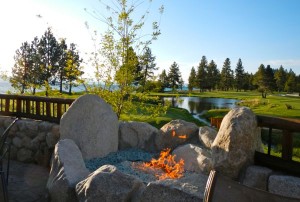
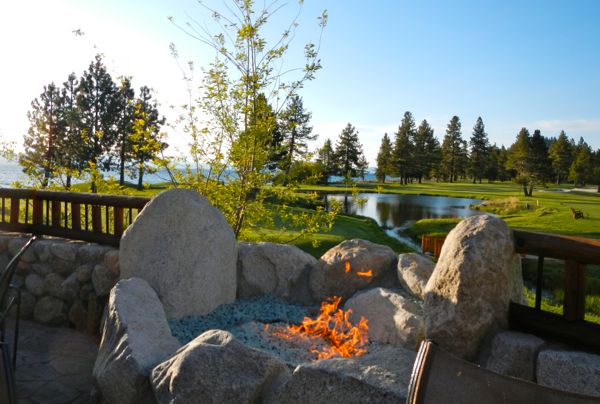
Brooks Bar

Brooks Bar

Tied with Lone Eagle for the best lakeview experience is by far Brooks Bar at Edgewood Tahoe Golf Course. The best mojitos here meet the best lake setting with the golf course on one side and the lake on the other. The lapping waves beckon you to the beach. The golf course greens call for a roll in the grass. If it’s nippy or if you just want ambiance on the patio, belly up to the fire pit and ask for a heater lamp. The staff would be happy to accommodate.

A close second to the other two is Sunnyside – which lives up to its name. It’s almost as if the seating is tiered to accommodate as many people as possible trying to secure a 180-degree view of Lake Tahoe. There’s nothing like basking in the sun on the patio steps away from the outside bar with the beach close by. Brenda said she’s transported to Hawaii or Arizona at Sunnyside.

The wooden furniture is more upscale than most. The drinks are superb and appetizers are good. A few rooms for rent upstairs beg for a West Shore stay.
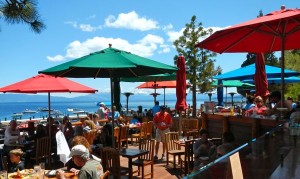
Sunnyside

Sunnyside

It’s so comfortable on what’s touted as “Tahoe’s largest outdoor deck” that dining alone on the long counter is more than acceptable.

Take me to the river

Tahoe City can stake claim to a bar and restaurant with history and a lot going for it. The Bridgetender situated along the Truckee River near Fanny Bridge offers an ideal setting for R&R, especially after partaking in the various recreational activities this lake town encourages.

When I say wooden furniture, I mean furniture that appears to be carved out of a log from a fallen Jeffery pine. The bar in the middle of the tables has Tahoe written all over it. The historic place has an ambiance. If it’s not enough to hear the river noises, a fountain over the small pond up front is quite soothing. The staff brings its “A” game.

The River Ranch has also been a Tahoe summer favorite with its sit-next-to-river patio amid the trees – but a wedding party got there first.

And this is Tahoe

There’s no way to dismiss the places that represent the mountain scene of Lake Tahoe and beyond.

One of the favorites is a short drive to Meyers. The al fresco experience at the Getaway Café banks a view of Cowboy Rock and Freel Peak while sitting amongst the flowers planted with love and care. There are tables for two and four and six. Umbrellas are out to provide adequate shade, but one can thoroughly enjoy baking in the sun. The pine trees surrounding the place say Tahoe. The straw grass placed on the lawn says rural. (Note: the food is always good, and it’s far enough off Highway 50 to mask the noise.)
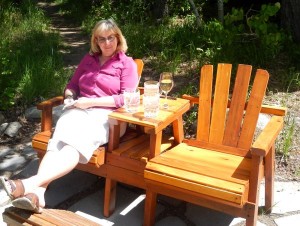
Sue at Sorensen's

Sue at Sorensen’s

Turn left on Highway 89 from the Getaway, and you can truly get away to Sorensen’s Resort. An absolute favorite, the aspens exemplify the Tahoe outdoor dining experience. It’s as if the trees are cradling you when sitting on the patio. Between the chirping birds and quaking aspen leaves in the breeze, diners will feel as though they’ve stepped into a spa.

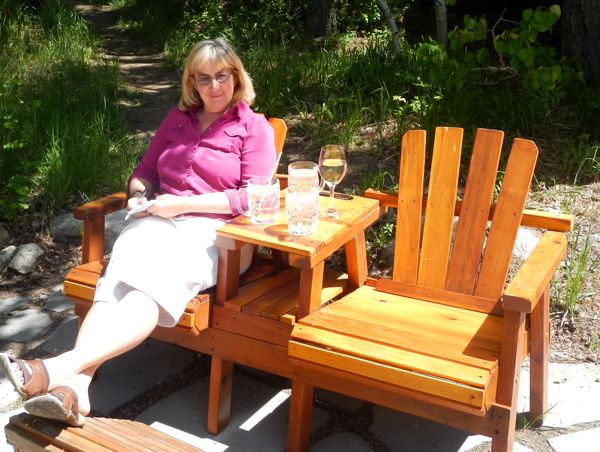
What’s the best seating there? Nestle into the high-backed wooden chairs, put your feet on the footstools and set up a mini table setting between the chairs. Don’t even think of leaving without ordering the berry cobbler. Try it with a Sprite or a Pinot Grigio, depending on your mood, and you may be parked there for hours as the leaf peepers or bikers come and go.

Going urban

Brothers bar maintains a long reputation for attracting a biker crowd, and for good reason. It’s fun, the bartender is on top of his business and the outdoor patio gets the full exposure of sun along Highway 89 north of the Y in South Lake Tahoe.

The picnic tables seem appropriate for a fun-and-games kind of place. If the horseshoe tournaments don’t bring you in, perhaps the large screen television on the patio for Monday Night Football may give you a change in scene from a living room.

There’s a fire pit for chilly evenings. But it’s the outdoor bar for major parties that says al fresco summer dining.

Across the highway on restaurant row, the Rockwater has a few options for al fresco dining. The grassy area can accommodate large parties in an open setting. The deck setting next to the outdoor bar is nice for some shade or to sit under the mounted heaters, depending on the temperatures outside. Fun activities like karaoke Wednesday nights round out the experience, and it’s good to know one can just sit outside and watch sports on the outdoor televisions.

It gives it a sports bar feel. But with that, the bar could stand to be a little less loud. The music blasts. At least it’s difficult to hear the traffic. (Note: the service is notoriously slow, so don’t be in a hurry.)

For more on roadside dining, hit the Coyote Grill at Round Hill, where wine and appetizers beckon and dogs are welcome. Sure, you’re practically sitting in the parking lot. But according to Amy: “Tahoe’s so nice, the views are even good in a parking lot.”

Wire chairs and tables are probably easy to clean. The food and service are adequate.

The best restaurant service and arguably food at the lake sits halfway up Ski Run Boulevard at the Blue Angel Café.

This is an eatery that paints a creative menu like it’s fine art. The café is planning to put out more tables and planted new sod next to the planter boxes to satisfy its loyal clientele’s thirst for outdoor dining. Bike racks out front make it obvious this restaurant knows its patrons better than most.

Also new to the whole Al fresco scene is Scusa, the Italian restaurant at the end of Sierra Boulevard right on Highway 50. Upon a stormy night, I peeked out to its new setting to find a cozy spot out back with crushed rock at its base, iron tables and chairs, a fountain flowing, heat lamps ready and a high fence to seal off the area.

Whether in or out, the food and wine with an elegant, adult-like setting is always worth going for.

For the casual flair

Want to feel like a kid again? Since everyone screams for ice cream at Lake Tahoe in the short summer season, the places that offer it and provide it will do much business in those months.
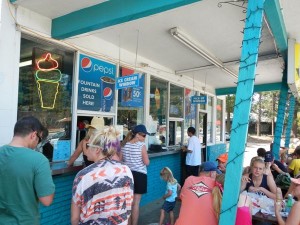
Sno-Flake

Sno-Flake

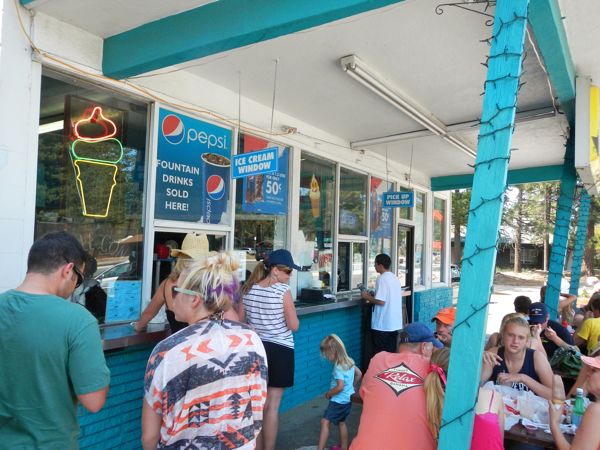
It’s hot. Our first thought is a soft serve cone from the Sno-Flake Drive-In, a mainstay in urban South Lake Tahoe. But of course, we’re not alone with our thought. The few picnic tables outside fill up fast. So as an alternative to consume this feast (even in a small size), Kae and I sat with our legs dangling off benches surrounding flower plants right alongside Modesto Avenue.

Looking across to the Tahoe Tribune building brought back many memories, some even good.

The Al Tahoe neighborhood brings out many people on their bikes. Sno-Flake might want to add racks for these patrons.

Cycling on the North Shore to Squaw Village easily made Kae, Roni, Brenda and me hungry for a smoothie. The Mountain Nectar touts about a dozen different flavors of smoothies and some milkshakes that had me taking note why I wanted to return some day.

If you go in the morning, sitting in front of the fire pit in the slanted wooden chairs outside the Fireside Café is wide open to the first takers.

It wouldn’t be summer without real ice cream on the South Shore at the Camp Richardson Ice Cream Parlor. Kae decided a lunch break last week should involve some sugar. Seven picnic tables are inviting to sit while she eats the huge scoop. Plenty of shade is provided by the tall pines. While the shop is right on Highway 89, the tables are back far enough for it not to be annoying.

Beyond the Lake Tahoe area

• The best in Pacific coast outdoor seating may be found at the Inn at Spanish Bay. You can’t go wrong with Carmel Bay in full view.

• While in Scottsdale, a diner can get a show from the Cantina Laredo patio as the waiter whips up the guacamole, right at the table.

• The show continues at the Troon North Golf Course Clubhouse, where a family of javelinas entertains diners at the sunset hours.

• While in St. Helena, check out the patio dining at Tra Vigne for brunch – in particular on Mother’s Day. The Tuscan Courtyard lives up to its name, where the trees provide shade without clunky umbrellas.

• SolBar restaurant in Calistoga allows dogs, which was quite annoying at a fine dining restaurant.

• Like kids? Bring yours to Skipolini’s Pizza’s patio in Clayton, where Kae grew up, or in Walnut Creek. The pizza itself would prompt one to drive 10 miles out of the way to have one.

Kathryn Reed contributed to this article.


July 4 picnic costs about 6 bucks a person

By Jeannie Nuss, Huffington Post

LITTLE ROCK, Ark. — How much does it cost to pack a picnic this Fourth of July? That’ll be $6 per person.

That’s according to the American Farm Bureau Federation, which launched an informal price survey this year looking at the cost of hot dogs, cheeseburgers and other Independence Day fare.

A typical summertime picnic averages $57.20 for 10 people, or $5.72 per person, according to the group, which puts out a similar estimate for Thanksgiving.

“Five dollars a person for a special event cookout is affordable for most people,” said John Anderson, chief deputy economist with the American Farm Bureau Federation. “We certainly know that there are people who struggle with affording food and other necessities, but in general, we’re blessed with very affordable food in this country.”

Sixty volunteer shoppers in 22 states checked retail prices for summer picnic foods for the American Farm Bureau Federation’s survey.

The group puts together a similar annual informal price survey about Thanksgiving dinner fare. Last year, the group said a turkey dinner with all the trimmings would cost about $49.48 for 10, or just under $5 per person.

However, since this year marks the group’s first Fourth of July price survey, Anderson said the group doesn’t have concrete numbers to compare with the 2013 figures.

“We expect the general level of prices to go up around 2 percent a year,” Anderson said. “That’s kind of normal price inflation, and … I certainly think that we’re in the ballpark of those normal price changes over the past year.”

Aside from burgers and hot dogs, the farm group’s picnic menu includes pork spare ribs, potato salad, lemonade, baked beans, watermelon, corn chips, chocolate milk, ketchup and mustard.

That list doesn’t include beer, which some Americans are shelling out a bit more for this year.

“More people are trading up to premium, more expensive beer,” said John Davie, president and CEO of Boston-based Consolidated Concepts, which works with thousands of food and restaurant outlets to help them save money on food and other supplies.

Davie also said the price of chicken breast has increased since this time last year.

Debra Graham agrees with that.

“It’s almost as cheap to buy steaks as to do chicken or burgers,” she said outside a Little Rock grocery store where she bought catfish for a Fourth of July fish fry.

But Graham, 52, said other prices seemed about as high as they usually are.

“If you want it, you’ve got to pay for it,” she said.


Scientists: Whole milk may be what kids need

By Mary MacVean, Los Angeles Times

Much of the recent debate over serving milk to children has been about flavored milk: Should it be distributed in schools? Or should the only milk given to children be of the unflavored, reduced-fat variety?

Two Harvard scientists known for questioning the conventional wisdom are challenging the idea of making lower-fat milks the only milk options available to children.

They note that guidelines from the U.S. Department of Agriculture and many health organizations recommend limiting the consumption of beverages that contain calories – such as soda and juice – “except reduced-fat milk, of which people in most age groups are encourage to consume three cups daily.”

David Ludwig and Walter Willett question “the scientific rationale for promoting reduced-fat milk consumption at these levels.”

They suggest that until there are additional studies, guidelines for milk consumption should designate a range of perhaps zero to three cups, avoid recommending low-fat over whole milk and focus on limiting consumption of flavored milks.

One problem, they say, is that there have been few randomized trials of the effects on weight gain of reduced-fat milk compared with whole milk and that current guidelines presume the lower-fat milks will decrease total calorie intake.

But studies show that a “primary focus on reducing fat intake does not facilitate weight loss compared with other dietary strategies,” they wrote Monday in JAMA Pediatrics.

It might seem counterintuitive at first. But the scientists explain with an example. What if a child who usually eats two 60-calorie cookies and drinks a cup of whole milk for a snack instead drinks skim milk? A cup of whole milk has around 150 calories, a cup of skim about 90. But if that child feels less full by consuming less fat and to compensate eats another cookie, Willett and Ludwig say, “this substitution of refined starch and sugar for fat might actually cause weight gain.”

The scientists said there’s evidence that high-glycemic-index carbohydrates – such as refined grains, sugary beverages and desserts like the cookies – are associated with weight gain while whole milk is not.

Much of the public conversation about milk, particularly in schools, has come in light of high rates of childhood obesity and efforts to improve the nutritional profiles of cafeteria foods. The debate over flavored milk often centers on the idea that kids don’t like low-fat milks but will drink them if they’re flavored with chocolate. But children generally like the taste of whole milk, which rarely is served in schools.

One reason is that whole milk contains saturated fat, which raises what’s called “bad” cholesterol, the kind that’s a risk factor for heat disease. But Willett and Ludwig say the picture is more complicated when compared with refined carbohydrates.

Reduced-fat chocolate milk reduces saturated fat by 3 grams but raises sugar by 13 grams per cup, the scientists wrote.

While people can get the calcium in milk from other sources, milk also provides protein and other essential nutrients – especially for people who have a generally poor diet.

Ludwig said 2 percent milk is “probably a reasonable compromise” between whole and 1% or nonfat milk.

“The issue is not to focus single-mindedly on fat reduction, and then condone lots of added sugars, as in chocolate milk,” he wrote. “The bottom line is that reducing fat has not proven to be an effective approach to obesity, whereas there is very good evidence for the adverse effects of added sugars,” especially for children.


Safety when grilling keeps fire department away

By Teri Mizuhara

One of the best smells of summer is something cooking on the barbecue; one of the worst smells would be your home or yard on fire after something went awry while cooking outdoors.

Californians love to barbecue almost anything that is edible, from meat and veggies to pizza and fruit, we simply love to cook outdoors. In fact 81 percent of U.S. households have a barbecue or smoker and 71 percent of us barbeque on July 4.

With all this outdoor cooking comes unwanted fires and/or burn injuries, so to keep yourself and your family safe, please take a few minutes to review these fire safety tips.

Make sure your barbecue is in good working order. If you own a gas grill, refer to your owner’s manual for information regarding the tanks, fuel lines and venturi tubes or have it serviced by a professional

Place your barbecue away from the sides of a building/awnings/overhangs or anything else flammable. Keep them out of high traffic areas too.

Use caution when using lighter fluid to light charcoal and never add lighter fluid to an existing fire as it may flashback and cause the container to explode.

Supervise children and pets around all outdoor grills, and keep all lighters and matches away from children.

Never wear loose clothing while cooking at a barbeque as they can catch on fire. Make sure everyone understands stop-drop-roll in the event their clothing catches on fire.

Never use a barbecue in enclosed areas as carbon monoxide will be produced. CO is deadly and undetectable as it has no odor.

After you have finished grilling your food, turn off the gas grill. If you are using briquettes, make sure they are completely out, douse them with plenty of water and stir the mixture to ensure they are completely out.

Never hesitate to call 911 in the event you have an uncontrolled fire or someone is burned.

For more fire safety tips, call (530) 644.2345 to receive free fire and life safety brochures.

Teri Mizuhara is public information officer for the CalFire unit that includes El Dorado County.


Weber grills much more than a kettle of briquettes

By Bryan Gruley, Bloomberg

Sixty-one years ago, George Stephen got tired of wind and rain messing up his cooking on an open-air grill, the main barbecue tool of the day. He grabbed a buoy made where he worked, Weber Brothers Metal Works in Illinois. He sliced it in half and fashioned a tight-fitting dome lid. It didn’t work very well until a neighbor suggested he poke holes in the kettle so air could fuel the fire. The Weber grill was born.

Stephen eventually bought the Weber metal shop, creating Weber-Stephen Products of Palatine, Ill., which is now the world’s largest grill manufacturer. The privately held company doesn’t disclose financials, but Euromonitor International says Weber-Stephen claims 35 percent of the $2.5 billion U.S. market, with rival Char-Broil a distant second.

In 1971, Stephen hired Mike Kempster, Weber-Stephen’s current chief marketing officer. He calls himself the “godfather of the brand.” In a warehouse adjoining a plant in Huntley, Ill., Kempster gestures at thousands of shrink-wrapped boxes of grills and smokers stacked in 20-foot towers. “Looks like a big supply, right?” he asks. “It’s probably less than a week.” He won’t specify how much the factory produces, but around 80 trucks haul stuff away daily. Shipments peak at about 110 semis a day just before July 4.

That’s a lot of barbecues, but grill sales have flattened over the past few years, partly because of the U.S. housing downturn, Kempster says. While the company sees that turning around, it still faces challenges from Europe’s financial struggles, volatile commodity costs, and low-cost overseas manufacturers.

Weber-Stephen has changed more in the past decade than it did in the previous half-century. It contracted to have grills built in China to go with production in Huntley and Palatine. It agreed to stop labeling products “Made in USA” to settle a class-action lawsuit that accused it of buying components from China and Taiwan suppliers. (The company denied wrongdoing.) It also introduced a line of compact grills designed for dense urban areas such as those sprouting up across Southeast Asia.

The biggest change was financial: In 2010 the Stephen family sold a majority stake to BDT Capital Partners, the Chicago merchant bank run by Byron Trott, the former Goldman Sachs executive known for his close ties to Warren Buffett. Kempster says BDT’s investment will help Weber-Stephen push overseas. The first nonfamily member to run the company, Thomas Koos, formerly of Jacuzzi Brands and Black & Decker, took over as chief executive officer in April.

The grill maker emulates General Motors’ Chevy-to-Caddy range of products, targeting consumers as they climb the income ladder. Weber-Stephen hooks college kids with the $29 Smokey Joe, a miniature kettle, then keeps them buying until they can afford a $799 Genesis gas grill or — if they need a backyard kitchen — a $5,000 Summit Grill Center, a behemoth with six gas burners, a built-in smoker, and an infrared rotisserie. There’s no fridge, just a cooler. “Consumers told us all they really needed is ice,” Kempster says.

When gas grills grew popular in the 1970s, the company offered a kettle fitted with a propane tank. “The shape was so associated with charcoal grilling, it just never caught on,” Kempster says. In 1985, Weber-Stephen introduced the rectangular Genesis gas line with triangular “Flavorizer” cooking bars designed to minimize flare-ups while mimicking the mouthwatering effect of meat and fish juices sizzling on hot coals. Today, four of Consumer Reports’ top seven midsize grills for 2013 are Webers, and the company’s new cookbook is an Amazon.com bestseller. Its U.S. call centers handle 500,000 questions a year, from how long to cook a pork tenderloin to the best way to grill a squirrel.

The new Weber-Stephen CEO has asked Kempster, 66, to stay for at least two more years. Kempster has nine Weber grills and smokers in his backyard, including a pair of 36-inch kettles he uses to cook for crowds. His go-to dishes are beef tenderloin and Alaskan king crab legs. He suggests snipping off the thicker ends of the crab legs and cooking them for 10 to 12 minutes before putting the thin ends on the grill.

Meathead Goldwyn, the barbecue impresario (given name: Craig) who runs the website Amazingribs.com, has more than a dozen grills and smokers in his suburban Chicago backyard—and a beat-up Weber kettle he bought for $50 about 20 years ago, Goldwyn says. “For what I do, which is help people learn to cook, you have to have a Weber kettle, because it’s ubiquitous.”


Learn how to cook using fresh ingredients

Lake Tahoe Community College instructor Steve Fernald is putting on a demonstration July 16 at 6pm on how to cook with ingredients from a farmers market.

The free event is at the South Lake Tahoe library, 1000 Rufus Allen Blvd.

It is sponsored by the Barton Foundation.