Study: Skipping breakfast not a healthy idea

By Mary MacVean, Los Angeles Times

Even Elmo knows that breakfast is the most important meal of the day in his world, but there hasn’t been enough scientific evidence for the federal government to recommend it for grownups.

Still, it sounds like it might be a wise move to stock up on oatmeal and the like. In an article released Monday in the journal Circulation, researchers found that men who skipped breakfast had a 27 percent higher risk of coronary heart disease than men who ate their morning meal – though we imagine that big daily plates of bacon and pancakes with syrup are not the ideal.

The researchers also found, using a large ongoing study of mostly white men, that those who ate late at night had a 55 percent higher risk of coronary heart disease. They didn’t find an association with the number of times a day a person ate.

Those associations were true — if somewhat less so — when other habits and conditions that would cause coronary heart disease were factored in, said the researchers, from Harvard University and Brigham and Women’s Hospital.

Snacking and skipping breakfast are common among Americans, the researchers noted. And such habits have been associated with weight gain, high blood pressure and diabetes, they wrote.

So they looked at the Health Professionals Follow-up Study, an ongoing look at 51,529 men who are questioned every two years about their health and habits.

The men who did not eat breakfast were younger, more often single and more likely to smoke and less active than the other men. The late-night snackers were also more likely to smoke and to have hypertension and sleep less than seven hours a night, the researchers wrote.

But the quality of the men’s diets was on average very high.

“The timing of the meal may be directly responsible for the metabolic effects that may lead to CHD, or alternatively, eating habits may be a proxy for specific foods more likely to be consumed at breakfast or late at night such as breakfast cereals high in dietary fiber and fortified micronutrients like folate or late-night snack foods high in calories,” the researchers wrote.

They said they would like to see additional studies looking at women and ethnic groups.


Wine for Dummies more than a book

By Venessa Wong, Bloomberg Businessweek

In 1995, John Wiley & Sons first published “Wine for Dummies,” an instructional book for aspiring oenophiles produced in the same format as the rest of the books in the popular yellow-and-black-jacketed reference series.

Other titles include “Personal Finance for Dummies,” “Auto Repair for Dummies,” and (a personal favorite) “Raising Chickens for Dummies.”

But the “For Dummies” brand has taken its Wine 101 education a step further. It’s licensed a Wines for Dummies wine, complete with labels bearing the same design as the books.

The Dummies wines were introduced in May by Vision Wine & Spirits, a New Jersey wine importer and marketer. They cost about $10 a bottle and come in four varieties: Chardonnay and Cabernet Sauvignon from California, and Pinot Grigio and Chianti from Italy.

“Wines for Dummies is intended for everyday consumers, regardless of experience or budget, to enjoy without anxiety or the knowledge of fancy wine lingo,” said Vision Wine & Spirits Managing Director Dan Lasner in a release. “With this new brand, consumers will spend less energy worrying about which wine to choose and more energy enjoying them.”

Even in a wine-savvy state like California (where the Dummies brand is scheduled to hit shelves this fall), it’s not as crazy a move as it may seem at first glance.

Americans love their wine – especially the affordable stuff – and unit sales in the U.S. were up 4 percent in the 52 weeks ended June 16, according to data compiled by Bloomberg. The top-selling brand was Barefoot Wine, which is owned by E&J Gallo Winery, the mega-winemaker behind other popular, low-cost brands such as André and Carlo Rossi.

There’s also evidence that Americans are interested in actually becoming knowledgeable about wine. The “Wine for Dummies” book is now in its fifth edition, with more than 1 million copies in print. It remains a best-seller, according to Wiley.

Wines for Dummies wine is available in 15 states (Maryland, Florida, Indiana, New Jersey, New York, Alabama, Colorado, Delaware, Kentucky, Mississippi, Ohio, Pennsylvania, South Dakota, West Virginia and Wyoming). By September, it will be in another 10 to 15 states, including California, Michigan, Arizona and Massachusetts.

Mark Tucker, marketing director for Vision Wine & Spirits, says distributors in New Jersey sold 2,100 cases to more than 500 stores and restaurants in the state during the first month. The brand is in Wegmans supermarkets and will soon be sold in Dollar General stores.

The Dummies reference series, which launched in 1991, has expanded beyond books before. It has a licensed product line that includes electronics, videos, home improvement tools and musical instrument starter packs.


A lesson in cooking via the farmers’ market

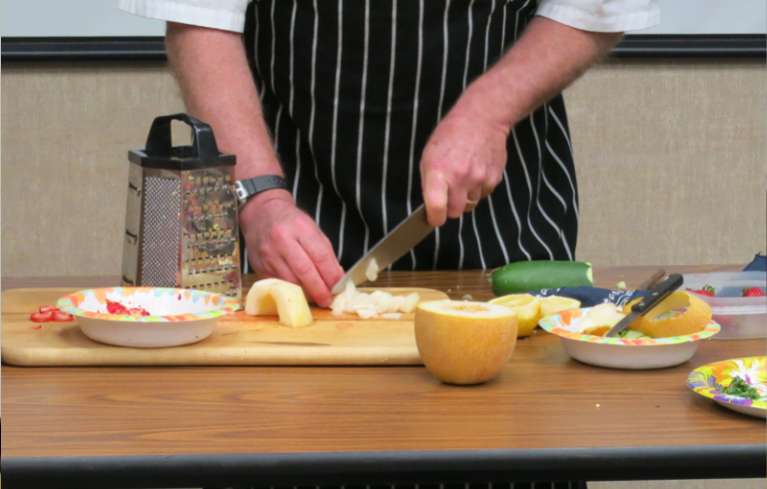
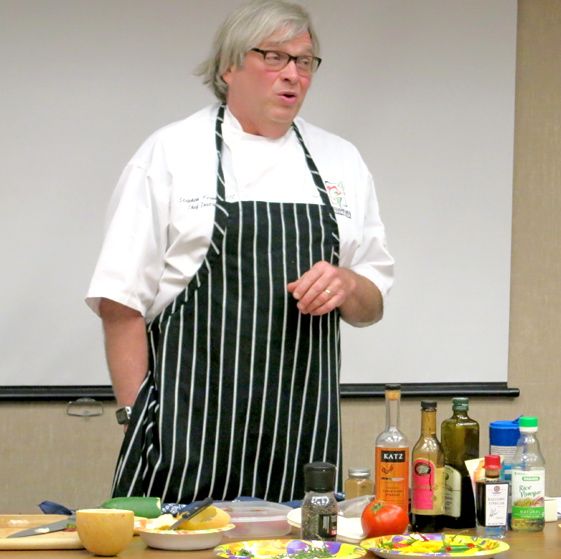
Chef Steve Fernald demonstrates cooking with food from the farmers' market. Photos/Jessie Marchesseau

Chef Steve Fernald demonstrates cooking with food from the farmers’ market. Photos/Jessie Marchesseau

By Jessie Marchesseau

Bright red tomatoes, dark green zucchini, sunshine yellow squash and purple sweet peppers were among the fresh produce adorning the table at chef Steve Fernald’s fresh cooking demonstration at the South Lake Tahoe Library on Tuesday.

“They say you eat with your eyes first. People either accept or reject a meal based on how it looks,” said Fernald, culinary arts instructor at Lake Tahoe Community College.

The demonstration was designed to show people how to create simple, tasty summer dishes with fresh ingredients from local farmers’ markets. Fernald suggests starting out by choosing the most colorful options at the market and practicing what he calls “cooking on the fly,” meaning creating dishes in your head as you shop for ingredients. He also described how he took the time to talk to the vendors, learning the differences between varieties of tomatoes and peppers, even discovering new items like melons he had never heard of before.

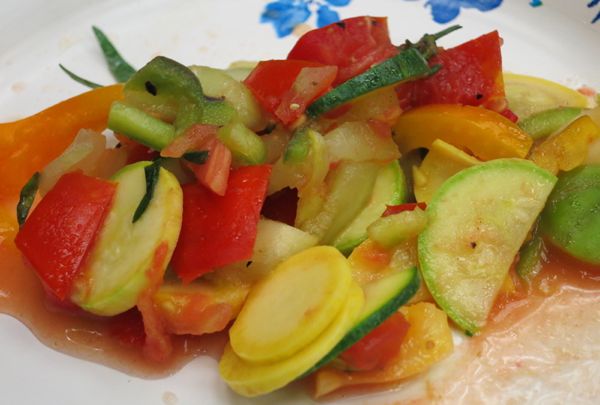
Mediterranean salad

Mediterranean salad

In addition to the fresh produce, Fernald purchased at the farmers’ market earlier that day, the table also displayed a selection of vinegars, olive oil, salts, fresh herbs and dried spices. From this arsenal, Fernald created two dishes: a savory Mediterranean salad and a sweet strawberry chili salsa which he served with homemade crunchy almond cookies.

Starting with the basics, the chef explained the importance of having a variety of textures and tastes in each dish. For example, a combination of crunchy and chewy or sweet and salty is more interesting to the palate than one solitary flavor or texture.

Another essential aspect of cooking, especially in uncooked dishes such as these, is often overlooked: cutting. He explained how size and shape should be considered for the specific preparation, and for uncooked food, small or thin pieces create the most surface area for flavor in your mouth.

Since the event was sponsored by the Barton Foundation, Fernald wanted to create dishes that maximized the flavor while keeping fat content low. One of the ways he achieved this was by using high-quality, high-flavor ingredients. Fernald explained how the gourmet apple cider vinegar, 18-year-old balsamic vinegar and rich olive oil on the table have bolder flavors – meaning you don’t have to use as much of them.

After the quick culinary lesson, the chef began his preparation. First was the Mediterranean salad for which he thinly sliced zucchini and summer squashes, then lightly salted them just enough to bring out the flavor, but not break down the tissues. Then he carefully cut sweet peppers and cucumbers, removing the seeds from both. All of this was tossed with a splash of rice vinegar and a light sprinkle of sugar, not for sweetness, but to encourage the vegetables to release their juices. Next came the chopped tomatoes with seeds left in for added texture, a drizzle of olive oil and, finally, a handful of freshly torn thyme.

Steve Fernald leaves the LTCC classroom to give a public cooking demo.

Steve Fernald leaves the LTCC classroom to give a public cooking demo.

The result was a simple dish exploiting the bright flavors of a summer harvest. Crunchy sweet peppers contrasted with soft ripe tomatoes and the fresh thyme left me thinking of my own little herb garden at home.

The next dish Fernald dreamed up was a little more off the beaten path, but no less delicious. Tiny little chili peppers were diced and tossed with a sweet apple cider vinegar. Then in went ripe red strawberries from Watsonville, sliced as thin as he could possibly get them, a sprinkle of sugar and just a pinch of salt. Next were tiny cubes of a melon Fernald discovered at the market just that morning (which he could not even remember the name of), fresh lemon juice and lemon rind. A quick drizzle of balsamic vinegar finished off this sweet and spicy combination.

To balance the heat of the dish, Fernald served it piled on crunchy almond cookies. The result was what one of the tasters in the room called “a party in your mouth.” The sweet flavor of strawberries gave way to a heat that notably cooled your face and urged you to take another bite. This dish had several people, myself included, going back for seconds.

Fernald also took the opportunity to pay homage to renowned chef and restaurateur Alice Waters of Chez Panisse in Berkeley. Waters and Chez Panisse are credited with pioneering the farm to table movement in the early 1970s by serving entirely locally sourced food.

Waters’ vision helped define American cuisine and is a large-scale example of what chef Fernald demonstrated: creating delicious, healthy food using fresh, local ingredients.

“You can tell the difference in not just the tomatoes,” Fernald said of the food from the local farmers’ market, “but in pretty much everything.”


Recipe contest emphasizes using seasonal produce

Savor the Season is a recipe contest for Northern Nevada residents.

Western Nevada College Specialty Crop Institute and NevadaGrown – Home Means Delicious are sponsoring the monthly event.

Go online to learn about locally-grown, seasonal fruits, vegetables and other foods, and submit a favorite recipe utilizing one – or all – of the foods for a chance to win.

The campaign is designed to educate the community about the benefits of eating locally and seasonally.


Champagne cork popping — another celebrity sport

Korbel Champagne owner Gary Heck watched a lot of bubbly get sprayed July 17 at the media cork popping contest. Photo/Kathryn Reed

Korbel Champagne owner Gary Heck watched a lot of bubbly get sprayed July 17 at the media cork popping contest. Photo/Kathryn Reed

By Kathryn Reed

STATELINE — Celebrity golfers will be able to put down their clubs briefly on Thursday and trade them for a bottle of Champagne.

Between the 17th and 18th holes they can test their ability at how far they can shoot a Champagne cork. The one who wins will be able to select a charity for Korbel Champagne to write a $5,000 check to.

Shane Battier with the Miami Heat on Wednesday demonstrated how it is done by hitting the fence. The contenders from the media who followed him didn’t fare as well. However, Tom Selissero with USA Today popped his cork 81 feet to win the Korbel golf bag and a couple clubs.

Korbel owner Gary Heck advised me to keep my thumb on the cork as I shook the bottle. He said I could shake it as long as I wanted. Then he told me at what angle to shoot. As a rookie to this sport, I came in seventh out of 33 with a 65-foot shot.

Heck was taking the wire off the all the bottles and giving pointers to whomever asked.

The Sonoma County sparkling wine company has created two drinks that it will be serving at the various concession stands throughout the American Century Championship golf tournament at Edgewood Tahoe from now through Sunday.

Having only sampled one – the Korbel Sparkling Eagle – I can recommend it. The melon flavor comes through without being too overpowering.

Korbel Sparkling Eagle

4 ounces Korbel Brut

1 ounce melon liqueur

1 ounce lemonade

Mix all ingredients in a rocks glass. Garnish with one jumbo cherry.

Korbel Long Drive

3 ounces Korbel Brut or Extra Dry

2 ounces lemonade

1 ounce blue Curacao

Into a tall glass, pour Korbel Brut or Extra Dry. Add lemonade, blue Curacao and ice.


Is ingesting sugar like consuming a toxin?

By Ferris Jabr, Scientific American

Our very first experience of exceptional sweetness — a dollop of butter cream frosting on a parent’s finger; a spoonful of strawberry ice cream instead of the usual puréed carrots — is a gustatory revelation that generally slips into the lacuna of early childhood. Sometimes, however, the moment of original sweetness is preserved.

A YouTube video from February 2011 begins with baby Olivia staring at the camera, her face fixed in rapture and a trickle of vanilla ice cream on her cheek. When her brother Daniel brings the ice cream cone near her once more, she flaps her arms and arches her whole body to reach it.

Considering that our cells depend on sugar for energy, it makes sense that we evolved an innate love for sweetness. How much sugar we consume, however — as well as how it enters the body and where we get it from in the first place — has changed dramatically over time. Before agriculture, our ancestors presumably did not have much control over the sugars in their diet, which must have come from whatever plants and animals were available in a given place and season.

Around 6,000 BC, people in New Guinea began to grow sugarcane, chewing and sucking on the stalks to drink the sweet juice within. Sugarcane cultivation spread to India, where by 500 BC people had learned to turn bowls of the tropical grass’s juice into crude crystals. From there sugar traveled with migrants and monks to China, Persia, northern Africa and eventually to Europe in the 11th century.

For more than 400 years, sugar remained a luxury in Europe — an exotic spice — until manufacturing became efficient enough to make “white gold” much more affordable. Christopher Columbus brought sugarcane to the New World in 1493 and in the 16th and 17th centuries European powers established sugarcane plantations in the West Indies and South America.

Sugar consumption in England increased by 1,500 percent between the 18th and 19th centuries. By the mid-19th century, Europeans and Americans had come to regard refined sugar as a necessity. Today, we add sugar in one form or another to the majority of processed foods we eat — everything from bread, cereals, crunchy snacks and desserts to soft drinks, juices, salad dressings and sauces—and we are not too stingy about using it to sweeten many raw and whole foods as well.

By consuming so much sugar we are not just demonstrating weak willpower and indulging our sweet tooth — we are in fact poisoning ourselves according to a group of doctors, nutritionists and biologists, one of the most prominent members of which is Robert Lustig of UC San Francisco, famous for his viral YouTube video “Sugar: The Bitter Truth.”

A few journalists, such as Gary Taubes and Mark Bittman, have reached similar conclusions. Sugar, they argue, poses far greater dangers than cavities and love handles; it is a toxin that harms our organs and disrupts the body’s usual hormonal cycles. Excessive consumption of sugar, they say, is one of the primary causes of the obesity epidemic and metabolic disorders like diabetes, as well as a culprit of cardiovascular disease. More than one-third of American adults and approximately 12.5 million children and adolescents in the U.S. are obese. In 1980, 5.6 million Americans were diagnosed with diabetes; in 2011 more than 20 million Americans had the illness.

The argument that sugar is a toxin depends on some technical details about the different ways the human body gets energy from different types of sugar. Today, Americans eat most of their sugar in two main forms: table sugar and high-fructose corn syrup. A molecule of table sugar, or sucrose, is a bond between one glucose molecule and one fructose molecule — two simple sugars with the same chemical formula, but slightly different atomic structures. In the 1960s, new technology allowed the U.S. corn industry to cheaply convert corn-derived glucose intro fructose and produce high fructose corn syrup, which despite its name is almost equal parts free-floating fructose and glucose: 55 percent fructose, 42 percent glucose and three percent other sugars. Because fructose is about twice as sweet as glucose, an inexpensive syrup mixing the two was an appealing alternative to sucrose from sugarcane and beets.

Regardless of where the sugar we eat comes from, our cells are interested in dealing with fructose and glucose, not the bulkier sucrose. Enzymes in the intestine split sucrose into fructose and glucose within seconds, so as far as the human body is concerned sucrose and high-fructose corn syrup are equivalent. The same is not true for their constituent molecules. Glucose travels through the bloodstream to all of our tissues, because every cell readily converts glucose into energy. In contrast, liver cells are one of the few types of cells that can convert fructose to energy, which puts the onus of metabolizing fructose almost entirely on one organ. The liver accomplishes this primarily by turning fructose into glucose and lactate. Eating exceptionally large amounts of fructose taxes the liver: it spends so much energy turning fructose into other molecules that it may not have much energy left for all its other functions. A consequence of this energy depletion is production of uric acid, which research has linked to gout, kidney stones and high blood pressure.

The human body strictly regulates the amount of glucose in the blood. Glucose stimulates the pancreas to secrete the hormone insulin, which helps remove excess glucose from blood, and bolsters production of the hormone leptin, which suppresses hunger. Fructose does not trigger insulin production and appears to raise levels of the hormone grehlin, which keeps us hungry. Some researchers have suggested that large amounts of fructose encourage people to eat more than they need. In studies with animals and people by Kimber Stanhope of UC Davis and other researchers, excess fructose consumption has increased fat production, especially in the liver, and raised levels of circulating triglycerides, which are a risk factor for clogged arteries and cardiovascular disease. Some research has linked a fatty liver to insulin resistance—a condition in which cells become far less responsive to insulin than usual, exhausting the pancreas until it loses the ability to properly regulate blood glucose levels. Richard Johnson of the University of Colorado Denver has proposed that uric acid produced by fructose metabolism also promotes insulin resistance. In turn insulin resistance is thought to be a major contributor to obesity and Type 2 diabetes; the three disorders often occur together.

Because fructose metabolism seems to kick off a chain reaction of potentially harmful chemical changes inside the body, Lustig, Taubes and others have singled out fructose as the rotten apple of the sugar family. When they talk about sugar as a toxin, they mean fructose specifically. In the last few years, however, prominent biochemists and nutrition experts have challenged the idea that fructose is a threat to our health and have argued that replacing fructose with glucose or other sugars would solve nothing. First, as fructose expert John White points out, fructose consumption has been declining for more than a decade, but rates of obesity continued to rise during the same period. Of course, coinciding trends alone do not definitively demonstrate anything. A more compelling criticism is that concern about fructose is based primarily on studies in which rodents and people consumed huge amounts of the molecule — up to 300 grams of fructose each day, which is nearly equivalent to the total sugar in eight cans of Coke — or a diet in which the vast majority of sugars were pure fructose. The reality is that most people consume far less fructose than used in such studies and rarely eat fructose without glucose.

On average, people in America and Europe eat between 100 and 150 grams of sugar each day, about half of which is fructose. It’s difficult to find a regional diet or individual food that contains only glucose or only fructose. Virtually all plants have glucose, fructose and sucrose — not just one or another of these sugars. Although some fruits, such as apples and pears, have three times as much fructose as glucose, most of the fruits and veggies we eat are more balanced. Pineapples, blueberries, peaches, carrots, corn and cabbage, for example, all have about a 1:1 ratio of the two sugars. In his New York Times magazine article, Taubes claims that “fructose … is what distinguishes sugar from other carbohydrate – rich foods like bread or potatoes that break down upon digestion to glucose alone.”

This is not really true. Although potatoes and white bread are full of starch — long chains of glucose molecules — they also have fructose and sucrose. Similarly, Lustig has claimed that the Japanese diet promotes weight loss because it is fructose-free, but the Japanese consume plenty of sugar — about 83 grams a day on average — including fructose in fruit, sweetened beverages and the country’s many meticulously crafted confectioneries. High-fructose corn syrup was developed and patented in part by Japanese researcher Yoshiyuki Takasaki in the 1960s and ’70s.

Not only do many worrying fructose studies use unrealistic doses of the sugar unaccompanied by glucose, it also turns out that the rodents researchers have studied metabolize fructose in a very different way than people do — far more different than originally anticipated. Studies that have traced fructose’s fantastic voyage through the human body suggest that the liver converts as much as 50 percent of fructose into glucose, around 30 percent of fructose into lactate and less than one percent into fats. In contrast, mice and rats turn more than 50 percent of fructose into fats, so experiments with these animals would exaggerate the significance of fructose’s proposed detriments for humans, especially clogged arteries, fatty livers and insulin resistance.

In a series of meta-analyses examining dozens of human studies, John Sievenpiper of St. Michael’s Hospital in Toronto and his colleagues found no harmful effects of typical fructose consumption on body weight, blood pressure or uric acid production. In a 2011 study, Sam Sun—a nutrition scientist at Archer Daniels Midland, a major food processing corporation—and his colleagues analyzed data about sugar consumption collected from more than 25,000 Americans between 1999 and 2006. Their analysis confirmed that people almost never eat fructose by itself and that for more than 97 percent of people fructose contributes less daily energy than other sugars. They did not find any positive associations between fructose consumption and levels of trigylcerides, cholesterol or uric acid, nor any significant link to waist circumference or body mass index (BMI).

And in a recent BMC Biology Q&A, renowned sugar expert Luc Tappy of the University of Lausanne writes: “Given the substantial consumption of fructose in our diet, mainly from sweetened beverages, sweet snacks, and cereal products with added sugar, and the fact that fructose is an entirely dispensable nutrient, it appears sound to limit consumption of sugar as part of any weight loss program and in individuals at high risk of developing metabolic diseases. There is no evidence, however, that fructose is the sole, or even the main factor in the development of these diseases, nor that it is deleterious to everybody.”

To properly understand fructose metabolism, we must also consider in what form we consume the sugar, as explained in a recent paper by David Ludwig, Director of the New Balance Foundation Obesity Prevention Center of Boston Children’s Hospital and a professor at Harvard. Drinking a soda or binging on ice cream floods our intestines and liver with large amounts of loose fructose. In contrast, the fructose in an apple does not reach the liver all at once. All the fiber in the fruit—such as cellulose that only our gut bacteria can break down—considerably slows digestion. Our enzymes must first tear apart the apple’s cells to reach the sugars sequestered within.

“It’s not just about the fiber in food, but also its very structure,” Ludwig says. “You could add Metamucil to Coca Cola and not get any benefit.”

In a small but intriguing study, 17 adults in South Africa ate primarily fruit—about 20 servings with approximately 200 grams of total fructose each day—for 24 weeks and did not gain weight, develop high blood pressure or imbalance their insulin and lipid levels.

To strengthen his argument, Ludwig turns to the glycemic index, a measure of how quickly food raises levels of glucose in the blood. Pure glucose and starchy foods such as Taubes’s example of the potato have a high glycemix index; fructose has a very low one. If fructose is uniquely responsible for obesity and diabetes and glucose is benign, then high glycemic index diets should not be associated with metabolic disorders—yet they are. A small percentage of the world population may in fact consume so much fructose that they endanger their health because of the difficulties the body encounters in converting the molecule to energy. But the available evidence to date suggests that, for most people, typical amounts of dietary fructose are not toxic.

Even if Lustig is wrong to call fructose poisonous and saddle it with all the blame for obesity and diabetes, his most fundamental directive is sound: eat less sugar. Why? Because super sugary, energy-dense foods with little nutritional value are one of the main ways we consume more calories than we need, albeit not the only way. It might be hard to swallow, but the fact is that many of our favorite desserts, snacks, cereals and especially our beloved sweet beverages inundate the body with far more sugar than it can efficiently metabolize. Milkshakes, smoothies, sodas, energy drinks and even unsweetened fruit juices all contain large amounts of free-floating sugars instantly absorbed by our digestive system.

Avoiding sugar is not a panacea, though. A healthy diet is about so much more than refusing that second sugar cube and keeping the cookies out of reach or hidden in the cupboard. What about all the excess fat in our diet, so much of which is paired with sugar and contributes to heart disease? What about bad cholesterol and salt? “If someone is gaining weight, they should look to sugars as a place to cut back,” says Sievenpiper, “but there’s a misguided belief that if we just go after sugars we will fix obesity — obesity is more complex than that. Clinically, there are some people who come in drinking way too much soda and sweet beverages, but most people are just overconsuming in general.” Then there’s all the stuff we really should eat more of: whole grains; fruits and veggies; fish; lean protein. But wait, we can’t stop there: a balanced diet is only one component of a healthy lifestyle. We need to exercise too — to get our hearts pumping, strengthen our muscles and bones and maintain flexibility. Exercising, favoring whole foods over processed ones and eating less overall sounds too obvious, too simplistic, but it is actually a far more nuanced approach to good health than vilifying a single molecule in our diet—an approach that fits the data. Americans have continued to consume more and more total calories each year — average daily intake increased by 530 calories between 1970 and 2000 — while simultaneously becoming less and less physically active.

Here’s the true bitter truth: Yes, most of us should make an effort to eat less sugar — but if we are really committed to staying healthy, we’ll have to do a lot more than that.

Hotels providing alternative to airport-airline food

By Nancy Trejos, USA Today

Hotels are taking your takeout orders.

A number of hotels across the country are offering gourmet meals for guests to take with them on their airplane rides home. They are packaged to fit in a carry-on and abide by the Transportation Security Administration’s 3.4-ounce maximum for liquids.

Hotels says the meals are popular with guests who don’t want to rely on airport concessions that often serve fatty fare or airlines that serve hardly anything at all unless passengers pay.

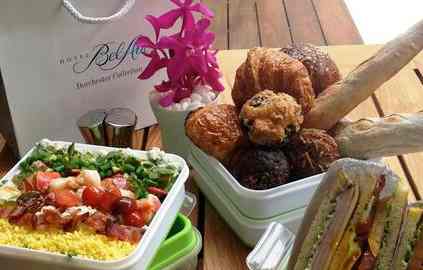
Hotel restaurants offer guests an alternative to airport food. Photo/Hotel Bel-Air, Los Angeles

Hotel restaurants offer guests an alternative to airport food. Photo/Hotel Bel-Air, Los Angeles

Some examples:

• At the Hotel Bel-Air, in Los Angeles, Wolfgang Puck and his team have designed a “Meals on the Move” menu that can be made-to-order right before guests take off for Los Angeles International Airport. Items include Thai Style Chicken Salad, Lobster Cobb Salad, and Santa Monica Farmers Market Fruit Bowl. The menu is posted in all rooms on iPads; costs range from $14 to $34.

• The Four Seasons Boston has a “For Your Trip Home” menu located on the reverse side of the pre-order breakfast menu that guests hang on their doors before bed. Offerings vary from “The Classic” featuring fresh mozzarella with basil and tomatoes, a Cobb salad and a slice of apple pie to the “Sky High” with American Spoonbill caviar with toast points and accompaniments. Prices range from $25 for the Breakfast On the Go to $120 for the “Sky High.”

• The Four Seasons Seattle has a “Want It To Go, Let Us Know” menu with a la carte items such as cheese with crackers, charcuterie with olive rosemary bread, a hard-boiled egg and nut butter and jelly sandwiches. The items are boxed, wrapped and bagged. Prices range from $2 to $8.

• Kimpton’s Hotel Monaco in Denver has a “Breakfast with Wings” menu with such options as fresh fruit, Greek yogurt and a granola parfait and steel cut oats, ranging in price from $7 to $10.

“We really just wanted to offer something more convenient, affordable, healthy and better quality than what they can get at the airport,” says Josh Mayo, general manager of Panzano, the restaurant at the Hotel Monaco in Denver. “We have many guests leaving the hotel early to catch a flight and they don’t have time to stop for the most important meal of the day, so we thought we could help them out with that.”

The hotels package the items so they can get through security. For instance, the liquid offerings at the Four Seasons Seattle are each 3 ounces. The Hotel Bel-Air makes sure liquids are extremely small and that salad dressing is in a sealed container on the side.

“We make sure that we package all items properly so that we protect the integrity of each dish, but also ensure that our guests will be able to take these boxes on the plane,” says Stephane Lacroix, director of Food and Beverage at the Hotel Bel-Air.

Hotels say the meals are increasing in popularity as airlines cut back on free pretzels and charge passengers for boxes of cheese and crackers.

The Hotel Monaco gets about three requests for meals-to-go each day. The Hotel Bel-Air has sold about five to 10 meals each week since starting the service about a month ago. “We expect the demand to increase during the busy summer season,” Lacroix says.

Maryam Wehe, senior vice president at Applied Predictive Technologies, which does hotel consulting, says the takeout meals can be a way to make a hotel stay more memorable.

“Offering meals-to-go can provide hotels with several opportunities, such as differentiating their brand from other hotel brands,” she says. “Furthermore, providing branded meals extends a positive guest hotel experience beyond checkout as long as guest expectations are managed carefully for meals to go versus in-hotel dining.”

Pamela Sievers, a home furnishings sales representative in Thousand Oaks, Calif., says she’d be willing to pay for a hotel takeout meal rather than rely on airport food.

“If one encounters delays and food concessions begin to close or run out of food, one can really be stuck,” she says.


Desserts that focus on peaches

By David Tanis, Los Angeles Times

With hot, sultry weather comes luscious, sweet, juicy stone fruit — just what we’ve been waiting for. Peaches, nectarines, cherries, apricots and plums fall into this category, and they are the true delights of summer. They all taste good together, whether baked in a cobbler or sliced for a fruit salad.

But let’s focus on peaches.

At the market the other day, there were ripe peaches that had been delivered straight from the orchard. They had a hairy exterior called peach fuzz, which is not seen very often these days. There is a reason, though it may seem incredible: modern peaches are mechanically defuzzed before shipping. Evidently, it has been determined that consumers prefer a smoother peach, and they would rather not remove the fuzz themselves. So peach fuzz now refers more to adolescent boys’ cheeks than to fruit.

For a truly smooth-skinned peach, choose nectarines instead. Contrary to popular belief, a nectarine is also a peach, just a different (and completely fuzzless) variety. Consider them interchangeable, though some prefer one to the other.

Most peaches are shipped firm and underripe, an unfortunate reality. Make sure the ones you buy are not rock hard, and have skin that has already turned reddish-yellow, with no green patches. Then a few days at room temperature will suffice to make them soft and sweet.

Now, to peel or not to peel. For peaches that will be cooked, dipping them in boiling water for a brief moment makes the skin easily slip off. For peaches to be sliced and eaten raw, peeling with a sharp paring knife is preferable. With nectarines, it’s O.K. to opt for unpeeled.

Here are two Italian methods to serve peaches to their best advantage as a dessert. One way is rather brilliant. Cool red wine, spiced slightly or not, is poured over sliced peaches in a glass. It’s a simple rustic-yet-elegant way to finish a meal. The tannins in the wine complement the fruit beautifully.

Another way, which requires a bit more finesse, is to serve peaches with zabaglione, the traditional egg custard flavored with musky sweet Marsala wine. Other sweet wines may also be used, like sherry or spumante. It takes just a few minutes to make, whisking over a double boiler. Zabaglione can be served hot, but in summer it is better cool. The faint butterscotch caramel-y flavor seems custom-made to accompany peaches.

Of course you will need ripe peaches for either of these desserts. But if fate should bless you with perfumed, perfectly ripe summer peaches, forget about any further adornment. Eat them as is, outside, letting the ambrosial juices drip where they may.


Dessert and breakfast — cobbler with fresh fruit

By Kathryn Reed

I’m a big fan of leftovers – the whole cook once, eat multiple times thing.

Usually my dinner extras become lunch. But what I really love is when dessert becomes breakfast.

So it is this week with the peach-blueberry cobbler I made over the weekend. The guests left and in the fridge were two “extra” servings. Breakfast.

k's kitchenConsidering some of things people consume for breakfast – doughnuts, sugary cereals and the like – cobbler isn’t so bad. I can also justify most things I want to eat, so maybe I’m not the best one to take advice from. For instance, the vanilla ice cream on top gave me my calcium for the day.

The recipe is from a 2007 issue of Cooking Light magazine.

Besides being super tasty, it is easy to make.

I used peaches from the farmers’ market, but had to get the blueberries from the grocery store because if the market had the berries, I shopped too late.

I did not peel the peaches nor did I use the cooking spray or turbinado sugar.

Peach-Blueberry Cobbler

Filling

½ C granulated sugar

2 T all-purpose flour

½ tsp grated lemon rind

¼ tsp salt

3 C chopped peeled peaches (about 2 pounds)

2 C fresh blueberries

1 T fresh lemon juice

Cooking spray

Topping:

1 1/3 C all-purpose flour

1/3 C granulated sugar

½ tsp baking powder

¼ tsp salt

3 T chilled butter, cut into small pieces

2/3 C low fat buttermilk

1½ T turbinado sugar

Preheat oven to 400 degrees.

To prepare filling, combine first 4 ingredients in a large bowl. Add peaches, blueberries, and juice. Spoon mixture into an 8-inch square baking dish coated with cooking spray. Bake at 400 degrees for 15 minutes.

To prepare topping, lightly spoon 1 1/3 cups flour into dry measuring cups; level with a knife. Combine flour, 1/3 cup granulate sugar, baking powder, and ¼ teaspoon salt, stirring with a whisk. Cut in butter with a pastry blender or 2 knives until mixture resembles coarse meal. Add buttermilk; stir just until moist.

Remove dish from oven; drop dough onto peach mixture to form 9 rounds. Sprinkle dough evenly with turbinado sugar. Bake at 400 degrees for 25 minutes or until bubbly and golden.


Beer drinkers want some exercise while imbibing

By Brad Tuttle, Time

Beer tends to be paired with burgers, not bicycles. But around the country, a new recipe in tourism mixes craft-beer tastings with cycling, running and rafting. Think of it as a sweaty spin-off of the foodie craze.

While the clientele tends to be fit, the physical demands of these brew tours are not all that daunting. John Stevens launched Port City Running Tours in his hometown of Portland, Maine, in 2012 and now offers 3-mile jogs on Saturdays with samplings at three breweries.

OARS offers a variety of beer-rafting adventures. Photo/OARS

OARS offers a variety of beer-rafting adventures. Photo/OARS

“The longest stretch is just under a mile,” he says. “Anyone can run that, especially if there’s beer at the end.”

Last year alone, more than 400 new breweries opened in the U.S., as sales of craft beer increased by a whopping 17 percent. Not surprisingly, beerercise expeditions have been popping up in areas with high concentrations of craft breweries and active residents. There’s no national count of such tours, but Portland, home to no fewer than 35 breweries, has at least three beer-focused cycling tours — including the funky Brewcycle, a jointly pedal-powered contraption that fits 15 riders.

And in Fort Collins, Colo. — 145,000 residents, nine breweries. Bob Williams launched Beer and Bike Tours last year, offering scenic day tours and multiday rides in the Rockies with ample brewery breaks. This autumn, the company is peddling beer-bike-foliage tours in Vermont, which has the most craft breweries per capita of any state in the country.

Beer-themed rafting trips have become a big draw for the California outfitter OARS, where in addition to the usual adventure equipment — tents, life jackets and sleeping bags — beer tours require an extra raft just to carry 10 or 11 5-gallon kegs.

“We try to put the kegs down on the bottom of the raft, near the water, to keep them cool,” explains Scott Saulsbury, head brewer for Southern Oregon Brewing Co., who has accompanied OARS on multiday trips down Oregon’s Rogue River for the past two summers.

As for what kind of beer goes best with rafting and cycling, there’s no consensus.

“Some people like porters regardless of what they’re doing, or if it’s 110 degrees,” says Saulsbury. Doctors might suggest water as the best postaerobics beverage, but don’t tell that to craft-brew aficionados. “Beer is just a terrific reward,” says Evan Ross, founder of Oregon’s Cycle Portland Bike Tours. “After working hard, that great feeling you get from beer is your body’s way of saying thank you.”