Dry farming turning out sweet produce

By Alastair Bland, NPR

A week without water can easily kill the average person.

But a garden that goes unwatered for months may produce sweeter, more flavorful fruits than anything available in most mainstream supermarkets — even in the scorching heat of a California summer. Commercial growers call it “dry farming,” and throughout the state, this unconventional technique seems to be catching on among small producers of tomatoes, apples, grapes, melons and potatoes.

At Happy Boys Farms, near Santa Cruz, sales director Jen Lynne believes dry farming could be an important agricultural practice in the future, when water will likely be a less abundant resource.

But the taste of her dry-farmed Early Girl tomatoes is the main reason chefs, wholesalers and individuals around the country are increasingly calling to place orders. She notes that many calls come from places where rain falls through the summer, making dry farming impossible.

Read the whole story


Roasted tomatoes make summer linger longer

By T. Susan Chang, NPR

At this time of year, we all love tomatoes. Many of us claim we’ll “take a big juicy tomato and bite into it like it’s an apple,” although you won’t often see that happen in actual fact.

Yet, even people who love a juicy fresh tomato also are likely to enjoy it with all the juice sucked out, as in sun-dried tomatoes and — especially — roasted tomatoes. It’s the way the process acts on flavors, caramelizing what’s on the outside, concentrating what’s on the inside. It’s true even for a soulless, pale-pink January tomato. You can count on roasting to isolate and spotlight whatever sugars are to be found in that poor, hardhearted, well-traveled specimen.

But when you roast an August tomato — the Rita Hayworth of nightshades, seething in aromatic volatile compounds, complex with the sweetness of captured sunlight, intrinsically tart with citric and malic acids — well, then, you have something worth stopping the presses for. Dressed in caramel notes, with a suggestion of salt and a big wink toward vinegar, a roasted tomato’s most memorable feature is its long, sensuous, deep and savory finish. It’s a tone poem in umami, and by the time you reach the coda it’s already instructed your brain to reach for the next.

Read the whole story


Lecture to focus on olive oil

What’s in Your Extra Virgin Olive Oil? is the subject of a Sept. 19 lecture at Tahoe Center for Environmental Sciences in Incline Village.

Selina Wang of the UC Davis Olive Center will present her research exposing the poor quality of olive oil available to U.S. consumers, showing that 65 percent of imported olive oil failed extra virgin standards. Guests will be able to sample olive oils and learn about their natural flavor attributes.

The free event starts at 5:30pm. TERC is at 291 Country Club Drive.


S. Tahoe restaurant owner strives for originality

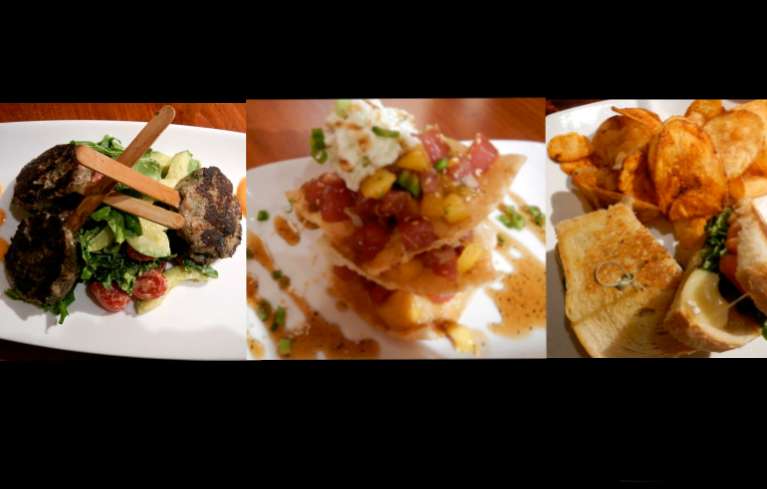
Gunbarrel's Lamb Lollipops, Tower 16 and Brie sandwich. Photo/LTN

Gunbarrel restaurant’s Lamb Lollipops, from left, Tower 16 Tuna and Brie sandwich. Photo/LTN

By Kathryn Reed

Unconventional. That’s exactly what the owner of Gunbarrel Tavern & Eatery wants to be.

“We are here to give the finger to standard ideas about what a menu is supposed to be. We try to do things different … to not abide by anything you have to do,” Alex Cox said.

Cox this month opened Gunbarrel restaurant in Heavenly Village where Wolfgang Puck’s used to be. He is also the owner of 22 Bistro at the Village at Squaw Valley.

He has incorporated his love for skiing into the names of his restaurants. Gunbarrel is the same name as Heavenly Mountain Resort’s face and the 22 comes from Squaw’s renowned KT-22.

Cox thought he was moving to Lake Tahoe to be a ski bum after he graduated from the University of Indiana. He was right. But what wasn’t in the original plan was to make Tahoe his home. That he has done for more than a decade.

What he brings to the restaurant business is a desire to showcase foods he and his staff like, with dishes that are unique, some that are prepared in original ways and other items that appeal to the masses.

Billy McCullough is the executive chef at both restaurants. McCullough is also executive chef of Dragonfly, the Truckee restaurant he owns. He is also the co-founder of Slow Food Lake Tahoe.

Gunbarrel’s head chef is Ricky Sausser. Sausser grew up on the North Shore. He worked for McCullough before being hired at 22 Bistro in 2009.

The goal, according to Cox, will be to use as much local food as possible. Local, though, could be the Central Valley since not much grows in Tahoe. But what he would like to do is use the biodome in Truckee or the one proposed for Squaw Valley to grow something like chard or kale to have on the menu as a truly locally sourced item.

Talks are also under way with farmers in Nevada to potentially provide produce to Gunbarrel.

The range of menu choices is varied. Those in the media who were invited to a special tasting last week raved about the Mac N’ Cheese. It comes as an appetizer with bacon, but as a side (without bacon) with the PBR Beer Can Chicken. This chicken is Cox’s favorite on the menu. An LTN reporter said she would easily order the chicken again.

For the Lamb Lollipops it takes some time over the grill before they come to the table. This is because the lack of a binding agent requires the chef to apply pressure as they cook so the meat stays on the stick. Then this appetizer is served with a harissa yogurt sauce and a mini cucumber mint salad.

The Tower 16 Tuna was another app that people raved about. The Fire-Roasted Cauliflower with achiote chili oil and toasted lemon zest just gets better as the flavors meld together.

The caramelized onions and balsamic glaze on the Brie Grilled Cheese added sweetness to the sandwich and balanced the richness of the Brie. The chips served with it are cooked and seasoned at the restaurant. What’s in the seasoning is a secret. But each bite is a bit different, at times sweet, at times spicy – all good.

To complement the variety of food items is an interesting drink menu. The beer and wine choices are limited.

Even the décor is a bit eclectic. The exposed concrete is a bit new age-industrial, while the tables are mountain wood.

Cox is working on creating an outside bar and eating area that would include fire pits and live music.

“At this time, due to the prohibitive cost, Gunbarrel Tavern does not validate parking. We are currently looking into other potential solutions but have yet to come to an effective resolution. We are hopeful, however, that we will be able to validate customer parking in the future,” Cox told Lake Tahoe News.

Gunbarrel is open for lunch and dinner seven days a week.


Beverages coming in specialized cans

By Kristen Leigh Painter, Denver Post

The standard 12-ounce beer can is being squeezed off store shelves as beverage makers try to one-up each other not only with what’s inside their cans but what the can itself looks like.

Consumers can now choose from cans with temperature-sensitive ink indicating a drinkable chill, wider tops meant to release more flavor and simulate drinking from a glass, or re-closeable lids.

Steep competition is driving companies across all beverage sectors toward customized aluminum can shapes, sizes, colors and textures — spurring innovation, and significant investment in new technology, among the world’s can manufacturers.

Seeing the writing on the wall three years ago, Broomfield, Colo.-based can-maker Ball Corp. invested $400 million into growing its speciality can capabilities.

Read the whole story


Multiple senses play a role in how food tastes

By Michael Moyer, Scientific American

Taste is not what you think. Every schoolchild learns that it is one of the five senses, a partner of smell and sight and touch, a consequence of food flitting over taste buds that send important signals — sweet or bitter, nutrient or poison? — to the brain. Were it so simple.

In the past decade our understanding of taste and flavor has exploded with revelations of the myriad and complex ways that food messes with our consciousness—and of all the ways that our biases filter the taste experience. Deliciousness is both ingrained and learned, both personal and universal. It is a product of all five senses (hearing included) interacting in unexpected ways, those sensory signals subject to gross revision by that clump of nerve tissue we call the brain.

Let’s start at the beginning: Food enters your mouth, meets your teeth and begins to be broken down by enzymes in your saliva. The morsel soon moves over your papillae, the few thousand bumps that line your tongue. Each papilla houses onion-like structures of 50 to 100 taste cells folded together like the petals of a young flower about to bloom—taste buds, we call them. These cells have chemical receptors attuned to the five basic tastes—bitter, sweet, sour, salt and umami, the last a word borrowed from Japanese that describes the savory flavors of roast meat or soy sauce.

Read the whole story


FDA looking for new ways to check food imports

By Justin Bachman, Bloomberg Businessweek

Food destined for the U.S. would be inspected abroad and importers would be held more accountable for ensuring its safety, under new rules proposed by the Food and Drug Administration.

Federal regulators are pushing to tackle a problem that has long plagued the food supply: too few inspectors facing more and more imports. As it stands now, only a tiny fraction of foreign-made foods is examined at the border before completing that inexorable procession to grocery stores and into American bellies.

In essence, the government is seeking to outsource work to companies that already have food-sourcing operations overseas – a way to “leverage the private sector,” as a former FDA official told the New York Times. Under the rules proposed in late July, food importers would need to ensure that their foreign suppliers comply with FDA safety rules or that local regulations meet U.S. requirements. The measures also outline accreditation procedures for third-party auditors who would inspect food suppliers.

The new rules are also designed to reduce the occurrence of recalls and the outbreaks of food-borne illnesses that can prove fatal. About 48 million Americans get sick, some 128,000 are hospitalized and about 3,000 die each year from food-borne diseases, according to federal officials.

Food imports have surged in recent years as Costco, Walmart, Target and other retailers have responded to consumer demand for a greater variety of foods and fresh produce available year-round. About 15 percent of the U.S. food supply is imported, including a fifth of vegetables and half the nation’s fresh fruit. Strawberries, for example, were once a seasonal product in U.S. stores but can now be purchased year-round.

At the same time, Americans continue to perceive domestically sourced foods as safer than imports, says Marianne Rowden, president and chief executive of the American Association of Exporters & Importers, a trade group that counts several large importers such as Target and Mondelez International as members. (That perception gap remains, Rowden notes, even after several illness outbreaks tied to U.S.-grown produce.)

The FDA portrays the changes as a more effective method of targeting the sources of contaminated foods rather than merely responding after people get sick.

“We will continue to check food at our borders,” Michael Taylor, the FDA’s deputy commissioner for foods and veterinary medicine, said in a statement on the agency’s website.

“However, rather than relying almost entirely on FDA’s investigators at the ports to detect and respond to food safety problems, importers would – for the first time – be held accountable for verifying, in a manner transparent to FDA, that the food they import is safe.”

Major food importers generally support the rule, mainly because the FDA consulted with the industry and conducted a thorough cost-benefit analysis, says Michael Robach, vice president of corporate food safety, quality and regulatory affairs for Cargill, a large U.S. food importer with operations in 55 countries.

“If you are doing the proper oversight … you’re actually in the long term going to be saving yourself money,” he says of costs associated with the inspection changes.

The Grocery Manufacturers Association, which represents U.S. food and drink companies such as Kraft Foods and General Mills was also supportive. The new law’s implementation “can serve as a role model for what can be achieved when the private and public sectors work together to achieve a common goal,” the association said in a statement.

What’s less clear, according to Rowden, is how smaller players without the infrastructure and supply-chain expertise of major food importers will comply with the law. She predicts “critiques around the edges of some technical aspects” but no major industry backlash against the regulations.

“The food companies are very conscious about their brands,” she says. “We look at this as brand protection, rather than just new regulation.”

The measures are open for public comment for 90 more days. They do not apply to seafood and fruit juices, two categories covered by other federal rules.

“To me, the real thrust of these regulations will always be about the FDA struggling to deal with the globalization of the food supply,” Rowden says. The agency, with its current staff and funding, is “just not equipped” to address so much food from abroad.



K’s Kitchen: Green bean salad with a kick

By Kathryn Reed

Summer is such a good time for salads. And with all this smoke in the air, who really wants to get the kitchen hot or to fire up the barbecue.

And with all the warm days we’ve been having, they are also a nice alternative.

The one below, though, isn’t ideal for a main dish for most people, but it would be a complement to many entrees.

k's kitchenWith the plethora of salad choices, it’s time to skip the lettuce and venture into new terrain. But this doesn’t mean having to become a vegetarian. Plenty of salads call for meat and those that don’t can easily have morsels added. Bacon would be a good addition to this salad.

Staples in my summer salad repertoire include my mom’s potato salad, Sue’s potato salad, a friend’s pasta salad, black bean-corn salad and green bean salad. The latter I adapted from my favorite grocery store when I lived in Sonoma County. Oliver’s makes this delicious salad that I have re-created for the past few years and now call my own.

Until I decided to write about the green bean salad I had never measured the ingredients. So, like all recipes, make whatever adjustments you want. The first batch I made was super spicy – went a little overboard with the chili oil – and Sue needed an ice cube to cut the heat. It meant more for me. But what I have here is something that is more sesame flavored than spicy.

Green Bean Sesame Salad

1 ½ pounds green beans

1 ½ cups sliced mushrooms

4 cloves garlic, minced

2/3 cup sesame oil

¼ cup rice vinegar

2 T hot chili oil

1/8 cup toasted sesame seeds

½ cup sliced almonds (optional)

Rinse and trim green beans. Parboil or steam until lightly crunchy. Drain, cool with cold water. Put beans into mixing bowl. Add mushrooms and garlic. Toss. Add liquid ingredients. Toss. Add sesame seeds and almonds. Toss again. Best if served a few hours later to let flavors meld. Serves 6.


3 chefs to compete at Sample the Sierra

Chefs are sharpening their knives for the second annual Sierra Chef Challenge, which is part of the 4th annual Sample the Sierra festival.

While the event is supposed to showcase what El Dorado County has to offer, the meat for the cook-off is coming from Reno’s Sierra Meat & Seafood Company and the mystery box of fresh produce from Mountain Bounty Farm out of Nevada City.

This years competitors are Peter Brinkerhoff, executive chef for Gar Woods, Riva Grill, Caliente & Bar of America; Glenn Simpson from Blue Angel Café; and Jeremy “Boomer” Acuña of Zephyr Cove Resort. They will compete in a 45-minute cook-off.

Sample the Sierra is Sept. 1 from 1-5pm on Ski Run Boulevard in South Lake Tahoe. Tickets are $30 and may be purchased online.


Beer aficionados now have equivalent to sommelier

By Deena Prichep, NPR

If you’ve been to a fancy restaurant, you’ve probably seen a sommelier — those wine experts who make sure you get the best possible match for your meal. But what if you don’t want a Chardonnay or Pinot? What if you want a nice cold beer?

A new program is working to bring this same level of knowledge to the world of malt and hops by turning out batches of certified beer experts known as Cicerones.

Ray Daniels, a Chicago brewer, started the Cicerone program five years ago. And he jokes that he did so for a fairly simple reason: bad beer.

“You’d go into a place that had a lot of taps, that you’d think might know their beer. And they really didn’t,” Daniels sighed. So Daniels came up with the Cicerone exam to standardize a canon of beery knowledge.

There are three levels of of Cicerones, starting out with Certified Beer Servers (an online exam), Cicerones (an in-person test, complete with a tasting component), and the top level of Master Cicerone (an in-person exam lasting two days). The exams focus on five basic components: keeping and serving beer; beer styles; flavor and tasting; brewing process and ingredients; and beer and food pairing.

Read the whole story