Study: Meat producers ignore calls for reform

By Eliza Barclay, NPR

Five years ago, a landmark report excoriated the animal agriculture industry’s practices and laid out a roadmap for how it could do better. But in the years since, the problems are just as bad — and maybe even worse.

That’s the conclusion of the Johns Hopkins Center for a Livable Future. This week, the center scolded the industry again with a review of how it has fared in the years since the Pew Commission on Industrial Farm Animal Production released its original report.

These pigs, newly weaned from their mothers, are at their most vulnerable stage of life. They’re getting antibiotics in their water to ward off bacterial infection.

“From a regulatory, or legislative, standpoint, we have actually regressed on many of these issues in the last five years,” says Bob Martin, who served as executive director of the original Pew commission, which included policymakers and scientists. Martin is now a program director at the Center for a Livable Future.

Though the Pew commission is not a foodie household name, its 2008 report has subtly shaped many consumers’ view of how our food animals are produced. It’s not the rosy view — it’s the highly critical one.

Back then, the commission identified the most worrisome systemic problems of producing 9.8 billion food animals every year in the U.S. It called out the animal agriculture industry for the excessive use of medically important antibiotics, particularly the industry’s habit of giving animals low doses for non-therapeutic uses like growth promotion.

Read the whole story


Sour beers are all the rage

By Michaeleen Doucleff, NPR

Move over, bitter IPAs and chocolaty stouts. There’s a new kid on the craft brewing block, and it’s going to knock your salivary glands into action.

They’re called “sour beers.” When you take a sip, it’s like biting into a Granny Smith apple that’s soaked in a French red wine: crisp, refreshing and a bit odd.

The Sam Adams brewery outside Boston. Photo/LTN file

The Sam Adams brewery outside Boston. Photo/LTN file

Sour beers are probably the oldest style of brewski in the world, but they’re just starting to get popular in the States. They were all the buzz at this year’s Great American Brew Festival. And with hundreds of brewers now dabbling in sours, it’s easier than ever to find them at a local bar or grocery store.

Most sour beers have little or no hops. So they’re a good option to try if you don’t like bitter beers or you’re a wine lover who prefers a pinot to a Pilsner, says New Belgium’s CEO, Kim Jordan of Fort Collins, Colo.

New Belgium, which produces the ubiquitous Fat Tire Ale, has started a whole series of sour beers, called Lips of Faith — one of the most widely available lines of sour.

So what in the heck are these strange brews?

Sours beers are to the adult beverage world what yogurt is to dairy. Its beer that’s been intentionally spoiled by bacteria — the good bacteria.

Read the whole story


Seaonal cereals bring out the hoarders

By NPR

This Halloween season, the cereal monsters are on the loose. Count Chocula, Boo Berry and Franken Berry have consumers in their grasp — for a limited time only.

General Mills’ line of “Monster Cereals” originally hit the market in the early ’70s, but the company decided in 2010 they would only be available during the Halloween season.

“That was bad news for some people,” says Dan Pashman, host of Sporkful food podcast.

Cereal fans found ways to get by. One of Pashmn’s podcast listeners turned her sister in Tuscan, Ariz., into a “Boo Berry mule” by making her cross the border into Mexico to get the cereal.

“This artificial scarcity has kind of galvanized a cult following around this time of year for these cereals,” Pashman tells Weekend Edition host Rachel Martin.

Read the whole story


Scientists disagree about the orgins of kale

By Pagan Kennedy, New York Times

Scientists disagree about when humans first tasted kale. But it is known that the ancient Greeks cultivated leafy greens, which they boiled and ate as a cure for drunkenness. And early Roman manuscripts include references to “brassica,” a word that encompassed wild turnips, cabbages and kalelike plants.

By the Middle Ages, kale had spread through Europe and Asia. The Italians developed plants with “dinosaur” scales, while the Scots created varietals with leaves like frilly petticoats. The Russians produced kale that could survive in the snow.

But by the time Tim Peters, who was then farming in Oregon, began experimenting with the plant in the 1980s, kale had become “boring.”

“You only saw the green kind in the supermarket,” he says, “if you could find it at all.”

To create his own varietals, Peters planted Siberian kale on his farm, and also along roadsides, so that bees could cross-pollinate the vegetables with neighborhood weeds.

“I love working with bees,” Peters says. “They’ll do stuff that you didn’t dream of.” One day he noticed that some of his blue-green Siberians had produced “babies” that looked nothing like their parents — they were red, with vellum-thin leaves. “I’d never seen kale like that before. I sent samples to seed companies, and they told me that it belonged to the red Russian family.”

Peters, it turned out, had created several new types of red Russian kale, a varietal that had been around for centuries. He named one particularly delicate strain Winter Red. As kale caught on, so, too, did Winter Red: some companies grew “huge productions of it and released it as ‘Red Russian’ or ‘Russian,’” he says.

Read the whole story


Chef Irvine to serve up food tips at Harrah’s

Robert Irvine is the featured celebrity chef for the fourth annual South Lake Tahoe Food and Wine Festival at Harrah’s and Harveys Lake Tahoe on Nov. 9-10.

Irvine is the of Food Network’s “Dinner Impossible,” “Restaurant: Impossible” and “Worst Cooks in America”.

The event includes tasting, discussions, presentations and demonstrations by celebrated food and wine experts.

The weekend begins with the Grand Market – Beyond the Fork at Harrah’s.

Additional events on Saturday evening include: Wine 101, a guided tour to the world of wine and winemaking; Wines That Rock, a tasting of exotic wines accompanied by an appreciation of timeless rock music; and Mixology 101,”where participants will learn the basics of building some of the most classic cocktails.

Irvine will star in two featured events: Chef in the Kitchen and Chef on Stage.

That Sunday is an afternoon of ribs, beer and football at the Ultimate Tailgate: Blues, Brews and BBQ hosted by Robert Irvine. Some of the best BBQ chefs will be on hand to show people how to be master their own grill.

For more information, event prices and to purchase tickets go online.


Demand for tequila not good for the land

By Ted Genoways, Bloomberg

To slake North America’s seemingly bottomless thirst (sales have almost tripled since 1995), and to meet growing demand in Asian and European markets, tequila producers have tripled the production of pure agave over the past decade through new growing, production, and distillation methods.

But these methods, scientists warn, have left the region vulnerable to severe ecological impacts.

Connoisseurs, meanwhile, complain that tequilas produced by the new methods are of such low quality that they can be enjoyed only by the frozen margarita crowd.

After decades of focusing exclusively on increased foreign sales, tequila producers may finally be forced to ask: How big is too big?

Read the whole story


Changing demographics alter U.S. food choices

By J.M. Hirsch and Suzette Laboy, AP

MIAMI — Salsa overtaking ketchup as America’s No. 1 condiment was just the start.

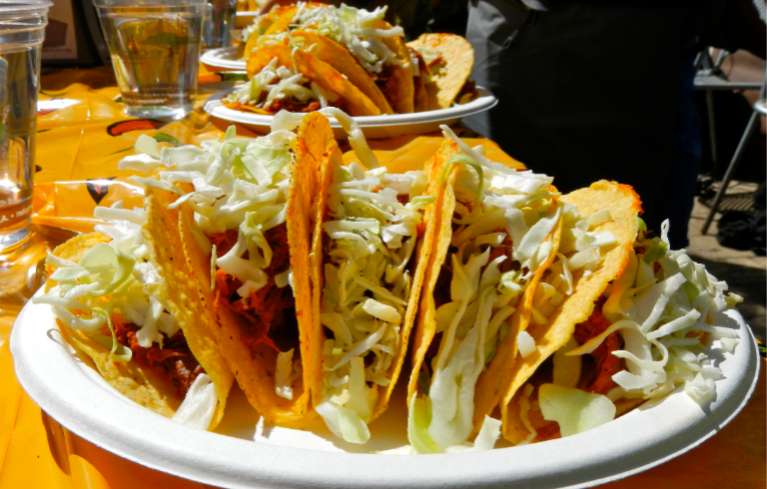
These days, tortillas outsell burger and hot dog buns; sales of tortilla chips trump potato chips; and tacos and burritos have become so ubiquitously “American,” most people don’t even consider them ethnic.

Sierra-at-Tahoe has an annual taco eating contest and salsa competition. Photo/LTN fiel

Sierra-at-Tahoe has an annual taco eating contest and salsa competition. Photo/LTN file

Welcome to the taste of American food in 2013.

As immigrant and minority populations rewrite American demographics, the nation’s collective menu is reflecting this flux, as it always has. And it goes beyond the mainstreaming of once-esoteric ethnic ingredients, something we’ve seen with everything from soy sauce to jalapenos.

This is a rewrite of the American menu at the macro level, an evolution of whole patterns of how people eat. The difference this time? The biggest culinary voting bloc is Hispanic.

Read the whole story


Juice sales getting squeezed by healthier choices

By Vanessa Wong, Bloomberg

Americans may be trading in soda for healthier alternatives, but it seems like juice isn’t one of them. Per-capita juice consumption in the U.S. dropped to 35.5 liters last year, from 39.9 liters in 2007, according to researcher Euromonitor International. It’s a complication for beverage makers looking for ways to make up for slowing soda sales.

Juice has been something of a bright spot this year for Coca-Cola, the largest juice and juice drink producer in the U.S. The company reported Tuesday that juice sales by volume in North America were up 4 percent from July to September, including a 7 percent increase for its fast-growing brand, Simply. On Wednesday, No. 2 juice maker PepsiCo reported share gains in chilled juice and strong performance by its new Tropicana Farmstand fruit-and-veggie drinks.

Considering the larger trend, however, it’s unclear how long this momentum can be sustained. Retail juice sales in the U.S. shrank 7.2 percent from 2007, to 9 billion liters last year, according to Euromonitor. Recent data show that sales of orange juice, the most popular, are now at their lowest level in 15 years.

Read the whole story


Sugar substitute replacing tobacco crops

By Duane Stanford, Bloomberg

The once-idled leaf-processing machines at a former tobacco trading house in Alma, Ga., are coming back to life. Except now the warehouse, which still smells of tobacco leaves and cigarette smoke, is becoming a hub for a sweeter crop: stevia.

Approved for commercial use in the U.S. five years ago, stevia extracts are fast becoming the sugar substitute of choice for a population trying to slim down and avoid artificial options. The no-calorie, natural sweetener, derived from plants grown mostly in China and South America, is creating an opportunity for U.S. farmers and processors looking to make up for dwindling tobacco demand and sell to the likes of Cargill and Coca-Cola.

Stevia may one day command about a third of the $58 billion global sweetener market, according to Stevia First, a grower in Yuba City.

U.S. tobacco output, meanwhile, has slid by half over the past 20 years. Since the two leaves can be handled using the same planting equipment, harvesters, drying barns, and loaders, processors are urging farmers to switch to stevia.

“I can remember 25 years ago when there were 300 tobacco farmers here,” says Julian Rigby, 62, a farmer who’s traded his tobacco fields near the Alma facility for stevia plots. “Today there’s one.”

Stevia, named after the 16th century botanist Petrus Jacobus Stevus, and tobacco have a lot in common. They can grow in similar soil and climates. Both leaves are picked, separated from their stems, and dried. But unlike cigarettes and other tobacco products, extracts from the stevia herb are “generally recognized as safe,” says the U.S. Food and Drug Administration.

That’s been a godsend for food manufacturers who have fought a backlash against sugar, fat, and salt as obesity rates ballooned in recent decades.

Read the whole story


Knowing when to pop the cork on fine wine

By Will Lyons, Wall Street Journal

Fine-wine collectors know the drill well. Every year, you allocate a small sum to buy a case of that special wine you know will improve your cellar. Having bought it on release, you lay it down for maturing until the time comes when its tannins, fruit and acidity are perfectly aligned and the wine is approaching its optimum taste.

Well, that’s the theory. In reality, every collector faces the intriguing question of whether to pull the cork or to leave the wine quietly maturing for another year.

In this information age there is a swathe of resources to call upon. Specialist wine magazines, columns like this, books, websites and high-end wine merchants are constantly reviewing and updating tasting notes on recent vintages and will be able to give you a steer on the present condition of a particular wine. But for those who regularly buy wine to lay down, there are a few catchall rules worth committing to memory.

Any fine wine, well made and stored properly, will last much longer than you think. I categorize fine wine as anything costing more than £15 a bottle from one of Europe’s recognized classic regions such as Bordeaux, Burgundy and the Rhône in France or Barolo in Italy. I’d also include German Riesling, Champagne and wines from Napa.

Wine has an uncanny ability to surprise and I have tasted wines from every decade of the last century and a few from the century before that have tasted far younger than their years.

Read the whole story