3-day food and wine event at Harrah’s

The eighth annual South Lake Tahoe Food and Wine Festival will be at Harrah’s Lake Tahoe Oct. 27-29.

Events for this year’s festival include dining and tasting experiences, plus a performance by trumpeter extraordinaire Chris Botti. 

Food and wine are the biggest stars and a spectacular Grand Market Expo – featuring dishes from Harrah’s, Harveys and other Caesars Entertainment properties’ best restaurants, plus top-shelf spirits and wines of Napa Valley and beyond – highlights the weekend.

Activities begin Oct. 27 with a Whiskey Tasting at Cliché Lounge on the 16th floor of Harrah’s hotel. 

For more information, event prices and to purchase tickets, go online


Hope as vintners assess long-term impact of fires

The moisture in grape vines makes them resilient. Photo/CalFire

By Esther Mobley, San Francisco Chronicle

Many of the most powerful images coming out of the Wine Country fires last week depicted the wine industry as charred, its future threatened.

A generations-old winery engulfed in flames and reduced to rubble. Symmetrical rows of grapevines, backlit by a bright line of approaching fire.

Uncertainty and anxiety grip the wine community. And as the magnitude of the damage becomes clearer and missing loved ones are located, attention will turn to the scale of the devastation to the pastoral region’s multibillion-dollar wine industry.

 No one would compare the loss of wine with the loss of life. But wine is these communities’ lifeblood — economic, cultural and otherwise. As Sam Coturri, owner of Sonoma’s Winery Sixteen 600, put it: “Saving our lives up here also means protecting our livelihood.”

Read the whole story


Sage Room – old school dining with modern flare

The Sage Room at Harveys is celebrating its 70th anniversary this year. Photo/Jessie Marchesseau

By Jessie Marchesseau

STATELINE – Frog legs sautéed with tomatoes, onion, garlic, basil, Kalamata olives and white wine; mushroom raviolis with a portabella-black truffle Marsala sauce; Steak Dianne, flambéed tableside with filet mignon, mushrooms, demi glaze and flaming brandy. These are just a few of the everyday delicacies served at the Sage Room inside Harvey’s Lake Tahoe.

Celebrating its 70th anniversary this year, the Sage Room has been adorning tables with fine Tahoe cuisine since 1947.

Just walking into the Sage Room feels like a step back in time. The lighting is low, wood graces the walls and ceiling, and deep burgundy covers the tables and chairs creating a warm and intimate atmosphere. The hand-hewn wood beams crisscrossing the ceiling came from the original Harvey’s Wagon Wheel Saloon and Gambling Hall opened in 1944 by Harvey and Llewellyn Gross. Just a few years after the Sage Room opened the local Washoe tribe gave the Grosses a gift of beautiful hand-made Native American lampshades which still hang from the ceiling today.

Sage Room maitre d’ Ozzie Sanchez makes a show whipping up some Cafe Diablo. He has been with the Sage Room for two decades. Photo/Jessie Marchesseau

Diners are offered a selection of traditional steakhouse fare and unique gourmet dishes. Several of the signature dishes are prepared tableside including the Steak Dianne, the Caesar salad with house-made croutons, a flaming cherries jubilee, and the crowd-pleasing café diablo, where blue flames of Grand Marnier travel up curling rinds of lemons and oranges. The servers preparing these dishes are both skilled and entertaining, often joking as they pour and sauté, eliciting applause from throughout the dining room with their showy preparations. But it’s not just the food, the ambiance and tableside shows which keep diners coming back year after year.

“We strive big time to make everyone feel like family,” said Ozzie Sanchez, matre d’ for the restaurant, who said on any given night he gives out a plethora of hugs to regular customers and sometimes even new ones.

The Sage Room’s staff is attentive, knowledgeable and experienced, many of them having been part of the team for decades. “We look for solutions, no matter what,” Sanchez said.

The Washoe tribe donated these chandeliers to the Sage Room nearly 70 years ago. Photo/Jessie Marchesseau

Teddy Herrera who prepared a tableside Caesar salad and Steak Dianne for a room of hungry media representatives last Thursday has been working at the Sage Room for 30 years.

“This is my second home here,” Herrera said. “I have so many customers and so many experiences here. They take care of me.”

And it’s not just lip service. Herrera named his youngest son Sage, in honor of his “second home.”

“That’s how much I love this place,” he said.

As he squeezed fresh lemons, fired up steaks and served up tapa-sized dishes for his afternoon guests, Herrera’s skill and enjoyment in his task was apparent.

The same could be said watching Evan Derdowski cooking up the sweet-tart cherries jubilee: setting the pan of juicy fruit aflame, then sprinkling in some cinnamon to make sparks fly. And the show was, of course, topped off with a luscious dessert of cherry caramel drizzled over vanilla ice cream alongside warm, juicy cherries.

The Sage Room, after 70 years, is offering up more than just food, it’s a true dining experience.

In celebration of this 70th anniversary, the Sage Room is has put together a special fixed-price dining option in addition to its regular menu which will be available through the end of the year.


Popcorn sales explode despite shrinking movie attendance

By Charlie Heller, Food & Wine

Fewer people may be going to the movies, but popcorn sales are exploding like, well, popcorn. Between February 2016 and 2017, sales of ready-to-eat popcorn and caramel corn rose 16.9 percent, in what expert corn-poppers are calling a potential “third golden age” of popcorn.

While popcorn is still the most popular food for moviegoers, a spokesman for the National Association of Theater Owners told the Guardian that the snack’s traditional home saw its worst summer box office totals in a decade this year. While this could be an obstacle for the continued rapid growth, it’s possible that newer venues and reasons for consumption of the ancient treat could help make up for it.

While it’s been eaten since the Aztecs were popping corn 4000 years ago, popcorn saw two more recent booms.

Read the whole story


K’s Kitchen: Versatile quinoa shines through

By Kathryn Reed

Quinoa is one those wonderful foods, especially for vegetarians because it’s another source of protein.

This is one of those recipes that can be made year-round. The vegetables involved can change based on what you like. I had fresh corn, so I used that. Frozen veggies in the off-season would work, or zucchini would be tasty any time.

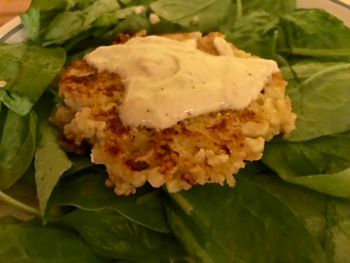
While it’s not necessary to put the cakes on a bed of spinach, this does make for a more complete meal. Another green could satisfy. Or serve these as a side dish or even as an appetizer. If they aren’t an entrée, you might want to make the patties smaller.

The spinach, cake and topping together all complement each other. To me this was a meal unto itself.

Quinoa Cakes with Spinach

2 C cooked quinoa

1 C corn

1/3 C Panko

1/3 C yellow onion, grated

3 T flat leaf parsley, chopped

3 garlic cloves, minced

1 tsp lemon rind

2 tsp lemon juice

¾ C feta cheese crumbles

3 large eggs

½ tsp kosher salt

½ tsp pepper

1½ T olive oil

6 C spinach

2 T mayonnaise

2 T sour cream

¼ tsp smoked paprika

Cook quinoa according to directions.

In large bowl combine quinoa with the next 11 ingredients.

Shape mixture into patties; should make eight.

Heat oil in a large nonstick skillet over medium-high. Add patties to pan; cook 4 minutes on each side or until browned. It may be necessary to add more oil.

Combine mayonnaise, sour cream, and paprika in a bowl. Add salt and pepper if so desired.

Divide spinach on four plates. Place two patties on each plate, then top with mayo-sour cream mixture.


Literacy was key ingredient for culinary revolution

By Helen Zoe Veit

The first edition of the “Boston Cooking-School Cook Book”—now known as “The Fannie Farmer Cookbook”—reads like a road map for 20th-century American cuisine. Published in 1896, it was filled with recipes for such familiar 19th-century dishes as Potted Pigeons, Creamed Vegetables, and Mock Turtle Soup. But it added a forward-looking bent to older kitchen wisdom, casting ingredients such as cheese, chocolate, and ground beef—all bit players in 19th-century U.S. kitchens—in starring roles. It introduced cooks to recipes like Hamburg Steaks and French Fried Potatoes, early prototypes of hamburgers and fries, and Fruit Sandwiches, peanuts sprinkled on fig paste that were a clear precursor to peanut butter and jelly.

Americans went nuts for the 567-page volume, buying “The Boston Cooking-School Cook Book” in numbers the publishing industry had never seen—about 360,000 copies by the time author Fannie Farmer died in 1915. Home cooks in the United States loved the tastiness and inventiveness of Farmer’s recipes. They also appreciated her methodical approach to cooking, which spoke to the unique conditions they faced. Farmer’s recipes were gratifyingly precise, and unprecedentedly replicable, perfect for Americans with newfangled gadgets like standardized cup and spoon measures, who worked in relative isolation from the friends and family who had passed along cooking knowledge in generations past. Farmer’s book popularized the modern recipe format, and it was a fitting guide to food and home life in a modernizing country.

Recipes today serve many purposes, from documenting cooking techniques, to showing off a creator’s skills, to serving up leisure reading for the food-obsessed. But their most important goal is replicability. A good recipe imparts enough information to let a cook reproduce a dish, in more or less the same form, in the future.

The earliest surviving recipes, which give instructions for a series of meaty stews, are inscribed on cuneiform tablets from ancient Mesopotamia. Recipes also survive from ancient Egypt, Greece, China, and Persia. For millennia, however, most people weren’t literate and never wrote down cooking instructions. New cooks picked up knowledge by watching more experienced friends and family at work, in the kitchen or around the fire, through looking, listening, and tasting.

Recipes, as a format and genre, only really began coming of age in the 18th century, as widespread literacy emerged.  This was around the same time, of course, that the United States came into its own as a country. The first American cookbook, “American Cookery,” was published in 1796. Author Amelia Simmons copied some of her text from an English cookbook but also wrote sections that were wholly new, using native North American ingredients like “pompkins,” “cramberries,” and “Indian corn.” Simmons’s audience was mainly middle-class and elite women, who were more likely to be able to read and who could afford luxuries like a printed book in the first place.

The reach of both handwritten recipes and cookbooks would expand steadily in the coming decades, and rising literacy was only one reason. Nineteenth-century Americans were prodigiously mobile. Some had emigrated from other countries, some relocated from farms to cities, and others moved from settled urban areas to the Western frontier. Young Americans regularly found themselves living far from friends and relatives who otherwise might have offered help with cooking questions. In response, mid-19th-century cookbooks attempted to offer comprehensive household advice, giving instructions not just on cooking but on everything from patching old clothes to caring for the sick to disciplining children. American authors routinely styled their cookbooks as “friends” or “teachers”—that is, as companions that could provide advice and instruction to struggling cooks in the most isolated of spots.

Americans’ mobility also demonstrated how easily a dish—or even a cuisine—could be lost if recipes weren’t written down. The upheaval wrought by the Civil War singlehandedly tore a hole in one of the most important bodies of unwritten American culinary knowledge: prewar plantation cookery. After the war, millions of formerly enslaved people fled the households where they had been compelled to live, taking their expertise with them. Upper-class Southern whites often had no idea how to light a stove, much less how to produce the dozens of complicated dishes they had enjoyed eating, and the same people who had worked to keep enslaved people illiterate now rued the dearth of written recipes. For decades after the war, there was a boom in cookbooks, often written by white women, attempting to approximate antebellum recipes.

Standardization of weights and measures, driven by industrial innovation, also fueled the rise of the modern American recipe. For most of the 19th century, recipes usually consisted of only a few sentences giving approximate ingredients and explaining basic procedure, with little in the way of an ingredient list and with nothing resembling precise guidance on quantities, heat, or timing. The reason for such imprecision was simple: There were no thermometers on ovens, few timepieces in American homes, and scant tools available to ordinary people to tell exactly how much of an ingredient they were adding.

Recipe writers in the mid-19th century struggled to express ingredient quantity, pointing to familiar objects to estimate how much of a certain item a dish needed. One common approximation, for instance, was “the weight of six eggs in sugar.” They also struggled to give instructions on temperature, sometimes advising readers to gauge an oven’s heat by putting a hand inside and counting the seconds they could stand to hold it there. Sometimes they hardly gave instructions at all. A typically vague recipe from 1864 for “Rusks,” a dried bread, read in its entirety: “One pound of flour, small piece of butter big as an egg, one egg, quarter pound white sugar, gill of milk, two great spoonfuls of yeast.”

By the very end of the 19th century, American home economics reformers, inspired by figures like Catharine Beecher, had begun arguing that housekeeping in general, and cooking in particular, should be more methodical and scientific, and they embraced motion studies and standardization measures that were redefining industrial production in this era. And that was where Fannie Merritt Farmer, who started working on “The Boston Cooking-School Cook Book” in the 1890s, entered the picture.

Farmer was an unlikely candidate to transform American cookery. As a teenager in Boston in the 1870s, she suffered a sudden attack of paralysis in her legs, and she was 30 years old before she regained enough mobility to begin taking classes at the nearby Boston Cooking School. Always a lover of food, Farmer proved to be an indomitable student with a knack for sharing knowledge with others. The school hired her as a teacher after she graduated. Within a few years, by the early 1890s, she was its principal.

Farmer started tinkering with a book published by her predecessor a few years earlier, “Mrs. Lincoln’s Boston Cook Book.” Farmer had come to believe that rigorous precision made cooking more satisfying and food more delicious, and her tinkering soon turned into wholesale revision.

She called for home cooks to obtain standardized teaspoons, tablespoons, and cups, and her recipes called for ultra-precise ingredient amounts such as seven-eighths of a teaspoon of salt, and four and two-thirds cups of flour. Also, crucially, Farmer insisted that all quantities be measured level across the top of the cup or spoon, not rounded in a changeable dome, as American cooks had done for generations.

This attention to detail, advocated by home economists and given life by Farmer’s enthusiasm, made American recipes more precise and reliable than they ever had been, and the wild popularity of Farmer’s book showed how eager home cooks were for such guidance. By the start of the 20th century, instead of offering a few prosy sentences that gestured vaguely toward ingredient amounts, American recipes increasingly began with a list of ingredients in precise, numerical quantities: teaspoons, ounces, cups.

In more than a century since, it’s a format that has hardly changed. American cooks today might be reading recipes online and trying out metric scales, but the American recipe format itself remains extraordinarily durable. Designed as a teaching tool for a mobile society, the modern recipe is grounded in principles of clarity, precision, and replicability that emerge clearly from the conditions of early American life. They are principles that continue to guide and empower cooks in America and around the world today.

Helen Zoe Veit is an associate professor of history at Michigan State University. She is the author of “Modern Food, Moral Food: Self-Control, Science, and the Rise of Modern American Eating” and the editor of “Food in the American Gilded Age.” She directs the What America Ate website. She wrote this for What It Means to Be an American, a project of the Smithsonian and Zócalo Public Square.




Non-alcoholic drinks part of cocktail fundraiser

Twice as many drinks will be available at the eighth annual Cocktails for a Cause fundraiser on Oct. 4 compared to previous years. This is because each mixologist will be crafting a mocktail and a cocktail.  

Non-alcoholic options are being created to encourage attendance by people who choose not to drink alcohol, but want to be part of the fun and support the cause.

Cocktails for a Cause is a kick-off to the Festival of Trees & Lights, a multi-day event in November and December. Both fundraisers are put on by the Barton Foundation and will support helping fund mental and behavioral health services at Barton Health.

The mixologists, who include bartenders from local establishments, come up with their own unique concoctions. Any flavor, ingredient, or garnish is permitted and all cocktails feature Tahoe Blue Vodka.

The winning signature mocktail and cocktail will be served at the Barton Foundation’s Gala in December. Two panels of local celebrity judges determine the overall winners and attendees vote for most congenial bartender.

Cocktails for a Cause takes place at Riva Grill in South Lake Tahoe.  Purchase tickets online. Tickets are $40 in advance and $45 on the day of the event. All attendees must be 21 or older.


2017’s extreme weather will affect wine globally

By Elin McCoy, Bloomberg

Earlier in the summer, the Napa Valley was on track to be one of the world’s luckiest wine regions this year, having escaped everything from hail to fires to grape-gobbling wild boar.

 Then a scorching, record-breaking heat wave with temperatures up to 117 degrees swept in and stuck around over Labor Day weekend, upending vintners’ expectations. In its wake, winemakers were left with plenty of shriveled grapes and worries about both quality and quantity, despite a cool spell this week that’s now slowing the harvest.

 Welcome to wine’s new normal: extreme weather events. They influenced this year’s harvest everywhere from Germany and France to Italy and Chile last spring and, at the last minute, Napa and Sonoma. “I’ve never seen a vintage like this,” admitted Cathy Corison of Corison Winery in Napa, who is now on her 43rd season. 

Read the whole story


K’s Kitchen: Tomato, corn, basil salad

By Kathryn Reed

With farmers’ markets getting ready to call it a season in the Lake Tahoe area and summer produce soon to be thing of the past, this recipe needs to be made soon.

While the ingredients can be found year-round, I try not to buy tomatoes out of season. They don’t have any flavor.

This is a great salad to serve with a variety of main courses. It would also be a good one to take to a pot luck.

Corn, Tomato, Basil Salad

2  large heirloom tomatoes, diced

½ tsp kosher salt

1/3 C extra virgin olive oil

1 T flat leaf parsley, chopped

3 T red wine vinegar

1 T grainy mustard

1 T sodium soy sauce

1 T white miso

1 medium shallot, minced

2  C corn kernels

¼ C shaved Parmigiano-Reggiano

2 T flat leaf parsley, chopped

12 fresh basil leaves, torn into small pieces

Put tomatoes in a large bowl. Sprinkle with salt; let stand.

Combine oil and next six ingredients (through shallot) in a pint jar. Shake until blended.

Add the remaining ingredients to tomatoes. Pour vinaigrette over mixture. Toss and serve.


Buffets a huge culprit of food waste

By Linda Himelstein, New York Times

Lawrence Eells, the executive chef at the Hyatt Regency Orlando, in Florida, would like his kitchen, or at least its operations, to be as lean as his roast beef. So in April, he welcomed a team of researchers looking at ways to reduce food waste, especially around the abundant all-you-can-eat buffets.

Experts from Ideo, the global design firm known for such creations as Apple’s first mouse and Ikea’s kitchen of the future, studied all facets of the buffet, from food preparation and presentation to the eating patterns of guests. The idea was to try to measure exactly how much food was consumed or repurposed, versus thrown away. They also aimed to pinpoint areas where innovations might help cut waste.

Their initial finding — that guests ate just over half of the food put out — surprised almost everyone. Perhaps even more striking was that only 10 to 15 percent of the leftovers could be donated or repurposed because of food safety regulations, while the rest ended up in the garbage. The sizable waste generated by coffee, juices and other liquids added to the conundrum.

Read the whole story