Barton cheeseballs for sale

Barton Auxiliary cheeseballs are available. They are only on sale this time of year and they sell out.

The are available at:

· Barton Memorial Hospital Snowflake Lobby, 2170 South Ave., Nov 6, 10am-1pm.

· Carson Valley Medical Center, 1107 Highway 395 Gardnerville, Nov. 13, 10am-noon.

· Festival of Trees and Lights, MontBleu, Stateline, Dec. 5–8, times vary.

Proceeds benefit Barton Memorial Hospital.

For more info, call Pearl Parks at (530) 543.1416 or Linda Coffman at (530) 577.0328.


Report: Global wine shortage growing by the case

By Roberto A. Ferdman, Atlantic

It isn’t only France that’s suffering from a dearth of wine — it’s the entire world, says a report released last week by Morgan Stanley Research.

And the shortage is only getting worse.

Last year, global supply for wine already barely exceeded demand. Adjusting the demand to include non-wine uses (such as making vermouth), there was actually an undersupply of about 300 million cases, marking the largest such shortfall in almost 50 years.

​Morgan Stanley Research

At the current pace, a global shortage of wine is fast approaching. “Data suggests there may be insufficient supply to meet demand in coming years, as current vintages are released,” the report says.

The problem is something of a two-headed monster.

Global wine consumption has been on the rise almost without interruption (save for a short stint between 2008 and 2009) since the late 1990s.

The U.S. and China, in particular, have been drinking more. The U.S., which guzzles roughly 12 percent of the world’s wine, has seen its per capita consumption double since the start of the century. And China, which is now the world’s fifth largest import market, has doubled its consumption not once, but twice in the past five years.

Read the whole story


Hight shares ways to eat like an Olympian

By Lisa Costantini, TeamUSA

October was Breast Cancer Awareness month, but every month snowboarder Elena Hight promotes awareness for the disease that one in eight women will be diagnosed with.

Last year, the two-time winter Olympian and halfpipe specialist became an ambassador for Boarding For Breast Cancer, a youth-focused breast cancer education and prevention foundation.

“I haven’t personally been affected by breast cancer but I know a lot of friends who have been, and in the sports world in general. B4BC really focuses on how a healthy lifestyle can help prevent cancer and breast cancer, and I’m really connected with that portion of the message,” the South Lake Tahoe resident who rides for Northstar said.

Elena Hight hopes to represent Lake Tahoe in the 2014 Winter Olympics.

Elena Hight hopes to represent Lake Tahoe in the 2014 Winter Olympics.

The last Tuesday of every month the food lover is the featured guest chef in a segment called “Tasty Tuesday” on B4BC’s blog. It is where the foundation gives readers recipes and ideas for healthy eating. Hight has shared her personal recipes for everything from stuffed peppers to vegan cookies, and said she got involved because “I am a huge fan of cooking, and cooking with local organic healthy ingredients.”

It was thanks to the 24-year-old’s busy travel schedule — which has had her circling the globe on the professional snowboard circuit since she was 14 — that she was able to see so much of the world, causing her to become “inspired by the different cultures and how food is a part of every culture. “Now,” she said, “cooking is a huge part of my life.”

She recalled being around 16 years old when she first started experimenting in the kitchen — trying to recreate some of the things that she found on the road that she couldn’t find when she got home. Cooking, she said, is “one of the best things that I have on the road to make me feel like I’m at home, no matter where I am. And I definitely use it kind of meditative. It takes me out of snowboarding and gives me something else to focus on during the season.”

But don’t think that means that snowboarding is not her number one priority. “My main goal moving forward is to win a medal from Sochi.”

To prove it she spent the summer on snow — including a month in New Zealand — preparing to get her snowboarding to a place she was happy with. And now that fall has arrived, she plans to spend a lot of time in the gym: strength training, conditioning, doing a lot of yoga — and just trying to be as strong as she can before the season starts. But for Hight, building strength doesn’t always equal time in the gym.

“I try to mix things up. Because even though the gym can be a great tool, it can also be very stale.”

She admitted that working out has not always been in her wheelhouse. “When I first got into snowboarding, there wasn’t a dry land training side of it.” Instead, she said, they spent their time snowboarding and playing other sports.

“But over the last five years, the progression has gotten so much higher — and the tricks that we’re doing have so much more risk that we really have to be at the top of our game,” Hight said. “So, now, getting into the gym and really making the most of that side of it has become a huge part of my snowboarding.”

And even though she has come to like the gym, she said she enjoys finding new and exciting things to do.

“I obviously do a lot of strength training, but I love doing classes, spin classes. I’m a huge yoga fan. I’ve gotten into mountain biking this year. Surfing. Just trying to make a workout out of everything and anything,” she said.

All of that, she said is helping her feel more prepared for her third Winter Games. “I learned a lot at both Torino and Vancouver, and I feel like it’s going to benefit me going into this season; just knowing how the qualifying works and what to expect once I get to the Olympics.”

Having been twice before she knows “there is no other stage like the Olympic venue. So there’s no way to prepare for it unless you’ve been there. And I definitely think that’s going to be an advantage for me.”

In the past, one of her advantages has been her ability to be the first when it comes to her sports progression. She was the first female to land a 900 in competition (and she did it at only 13 years old). And earlier this year, she made history by becoming the first to land a double backside alley-oop rodeo in competition — something she said she continues to work on so she can land it every time at contests.

“As far as tricks right now, I’m just working on getting bigger amplitude and being very consistent going into the season — cleaning up the runs that I already have,” she said.

Another first she could see adding to her resume: the first snowboarder with a cookbook? “That would be amazing!”

But she said there is one thing you won’t see in it. “I am a pretty experimental eater, but the only food that I absolutely cannot handle are oysters.”

We asked Hight to share one of her favorite — oyster-free — recipes with us, a kale lentil salad. She said salads are a great go-to on the road because they keep you from reaching for heavier foods.

“Airport eating is tough, so I always carry snacks with me: a fresh piece of fruit, a good granola bar or even protein powder.”

Here is what you’ll need to make your own Hight approved meal.

 Elena Hight’s Kale Lentil Salad

Everyone has his or her diet staples — their go-to recipe that is simple and easy to throw together because you have made it so many times that you don’t even need to think about it. This salad is one of my staple lunches. It is chock-full of goodness from super food ingredients that fill me up and keep me going through the day. It is very quick to throw together and delicious, so there is no reason to not enjoy a healthy lunch no matter how many things I am trying to fit into my day.

Salad:

A handful of kale (I like curly red kale but any kale will work)

½ inch slice red onion

½ red bell pepper

½ avocado

¼ cup sprouted lentils

4-6 walnuts chopped

Apple Cider Dressing:

¼ cup sesame oil

¼ cup apple cider vinegar

1 T mustard

1½ tsp honey

½ tsp ginger

½ tsp cinnamon

1 tsp cumin

A pinch cayenne pepper

Boil ¼ cup sprouted lentils in ¾ cup water. I like to use sprouted lentils for a few reasons, but please note: they cook extremely fast! Just 4-6 minutes and they will be done. While the lentils are cooking, chop your vegetables and walnuts and plate. Strain lentils and add to your salad plate.

To make the dressing, thoroughly mix all ingredients in a jar. Drizzle desired amount over salad and save the remainder.


Salmonella outbreak highlights flaws in food safety system

By Katharine Mieszkowski, Center for Investigative Reporting

Each month, the U.S. Department of Agriculture publishes a list calling out chicken processing plants across the country that have failed salmonella testing. Notably absent from its October report: the three Foster Farms plants in Central California that have been linked to a virulent outbreak.

Those facilities in Fresno and Livingston easily passed, receiving high marks from federal inspectors for controlling the human pathogen on their young chicken carcasses, according to Daniel Engeljohn, assistant administrator with the USDA’s Food Safety and Inspection Service.

But inspectors don’t routinely test the chicken for salmonella once it’s chopped up into parts, like drumsticks, breasts and thighs, to be packaged and sold. And it’s in that secondary processing that food safety regulators speculate the contamination may have spread.

The outbreak has exposed weaknesses in the country’s food safety system, which is designed to spot salmonella at one stop in the journey from the typical bird’s birth to its perch in the supermarket refrigerator case. And, even as the plants continue operating, neither federal regulators nor Foster Farms officials have publicly pinpointed the cause of the outbreak.

There are no federal rules for how much salmonella is acceptable in chicken parts. Federal regulators say they’re developing them. But even if those rules had existed already, it is unlikely they would have caught the problem at the Foster Farms plants.

And if inspectors had raised the alarm before the outbreak of foodborne illness, the best they could have done is pressure the plants to improve their processes. A famous court case involving beef and salmonella found the USDA did not have the authority to close a plant that consistently failed its testing for the human pathogen.

Meanwhile, the rate of salmonella infection in the United States is holding steady with no sign of going down, while Europe has managed to cut its rate dramatically in a five-year period, according to the European Food Safety Authority. That’s in part because some European countries test for salmonella at the beginning of the process – when the chickens are being raised for slaughter.

In the current outbreak traced to the California Foster Farms plants, 338 people had been reported infected with seven strains of salmonella Heidelberg as of Oct. 17. Those strains are antibiotic-resistant, which might be contributing to the high rate of hospitalization associated with the outbreak. It has sickened people in 20 states and Puerto Rico, though most of the cases have occurred in California. For every reported illness from salmonella, the Centers for Disease Control and Prevention estimates 29 more cases might remain unreported, putting the likely toll closer to 10,000 infections.

Since January, federal inspectors have documented food safety violations at the three Foster Farms plants, including fecal material on carcasses. But federal food safety officials say those violations are no worse than what you’d see in a typical chicken processing plant.

And those same plants had such a strong record on salmonella that their young chicken carcasses were tested for it by federal inspectors only about once every two years, Engeljohn said.

In the most recent tests, which took place within the year, fewer than 2 percent of the carcasses tested were tainted with the human pathogen. Under federal rules, no more than 7.5 percent of broilers tested should show evidence of the bacteria, which underscores that some salmonella is tolerated in chicken meat in the United States.

At these three Foster Farms facilities, something appears to have gone wrong later in the process. Exactly what happened is still unclear. If the company knows what happened, it has not disclosed it.

The federal government does not typically inspect chicken for salmonella once it’s been chopped into parts from whole. It did so at these three plants once the outbreak happened, though the rates it discovered were only slightly higher than those found at other plants across the country.

The government estimates 24 percent of all chicken parts have salmonella at plants nationwide. The Foster Farms plants had between 25 and 27 percent.

In response to the outbreak in early October, the USDA’s Food Safety and Inspection Service threatened to shut down the plants by withdrawing its inspectors, who have to be on-site for the plants to operate. Under pressure, the company said it would implement new processes. The plants stayed open.

One change at the plants: Chicken parts now will be washed with an antimicrobial treatment, according to the USDA. This is done already at another Foster Farms plant in Washington state, where federal inspectors found a much lower rate of salmonella on chicken parts.

“They’re treating their parts with an additional antimicrobial treatment, which all of the rest of the industry does not use, which we’re encouraging the industry to do,” Engeljohn said. Regulators do not have the authority to mandate that all plants adopt that treatment.

Yet, even if the federal government develops performance standards for salmonella on chicken parts, the USDA is unlikely to shut down facilities that do not meet those standards before people get sick. A pivotal 2001 court case, Supreme Beef Processors v. USDA, found that the agency cannot close a meat processing plant that consistently fails salmonella testing because, in this country, the bacteria is not considered an “adulterant” in meat.

That means it’s treated as an unfortunate food safety hazard and a natural constituent of poultry that consumers should cook properly to destroy. Once something is considered an adulterant, like E. coli O157:H7 in ground beef, it cannot legally be sold as food for humans unless it has been inactivated by cooking or some other process.

When a poultry plant fails its salmonella testing, federal inspectors put pressure on the company to improve its processes. Plants that have failed also are tested more often to ensure they’re cleaning up. If a facility repeatedly fails these tests, the agency can threaten to withdraw its inspectors to shut it down. But it is unlikely that the USDA will actually do so, or else risk being sued as it was in the Supreme Beef case.


GMO food label battle heating up

By Eric M. Johnson and Carey Gillam, Reuters

Major U.S. food and chemical companies are pouring millions of dollars into efforts to block approval of a ballot initiative in Washington state that would make it the first in the United States to require labeling of foods containing genetically modified crops.

Despite early strong support for the measure, a recent poll suggests sentiment against the measure, known as I-522, is growing amid an onslaught of corporate-financed advertising ahead of the Nov. 5 referendum. Voters will decide whether many common grocery items containing ingredients from genetically altered crops should be labeled as such.

Supporters say labeling foods made from genetically modified organisms (GMO) would provide information for consumers to make informed shopping choices. Food and chemical companies say the wording would suggest something is wrong with gene modified ingredients that the companies believe are safe.

Many foods are made with crops that have been genetically altered. Corn and soy, two top biotech crops, are key ingredients in processed foods from cereal to chips to cookies.

The Grocery Manufacturers Association, which represents more than 300 food and beverage companies, has put roughly $11 million into fighting the measure, or roughly half of the nearly $22 million raised by opponents of labeling, according to Washington Public Disclosure Commission figures as of Tuesday.

That far outstrips the roughly $6.8 million raised by supporters of the labeling initiative, according to the Commission.

“They are making this the most expensive race and are desperately adding last-minute money to try and buy this election,” said Liz Larter, spokeswoman for “Yes on 522” campaign, a reference to the ballot measure’s number.

State Attorney General Bob Ferguson, a Democrat, said in a lawsuit filed Oct. 16 that the grocery group illegally collected and spent more than $7 million while shielding the identity of its contributors.

Read the whole story


Apple Hill bounty perfect for sauces, pies

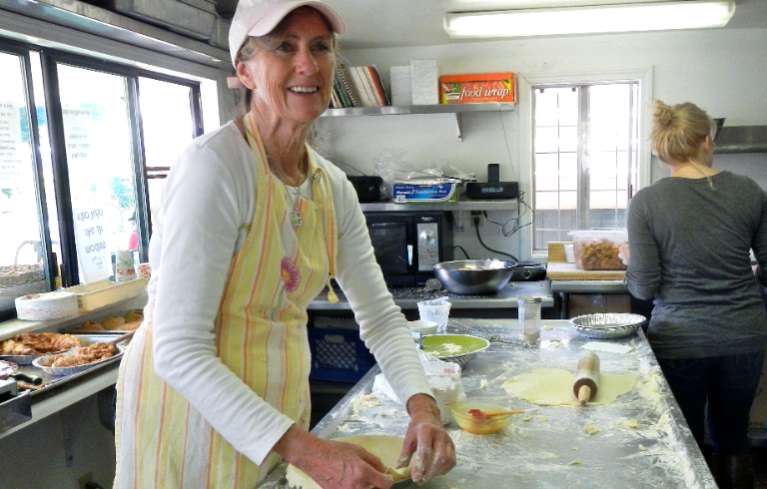
Vicki Price is busy basking pies at the Apple Pantry. Photos/Kathryn Reed

Vicki Price is busy basking pies at the Apple Pantry Farm in Apple Hill. Photos/Kathryn Reed

By Kathryn Reed

CAMINO – It’s apple season. And while these sweet and tart orbs are full of nutrients, sometimes it’s better to alter them in ways that makes them not be so healthy.

Pie is normally my first choice for what to do with the haul I bring back from Apple Hill this time of year. And while the ones I have left will become a pie, I used many of them for applesauce.

I have fond memories of mom canning applesauce when I was growing up. She spoiled me. I turn my nose up now at what is on store shelves. Most are way too sweet, and some don’t even taste like apple.

Like a lot of foods, there is a tremendous amount of personal preference. Sweet or tart? Just how much cinnamon is the right amount? Chunky or smooth? I’m one who likes cinnamon, but wasn’t sure what others thought. Apparently they agree with me. But the samples I made lacked the amount of cinnamon I would have put in if they were just for me.

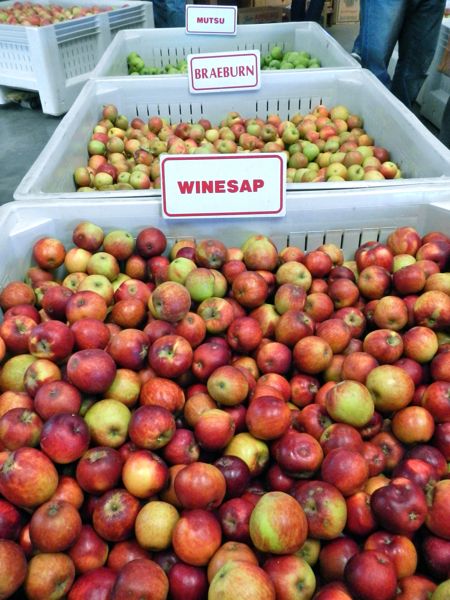
A slew of apple varieties to choose from.

A slew of apple varieties to choose from.

I don’t have a food mill, which would have made the sauce smooth enough to serve a baby. I used a potato masher to make the chunks of apple smaller, but I would still describe all that I made as chunky.

The biggest revelation is that what I’ve known all these years about Golden Delicious was thrown in the trash this week. Mom had advised me to, “Stay away from Delicious.” This has been our family mantra for pies and it was her same warning for applesauce, in  particular for Red Delicious. And while I will stick with that philosophy for pies, others and I are saying yes to Golden Delicious for sauce.

Vicki Price at Apple Pantry Farm swears by Golden Delicious for her pies and sauce.

“It’s the best because of the high sugar content. You really taste the fruit,” Price, who lived in South Lake Tahoe for 30-plus years, told Lake Tahoe News. She likes not having to add as much sugar to her products because it’s naturally in the fruit.

Peter Jivanove at Mother Lode Orchards said to use Empire apples.

“It’s the best of both worlds – sweet and tart,” he said of that varietal.

Jivanove also said a number of bakeshops in the Apple Hill area buy Golden Delicious from his orchard.

Candy Tuso would only use Pink Ladies if she could get them all the time. On Saturday she was using Granny Smith because that’s what was available.

(I grew up using Pippin for pies, with Granny Smith the backup because they are more readily available in grocery stores.)

Tuso, who is at Apple Ridge Farms, also likes the density of Arkansas Blacks.

O'Halloran's is one of the older orchards in Apple Valley. Apple Hill Growers Association turns 50 in 2014.

O’Halloran’s is one of the older orchards in Apple Valley. Apple Hill Growers Association turns 50 in 2014.

For Donna O’Halloran of O’Halloran’s it’s all about mixing Romes, Wine Sap and Golden Delicious. But she admits if she were to ask her employees their preference, each would likely have a different answer.

(She also said Golden Delicious always make a good pie, and that Red Romes make an impressive baked apple.)

At Hangtown Kid Apple Orchard they are trying to grow Gravenstein, which is a popular apple in Sebastopol. Cindy Cogswell is filling in for her sister, Gail, on this particular day. (Gail and John Palmer own the orchard.) That’s what they prefer for pies because they are more tart.

Apples are usually in season September-December. The growers in Apple Hill have mixed thoughts about freezing them. But having cold storage – like, a garage in Tahoe in the winter – should keep apples into the spring.

More than 750,000 people visit Apple Hill each year.

More than 750,000 people visit Apple Hill each year.

When the sauces were warm, I liked the Wine Sap-Golden Delicious-Red Roma best. Chilled, I liked the Golden Delicious best.

Seven women at the AAA office in Carson City tasted the five versions of applesauce made from the fruit the growers recommended. It was a blind tasting and until they read this they haven’t known what they tasted.

Here is what they had to say:

• Golden Delicious

Vanessa – Spicy, good for sweet things.

Kathy – Nice and sweet. (Tied for favorite with Arkansas Black.)

Susan – Sweet, with cinnamon.

Angie – Sweet, cinnamon, yum! My favorite.

Dawn – A bit bland. More cinnamon.

• Arkansas Black

Deb – Right combo sweet and tart. All needed more cinnamon.

Kathy – Nice and sweet. (Tied with Golden Delicious.)

Angie – Tart, OK.

Dawn – Nice and tart, but too chunky.

• Wine Sap-Golden Delicious-Red Rome

Angie – Mushy, OK.

Dawn – Mellow. Not enough kick.

• Pink Lady

Angie – Sweet, OK.

Natalie – Tart enough to stand up to the cinnamon.

Dawn – Tangy, but needs to be smoother.

• Empire

Angie – Mushy, OK.

Dawn – Blah, blah, blah.

Apple Sauce

6 medium Golden Delicious apples

1/8 C sugar

2 tsp cinnamon

Dash nutmeg

Slice the apples like you would for a pie. Put in medium saucepan on low heat. When slightly mushy, add the remaining ingredients. Keep stirring.

Adjust flavoring to your preference.

Use potato masher or food mill to make sauce less chunky.

Eat warm or chilled.


Tricks for dealing with all that Halloween sugar

By Bonnie Rochman, Wall Street Journal

Amid the ghosts and ghouls spooking trick-or-treaters this week, there is something even more terrifying to their parents: sugar.

Research into candy and children helps explain why they love it and, despite some contradictory theories, offers a few guidelines for this time of year.

Children may be more partial than adults to sugar because of the way their taste buds are clustered. “Children have the same number of taste buds as adults, but their tongue is a whole lot smaller, so the flavors are more intense the younger you are,” says Brian Wansink, director of Cornell University’s Food and Brand Lab, which researches why we eat what we do. “That’s why little kids don’t like bitter foods and really like sweet foods. The effect is magnified.”

Americans eat far more added sugar—white sugar, brown sugar, corn syrups and honey, among others—than is recommended. The average person consumes 22 teaspoons of added sugar a day, or 355 calories. Boys, ages 14 to 18, take in 34 teaspoons, or roughly 550 calories, according to the American Heart Association. Researchers say children and teens should follow recommendations for adults of no more than 9 teaspoons a day for men and 6 teaspoons for women.

U.S. government dietary guidelines use a different system, recommending that added sugars and solid fats combined, the so-called discretionary calories, should make up no more than 15 percent of a daily diet. However, kids and teens on average exceed this level from added sugars alone, which account for 16 percent of their daily total calories, according to a recent report from the Centers for Disease Control and Prevention.

Read the whole story


Halloween candy may keep you up at night

By Shelby Freedman Harris, Huffington Post

Halloween is almost here and stores are filled to the max with candy. Although Halloween candy can be a nice indulgence, the sugar high (and sugar crash) from overeating these treats makes some regret opening that bag of candy before the trick-or-treaters even arrived.

We tend to discuss the negative effects that sugar can have on our body. If you’re anything like me, you’ll gravitate towards chocolate. What we don’t realize is that chocolate, besides being a sugary treat, also contains caffeine — something that can significantly disrupt your sleep.

Simply put, caffeine is a stimulant. Most people prefer to use it after waking up in the morning to increase alertness. It enters the bloodstream through the stomach and can work in as little as 15 minutes after consumed. Caffeine takes approximately six hours for just one half of the dosage to be eliminated from the body. For most, that glass of soda with dinner at 7pm. will only be half gone by 1am. Plus, the older you get, the longer it takes for caffeine to leave your body, negatively impacting sleep even more.

Read the whole story


Shoppers saying no to canned food

By Vanessa Wong, Bloomberg

Maybe canned foods remind us of school lunches. Or power outages. Or Y2K paranoia. Or cuisine from the ’50s. Perhaps it’s concern about BPA. Maybe the home canning trend keeps consumers from the supermarket. Because sales of preserved foods in the U.S. are fading.

Except during the recession, when consumers sought less expensive groceries, retail sales of canned, jarred, and otherwise preserved foods have been in decline. Ready meals such as canned stew, fruit, and seafood saw the steepest drops since 2003, according to researcher Euromonitor International.

Last year, volume sales of canned and preserved foods dropped by 1 percent, and Euromonitor estimates that by 2017, retail sales will be down 5 percent from 2012 levels, to 5 millions tonnes.

Sure, they’re affordable and can reduce food waste. But, as the firm explains in a report, because these products can be kept on shelves for years and can contain high levels of sodium, they are perceived to be less fresh and less healthy than even frozen and chilled foods. As the economy recovers, consumers are gradually trading back up. “Given the current health and wellness mind set of Americans, they are trying to avoid canned/preserved food if they can afford to do so,” Euromonitor writes. (This obsession with freshness doesn’t seem to be stopping people from hoarding Twinkies.)

Read the whole story


Study: Coffee a better choice than smoothies

By Michael Mosley, BBC News

Which is healthier – coffee or smoothies?

It seems obvious that the answer must be a smoothie. After all, drinking coffee is a necessary evil while having a smoothie, made from fruit, is part of your five-a-day. But when you look into the scientific studies they reveal something much more surprising. Let’s start with coffee.

There have been numerous claims down the years that drinking coffee will increase your risk of a whole range of terrible things from heart disease to cancer.

These claims have been largely based on case control studies, where you take a group of people who drink coffee and compare them with another matched group who don’t.

The problem with this approach is that coffee drinkers are more likely than non-coffee drinkers to have other “bad” habits, like drinking alcohol or smoking, so it is hard to tease apart what is really doing the harm.

A more reliable way to get at the truth is to do what is called a prospective cohort study. You take a group of disease-free individuals, collect data about them, then follow them for a large number of years to see what happens.

Read the whole story