El Dorado County vineyard manager making a difference

By Mike Dunne, Sacramento Bee

We wine writers devote entirely too much space to wines and the vintners who make them, not enough to grapes and the farmers who grow them.

Well, then, let’s catch up with Ron Mansfield, who farms 300 acres of wine grapes on and about Apple Hill in El Dorado County.

A big guy with a homespun drawl and laconic manner, Mansfield brings the sensitivity and precision of a bonsai artist to vines. As a consequence, on the short list of people responsible for El Dorado County’s standing as a fine-wine region he’s at or near the top.

Read the whole story


No-tip restaurants gaining in popularity

By Charles Passy, MarketWatch

Is the no-tip movement at restaurants reaching, well, a tipping point?

In recent years, such renowned restaurants as Thomas Keller’s Per Se in New York and French Laundry in Yountville, Alice Waters’ Chez Panisse in Berkeley, and Grant Achatz’s Alinea in Chicago have put no-tip policies in place. So did the recently closed Linkery restaurant in San Diego.

Perhaps the policies at these establishments shouldn’t come as a surprise, since restaurant patrons are increasingly saying they don’t like to play the tipping game. A solid majority of Americans — 75 percent — say they tip less than the customary 20 percent when dining out, according to a new survey by vouchercloud.net, which researches consumer spending habits. Additionally, the website reports that 46 percent of Americans say they are tipping less in general than they did five years ago.

Read the whole story


UC Davis establishes center to study coffee

By Edward Ortiz, Sacramento Bee

UC Davis has made a name for itself researching beverages people use to relax – like wine and beer. Now it’s turning its attention to one Americans use to get wired: coffee.

On March 11, a roster of eight UC Davis scientists will come together for a research conference run by the school’s recently founded Coffee Center. At the conference, the scientists and coffee industry stakeholders will gather to plumb such diverse topics as the genetics of coffee and the sensory perception of coffee drinkers.

It’s the first step in an effort that some on campus see as leading to a dedicated coffee research study center akin to the Robert Mondavi Institute for Wine and Food Science, said J. Bruce German, director of the Foods for Health Institute at UC Davis. He also suggested the school could eventually offer a major in coffee science.

Coffee is certainly a powerhouse commodity. It is the largest food import in the U.S., and the world’s most widely traded tropical agricultural commodity, according to the International Coffee Association. Worldwide coffee production is growing along with coffee consumption. In 2012-13, production is expected to hit a record 148 million bags.

Read the whole story


Drought driving up food prices

By Dana Hull, San Jose Mercury News

With 2013 the driest year on record and 2014 possibly worse, the devastation of California’s drought is trickling down to crops, fields, farmers markets, grocery stores — and the kitchen table.

While it’s too early to tell precisely how much the drought will push up household grocery bills, economists say consumers can expect to pay more for food later this year because fewer acres of land are being planted and crop yields are shrinking.

Large grocery chains have distribution networks and can import produce from around the world to keep customers in everything from cantaloupe to cauliflower, but experts say California’s smaller yields will inevitably lead to higher consumer prices here and elsewhere. Some consumers already are plotting ways to keep their food budgets under control if there is a big spike in prices.

Read the whole story


Study: Veggies better in middle age than meat

By Allison Aubrey, NPR

Americans who ate a diet rich in animal protein during middle age were significantly more likely to die from cancer and other causes, compared with people who reported going easy on foods such as red meat and cheese, fresh research suggests.

The study published Tuesday in the journal Cell Metabolism, was based on an analysis of data from NHANES, an ongoing federally funded study that surveys Americans about their eating habits and behaviors.

In this particular study, researchers tracked about 6,000 older adults included in the survey to find connections between dietary patterns, death and disease.

But here’s the catch: The researchers also found that for older people, ages 65 and up, there may be a benefit to eating more protein. In this age group, higher levels of protein seemed to be protective against cancer and premature death.

Read the whole story


International dispute over naming of foods

By Latoya Dennis, NPR

What’s in a name? It’s an age-old question Juliet once asked Romeo in Shakespeare’s famed play.

Today, it’s a serious question between the U.S. and the European Union, which has said it wants U.S. food makers to stop using European names.

But depending on what food you’re talking about, a name could be a lot, says Kyle Cherek, the producer and host of a TV show called Wisconsin Foodie. Cherek argues that certain products are so unique that only one country or region should be allowed to lay claim. So, for example, he says only onions from Vidalia, Ga., should be called American Vidalia, and Lambic beer absolutely has to come from a specific valley in Belgium.

But not everything fits into that category. Take, for instance, cheddar cheese — which is big business in Wisconsin.

Read the whole story


K’s Kitchen: A warm traditional Italian soup

By Kathryn Reed

One of the great things about Lake Tahoe is soup season lasts a long time.

With there being so many soups in the world, it’s possible to have a different one nearly every night. And they also make for great leftovers.

Sometimes I will increase the ingredients to ensure I have leftovers. Such is the case with the soup below.

This recipe is so easy that it would be a good one to have your kids make. And not many ingredients are involved. Often I have everything on hand so a trip the grocery story is not required.

Use small pasta because a larger one like a bow tie will absorb too much of the liquid and what you are left with is not soup. It’s still good, just different. It seems like no matter the size of pasta that by the second day the consistency is more solid than liquid soup. If soup is what you desire, add water or broth.

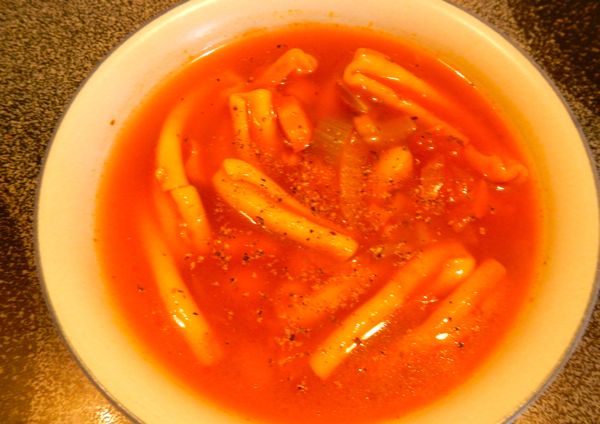
The name of the soup means pasta and beans. It’s a traditional Italian dish.
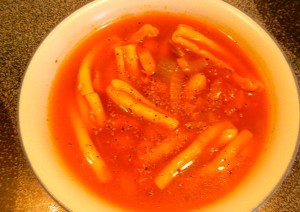
e pasta soupPasta e Fagioli

1 T olive oil

1 medium onion, diced

2 celery stalks, diced

1 medium carrot, diced

1 (23-ounce) carton vegetable broth

4 large garlic cloves, minced

1 C small pasta shells

1 (15 ounce) can tomato sauce

1 (15 ounce) can white or pinto beans, drained

1 tsp dried basil

½ tsp dried sage

½ tsp ground pepper

Heat oil in medium saucepan over medium heat. Sauté onion, celery and carrot until onions begin to change color. Add broth and bring to boil. Uncover, add garlic and pasta. Cook until the pasta is the consistency you prefer. Stir in tomato sauce, beans and spices. Cook until heated through. Adjust seasonings if necessary.


Gloved rule for handling food being rethought

By Jeremy B. White, Sacramento Bee

Just months after Gov. Jerry Brown signed into law a measure compelling bartenders and chefs to don gloves when handling ready-to-eat food, the bill’s author has responded to a food industry uproar by unveiling an effort to undo the change.

“It didn’t sound that dissimilar to the existing law, which said that we should minimize hand contact and that there should be good hand-washing procedures,” said Assemblyman Richard Pan, D-Sacramento, who wrote the bill.

But soon after it passed, Pan said, “we started hearing from local restaurants, smaller restaurants, and also bartenders about the impact it would have on them.”

The glove guideline was mixed into a broader food safety code package that sailed to Brown’s desk with no opposition (among other things, the overall bill contemplated that ancient riddle of what, exactly, goes into a hot dog). Strictly speaking, the bill doesn’t require gloves. Rather, it prohibits bare-handed contact with foods that are ready to eat.

Read the whole story


Cheap beer in vogue among marketers

By Duane D. Stanford, Bloomberg

Joe Six-Pack is getting some love again.

MillerCoors LLC and Anheuser-Busch InBev NV, after years of focusing on craft ales, ciders and imports, are paying more attention to the working man’s drink of choice: cheap beer. The two brewers, which account for three-quarters of the U.S. beer industry, will boost marketing this year for economy brands such as Keystone Light and Busch Light.

During the televised Nascar race on March 2, MillerCoors will begin airing the first national advertising for Keystone Light since 2011. A similar campaign for Miller High Life, which calls itself the “champagne of beers,” starts in April. AB InBev will expand its marketing for Busch to year-round and has introduced a fuller flavored version called Busch Signature Copper Lager.

As persistent unemployment after the recession left blue-collar workers with less money for beer, brewers shifted resources to higher-margin brands such as MillerCoors’s Blue Moon and Leuven, Belgium-based AB InBev’s Bud Light Lime. As the economy rebounds, companies are racing to win with a crowd that is among the most loyal and thirsty of beer drinkers.

Read the whole story


FDA overhauling food labels

By Ryan Jaslow, CBS

Nutrition fact labels are finally undergoing a makeover. The Food and Drug Administration has proposed new changes to labels on food packaging that are aimed at making them easier to understand — the first major update since about 1994.

Under the changes, serving sizes will be made easier to understand, calories will be featured more prominently and for the first time, added sugars will be included.

The label updates aim to incorporate the new science that has since come out on how eating foods might raise risk for obesity and chronic disease, according to the FDA. For example, old labels focused more on fats, but calorie consumption is what really drives weight gain and obesity, researchers have since determined.

Read the whole story