Wine terroir goes under the microscope

By Becky Grunewald, Sacramento Bee

UC Davis professor of viticulture and enology, David Mills, knew that he was firing a shot across the bow when he recently presented a scientific paper addressing one of wine-making’s most beloved mysteries.

That mystery is the somewhat ineffable concept known as “terroir” – a French word with no English corollary – defined as a wine’s unique growing environment that contributes to its distinct aroma and flavor. For many wine experts, terroir is the elusive force that gives a wine its personality. It’s why a Cabernet Sauvignon from Bordeaux tastes different from one produced in the foothills.

Traditionally, the explanation of terroir’s influence primarily has focused on weather patterns, geography and cultivation techniques, and soil composition. For example, attributes such as “chalkiness” or “minerality” in wine are often attributed to soil, despite a lack of scientific evidence.

Mills, however, reported that unique colonies of yeast, fungus and bacteria on the surface of wine grapes also could be significant in determining a wine’s regional quality.

Terroir gets top billing when it comes to French wine, whether it’s a bottle from the regions of Bordeaux, Burgundy or Champagne. In the United States, wines are marketed by specific grapes.

When it comes to terroir, microbes haven’t always been part of the conversation.
Read the whole story


K’s Kitchen: Salsa without fresh tomatoes

By Kathryn Reed

There was a time when the only kind of salsa you could buy was in a jar. And it seldom had much flavor.

Now there are a ton of fresh salsas on the market that can satisfy most any taste.

But sometimes a homemade salsa is what tastes best. But what do you do when it’s not tomato season? The recipe below is the answer to that question. Canned tomatoes this time of year have more flavor than those waxy things being sold in the grocery store. It’s also easier to open a can than it is to dice tomatoes.

This version is rather mild – in my opinion – but ideal if you are sharing with others when you don’t know how much heat they can take. Salsa is also one of those things that just gets better the longer the ingredients meld. For that reason, I would recommend making this at least a day before you plan to use it.

While I used a fresh jalapeno, you could use canned.

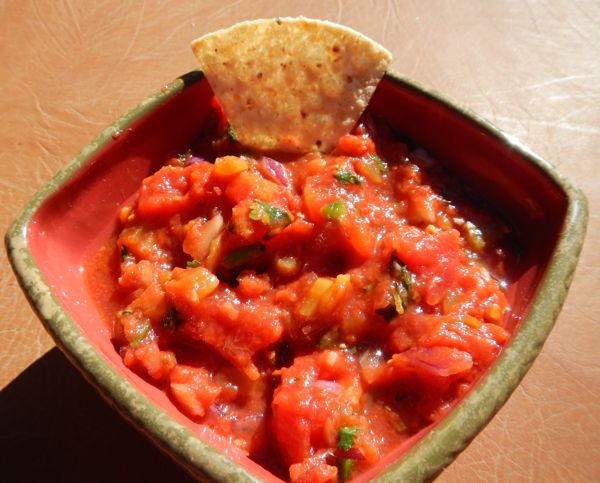
salsa

Salsa (makes 5 cups)

2 14 ounce cans stewed tomatoes

1 8 ounce can tomato sauce

1 large onion, finely chopped

5 green onions, finally chopped

7 ounces diced chiles

3 cloves garlic, minced

¼ C cilantro, chopped

½ tsp ground cumin

1 large jalapeno, minced

Salt and pepper to taste

Mix all the ingredients together. Cut tomatoes so they are bite (or chip) size.


School districts push back on federal lunch menu

By Tom Hamburger, Washington Post

In Georgia, kids resisted the loss of their beloved fried chicken. In New Mexico, whole-wheat tortillas went straight to the trash can. And in Tennessee, after schools replaced familiar flaky white biscuits with a whole-grain variety, one official reported a “severe amount of rejection.”

What began as an effort led by first lady Michelle Obama to serve more-healthful food to American schoolchildren has turned into a clash of cultures across the country — and, now, a high-profile Washington lobbying battle.

At stake in the argument over lunch menus, beyond the natural tension between nutrition and children’s taste buds, are the profits of several large food companies that sell frozen pizzas, french fries and other prepared foods to schools.

The dispute provides a fresh illustration of the ways special interests can assert power in Washington. In this case, food companies forged an alliance with a key lobbying group, the School Nutrition Association, and pushed it to shift its position from publicly supporting the Obama-backed standards to pressing Congress for relief.

On Thursday, a House committee voted for a Republican-backed measure that would allow school districts to temporarily opt out of the nutrition standards, which were passed in 2010 with the support of the White House and set mandates to reduce sodium and increase whole grains and servings of fresh fruits and vegetables.

The party-line vote served as a rebuke of sorts to the first lady, who has made curbing childhood obesity a priority and delivered a series of public pronouncements in recent days decrying the opt-out proposal as a full embrace of junk food.

The measure is expected to be considered later this summer when House and Senate members meet to negotiate spending bills.

Read the whole story


Strawberry expert at center of battle over fruit’s future

By Larry Gordon, Los Angeles Times

On an ocean-facing hillside with stunning views of Monterey Bay, Douglas Shaw circulates among thousands of strawberry plants he has helped to breed and grow. But the man who is considered California’s most esteemed strawberry expert declines to choose his all-time favorite.

The UC Davis plant sciences professor is a bit like a father unwilling to favor one child above his others — patented strawberry varieties with names such as Albion, Benicia, Portola, Monterey and San Andreas. He’s also an unsentimental scientist with an eye toward hardier and tastier descendants.

“You can’t get too attached to them, because the idea is that you are supposed to be replacing them with something better,” he said.

He bites into one berry and reports that it tastes both sweet and acidic, a combination some people crave.

“It’s not rocket science,” he said of his evaluations. “It’s objectivity.”

Watsonville’s fog, sandy soil and cool temperatures, often just in the 60s during summer days, make it ideal for growing the berries. Farmers here produce the most strawberries in the state, far surpassing growers in other productive areas in Santa Maria, Oxnard and Irvine.

Across town, the quasi-governmental California Strawberry Commission has its headquarters in an office suite decorated with photos of strawberry baskets and harvests and a floor rug in the shape of a berry. At the office entrance, as if emphasizing the connection to the world of fields and supermarkets, a white board lists temperatures throughout the state, prices and production statistics.

Watsonville has long been ground zero for California’s $2.3-billion-a-year strawberry industry. Now it has taken center stage in a sour legal battle over the fruit’s — and Shaw’s — future.

Read the whole story


Eating invasive species may help eliminate them

Tahoe Lobster Co. was the first to harvest invasive crawfish from Lake Tahoe . Photo/LTN file

Tahoe Lobster Co. was the first to harvest invasive crawfish from Lake Tahoe . Photo/LTN file

By Ramit Plushnick-Masti, Washington Post

HOUSTON — It seems like a simple proposition: American lakes, rivers and offshore waters are filling up with destructive fish and crustaceans originally from other parts of the world, and many of them are potential sources of food.

So why not control these invasive populations by getting people to eat them?

The idea gained momentum recently when lionfish, which invaded the Gulf of Mexico, were successfully marketed to restaurants and appear to be in decline.

But businesses and scientists have struggled to repeat this apparent triumph with other species. Some, such as Asian carp, are not appetizing to Americans. Others, such as feral hogs, reproduce too quickly for the strategy to make a dent. And then there’s the question of whether turning the animals into sought-after cuisine undermines the larger goal of eliminating them.

“Eating invasive species is not a silver bullet,” said Laura Huffman, the Nature Conservancy’s director in Texas. But it can still be “a way to get people engaged in the topic and in the solution.”

Read the whole story


Pet owners cooking for Fido from scratch

By April Fulton, NPR

We’re not only obsessed with what we eat. We’re now obsessed with what our pets eat. They make us healthier and happier, so who can blame us for wanting the best?

While the pet food industry has started adding salmon, vegetables and other ingredients humans favor to its products, the store-bought stuff just doesn’t make the cut anymore for some owners. They’re skipping the pet food aisle altogether in favor of cooking up big batches of Fido’s meals.

Veterinarians say these pet food home chefs do it for different reasons.

“For some people, it’s the human-animal bonding. For some it’s the philosophical benefits: they want to keep kosher, or [they’re] vegetarians,” and want to feed their pets the same way, says Sean Delaney, a board-certified veterinary nutritionist who co-authored a textbook on pet nutrition.

Read the whole story


Report: Climate change will lead to less nutritional food

By Evan Halper, Los Angeles Times

Climate change threatens to undermine not only how much food can be grown but also the quality of that food as altered weather patterns lead to a less desirable harvest, according to a study.

Crops grown by many of the nation’s farmers have a lower nutritional content than they once did, according to the report by the Chicago Council on Global Affairs.

Research indicates that higher carbon dioxide levels in the atmosphere have reduced the protein content in wheat, for example. And the International Rice Research Institute has warned that the quality of rice available to consumers will decrease as temperatures rise, the report noted.

The U.S. should embrace research into animal biology and plant management with the kind of enthusiasm it did space exploration in the 1960s, the council said, warning that the consequences of inaction could be severe.

Read the whole story


Price impacts what people think of food

By Kevin Short, Huffington Post

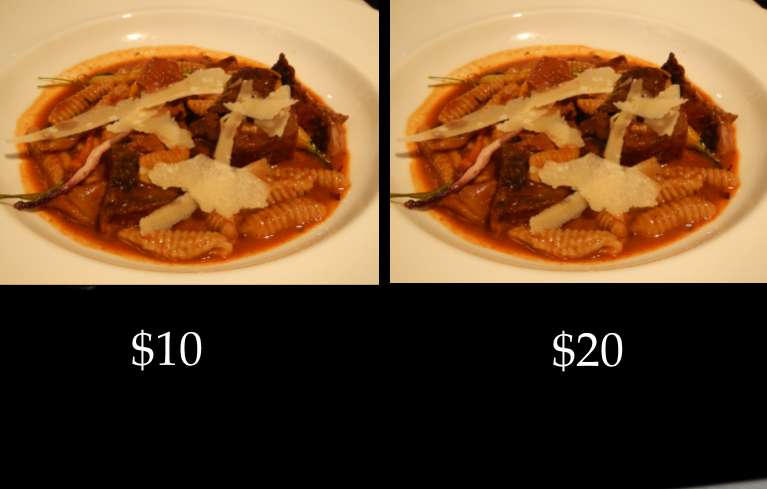
Which of these plates looks like a better meal to you?

food cost

According to science, you’d probably be happier with meal No. 2, since it’s more expensive. A new study out of Cornell University found diners tend to rate the quality of their food higher if they pay more for it, and people who pay less for the same exact meal report feeling more guilty, bloated and uncomfortable.

“We were surprised by the results. Especially, we found that pricing has little impact on how much one eats, but a huge impact on how one interprets the experience,” Brian Wansink, a co-author of the study and professor of consumer behavior at Cornell University, told Huffington Post.

The researchers offered 139 diners an all-you-can-eat buffet at an upscale Italian restaurant for either $4 or $8 dollars. Though the diners ate the same food and the same amount, those who paid $8 rated their meal an average of 11 percent higher. The $4 diners were more likely to feel guilty and that they’d overeaten.

The study adds to the body of research around how to maximize restaurants’ bottom lines while managing customers’ waistlines. Price cuts can actually hurt people’s perception of a restaurant and cause diners to feel their meal was less worthwhile, the researchers found.

Read the whole story


Craft beermakers prefer more expensive hops

By Venessa Wong, Bloomberg

The most popular style of craft beer in the U.S. right now is India Pale Ale. Not only do Americans want hopped-up craft beer in pale and brown ales, they prefer more fragrant, costlier hops.

The average price for all hops was $3.59 per pound in 2013, nearly twice as much as in 2004, according to data from the Hop Growers of America.

Craft beers make up about 8 percent of U.S. sales by volume and tend to use more aroma hops (which give beers their citrus, pine, and other notes) than alpha hops (which lend a bitter flavor). Aroma varieties cost more because of lower yields, says Ann George, executive director of the Hop Growers of America, and the higher demand is luring some growers to remove alpha varieties to grow the aromas. Aroma hops can cost two to as much as seven times more per pound than alpha hop varieties, according to Chris Swersey, technical brewing projects manager at the Brewers Association.

Cost has not stopped craft brewers from using higher-priced hops in high concentrations. While the average beer is made with about 0.2 pound of hops per 31 gallons, craft brewers use 1.25 pounds, according to George.

Read the whole story


K’s Kitchen: Black bean dip

By Kathryn Reed

There is such a thing as too much garlic. I learned this the hard way.

Usually I’m of the belief garlic is a food group. Not so with this recipe. The first time I made it I put way too much garlic in it. I kept eating it, but it really wasn’t that great.

So, the trick to any dish is to season, taste and season until it tastes just right. Do the same with the garlic. Because cloves come in varying sizes and taste buds are different it is better to add more garlic as needed because it’s impossible to take it out.

We had plenty leftover since it was not the best the first time. Sue used some with scrambled eggs and said it was wonderful. I used the mix as a base for nachos.

This could be served warm or cold. If serving it heated, adding about a quarter cup of cheese would work and make it a little thicker.

It’s not the most attractive looking appetizer. A sprig of cilantro or even some chopped up and put on top would make it a little more appetizing to those who don’t know what they are about to eat.

Black Bean Dip

1 15 ounce can black beans, drained

¼ C medium onion, rough chop

4-6 cloves garlic

¼ C roasted red peppers

¼ C vegetable broth

2 T balsamic vinegar

Put all ingredients into a blender. Serve with chips