Gluten free appears to be here to stay

By Kim Severson, New York Times

In the luxe dining room of Del Posto, one of New York’s most heralded and expensive Italian restaurants, one-third of the tables on any given night will have at least one gluten-free diner.

Mark Ladner, the restaurant’s chef and widely considered to be one of the best pasta cooks in the nation, knows it is a remarkable number. Gluten, the protein in wheat that gives dough its elasticity, has been a key ingredient in his culinary success. But Ladner also knows gluten-free dining remains a big and growing business, so he offers each of his pasta dishes, down to his 100-layer lasagna, in gluten-free form.

Similar gluten-free dishes, like pasta made with rice and corn starches and chewy focaccia, are woven into the menus at all the restaurants owned by Del Posto’s proprietors, Mario Batali, Joe Bastianich and Lidia Bastianich, Bastianich’s mother. “It really has become a thing, and I don’t think it’s going to go away anytime soon,” Ladner said.

A decade ago, few people other than those with celiac disease, a digestive condition, knew much about the health implications of gluten. But today, if you aren’t gluten-free, you likely know someone who is or is trying to be. The style of eating has become a way of life for many and a national punch line for others. More than a quarter of Americans say they are cutting down on gluten or eliminating it entirely. Optimistic researchers predict the market for gluten-free products will hit $15.6 billion by 2016. The Food and Drug Administration has noted the diet trend as well, and passed new labeling laws for gluten-free products to take effect in August.

Read the whole story


Discounts available for seniors at farmers’ markets

El Dorado County Area Agency on Aging has a limited supply of senior farmers’ market check booklets available for qualified El Dorado County seniors. Booklets will be distributed on first come, first served basis to seniors who are at least 60 years of age and meet income guidelines (one-person household with annual income less than $21,590 or two-person household with income less than $29,101). Each eligible senior will receive one booklet that includes 10 checks redeemable for $2 each to be used at certified farmers’ markets for the purchase of fresh, unprepared, locally grown fruits, vegetables, cut herbs and raw unprocessed honey.

Distribution of the Farmers’ Market check booklets will take place on the following dates:

July 9 from 8am to noon at the Cameron Park Farmers’ Market, located at Coach Lane and Strolling Hills Road in Cameron Park.

July 15 from 8am to 1pm at the South Lake Tahoe Farmers’ Market, American Legion parking area, located at 2748 Lake Tahoe Blvd in South Lake Tahoe.

July 19 from 8am-noon at the Ivy House Parking Area, located at Cedar Ravine and Main Street in Placerville.

Quantities of the booklets are limited.

For more information, call 530.621.6251.


Avoid mistakes when beginning a wine cellar

By Jean-Manuel Duvivier, Wall Street Journal

If you enjoy wine, are starting to take more than a passing interest and have perhaps bought the odd reference book about vino varieties, it might be time to think about beginning your very own wine cellar.

The worst habit you can get into is to stop off at your local wine shop once a week and pick up the odd few bottles. A much better approach is to buy by the dozen or a six pack, as most wine merchants will offer a discount on a mixed case. Better still is to select two or three wine merchants, order their catalogs or look online and, when you’re in the mood, spend some time selecting your favorite wines and comparing prices. I like to do this on the weekend, with a cup of tea and all the catalogs spread out over the kitchen table.

But a cellar isn’t just a few cases of your favorite wine. It may sound like a cliché but a good cellar requires a bit of forethought and planning to provide pleasurable drinking over the long term. I like to break wine collecting into three categories: wines for immediate drinking, wines to lay down that will improve with age, and investment wines—those special bottles whose value will steadily increase year on year.

Read the whole story


‘Stuffed’ foods add spin to barbecuing

By Bill Daley, Chicago Tribune

Grilling already has got its steaks, slabs and skewers. With summer coming, maybe it’s time to slap another “s” down on that sizzlin’ hot grate: as in “stuffed.”

Stuffing can mean extra prep work, not something most people will naturally want to deal with on a lazy, hazy summer day. But it’s all worth it to Ted Reader, a Toronto chef, barbecuing expert and product developer, who has a number of stuffed recipes in his latest book, “Gastro Grilling” (Pintail, $25).

“The No.1 reason is to add fun to your food, to change it up,” Reader says in making a case for stuffing. “You can grill burgers, hot dogs, steaks and chicken breasts, and that’s great. But there’s so much more you can do to make these things better.”

Stuffing can add flavor and moisture to foods, particularly leaner cuts of meat, says Jamie Purviance, an El Dorado Hills-based chef and author of several grilling cookbooks. (The most recent? “Weber’s Big Book of Burgers,” Oxmoor, $21.95, published in April.)

Read the whole story


Cooler uses dirt instead of ice

By Jenn Harris, Los Angeles Times

Ice-cold beer is essential to any summer party, but no one volunteers to pick up the ice, then to restock halfway through the party. eCool, a company in Denmark, is attempting to solve the party ice predicament with an ice-less cooler.

The eCool earth cooler is an underground cooler that uses dirt to chill your beer instead of ice. According to the website, you use a garden drill to create a hole in the ground. Or it says that if “you’re a real man” you can dig one yourself.

Once you place the cooler in the ground, you use a lever to lower up to 24 cans of beer into the cooler. You use the same lever to lift the cans out of the cooler when you’re ready to drink.

Read the whole story


If you’re not eating enough, you might gain weight

By Heidi Mills, Outside

Shannon Scott thought training for a distance triathlon would help her drop the few extra pounds she’d always hoped to shed.

Scott began working out for an hour and a half to two hours each day. When she didn’t lose weight, she cut back her daily calories to 900 a day. Still, she couldn’t get the scale to budge.

She signed up for Ironman Canada, adding even more volume to her training schedule each week. Aware of the physical demands on her body, she raised her daily caloric intake to 1,200 calories a day, but wouldn’t allow herself to eat any more than that. Each week of training, she gained another pound.

“It was so frustrating and counter intuitive,” Scott said.

Scott is just one of many athletes who start training for an endurance event with the expectation of losing weight. While some do indeed drop weight, others feel defeated as they watch the scale move in the opposite direction. On forums of endurance web sites such as Slowtwitch.com, conversation threads show athletes expressing frustration over weight gain during training.

Read the whole story


Cast iron pans hot again for cooking

By Blair Anthony Robertson, Sacramento Bee

You can spend lots of cash outfitting your kitchen – with designer pots and pans, with gadgets large and small – and wonder where all the money went. That’s not the case with cast iron. It’s inexpensive, sturdy as a tank, versatile as a Swiss Army knife and, best of all, will probably outlive you.

A 12-inch skillet, for example, costs about $30 and has a life expectancy of, say, forever.

Once considered impossibly clunky and old-fashioned, cast-iron cookery has made a major comeback in recent years. A new generation of home cooks has discovered the nonstick potential of a well-seasoned skillet. People are sautéing, searing, frying, making flapjacks and even baking bread.

Yes, cast iron, which has been around for centuries and mass-manufactured since the 1800s, is cool again, in large part because no cookery seems to retain heat better. And, with a little bit of knowledge and care, you create a nonstick surface nearly the equal of Teflon-coated pans, which tend to last but a few years.

Read the whole story


K’s Kitchen: Drink transports imbiber to Caribbean

By Kathryn Reed

Ginger ale was a drink that was always in Sue’s fridge as a kid. While that’s not the case as an adult, it is still her favorite soft drink.

It’s the ginger that appeals to her.

Ireland is credited as the birthplace of ginger ale; in about 1851. However, it is Canadian John McLaughlin who is noted as the inventor of what we know today as the Canada dry version of ginger ale. This was in 1907.

But sometimes ginger ale requires some doctoring, as in making it a true adult beverage.

The drink below is a little too easy to drink, especially on a warm day. But what’s nice is it is not super sweet. More triple sec and less lime juice would make it sweeter.

sue's drinkSue’s Cool Caribbean

1 shot rum

1½ shots triple sec

1½ shots lime juice

2/3 cup ginger ale

Ice

Pour all ingredients over ice. Stir. Drink. Repeat.


Growing dome to teach South Shore students where produce comes from

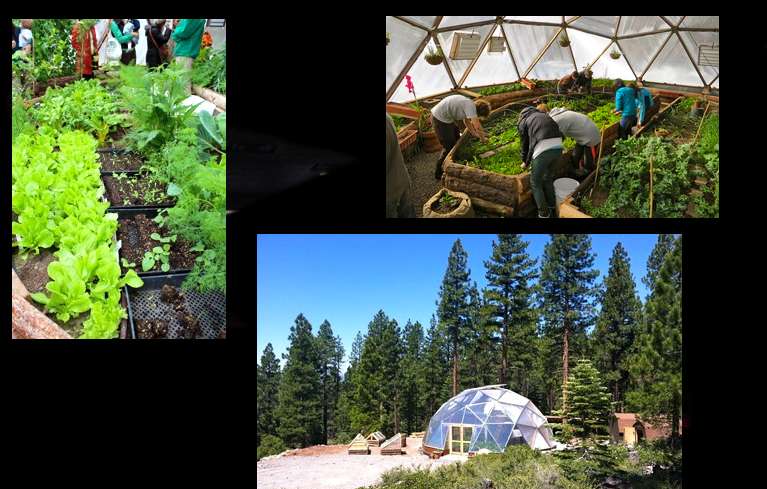
Sierra Houses' growing domes will be much like Truckee's  dome. Photos/Provided

Sierra Houses’ growing domes will be much like the Truckee dome. Photos/Provided

Publisher’s note: This is one in a random series of stories about growing vegetables in South Lake Tahoe.

By Kathryn Reed

Students at Sierra House Elementary School are about to get two nontraditional classrooms. They are going to be full of dirt – and ideally a lot of edible plants.

Parents and community members for some time have been working on bringing a growing dome to the South Shore campus. They are on track to have two domes installed by October.

Domes are a four-season geodesic greenhouse structure that use a fish pond and passive solar design to heat itself.

The original plan was one dome, 28-feet in diameter that would be 600-square-feet. Now the plan is two domes, each 18-feet in diameter for a total space of about 500-square-feet. They will lose a little space this way, but gain more, too, in terms of teaching possibilities. Different crops and growing methods could be taught with two domes.

The smaller dome comes with fewer restrictions when it comes to permitting. Lake Tahoe Unified School District and Tahoe Regional Planning Agency still need to have final approval, but school board members told the group at a May meeting to carry on with the two-dome idea.

“The main goal of having a dome is for kids to see food growing year-round,” parent Rebecca Bryson told Lake Tahoe News.

It might mean a salad bar is created in the school cafeteria using all ingredients from the dome, or a veggie side dish is served from dome-grown produce. A lemon tree may be part of the dome and then kids could see what it’s like to have fresh squeezed lemons on a variety of things.

“We really envision during recess kids will go in there. We want it not just for instruction,” Bryson said. She expects kids will want to see how things have changed, to touch plants and explore on their own.

And the goal is not to limit it to Sierra House kids, but have other schools come for regular visits. Instructors will be teachers and parents.

This project is a collaboration between Sierra House PTA, Small World Parents Network, Lake Tahoe Sustainability Collaborative and the Truckee Dome Raising Project.

Truckee has had a dome for a couple years, but on private property. However, schoolchildren are there regularly. The South Shore contingency made another trip to Truckee this month to get more insight. Truckee’s dome at 36-square-feet is twice as big as one of Sierra House’s domes.

While the dome will be on district property, taxpayer money is not going into this. So far the group has raised $85,330 of the estimated $120,000 that is believed to be needed.

Part of that money is from a grant Gardens 4 A Healthy Tahoe secured through the General Mills Foundation. The $20,000 awarded locally is going toward the domes and the South Lake Tahoe Family Resource Center’s garden.

Once these domes are erected, the organizers would like to find a way for domes to be the norm throughout Lake Tahoe Unified. If this happens, then there is the possibility through AmeriCorps to have someone full time overseeing the domes.

Nutrition has been a growing quest of parents. They have been working with Kathy Martinez, the district’s nutrition coordinator, to create parent-led nutrition classes. Bryson said they’ve found kids who’ve never eaten celery before or didn’t know bell peppers could be orange. They also find that students will taste unusual produce in a classroom, but toss the same thing in the garbage in the cafeteria.

That is one way the dome may help – making different food fun, not scary and gross.

But not all of the food being wasted at the schools is ending up at a landfill. Sierra House began a composting program about 1½ years ago, Bijou and the magnet school started last fall, and Tahoe Valley will have one next school year.

At Bijou, the garbage had to be picked up every three business days. With composting, the garbage truck now comes about every 10 days. For health code reasons, compost is picked up weekly.

—-

Notes:

• For more info about the dome project, email TahoeDomes@gmail.com.

• To donate to the cause, go online or write a check to LTUSD: SHGD and drop it off at the school or district office.



K’s Kitchen: Brussels sprouts, tofu and noodles

By Kathryn Reed

Rice is usually my go-to accompaniment for Asian foods. I suppose it’s because that is what I grew up with.

It wasn’t until I was an adult that I ordered dishes with noodles. But it took even longer for me to cook with them. I don’t have a good explanation for why, other than habits are hard to break.

It is important to pat the tofu dry. This will allow it to get a sear and absorb the flavors of the sauce.

Chicken would be an easy substitute for tofu. And broccoli would be a veggie that is always available, or just as an alternative since not everyone likes Brussels sprouts.

This marinade would be good for a variety of proteins and vegetables. If you add a lot more to the dish, you might want another package of noodles, too.

noodles

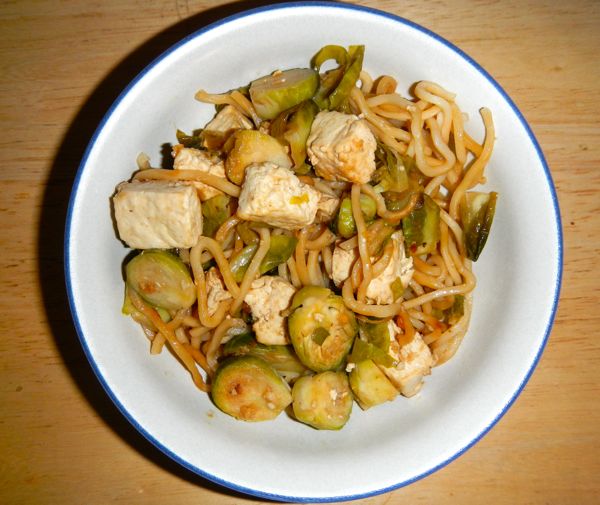
Noodles with Tofu and Brussels Sprouts (serves 4)

1 8 ounce package uncooked soba

2 C Brussels sprouts, cut in half

Cooking spray

1 container firm tofu, cut in cubes

2 T rice vinegar

2 T sesame oil

2 T soy sauce

1 T peanut butter

1 tsp brown sugar

¼-½ tsp crushed red pepper

2 garlic cloves, minced

3 green onions, chopped

Cook soba noodles for about 3 minutes in boiling water. Drain.

Combine vinegar, sesame oil, soy sauce, peanut butter, sugar, crushed red pepper, garlic and green onions in bowl. Mix well.

Coat pan with cooking spray. Cook tofu until slightly brown on at least two sides. Remove tofu from pan.

Add Brussels sprouts. If pan is dry, add a splash of water. Cook until tender.

Add tofu and marinade. Cook until everything is coated with mixture and heated through.