K’s Kitchen: Corn and zucchini enchiladas

By Kathryn Reed

I’ve had a thing for corn this summer. But that’s not the best food choice when someone in the house has braces. The recipe below, though, makes these yellow nuggets edible for her.

It seems like every ear I buy at the farmers’ market is sweeter than the next.

While these enchiladas could be made year-round with canned or frozen corn, that seems sacrilegious to me. The only way I would make this dish out of season is if I had frozen corn from the summer, which I do on occasion. (Just blanch the cobs, then take the kernels off the cob and put them in a freezer bag.)

It’s possible to get the corn, red onion, garlic, chilies and zucchini from most farmers’ markets.

A smoked cheese adds depth to the concoction. Cheddar and Gouda work well.

The heat factor is up to you. That’s controlled by the cayenne and chilies.

The number of enchiladas you get will depend on the size of tortillas and how much filling you put in each. I’ve always filled a 9 x 13 pan with the amount of filling this makes. Leftovers freeze well.

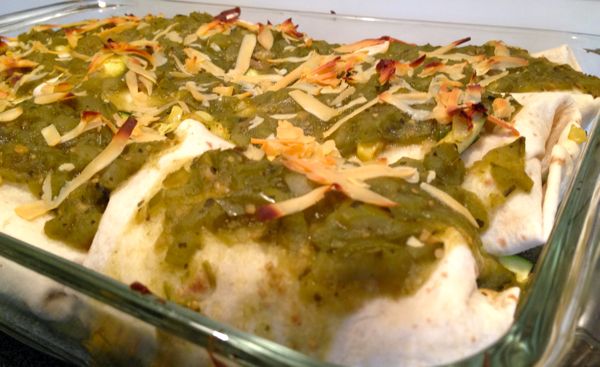
corn enchiladasCorn and Zucchini Enchiladas

1 T olive oil

1 medium red onion, diced

Cayenne pepper

3 ears of corn, about 3 cups kernels

2½ tsp cumin

5 garlic cloves, minced

3 jalapeno or Serrano chilies, minced (remove seeds)

3 medium zucchini, diced, about 2 cups

½ C cilantro, chopped

Tortillas

1 16-ounce jar chunky salsa verde

6 ounces smoked cheddar cheese, grated, about 2 cups

Heat oil in a large skillet. Add onion and at least 3 pinches of cayenne. Sauté over medium heat until the onion is soft. Add the corn, cumin, garlic and chilies. Sauté until corn is tender. Add zucchini, cook until tender, but not mushy. Add cilantro.

Place 1/3 cup vegetables in the center of each tortilla and sprinkle with 2 tablespoons of cheese. Place seam side down in 9 x 13 baking dish. Top with any remaining mixture. Pour enchilada sauce over tortillas. Top with any remaining cheese. Bake covered for 20-25 minutes.


Climate scientists have a beef with beef

By Geoffrey Mohan, Los Angeles Times

If you want to slow climate change, white meat may be the right meat, according to two studies that tally the environmental effect of the beef industry.

Raising cattle in the U.S. requires 28 times as much land and 11 times as much irrigation water, and pumps at least five times as much planet-warming gases into Earth’s atmosphere than producing the equivalent calories of dairy products, poultry, pork or eggs, according to a study published online Monday in the journal Proceedings of the National Academy of Sciences.

And from 1961 to 2010, worldwide emissions of planet-warming gases from livestock increased 51 percent, with the bulk of the increases coming from developing nations that are rapidly adopting the U.S. model of meat consumption, according to another study published Monday in the journal Climatic Change.

“For people, the obvious answer is: whenever possible, replace beef with something else,” said Gidon Eshel, a geophysicist at Bard College and lead author of the study in Proceedings of the National Academy of Sciences.

The beef industry, not surprisingly, is not impressed.

Read the whole story


Series of outdoor dinners benefits nonprofits

Sugar Bowl Resort will kick off its annual dining series at Donner Summit’s Lake Mary on July 18.

There will be 13 dinners on the shores of private Lake Mary, with a portion of each evening’s proceeds benefiting different local nonprofits.

Chef Alan Davis serves French-inspired California cuisine paired with a wide selection of wines, and creative homemade desserts.

Dinners are from 5:30-9pm. Reservations are highly recommended.

Lake Mary is located next to Sugar Bowl Resort.

Dinner dates and no-profit partners are as follows:

July 18: Donner Summit Historical Society

July 20: Truckee Trails Foundation

July 23: Truckee Donner Land Trust

July 25: Mountain Area Preservation

July 26: Donner Summit Area Association

July 30: Gateway Mountain Center

Aug. 3: Tahoe Food Hub

Aug. 10: Arts for the Schools

Aug. 24: Sugar Bowl Academy

Aug. 31: Excellence in Education

Sept. 1: Humane Society of Truckee-Tahoe

Sept. 7: Tahoe Nordic Search & Rescue

Sept. 14: Sierra Avalanche Center

To make reservations, call 530.426.7002.


Mega-grocers cashing in on organics

By Ari LeVaux, Outdoor

Walmart, already one of the country’s largest distributors of organic foods, will gobble up additional market share this summer, thanks to a deal it struck with Wild Oats to carry more than 100 of the natural-food chain’s house-branded products.

The agreement, coming on the heels of Target’s Simply Balanced line, which is 40 percent organic, marks a new era. One obvious benefit is that prices for organic foods should drop nationwide as production increases and competitors are forced to match big-box discounts.

But the supersizing of organic comes at a cost. When the term first gained traction, in the 1980s, it was mainly used by small farms supplying local markets. In 2000, when the Department of Agriculture created the USDA Organic label, its standards included a list of roughly 100 substances, including some synthetic chemicals, that would be allowed in the farming process. The list is picked over incessantly, but in September of last year, the USDA made it more difficult to remove pesticides and herbicides it had already approved.

All of which means that, for consumers, shopping is more complex than ever.

Read the whole story


Lobby seeks to expand wine sales in Nev.

By Sean Whaley, Las Vegas Review Journal

CARSON CITY — A coalition of wine enthusiasts has formed to lobby the 2015 Legislature to allow production and sales of the fermented beverage in Clark and Washoe counties.

Nevada law now bans the selling of wine that is made “on premise” in counties with more than 100,000 residents.

The prohibition means wineries can operate now in only less populated Nevada jurisdictions. Nye, Douglas and Churchill counties have operating wineries.

The Nevada Wine Coalition will lobby the Legislature to remove the population limitation and allow wineries to make and sell wine on-site in a tasting room.

Reno resident Dennis Eckmeyer, president of the coalition, said wine is a $36 billion industry in the United States and has seen growth every year for 21 years.

Read the whole story


Squaw chef produces explosion of flavors

By Kathryn Reed

OLYMPIC VALLEY – Heirloom tomatoes, corn bisque and black trumpet mushrooms = heaven, even for a carnivore.

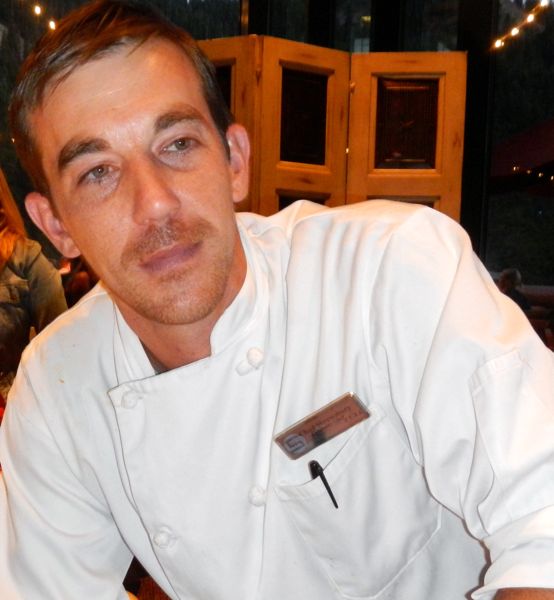
Chef Chad Shrewsbury had guests of this month’s Study of the Seasons: Farm to Tahoe dinner at the Resort at Squaw Creek’s Six Peaks Grille raving about his ability to transform ordinary ingredients into extraordinary culinary delights.
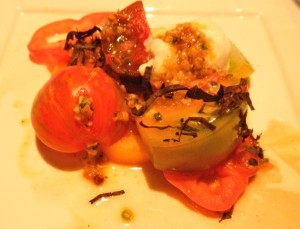
Heirloom tomatoes, above, and the corn bisque soup were highlights of the July 5 Farm to Table dinner at Resort at Squaw Creek. Photos/Kathryn Reed

Heirloom tomatoes, above, and the corn bisque soup, below, were highlights of the July 5 Farm to Table dinner at Resort at Squaw Creek. Photos/Kathryn Reed

The sea salt on the tomatoes reminded Sue of growing up in Vermont when her mom would pick tomatoes out back and serve them sliced with a dash of salt.

Shrewsbury’s dish elevated this classic first course with the addition of Burrata cheese (a mix of mozzarella and cream), purple basil (which is sweeter than regular basil), sherry vinegar and a pine nut relish. While finely chopped, that relish provided an unexpected crunchiness because visually it was not obvious nuts were part of the dish.

Using more than just red tomatoes from Greg’s Organics in Grass Valley also made the dish wonderful to just look at.

These dinners are all about using ingredients sourced from regional farms in the foothills near Lake Tahoe. Each course is then paired with a wine. The July 5 dinner featured Clos LaChance winery in San Martin.

Winemaker Bill Murphy chose a 2013 Sauvignon Blanc to pair with the heirloom tomatoes. Sue liked squaw dinner-4-soupthe fig she noted in the wine, saying it complemented the pine nut relish. While many Sauvignon Blancs are fine without food, this one in particular had its fruitiness enhanced by the tomatoes.

For most people, the next course was pork belly with Blue Lake beans, jalapeno polenta, citrus salad and mole rapido. I had the corn bisque, which Sue (the carnivore) said was her favorite dish of the night.

The pork was served with a 2010 Reserve Pinot Noir. Murphy noted it was darker in color than most Pinots, which is what the Santa Cruz Mountains tend to produce.

Standing in front of the picture windows with a backdrop of the towering granite peaks that make up Squaw Valley Ski Resort, Murphy answered questions about his wines and the industry in general. He explained how he started in the wine business as a hobby. Now he and his wife have 150 acres of estate grown grapes.

Murphy believes the climate has more to do with the end product of a wine than the terroir. He points to the hot sunny days and cool nights of Santa Cruz for adding so much to the grapes he grows.

He is extremely familiar with the North Shore, having had a house at Squaw Valley for the last 20 years and at Tahoe Donner before that.
Chef Chad Shrewsbury has been with the Resort at Squaw Creek for seven years.

Chef Chad Shrewsbury has been with the Resort at Squaw Creek for seven years.

Sue liked that the Pinot had a long finish, meaning it stayed on her taste buds longer. It paired nicely with the pork, but was not a good choice for the bisque.

Pork belly is traditionally a fatter cut of meat. Sue noticed it was a bit salty, but a sip of wine took it away. The polenta was not spicy, despite having jalapenos in it.

A unique twist with the corn bisque was the pieces of gnocchi in it. It was the texture more than anything that complemented the silkiness of the soup. This bisque was so refined. While the corn flavor was obvious, it wasn’t overwhelming. It could have been a meal unto itself.

That is one of the things about this four-course dinner — the portions are extremely generous. None of this take two bites and call it a serving like so many places. But at the same time, come hungry or you won’t be able to eat everything. Plus, the wine pours are ample.

I was not able to finish my next course because I was already getting full. But it is something I would love to have again. The pasta came with fava beans, spinach, cherry tomatoes, artichoke hearts and black trumpet mushrooms.

Those same mushrooms accompanied the Chilean sea bass that also had sweet corn and parsley tomato jus.

Sue said the earthiness of the mushrooms is so distinct that it was like they had been growing deep in the soil. I have such a thing for mushrooms that I made sure not a nibble was left on the plate.

Shrewsbury’s skills as a vegetarian chef have been honed through the years because his wife doesn’t eat meat. He’s been at Six Peaks Grille for seven years.

“I like earthy food, stuff that you get fresh from the farmer,” Shrewsbury told Lake Tahoe News. “I keep it basic, but I keep the flavor profile. If you explode the subtle flavors of food, people love it.”
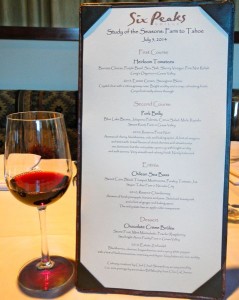
The next Farm to Table dinner is Aug. 20

The next Farm to Table dinner is Aug. 30.

Based on the empty plates returning to the kitchen, Shrewsbury nailed it.

This third course was served with a crisp 2010 Reserve Chardonnay.

The only disappointment of the evening, though, was dessert. Fortunately we were so full it’s not like we really needed more. The chocolate crème brulee was not a traditional crème brulee. It came with stone fruit, mint marmalade and powder raspberry. None of it seemed to go together.

Dessert came with a 2010 Estate Zinfandel. It was wonderful not to have a traditional dessert wine. Zins pair so well with chocolate, that this was perfect for the last course – even for those who didn’t eat their dessert.

—-

Notes:

• The next dinner is Aug. 30. For more info, go online or call 530.583.6300.


Certain foods can affect stress levels

By Allison Aubrey, NPR

Eat more when you’re stressed? You’re not alone. More than a third of the participants in a national survey conducted by NPR, the Robert Wood Johnson Foundation and the Harvard School of Public Health said they change their diets during stressful times.

And many of us are quick to turn to either sugary foods or highly refined carbohydrates such as bagels or white pasta when the stress hits.

“There can be a bit of a vicious cycle,” says David Ludwig, a professor of pediatrics and nutrition at Harvard University and a researcher at Boston Children’s Hospital. “When we feel stressed we seek foods that are going to comfort us immediately, but often times those foods lead to surges and crashes in hormones and blood sugar that increase our susceptibility to new stresses.”

Now, of course, we can’t control lots of the events and circumstances that lead to stress. But, Ludwig says, “our body chemistry can very much affect how that stress gets to us.”

Read the whole story


Wine tasting allowed at Calif. farmers markets

By Willa Young, Los Angeles Times

Skip the peaches and cheese, farmers market guests can now sample wine at farmers markets all over California.

Gov. Jerry Brown signed a measure into law Tuesday that allows farmers markets to conduct wine and cider tastings. The bill, AB2488, was approved by the Assembly and the Senate of California unanimously. Wineries and cidermakers can apply immediately for a permit through the Department of Alcoholic Beverage Control.

The wine and ciders must be produced from fruit grown and bottled by the winery and the tastings must be done by the permit holder, a family member or an employee. Also, wine sellers may not sell more than 5,000 gallons of wine annually and may not serve an individual customer more than 3 ounces a day. These provisions are in place to keep the tastings responsible and controlled.

Read the whole story


K’s Kitchen: Zucchini soup

By Kathryn Reed

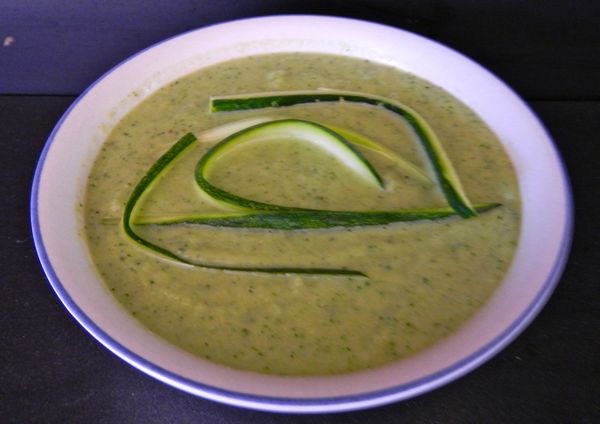
I remember when I grew zucchini it got to the point I had so much even my colleagues were tired of it. Squash can be prolific.

And while it’s possible to get zucchini year-round, I’ll get on my soapbox and shout – fresh is best. Now is the time to be loading up on veggies at farmers’ markets.

Soup isn’t something I usually make in the summer, but with the abundance of zucchini at the market, I had to do something other than my usual mixed veggie medley.

Sue said this was like eating a garden. I thought the flavors came together better a few hours after cooking it. If serving for others, I would suggest making it a day ahead.

She also was afraid it was fattening. It’s not. No cream. But it is thick. The thickness can vary based on the amount of zucchini and liquid used. Add water if you want a thinner soup.

zucchini soup Zucchini Soup

1 T butter

2 T olive oil

1 medium onion, chopped

3 garlic cloves, sliced

Kosher salt and pepper

1½ pounds (or more) zucchini, chopped

1 C vegetable stock

Julienned raw zucchini for garnish, optional

Melt butter with olive oil in large saucepan. Add onion, garlic, salt and pepper. Cover over moderately low heat until soft.

Add zucchini. Cook for about 10 minutes or until soft.

Add stock. Bring to simmer.

Puree mixture in blender until smooth. Return to heat. Season with salt and pepper.

Serve hot or cold, with or without garnish.


Squaw Valley Institute sponsoring farm dinner

Squaw Valley Institute is having a farm to table dinner Aug. 21 at the historic Poulsen family estate in the heart of Squaw Valley.

The evening will have an Argentinian culinary flair. Local chefs such as Elsa Corrigan of Mamasaki, John and Nyna Weatherson of Trokay, Wyatt DuFresne of Plumpjack’s, Billy McCullough of Dragonfly and Dan McCabe of Rocker will use organic ingredients sourced from the Tahoe Food Hub for the evening’s different courses.

All food will be paired with varietals from Placer County’s boutique Vina Castellano winery.

Guests will also be able to enjoy the unique hand crafted selections of local brew masters Alibi Ales of Lake Tahoe. The evening begins at 5:30, with dinner being served at 7pm sharp.

For tickets and more info, go online.