Sierra House to be growing veggies this fall

Excavation work is beginning at Sierra House Elementary where two growing domes will be erected. Photo/Rebecca Bryson

Excavation work begins at Sierra House Elementary where two growing domes will be erected. Photo/Rebecca Bryson

By Kathryn Reed

Grading began this weekend at Sierra House Elementary School on what will be two growing domes by the end of November.

A cadre of parents determined to make this a reality has never wavered in their desire to bring this to fruition. With the Tahoe Regional Planning Agency signing off on the necessary permits, all that is left is final approval from the state architect’s office. Steve Morales, facilities manager for Lake Tahoe Unified School District, said this could come any day.

Holes for the two 18-foot diameter domes will be dug this week, with the foundation then going in. The foundation will be built higher than what is normal for a structure because inside will be dirt. This will allow for some insulation.

Between the domes will be a 25-foot by 25-foot outdoor learning area.

The domes are likely to go up in mid-November.

“Erection of the two domes will take place in probably less than eight days. They are a kit. The dome company sends erection crews out with supervisors,” Morales told Lake Tahoe News.

Then it will be up to the parents to outfit the interiors how they want.

Rebecca Bryson, a parent who has been instrumental is making the dome a reality, said parents will likely spend Thanksgiving week getting the interior of the domes situated how they like. Volunteers will do the teaching, including master gardeners.

To start with Bryson expects lettuce, kale and other winter crops to be grown.

The parents have raised nearly $118,000 for the project. The district has incurred expenses mostly just in terms of personnel.

Ravinder Saini gives pomegranate seeds to her daughter, Arya. Photo/Provided

Ravinder Saini gives pomegranate seeds to her daughter, Arya. Photo/Provided

Soroptimist International South Lake Tahoe was the single biggest donor at $25,000. The remainder of that cash will be given to the parents group on Wednesday at the service club’s weekly meeting.

The dome in Truckee requires about a $500 operation and maintenance fund each year. The South Shore parents are using that figure as a barometer for what it will need to put aside for O&M costs; with the realization annual fundraisers may be necessary to keep the domes operational.

Nutrition, healthy eating and teaching students where food comes from before it reaches the grocery store are all components of the growing dome. It’s also a chance for kids to play in the dirt, see veggies grow from seed into something edible, and to learn about other aspects of gardening. They will also get to eat what they grow.

“We will be able to supplement school lunches,” Bryson told Lake Tahoe News. “McDuff’s was one of the early sponsors. They would like to make pizzas with kids using ingredients from the dome.”

Some lessons are already being taught. This fall students throughout the district were introduced to pomegranates through a joint project with Barton Health, UC Cooperative Extension and Raley’s.

Bryson said it’s possible art students from Lake Tahoe Community College will create a Let it Grow mural at the elementary site by the domes.

Water for winemaking an issue during drought

By Mike Dunne, Sacramento Bee

If you have one of those “Save Water Drink Wine” bumper stickers on your car, you might want to rip it off.

And not only because the wit is so lame.

The advice is erroneous. In this time of drought, a bumper sticker urging fellow motorists to “Save Water Drink Water” makes more sense.

After all, 29 gallons of water were used to produce that glass of cabernet sauvignon you look forward to drinking with tonight’s dinner.

That, at least, is the calculation of the Water Footprint Network, a nonprofit foundation in the Netherlands that advocates for more sustainable, efficient and fair ways to use water.

Mesfin Mekonnen, a postdoctoral researcher at the University of Twente in the Netherlands, and a Water Footprint associate involved in compiling data, said via email that the 29-gallon figure was based on such factors as rainfall, irrigation and water used in cellars during winemaking.

In California vineyards and cellars, is 29 gallons of water to produce a single glass of wine a realistic estimate?

Read the whole story


Judge upholds Calif. humane hen housing law

By Jacob Bunge, Wall Street Journal

A federal judge has dismissed a lawsuit challenging a California law that requires all eggs sold in the Golden State to come from hens housed in roomier cages.

The ruling deals a blow to a joint effort by a half-dozen farm states, including Missouri and Iowa, whose attorneys general have argued the law overstepped California’s legal authority and violated principles of interstate commerce enshrined in the U.S. Constitution.

The law, which takes effect Jan. 1, requires all producers selling eggs in California to house egg-laying hens in enclosures spacious enough for birds to lie down, stand up and fully spread their wings. The rules stem from a voter-approved 2008 ballot initiative covering California farmers and a 2010 state law that extended the standards to all producers selling eggs in the state.

The attorneys general have argued California lawmakers were attempting to force expensive new rules on any U.S. farmer who might market eggs in the state. They said farmers would have to spend hundreds of millions of dollars overhauling farms to ensure they would have access to the California market, the most-populous U.S. state and the biggest for egg sales.

Read the whole story


Law aims to rid farmers markets of cheaters

By David Karp, Los Angeles Times

Bringing to fruition a decade-long campaign by farmers market stakeholders, Gov. Jerry Brown signed AB1871, which for the first time provides what supporters say is adequate funding to ensure that growers at certified farmers markets produce what they sell.

“This is the single-most significant change to farmers market laws since they were established in 1977,” said Ben Feldman, chair of the California Alliance of Farmers’ Markets.

Starting Jan. 1, 2015, the bill will increase the state fee paid by markets for their vendors from 60 cents to $2 daily. Currently only farmers pay the fee, but next year it will extend to all vendors, including food and crafts sellers in non-agricultural sections.

Legislative analysts have estimated that the bill will raise $1.35 million annually, including more than $1 million in new revenues, which will go to the California Department of Food and Agriculture. It will be used chiefly for hiring new state inspectors and reimbursing counties for local investigative work, as well as maintaining a database of markets and growers.

Across the state, consumers should see more inspectors at farmers markets. As cheaters are caught and fined or suspended from participation, shoppers will have greater confidence that the farms they buy from really grew the produce. In the short term, they may also see a reduction in the quantity and variety of produce at certain markets, as cheating becomes more difficult.

Read the whole story


Celebrity chefs to take over Harrah’s-Harveys

The fifth annual South Lake Tahoe Food and Wine Festival is  at Harrah’s and Harveys Lake Tahoe on Oct. 18-19.

Award-winning chef Rocco DiSpirito is the featured celebrity chef. He will be hosting several key events. He has starred in shows such as “Restaurant Divided,” on the Food Network and “Now Eat This! with Rocco DiSpirito.” He also starred in his own reality TV series, “Rocco’s Dinner Party.”

Author of 10 cookbooks, DiSpirito’s best seller, “The Pound A Day Diet,” reached No. 1 on the New York Times best seller list.

This year marks the return of chef Mark Estee. Estee’s résumé runs deep with stages in some of the world’s best kitchens, including Gary Danko, Lespinasee and Chez Panisse. He currently owns several popular eateries in Nevada and California, including Campo Reno, Campo Mammoth and Chez Louie inside the Nevada Museum of Art.

The South Lake Tahoe Food and Wine Festival kicks into gear Oct. 18 with the Grand Market Expo at Harrah’s Special Events Center.

For more information, event prices and to purchase tickets, go online. Patrons must be at least 21 years of age to attend any of these events.


Drought reduces California harvest

By Dale Kasler, Sacramento Bee

It’s harvest time in much of California, and the signs of drought are almost as abundant as the fruits and nuts and vegetables.

One commodity after another is feeling the impact of the state’s epic water shortage. The great Sacramento Valley rice crop, served in sushi restaurants nationwide and exported to Asia, will be smaller than usual. Fewer grapes will be available to produce California’s world-class wines, and the citrus groves of the San Joaquin Valley are producing fewer oranges. There is less hay and corn for the state’s dairy cows, and the pistachio harvest is expected to shrink.

While many crops have yet to be harvested, it’s clear that the drought has carved a significant hole in the economy of rural California. Farm income is down, so is employment, and Thursday’s rain showers did little to change the equation.

An estimated 420,000 acres of farmland went unplanted this year, or about 5 percent of the total. Economists at UC Davis say agriculture, which has been a $44 billion-a-year business in California, will suffer revenue losses and higher water costs – a financial hit totaling $2.2 billion this year.

Read the whole story


A guide to drinking wine at home

By Eric Asimov, New York Times

People who love wine generally consume more of it at home than anywhere else. And regardless of the quality of their glasses or the extent of their cellars, those who most enjoy wine at home share one attribute: a commitment to drinking it.

Many people who profess to value wine break out bottles only on special occasions, or on weekends. But people who really love wine think of it as an ordinary part of their meals, like salt or bread. Regular consumption is the single most important characteristic of the confident wine lover.

The benefits of commitment far outweigh a primer on proper glassware or schematics for pairing food and wine. Drinking wine regularly develops your critical ability and your sense of your own taste. And it helps answer the crucial question: Do you like wine enough to want to learn more about it? If you do like it, the repetition of pouring a glass with a meal becomes a pleasurable learning experience, which in turn leads to a greater sense of confidence. That, more than anything, improves the experience of drinking wine anywhere.

Regular wine consumption does not mean you need to drink a lot. It could be just a glass with dinner. Or a couple could share a bottle, which, like the 90-foot baseline in baseball, is just the right proportion: Two people can generally finish a bottle happily rather than woozily. Either way, or anywhere in between, regular drinking renders wine ordinary in the best sense rather than extraordinary.

Read the whole story


Coke, Pepsi work to reduce drink calories

By Shan Li, Los Angeles Times

Soda giants Coca Cola Co., PepsiCo and Dr. Pepper Snapple Group are getting together to urge Americans to stop drinking so many sugary drinks.

The beverage companies announced a new initiative Tuesday to reduce by 20% the number of beverage calories consumed per person in the U.S. by 2025.

The drink makers — who announced the plan at the Clinton Global Initiative — will focus on introducing lower-calorie products and small sizes and on marketing low-calorie offerings such as water more aggressively. They will also work on adding calorie information to areas such as vending machines and self-service fountain equipment.

Susan Neely, chief executive of the American Beverage Association, said these efforts will “help transform the beverage landscape in America.”

Read the whole story


Moe’s brings authentic bbq to Lake Tahoe

By Kathryn Reed

TAHOE CITY – You know it’s going to be a messy meal when there is a roll of paper towels on the table. And that’s a good thing at a barbecue joint.

Anyone who has been to the South knows what you get out West often isn’t authentic barbecue. It’s like it’s been California-ized. Not true of Moe’s Original Bar B Que in Tahoe City.

Moe's in Tahoe City has food for barbecue die-hards and vegetarians. Photos/Kathryn Reed

Moe’s in Tahoe City has food for barbecue die-hards and vegetarians. Photos/Kathryn Reed

This is one of 31 restaurants in the chain that was founded by three guys who met at the University of Alabama in Tuscaloosa. Mike Fernandez, Ben Gilbert and Jeff Kennedy are all from Alabama. (Two more restaurants are opening in October.)

This is the only Moe’s in Tahoe, but there is talk of opening a second one in the region. It opened this summer.

Cooks at each restaurant are encouraged to put their own spin on menu items.

“A lot of different things are done here. Instead of using bacon fat for collard greens, we use roasted tomato and garlic so it ends up as a full vegetarian product,” Eric Pilcher told Lake Tahoe News.

Pilcher, along with Josh Wallick and Luke Dannals own the Tahoe City franchise. Each day the meat is smoked fresh with fruitwood. If any of the pork, turkey or chicken is left, it might be turned into a gumbo or jambalaya. All of it is covered with two sauces. The sauce’s ingredients, well, Pilcher wouldn’t say. Extra sauce is on the table just in case.

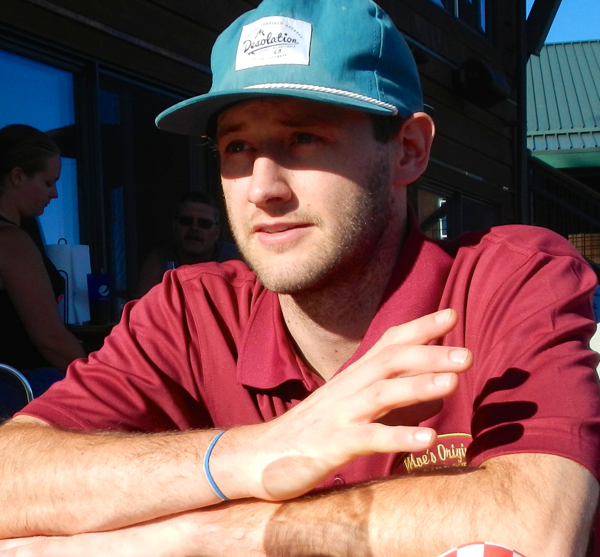
Owner Eric Pilcher said music will be a big component of Moe's.

Owner Eric Pilcher said music will be a component of Moe’s as well as community involvement.

The sauce recipe is from Moses Day of Tuscaloosa, Ala. That’s who taught Fernandez how to fire roast meats. Day had no problem with the college boys using his recipe as long as they named their business after him. Which they did.

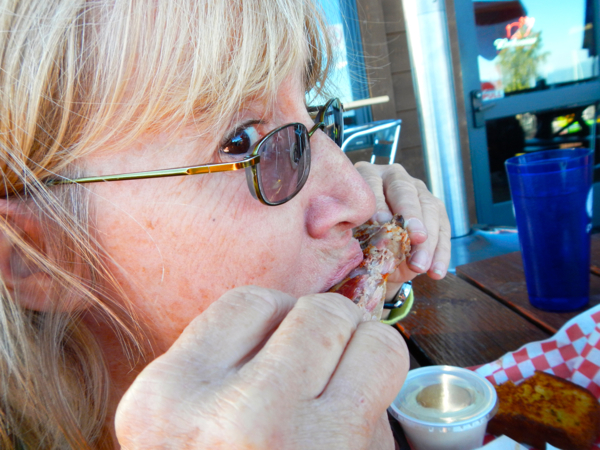
Sue said the pulled pork “is out of this world,” adding the sweet, smoky flavor was the best she has ever had. The white sauce on the smoked turkey seemed to be embedded into the meat, not just poured on top. She only put the ribs down long enough to get more paper towel.

While tofu is on the menu, the multitude of sides are more than enough to keep a vegetarian happy. Side dishes, which are not the same every day, and desserts are often family recipes from someone in the organization.

The fried green tomatoes were a highlight because they were breaded and cooked perfectly, plus the accompaniment of sweet red onions added to what can sometimes be a bland dish. Some of that barbecue sauce tasted really good on these tomatoes.

Sue enjoys one of the ribs.

Sue enjoys one of the ribs.

The jalapeno corn bread could use a few more peppers (for that California influence), but otherwise it was tasty. It actually tasted like corn.

Most collard greens are too salty for my palate, but the vinegar in these helped balance the salt a bit.

I didn’t want to share the tomato-cucumber salad. Sue said it tasted like a garden. It wasn’t complex, seeming only to be seasoned with salt, pepper and vinegar. But it was a terrific blend that was crisp and refreshing.

Moe’s is definitely casual – which is perfect when you have sauce on your cheeks and need a second moist towelette that comes at the bottom of the plastic containers. And sitting outside with Lake Tahoe as the view, well, it’s hard to not want to stay and keep eating more.

—-

Notes:

• Moe’s is online.

• Address: 120 Grove St., Tahoe City.


Exec chef at Lake Tahoe Hard Rock a STHS grad

By Kathryn Reed

Jonathan Snyder, who is no stranger to Tahoe or the culinary world, is eager to transform the food scene on the South Shore.

He has been tapped to be the executive chef at Lake Tahoe Hard Rock hotel-casino.

Snyder is a 1991 graduate of South Tahoe High School. He moved to the area as a kid when his parents bought what was the Dory’s Oar in South Lake Tahoe. His wife, Michelle, is also a grad of STHS. Having twin 4-year-olds – a boy and girl – played a role in their decision to return to Tahoe from Las Vegas.

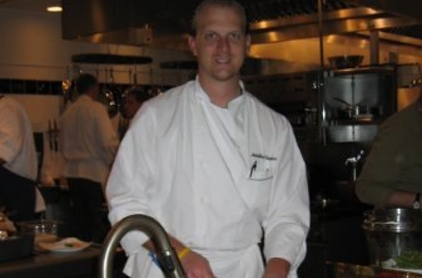
Jonathan Snyder is executive chef of Hard Rock Lake Tahoe. Photo/Provided

Jonathan Snyder is executive chef of Hard Rock Lake Tahoe. Photo/Provided

“We want to give our kids the same type of upbringing my wife and I had,” Snyder said.

The family has been vacationing in the basin at least annually. Hiking, biking and skiing are how they like to enjoy the outdoors.

When Snyder left Tahoe he went to the Culinary Institute of America in New York. He spent eight years as executive chef at the Prime Steakhouse at Bellagio in Las Vegas, two years as assistant corporate chef for Pure Management Group, 2½ years as chef at Rare 120 at the Hard Rock Hotel Las Vegas, 16 months as executive sous chef for the Manchester Grand Hyatt San Diego, and nearly two years as executive chef at House of Blues/Foundation Room in Vegas.

As executive chef of Lake Tahoe Hard Rock, Snyder will oversee all the food and beverage operations. There will be four restaurants, with three having a bar in them. Then there will be two or three standalone bars. Plus, there will be the pool bar.

Specifics of what the restaurant concepts will be are being kept under wraps. There will be one that is more upscale, one that is open 24 hours, one serving breakfast, and something on the casual side. Snyder said one restaurant – he wouldn’t say which one – will have a similar concept to what exists at the Vegas Hard Rock.

“One will be a lot more fun, not as formal. It will be a really cool spot that people will enjoy. I think a lot of locals will enjoy that spot,” Snyder said.

He added that the Stateline property, including dining establishments, is going to have a Tahoe feel.

“Warner Hospitality is the managing partner. They had some concepts in mind, but as far as the menus go, that has pretty much been put in my hands,” Snyder told Lake Tahoe News.

Tastings are under way and will be ongoing through the fall to finalize the menus.

While the official word is the hotel-casino that is being transformed in Stateline at what was the Horizon will be ready during the 2014-15 ski season, there is talk of a December opening.

Snyder is doing research to find out where to get the best locally/regionally sourced food. He is in talks with the Tahoe Lobster Company to possibly have a crayfish dish made with the crustaceans pulled from Lake Tahoe.

While menus will change, restaurants will also have signature dishes that will be a mainstay.

“To me a big part of being a chef, being a restaurant operator, is staying current with trends and staying current with seasons, and being able to change and adapt,” Snyder said.

He doesn’t flinch at the prospect of having to cater to special diets – be it vegetarian or gluten free. Snyder said with all the food allergies out there it’s important for chefs to be able cook for everyone.

When it comes time for adult beverages, locally sourced ingredients will be considered for stocking the bars, too.

“It is like being a chef behind the bar, especially with the different juices, flavors and garnishes,” Snyder said.

Specialty cocktails, wine and beer lists are being finalized. This may include wines from El Dorado and Amador counties, but definitely Sonoma and Napa counties.

Snyder said he is looking forward to launching Lake Tahoe Hard Rock from scratch. He’s had experience opening restaurants, though he said it’s not easy to make sure all the moving parts fall into place.

It will take a team to make it work. He expects to hire between 40 and 50 cooks, and another 50 who will be servers/bartenders and other front-back of house staff.

——

Notes:

• The hotel’s career center opens Sept. 22 at 50 Highway 50, Stateline. The property will hire more than 500 employees for hotel, gaming, restaurant and entertainment positions. For more info, go online and click on the “Careers” tab to view all available positions.