Free lunch for veterans

Carson Valley Inn is serving a free spaghetti lunch for all veterans and active military – plus one guest – on Veterans Day.

The event will be in the Valley Ballroom from 11am-3pm Nov. 11. Present military ID for entrance.

There will be a Veterans Day colors presentation, the national anthem and an invocation at 11am.

The Carson Valley Inn is located on Highway 395 in Minden near the start of Highway 88.


Barton cheeseball sales to begin

It’s time to think about ordering the famous Barton cheeseballs.

They will be on sale during the Barton Auxiliary’s Holiday Faire on Nov. 9 from 9am to 3pm at St. Theresa Parish Hall in South Lake Tahoe.

Starting Nov. 6 they will be available at Barton Memorial Hospital. Carson Valley Medical Center will start selling them Nov. 13. They will also be on sale during the Festival of Trees and Lights, Dec. 3-7 at Harrah’s Lake Tahoe.


Study: Coffee is good for the liver

By Laura Geggel, Washington Post

Whether they drank decaf or regular, people who consumed large quantities of coffee daily had lower levels of abnormal liver enzymes, a new study finds. This suggests that a chemical in coffee other than caffeine may help the liver, the researchers said.

Other studies have found that drinking coffee is associated with lower risks of developing diabetes, cardiovascular disease, nonalcoholic fatty liver disease, cirrhosis and liver cancer.

To answer the decaf question, researchers used data from the National Health and Nutrition Examination Survey, which is conducted by the Centers for Disease Control and Prevention to assess the health of Americans. In this survey, not only are participants interviewed, they also undergo physical examinations including blood tests.

Read the whole story


Weather takes toll on Calif. olive oil

By Tim Hearden, Capital Press

DAIRYVILLE — Despite some weather issues, olive oil producers in California hope to at least match last year’s mark of 3.5 million gallons, an industry expert says.

As the harvest of oil olives started about two weeks earlier than normal, growers anticipate “excellent” quality, said Patty Darragh, executive director of the California Olive Oil Council.

Last year’s production was a big jump from the roughly 2.5 million gallons turned out in 2012. But olives are an alternate-bearing fruit, and freezes, a wet spring and wind pressure may have hampered growth, Darragh said.

However, the drought that’s stymied production of many crops in California hasn’t affected oil olives as much, she said.

The Gerber-based Pacific Farms and Orchards, which produces Pacific Sun Olive Oil, anticipates a fairly light crop on the oil varieties because of poor chilling hours in the winter and warm weather during the bloom, general manager Brendon Flynn said.

Grower Larry Maben, who sells to the California Olive Ranch, said yield was down from his trees near Orland.

Read the whole story


Drought-stressed trees producing better fruit

By Sasha Khokha, KQED-TV

California’s severe drought is putting stress on everyone these days: the residents whose wells are running dry; the farmers forced to experiment with growing their produce with much less water; and of course, the thirsty fruits and vegetables themselves.

But preliminary research suggests the dryness isn’t hurting the produce’s nutritional value, and with a few added minerals may even boost it.

That’s the tantalizing concept Tiziana Centofanti has been studying at the U.S. Department of Agriculture lab in Parlier, a sprawling campus of experimental farmland about half an hour south of Fresno.

Centofanti is a research scientist affiliated with the Center for Irrigation Technology at Fresno State. One of the questions she’s asking is how fruit trees react to drought, compared to fruit from trees that get plenty of water.

Read the whole story


Drought takes bite out of Calif. rice harvest

By Terence Chea, AP

California’s deepening drought is shrinking its rice harvest, and that’s bad news for farmers, migratory birds and sushi lovers.

The $5 billion industry exports rice to more than 100 countries and specializes in premium grains used in risotto, paella and sushi. Nearly all U.S. sushi restaurants use medium-grain rice grown in the Sacramento Valley.

The rice harvest is just the latest victim of California’s historic drought, which has sharply reduced crop production as it enters its fourth year. With 95 percent of the state in “severe” to “exceptional” drought, farmers are leaving fields unplanted, cattle ranchers are reducing herds and almond growers are tearing out orchards.

California, the nation’s second largest rice-growing state after Arkansas, usually produces more than five million pounds of rice and sells about half of it abroad.

But this year rice farmers only planted 420,000 acres — 25 percent less than last year — because of water restrictions, according to the California Rice Commission.

On a clear October day, farmer Mike DeWit watched as a giant combine harvester cut and threshed a field of rice plants, discharging the grain into a tractor-pulled wagon.

DeWit, who usually plants 1,000 acres of rice on his family farm in Woodland, outside Sacramento, said he only planted 700 acres this year because his water supply was cut by 30 percent.

So he idled one of his combine harvesters, and hired one less worker and one less tractor.

“I think it’s the worst as far as the California rice industry is concerned on record,” DeWit said. “One more dry year, and I think the impacts on California rice farmers will be devastating.”

The reduced plantings also impact migratory birds and other wildlife that depend on flooded rice fields as habitat. Every fall, millions of waterfowl fly south from Canada and Alaska to spend their winters in California’s Central Valley.

After the fall harvest, farmers usually cover their fields with water to break down the rice stalks, creating wetlands habitat for millions of ducks and geese that can feed on uncollected grains and other plants.

“It is environmentally a very nice crop to have in the system. It mimics the natural system of a couple hundred years ago, when that area was wetlands,” said Bruce Lindquist, a rice researcher at UC Davis.

In a typical year, rice farms flood 250,000 to 300,000 acres in winter, but this year as few as 50,000 acres may be flooded because of water restrictions, according to the rice commission.

Conservationists are worried that waterfowl and shorebirds will be at greater risk for disease as they crowd together in fewer rice fields and wetlands.

“When you have less rice out there, the impacts are significant for our environment, our economy, for the farms as well,” said Jim Rice, a rice commission spokesman.

This year, conservation groups are renting 14,000 acres from rice farmers and temporarily flooding them, turning the fields into “pop-up wetlands” for birds traveling along the Pacific Flyway.

The rice commission doesn’t track prices, but Taro Arai, who runs eight Japanese restaurants in the Sacramento area, said he paid 8 percent more for rice this year and expects to pay even more next year.

Arai, “chief dreaming officer” of the Mikuni Restaurant Group, is concerned about the reduced supply and rising cost of California sushi rice, but he’s reluctant to buy rice from outside the state.

So he’s looking into growing and harvesting his own rice as he prepares to open more restaurants in Northern California.

“Sushi rice makes or breaks sushi for every restaurant in California or the United States,” Arai said. “I hear the rumors there’s a cheaper rice, but you want to eat high-quality California rice.”
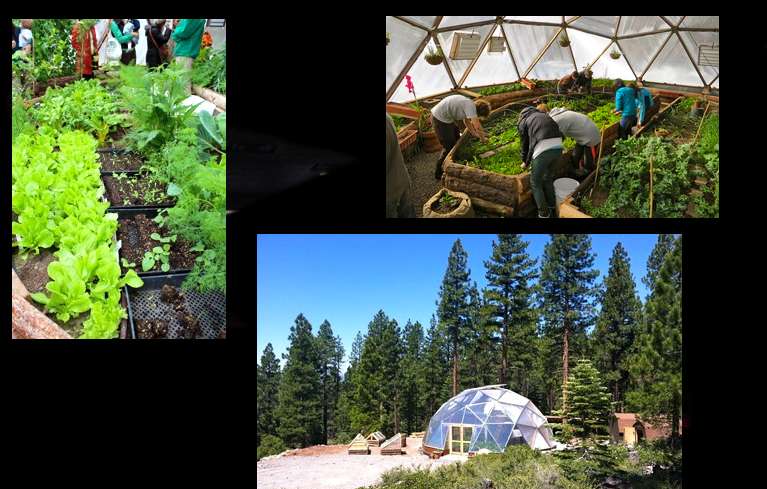


Film explores food sustainability in the Sierra

By Kathryn Reed

TRUCKEE – Food is one of the basic needs to survive. Usually it is something people living the Lake Tahoe-Truckee region import.

But what if it didn’t have to be trucked in?

Mayumi Elegado, publisher of Truckee’s Moonshine Ink, and Stacy Caldwell with Tahoe Truckee Community foundation started exploring that concept earlier this year. Their brainstorming led to the creation of the 25-minute movie “Elevate Tahoe”.

The Truckee growing dome is featured in the film "Elevate Tahoe" . Photos/Provided

Truckee’s growing dome is featured in “Elevate Tahoe”. Photos/Provided

SBS Media House created the film that profiles locals who are creating a sustainable food system. They raised more than $5,000 through KickStarter to fund the project.

On the KickStarter page, it says, “In our Elevate Tahoe film, we will feature a program that gets kids to like kale and even request fresh vegetables to be put on the home grocery list, a farmer takes us underground to extend the growing season, and a forager dishes on the bounty that can be found in the woods and your backyard, and how you can bring it home. All of these things are going on every day at the hands of normal people driven to improve the food they, their families, and their communities consume.”

While many people have small gardens in the summer, the film explores how food can be grown in this region throughout the winter, how to harvest native plants – including Manzanita, and how to preserve food so it can be used in the winter.

One segment of the film focuses on the growing dome that Truckee has. This was the inspiration for the two that will be built at Sierra House Elementary School this fall.

Another installment has organic farmer Gary Romano talking about what it takes to grow vegetables year-round.  For much of his segment he is holding a copy of the book “Why I Farm” which was published by Bona Fide Books in Meyers.

Alicia Funk with the Living Wild Project shows how powder from Manzanita berries can be used as a flour or natural sweetener. The other bonus to native plants is they are drought resistant.

Elegado and Caldwell are making the film available to various entities, with the latest showing being Oct. 14 during the Truckee-Donner Chamber of Commerce breakfast. Their goal is to soon have it available via iTunes.


Childhood dream evolves into chocolaty success

By Bernie Pacyniak, Candy Industry

For Dorinda Vance, it started early on in life. As a 12 year-old girl, she learned to make crave-inducing, chocolate-covered cherries. That skill ignited a passion in Vance that eventually steered her toward learning the art and refining the science of chocolate.

The mother of four boys, she homeschooled her sons until they reached high school.

When her last two sons were in 7th and 8th grade, Vance decided to pursue her dream and love for chocolate. She first attended Ecole Chocolat in San Francisco before traveling to Chicago for further hands-on education at the Barry Callebaut Chocolate Academy.

From there, she fine-tuned the process, putting her own artisanal touch on the craft and winning “People’s Choice” and “Most Original Taste” awards at a Lake Tahoe chocolate competition for her Sea Salt Caramels. Those acccolades earned her the title, “Duchess of Chocolate.” Shortly thereafter, Vance opened her first storefront in Truckee with her son, Dustin, joining her to help run the business.

Recently, she moved her shop to a picturesque Truckee River location in nearby Reno, and opened her second storefront in Squaw Valley.

Read the whole story


Energy drinks are not sports drinks

By Devon Jackson, Outside

Ever chug a can of let’s say, Brand E, energy drink and not only feel that good-as-advertised jolt of extraness but experience a skip or two in your chest as well? Even though most of the evidence is anecdotal and the studies—which continue to pile up—don’t yet know exactly why, the link between energy drinks and a racing heart (or worse) seem pretty incontrovertible.

The latest report to make this connection concluded that energy drinks can cause “angina, cardiac arrhythmia (irregular heartbeat) and even sudden death.”

This finding confirms that of a similar report from a year ago — and confirms some people’s popular conceptions (or misconceptions) that energy drinks should be imbibed with caution — and most probably in moderation, and almost definitely not right before or during any sort of trying physical activity.

“Most ‘energy drinks’ have contents that can be good or bad, depending upon the dose — sugar, caffeine, and taurine,” says Kim Williams, chief of cardiology at Chicago’s Rush University Medical Center. “At this time, though, there is no definitive way of determining which if any ingredient is the most harmful or under what circumstances.”

Read the whole story


Drought conditions good for wine grapes

By Oulimata Ba, HNGN

California’s record-breaking drought may be wreaking havoc on local wildlife and forcing residents to steal water.

But for state vineyard owners, the lack of water has produced the best wine grapes in years.

“This year’s vintage could be one for the ages,” Michael Coats, who co-owns Valerie’s Vineyard in Sonoma County, told the Wall Street Journal.

Winemakers across the Golden State’s Napa and Sonoma counties say the three-year drought has produced weather conditions that have made the grapes tastier and better in quality. The secret is the lack of water, which causes the vines to grow smaller grapes, leading to a higher concentration of sugar, according to Michael Honig, president of Honig Vineyard & Winery in Napa County.

Read the whole story