Green bean casserole popular on T-Day

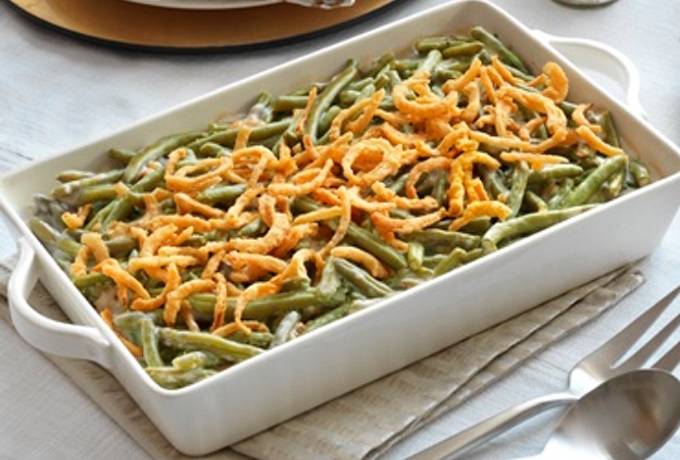
Green been casserole is a staple on many Thanksgiving menus, but they aren’t all the same. Some people use a secret ingredient to make the dish all their own.

Del Monte asked 1,500 people in the United States to share what their favorite special ingredient is as well as to rate their fondness for the classic side dish. Bacon is the No. 1 secret ingredient, with cheese, mushrooms, bread crumbs (including crouton and crushed crackers), and almonds rounding out the top five.

It’s estimated 30 million green bean casseroles will be served on Thanksgiving.

According to the survey, here are the percentages of residents in the following states who say they really like or love green bean casserole:

• Kentucky 78 percent

• Wisconsin 77

• Missouri 76

• Iowa 75

• Maine 74

• New Hampshire 73

• Florida 72

• Colorado 71

• California 69

• Mississippi 68.

Photo/Del Monte

Photo/Del Mont

Classic Green Bean Casserole

2 cans condensed cream of mushroom soup

1 C milk

2 tsp soy sauce

¼ tsp black pepper

4 cans green beans, drained

2⅔ cups French fried onions, divided

Stir soup, milk, soy sauce, black pepper, beans and 1 1/3 cups onions in a 3-quart casserole.

Bake at 350 degrees uncovered 25 minutes or until bean mixture is hot and bubbling. Stir bean mixture. Sprinkle with remaining onions.

Bake 5 minutes longer or until onions are golden brown.

— Lake Tahoe News staff report


Changing food labels may reduce waste

By Roff Smith, National Geographic

LONDON—Everyone’s done it: You reach into your fridge and pluck out something tasty that you’ve meaning to eat but had half-forgotten about, only to discover that its “best before” date passed a few days earlier.

What to do? If you’re like many people, you let out a resentful sigh and toss it — better safe than sorry —  and resolve to be more watchful, less wasteful, in the future.

But did you really need to throw away that perfectly good-looking (and good-smelling) wedge of manchego or container of ice cream?

Depending on what it was, and how well it was kept, probably not, says Emma Marsh, who leads Love Food Hate Waste, a U.K.-based group that’s dedicated to tackling food waste. “More than half of the food we throw out is food we could have eaten,” she says, referring to British consumers.

Food waste is a growing global concern, with 1.3 billion tons of food — as much as a third of the food that is produced on the globe each year, worth over $750 billion — going to waste each year, according to the United Nations’ Food and Agriculture Organization. Aside from the morality of such loss in a world where an estimated 800 million people go to bed hungry each night, the economic and environmental implications are staggering. More than a quarter of the world’s agricultural land is being worked to grow food that nobody eats.


App takes guessing out of wine buying

By David Goldman, CNNMoney

For most of us, wine remains a big mystery.

Making a selection at a wine store is a daunting task that usually comes down to just two decisions: red or white and what price you’re willing to pay. Then you just choose the wine with the prettiest label.

A new app called Next Glass aims to make buying wine much easier — and a whole lot more scientific.

Next Glass works like this: When you first download the app, you are asked to rate a few wines that you like. Then, at a wine store, you scan a wine bottle’s label. You’ll instantly get a score out of 100. The higher the score, the more likely you’ll enjoy that wine.

And if wine’s not your thing, don’t fret: Next Glass also rates beer.

Read the whole story


Cost of Thanksgiving dinner barely budges

By J.M. Hirsch, AP 

Giving thanks will be a little costlier this year, but — and here’s something you can be truly thankful for — it probably won’t empty your wallet.

The price for putting Thanksgiving dinner on the table for 10 people is expected to rise slightly this year, clocking in at $49.41. That’s 37 cents higher than in 2013. For that, you can blame dairy products, coffee and that all-important marshmallow-topped sweet potato casserole, according to the annual informal survey of consumer grocery prices performed by the American Farm Bureau Federation.

The group found that the price of dairy — as in milk for the mashed potatoes and whipped cream for the pies — collectively jumped 25 cents over last year. Miscellaneous ingredients, such as coffee, sugar and eggs, account for another 28 cents, while 3 pounds of sweet potatoes jumped 20 cents.

The good news is that a drop in fuel prices won’t just make it cheaper to drive to Grandma’s house for the big meal, it also helped keep down the cost of some ingredients. Flour-based foods, such as stuffing mix, pie shells and dinner rolls, will run about 21 cents less than last year, likely due to energy cost savings by the processors, says John Anderson, the Farm Bureau’s deputy chief economist.

The group estimates the cost of Thanksgiving dinner by averaging non-sale food prices around the country based on feeding 10 people a meal of turkey, bread stuffing, sweet potatoes, rolls with butter, peas, cranberries, carrots and celery, pumpkin pie with whipped cream, and coffee and milk. And yes, their estimates account for needing leftovers.

And here’s something to consider: Though this year’s cost is up, it’s still 7 cents lower than in 2012.

News earlier this week that turkey production is at its lowest level in nearly three decades and wholesale prices are at an all-time high briefly spooked some folks. But most consumers won’t see that reflected on their grocery bills. Retailers aren’t likely to pass on to consumer much if any price hike that they are paying for the big birds, and the Farm Bureau actually expects the cost of a 16-pound turkey to drop by 11 cents this year.

Of course, there are plenty of ways to spend more this Thanksgiving. Upgrade that 16-pound conventional bird to an organic, free-range model and suddenly the Farm Bureau’s $21.65 estimate can jump to $100 or more at specialty online retailers. Not into baking? Instead of spending about $3 on a homemade pie, you can spend $25 or more on high-end mail order versions.

Or maybe you don’t want to cook at all. A complete and fully cooked Thanksgiving dinner for 12 people from Whole Foods Market will cost around $170.

Then again, maybe you want to spend less. Shop smart at a bargain retailer and you could shave more than a third off the Farm Bureau’s total. Using the same menu for 10 people, Wal-Mart estimates that shopping for Thanksgiving dinner at one of its stores will cost just $32.64.

But maybe you got off the hook this year and aren’t hosting Thanksgiving. If instead of cooking you’ll be traveling by car, you’ll see savings at the pump. Gasoline is running about 33 cents less per gallon than it was a year ago, with a national average of $2.88, according to travel tracker AAA. And it doesn’t matter where you’re driving. Gas can be found for less than $3 a gallon in every state in the continental U.S.

Don’t want to drive? If you’re traveling by train, you’ll pay a bit more. Amtrak says its ticket prices have increased an average of 2 percent over last year. Same goes for flying. The average price of an airline ticket for travel this Thanksgiving is $307.52, not including an average $51 in taxes and fees, according to the Airlines Reporting Corp., which processes ticket transactions for airlines and travel agencies. That’s up 1.1 percent from last year.


Finding the right wine for Thanksgiving

By Mike Dunne, Sacramento Bee

Summer wasn’t even over before the most popular wine question of fall popped up: What wine do you serve at the Thanksgiving feast? Judy Laverty asked this as she moderated the Blazing Pans cooking competition in early September at the Lake Tahoe Autumn Food and Wine Festival in the Village at Northstar.

This is a cook-off in which two of the Tahoe area’s more celebrated chefs go head-to-head in a format and with an intensity akin to the popular TV series “Iron Chef.”

This year’s contestants were defending champ Mark Estee of Campo in Reno and challenger Ben “Wyatt” Dufresne of Plumpjack Café in Squaw Valley, the ultimate winner.

Within 75 minutes, the chefs were to prepare four courses featuring an ingredient they learned of only as the clock started its countdown. This year, that was a whole organic free-range turkey.

Thus Laverty’s question to the five judges, one of whom was myself. I was more-or-less ready with my usual answer: Set the table with whatever wine you like and whatever you expect your guests will like. If it’s a big gathering, almost surely someone about the table will expect Chardonnay. Another will be looking forward to Cabernet Sauvignon. Not my first choices, but go ahead, be the most hospitable of hosts.

Read the whole story


Rethinking the reality of superfoods

By Devon Jackson, Outside

Imagine a food-playoff system wherein watercress, a decent if unremarkable little vegetable long overshadowed by broccoli, kale, carrots, and many other veggies, not only makes it to the Sweet 16 but comes out on top. Improbable?

According to a new ranking put out by the Centers for Disease Control, watercress is the powerhouse vegetable among powerhouse fruits and vegetables (PFV). It’s a ridiculous designation that highlights just how useless “superfoods” ratings actually are.

First, let’s look into what constitutes a powerhouse fruit or vegetable anyway. The CDC defines PFVs as “foods providing, on average, 10 percent or more daily value per 100 kilocalories of 17 qualifying nutrients.” So if a 100-calorie serving of a certain food has a higher than usual amount of 17 nutrients, including potassium, fiber, protein, calcium, and iron, the CDC calls it a superfood. Researchers ultimately identified 41 of these nutrient-dense eats.

Read the whole story


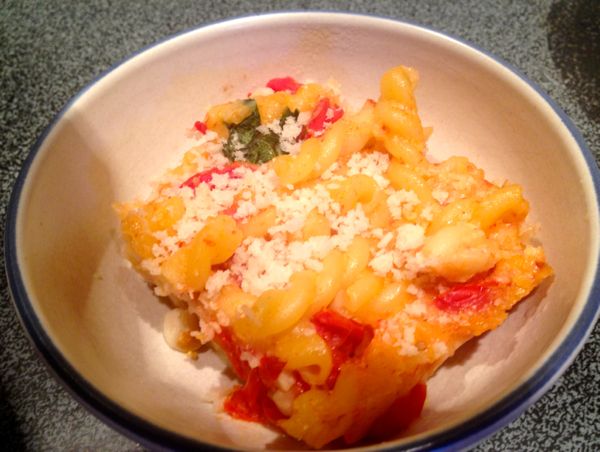
K’s Kitchen: Mac and cheese without a box

By Kathryn Reed

With temperatures consistently below freezing at night, it is time to start cooking comfort food. They tend to be dishes that make the house smell good, warm the insides and often involve having plenty for leftovers.

Mac and cheese has never been one of my favorite meals – not even as a kid. In fact, I had never made mac and cheese until I was an adult. It was for my nieces and nephew. It was that Kraft stuff that is a color yellow that I don’t think is found in the natural world. It’s all about additives.

My mom made a mac and cheese from scratch. I didn’t like that either.

Considering I like pasta and cheese it seems hard to imagine I would not like this simple combination.

Thanks to Sue I finally do. She made the recipe below. What makes this ensemble different is the add-ons and the different cheeses. It’s a bit of a grownup mac and cheese.

mac and cheeseAdult Mac and Cheese

2 C grape or cherry tomatoes, halved

4 T extra virgin olive oil, divided

6 ounces penne pasta

2 tsp garlic, minced

5 T all purpose flour

1¾ C milk

½ tsp kosher salt

½ tsp pepper

¾ C part-skim mozzarella cheese, shredded

1/3 C Parmesan cheese, grated

½ C fresh basil leaves

3 T panko

1/8 tsp crushed red pepper

Preheat boiler to high.

Combine tomatoes and 2 tsp oil on a jelly roll pan.

Broil 3 minutes or until tomatoes begin to break down.

Cook pasta. Drain water and return to pot.

In saucepan over medium heat add oil and garlic. Cook 1 minute and then add flour, milk, salt and pepper. Combine with a whisk. Simmer until thick; stirring constantly.

Remove pan from heat and stir in cheeses.

Add mixture to pasta. Stir to coat pasta.

Add tomatoes and basil.

Mixture may be spooned into individual ramekins or baking dish. Top with panko and red pepper flakes. Broil for 2 minutes or until panko is brown. Additional basil leaves may be used as garnish.


South Shore eateries signing up for restaurant week

Tahoe South Restaurant Week will feature at least 10 South Shore dining establishments.

Participating restaurants to-date include: Azul Latin Kitchen, Beacon Bar & Grill at Camp Richardson, Blue Angel Café, Boathouse on the Pier, Echo Restaurant at Lake Tahoe Resort Hotel, Edgewood Tahoe, Jimmy’s at the Landing, MacDuff’s Pub, Riva Grill, and Tavern at Tahoe Beach Retreat.

The Jan. 9-16 event connects foodies with local eateries. Participating restaurants will feature specially-priced and prix fixe menus highlighting the theme Made with Altitude. There are no passes, tickets or coupons. Instead, diners simply visit their favorite participating restaurants throughout the week to enjoy the special menus.

Tahoe South Restaurant Week is part of California Restaurant Month, designated by Visit California. More than 30 destinations across California, from the desert and coast to Wine Country and High Sierra, will host restaurant weeks and other value-driven food programming in January.

For additional restaurant week information and menus, go online.


Desire to eat ‘clean’ food can become an obsession

By Sumathi Reddy, Wall Street Journal

The growing interest in eating healthy can at times have unhealthy consequences.

Some doctors and registered dietitians say they are increasingly seeing people whose desire to eat pure or “clean” food—from raw vegans to those who cut out multiple major food sources such as gluten, dairy and sugar—becomes an all-consuming obsession and leads to ill health. In extreme cases, people will end up becoming malnourished.

Some experts refer to the condition as orthorexia nervosa, a little-researched disorder that doesn’t have an official diagnosis in the Diagnostic and Statistical Manual of Mental Disorders, or DSM, considered the bible of psychiatric illnesses. Often, individuals with orthorexia will exhibit symptoms of recognized conditions such as obsessive-compulsive disorder or end up losing unhealthy amounts of weight, similar to someone with anorexia.

Read the whole story


Adrenaline junkies and spicy food may be related

By AC Shilton, Outside

A friendly reminder for all of our spice-loving readers: There is no shame in dousing your Thanksgiving feast in Sriracha. Tell your offended mother that science has linked your love of spicy condiments to your adrenaline-seeking personality.

Biologically speaking, we should all hate spicy food. Burning—and the pain that comes with it—is bad, right? “If your dog gets a little something spicy, it has a very clear negative reaction to the burning,” says Dr. Nadia Byrnes, who conducted a study on the link between personality type and spicy food. “So if we think about it from purely a biological standpoint, the more that something burns, the less you should like it.”

But that’s clearly not the case. In 2012, market research company IBISWorld included hot sauce in its list of top 10 fastest growing industries. Huy Fong Foods, makers of our beloved “Rooster Sauce,” made $85 million in revenue in 2013.

Read the whole story