Girl Scouts to sell cookies online

By Leanne Italie, AP

NEW YORK — Watch out world, the Girl Scouts are going digital to sell you cookies. For the first time in nearly 100 years, Girl Scouts of the USA will allow its young go-getters to push their wares using a mobile app or personalized websites. But only if their scout councils and guardians say OK.

“Girls have been telling us that they want to go into this space,” said Sarah Angel-Johnson, chief digital cookie executive for the organization covering about 2 million girls. “Online is where entrepreneurship is going.”

And the best news for these digital natives: They can have cookies shipped directly to your doorstep.

More than 1 million scouts, from kindergarten-age Daisies to teens, were expected to opt in as cookie-selling season cranks up this month and the scouting organization gets digital sales under way. But digital sales are intended to enhance, not replace, the paper spreadsheets used to generate an estimated $800 million in cookie sales a year — at anywhere from $3.50 to $5 a box, depending on scout council.

There are important e-lessons here, scout officials said, such as better articulating and tracking goals, learning to handle customers and money in a new way, and more efficiently processing credit card information.

“A lot of people have asked, ‘What took you so long to get online?’ We spend a lot of time thinking how do we make this safe, scalable and smart,” Kelly M. Parisi, chief communications executive for Girl Scouts of the USA, said at a recent demonstration for select media.

Councils were offered one of the two platforms but not both. For web-based sales, scouts customize their pages, using their first names only, and email prospective customers with links to click on for orders. They can also put up videos explaining who they are and what they plan to do with their proceeds. The mobile platform offers tabs for tracking sales and allows for the sale of bundles of different kinds of cookies. It can be used on a phone or tablet.

“They can get them quicker than waiting for me to deliver them because sometimes it takes me a long time to deliver,” offered 11-year-old Priscilla at the preview. The adults at the event asked that only first names of scouts be used.

Added 7-year-old Anna: “My favorite part is that now I can sell more Girl Scout cookies.” She pulled down about 200 boxes last year and has upped her goal to 600.

Girl Scouts use their cookie money to pay for community service work or troop activities such as camping and other trips.

The websites will not be accessible without an email invitation, requiring the girls to build client lists. And personal information is as protected as any digits out there, for both the scouts and customers, using encryption in some cases. Much of the responsibility to limit identifying details about scouts online falls on parents.

Troop Leader Karen Porcher of the Bronx has an 11-year-old scout and is particularly psyched about the digital options. They live in a house rather than an apartment, and she and her husband work at home, eliminating at-office cookie and neighborly building sales.

“During cookie season my daughter is wearing her (scout) vest on the subway and people are so excited to see a Girl Scout,” Porcher explained. “Strangers actually will buy a case of cookies and wait for her to call. This is going to be amazing because now she can just say ‘Give me your business card,’ or ‘I’ll take your email address,’ send the email and they can be delivered. This is gonna be sweet.”

Porcher also sees word-of-mouth value in getting cookies delivered quickly.

“People are going to be walking around with cookies and others are going to say, ‘Whoa, how did you get those already?'”

Zack Bennett of Manhattan has a 9-year-old scout who sold more than 1,000 boxes last year. She hopes to increase her goal to 1,500 this season and went through training to learn how to set up her new cookie website. But dad won’t be letting her loose alone.

“I’ll be sitting in the backseat to help her, certainly when it comes to credit cards, things of that sort,” he said. “But it makes perfect sense to have it be on the computer. It’s definitely time the Girl Scouts came into the 21st century.”
Trend: Inhaling alcohol instead of swallowing

By AC Shilton, Outside

Bold prediction: In 2015, we won’t drink our liquor. We’ll inhale it.

Julie Palmer got the idea for the Vaportini—a device that vaporizes spirits—while traveling in Helsinki. A friend introduced her to the Finnish tradition of dumping vodka over the coals of a sauna, and she found the effect intoxicating. So Palmer decided to bring the tradition back to the United States, but in a way that involved less awkward sauna nudity.

With the help of her father, a retired engineer, Palmer designed and patented the Vaportini, a pint-glass-like base with an orb perched on top.

Read the whole story


Fasting an alternative to holiday glutton

By Eliza Barclay, NPR

Before this season of overindulgence freights us with unwanted pounds or a glutton’s guilt complex, why not try the opposite of the holiday feast: the fast.

Fasting need not be a punishing, multiday ordeal of deprivation. Increasingly, scientists are warming to the intermittent fast, which can be as brief as one skipped meal once or twice a week.

The benefits of fasting seem to extend far beyond managing weight. A recent paper in the Proceedings of the National Academy of Sciences makes a cautious but encouraging case for how regularly cutting way back on calories for a short period of time may be good for your health (and that we need to study it more).

Read the whole story


Fewer El Dorado County grapes to harvest

El Dorado County produced fewer wine grapes than the last three years, but the quality is said to be high.

Significant spring rains followed by consistent, slightly above average temperatures during the growing season marked one of the earliest harvests on record.

“The quality of this year was outstanding,” Josh Bendick of Holly’s Hill Vineyards said in a press release. “2014 was the shortest harvest we have ever had. Although we’ve started picking earlier in previous years, we were done earlier this year.“

There are more than 70 wineries and nearly 2,000 vineyard acres in the county.

The drought is a larger contributor less tonnage.

Wildland fires in the area burned on the fringes of the wine region.

— Lake Tahoe News staff report


Time to think about wine at Christmas

By Will Lyons, Wall Street Journal

Christmas isn’t a time to improvise. The holiday season is all about spending time with family and friends, basking in the warm glow of the familiar. It’s the same with wine.

At this time of year, I like to pull out old favorites, confident in the knowledge that I know what I’m getting and can relax and enjoy them for what they are.

This year, I’ve done the work for you and sipped my way through dozens of wines to find the perfect case for the holidays.

In the course of the next month, you’re likely to find yourself opening more bottles of sparkling wine than at any other time of the year. So you need an affordable fizz as well as something sought-after and rare.

I’ve chosen two sparkling wines that I think offer tremendous value for money: New Zealand’s Miru Miru and California’s Quartet. Both are ideal for small family gatherings and larger drinks parties. For something a little more special, there’s a stunning vintage Champagne from Pol Roger.

Read the whole story


Reassessing Merlot 10 years after ‘Sideways’

By Chris Macias, Sacramento Bee

The words were like a corkscrew through the heart of a signature wine grape.

“If anyone orders Merlot, I’m leaving. I am not drinking any (bleeping) Merlot!”

This seeing-red meltdown might be the second most famous movie line about wine (the top prize has to go to Hannibal Lecter and his Chianti). And it was 10 years ago this fall that moviegoers first heard Paul Giamatti’s Miles utter it in “Sideways,” a film that would go on to earn more than $100 million at the global box office, five Oscar nominations and a win for best adapted screenplay.

But this infamous Merlot diss became more than just a memorable quote from the road-trip dramedy that mixed Santa Barbara County’s bucolic wine country with a mighty mid-life crisis. Miles’ anti-Merlot rant seemed to cause ripples in the wine marketplace, a phenomenon studied in a 2008 paper called “The Sideways Effect: A Test for Changes in the Demand for Merlot and Pinot Noir Wines.”

This research team was headed by Steven Cuellar, an economics professor at Sonoma State University. The study found that national grocery store sales of Merlot fell 1.4 percent each year after 2005, though its decline had been underway for a few years prior.

Meanwhile, sales for Miles’ preferred Pinot Noir skyrocketed in the months after the movie’s 2004 release, to the tune of a 16 percent sales spike, according to an A.C. Nielsen analysis.

Nevertheless, a decade after the film’s release, Merlot still ranks as one of the country’s most popular wines.

Read the whole story


World may be running out of chocolate

By Roberto A. Ferdman, Washington Post

There’s no easy way to say this: You’re eating too much chocolate, all of you. And it’s getting so out of hand that the world could be headed toward a potentially disastrous (if you love chocolate) scenario if it doesn’t stop.

Those are, roughly speaking, the words of two huge chocolate makers, Mars, Inc. and Barry Callebaut. And there’s some data to back them up.

Chocolate deficits, whereby farmers produce less cocoa than the world eats, are becoming the norm. Already, we are in the midst of what could be the longest streak of consecutive chocolate deficits in more than 50 years. It also looks like deficits aren’t just carrying over from year-to-year — the industry expects them to grow.

Last year, the world ate roughly 70,000 metric tons more cocoa than it produced. By 2020, the two chocolate-makers warn that that number could swell to 1 million metric tons, a more than 14-fold increase; by 2030, they think the deficit could reach 2 million metric tons.

The problem is, for one, a supply issue. Dry weather in West Africa (specifically in the Ivory Coast and Ghana, where more than 70 percent of the world’s cocoa is produced) has greatly decreased production in the region. A nasty fungal disease known as frosty pod hasn’t helped either. The International Cocoa Organization estimates it has wiped out between 30 percent and 40 percent of global coca production.

Because of all this, cocoa farming has proven a particularly tough business, and many farmers have shifted to more profitable crops, like corn, as a result.

Read the whole story


FDA releases sweeping calorie labeling rules

By Lindsay Abrams, Salon

All those foods that will basically kill you as soon as your order them? Now they’re at least going to have to warn you first.

The Food and Drug Administration, after much delay, has finally released its national calorie labeling requirements. As mandated under the Affordable Care Act, the rules, which go into effect one year from now, will require chain restaurants and other food establishments with 20 or more locations to post calorie counts on their menus.

Here’s what it will look like:

When you sit down at a restaurant, you’ll be able to see how many calories each item contains. If you drive through for take-out, the calories will be there, too. Ordering pizza for delivery? Despite big pizza’s best efforts to fight it, calories will be listed by the slice. The prepared food offered at grocery stores is covered, too, an inclusion that the National Grocers Association finds ”disappointing.” Buying a snack from a vending machine? You’ll have to be able to see the labels before you make your selection. Your deli sandwiches, salad bars salads, scoops of ice cream and bakery muffins? Check, check, check and check. Even movie theater popcorn, long a Trojan horse for unexpected calories, will be labeled. And, in a move that surprised some food policy experts (in a good way), so will alcoholic beverages — at least, those that are listed on menus (drinks mixed at bars are exempted).

Read the whole story


Wood or plastic better for a cutting board?

By Alison Spiegel, Huffington Post

Ask any chef or home cook what the single most important tool in the kitchen is and he or she will almost certainly give you the same answer: a chef’s knife. One, dependable all-purpose chef’s knife — and knowing how to use it — is going to make the biggest impact on your cooking, whether you’re a newbie in the kitchen or an experienced restaurant chef.

What most people overlook when they give or receive this answer is the knife’s partner in crime: the cutting board. Often forgotten for its flashier, sharper-looking companion, the cutting board doesn’t always get the attention it deserves. People assume all cutting boards are alike, and may not give much thought to size or material. If you’ve been using the same cutting board for every dish, or if you’ve simply never considered the difference between a wood or plastic board, we’re here to correct your ill-informed ways.

Contrary to popular belief, plastic cutting boards are not automatically safer than wood. Studies have shown that wood can actually be more sanitary in the long run. People assume that because wood is a porous surface and plastic isn’t, plastic boards are more resistant to bacteria. This assumption doesn’t take into account the scars a plastic cutting board will get from daily use.

Read the whole story


Bread & Broth carves up 25 years of Thanksgiving memories with traditional meal

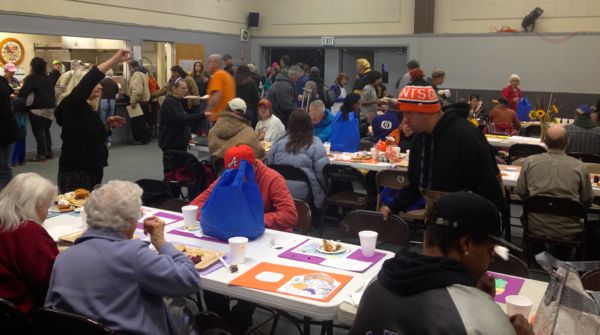
On Nov. 24 volunteers dished up more than 200 Thanksgiving dinners at Grace Hall in South Lake Tahoe. Photos/Kathryn Reed

On Nov. 24 volunteers dish up more than 200 Thanksgiving dinners at Grace Hall in South Tahoe. Photos/Kathryn Reed

By Kathryn Reed

An aroma wafted outside, making the cold, hungry diners even more eager to get inside. This was no ordinary dinner they were waiting for.

A buzz filled the kitchen. Placemats were at each setting. Cans of whipping cream were at the ready to top the pumpkin pie. Nearly 50 volunteers helped pull off the annual Bread & Broth Thanksgiving dinner.

Thanksgiving dinner is always the busiest dinner for this nonprofit that is celebrating its 25th year of serving a weekly community meal to those on the South Shore. While mostly it’s people in need who attend the Monday meal, it is open to anyone.

Most years more than 250 people line up outside Grace Hall in South Lake Tahoe for the traditional Thanksgiving dinner. This year was no different. Christmas Cheer cooked the Thanksgiving meal 25 years ago, but Bread & Broth soon took over because they were better organized to do so.

“It actually used to be higher 20 years ago – 300-plus. The whole community part took in the meal, it was an event of the season, still is to a certain extent,” Diane Weidinger, who runs the program, told Lake Tahoe News. “This year our Monday team will supply Second Serving with trays of the same dishes so people can enjoy another Thanksgiving meal on Friday.”

For Tonya Schmitt the helping was more than she could finish. She was taking the leftovers home.

“It reminds me of home; right down to the sweet potatoes with marshmallows,” Schmitt told Lake Tahoe News.

Like all the meals served at Bread & Broth, they are made from scratch by volunteer cooks. Monday’s meal consisted of turkey, dressing, mashed potatoes (with gravy), green beans, sweet potatoes, cranberries, green salad and dessert.

Jasmine Pereschica attended with her daughter and son. Like most kids, her daughter wanted dessert instead of the healthier items on her plate.

“You can tell someone put a lot of thought into it,” Pereschica said of the dinner. “The turkey is moist and not dry. The cranberries are really good.”

Stephan Moise, executive chef at Ridge Tahoe, and his culinary team make 10 gallons of gravy every year.

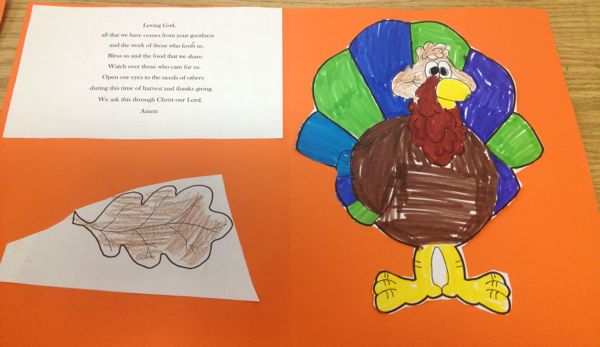
Students in Irene Kaelin’s fifth-grade class at Tahoe Valley Elementary School and kids from St. Theresa’s religious education class made the festive placemats.

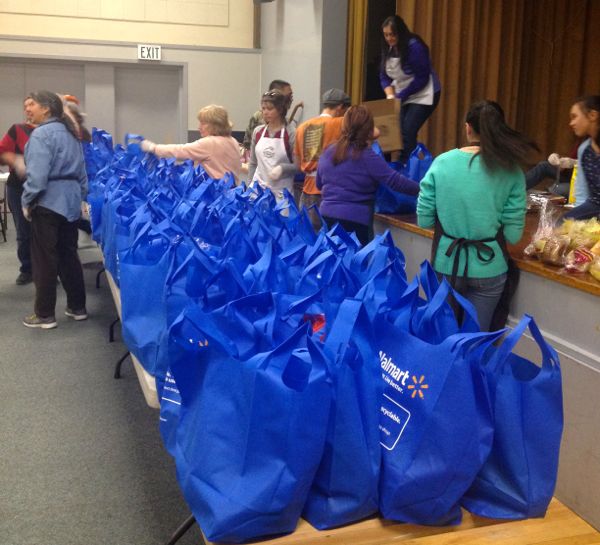
Walmart donated reusable bags that the volunteers filled with groceries so those in need had more to eat as the week went on.

Each week bags of groceries are available.

Each week bags of groceries are available.

A quarter-century tradition

When Bread & Broth started is was under the ministry of St. Theresa Church. It has become more than that, even though St. T’s is still a big part of the overall concept.

Today, people from other churches and non-believers help.

“When they first started years ago, St. Theresa’s Church supported the program with a second collection several times a year,” Weidinger said.

Cash was never flush. The recession made things worse. Then the Adopt A Day of Nourishment program and partnership with the Food Bank of El Dorado County started. Those two changes have put the organization on stable ground.

The group also receives donations from grocery stories, businesses and individuals. It comes in the form of cash, food, bags for giveaways, and containers for leftovers.

“B&B is now giving back to the church with its recent – over the last two years – purchases of the following commercial equipment: stove, oven, freezer, refrigerator, warming oven, 50-gallon water heater, prep island, industrial meat slicer and vacuum cleaner. We now pay a percentage of the utility bills for Grace Hall as well as refuse and repair costs,” Weidinger said.

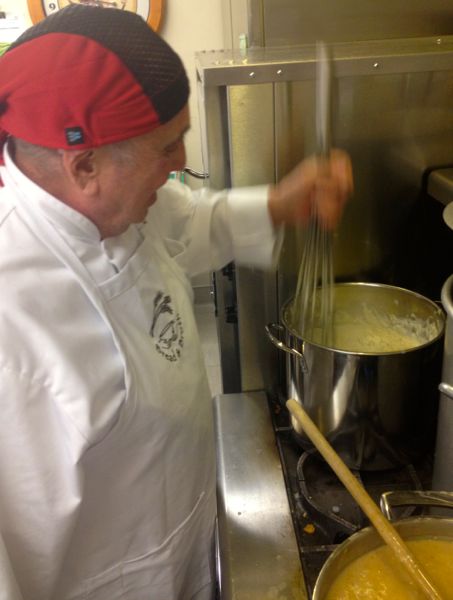
John Mauriello is a regular cook at Bread & Broth.

John Mauriello is a regular cook at B&B.

Expanding food offerings

People have the opportunity to eat at Lake Tahoe Presbyterian Church on Fridays. That program is called Second Serving.

Local restaurants provide 5 gallons of soup.

Volunteer cooks then whip up a sandwich or pasta dish to complement the soup.

The Presbyterian church was part of the original Bread & Broth team 25 years ago. Founding member Susan Baker is still involved as a Second Serving coordinator. Wendy David, one of the Bread & Broth cooks, has also been around since the beginning.

It takes a dedicated crew to pull off these meals each week. About 100 volunteers work for Bread & Broth, and another 25 for Second Serving.

A 17-person advisory board oversees the big picture. Nine committees make sure the nuts and bolts get taken care of.

“Unlike 25 years ago we have 20 cooks, plus seven from Second Serving, who cook once a week, once a month,” Weidinger said. “Years ago they had two cooks for each of the two days a week they served (Tuesday and Thursday), those four cooks would be in the kitchen every week. In the 1990s they had approximately 20 volunteers and eight board members.”

Placemats are from children.

Placemats are from children.

No ordinary meals

This is no simple fare being dished up each week.

While the cooks have license to be creative, they are also somewhat limited by what is in the pantry and cooler. They take inventory of what’s available a few days beforehand and lay out the protein they want to use.

“They arrive Monday morning to access what products were picked up from the grocery stores a few days earlier and then hope that Monday’s donations from other grocery stores will supplement the meal. They are making decisions on what to make and serve 3½ hours before the doors open at 4pm,” Weidinger explained. “If the donations are weak, they survey the canned products in the pantry and come up with a dish. Most cooks prepare a complete meal – protein, starch, at least one vegetable, salad – that is if greens were donated, otherwise canned fruit salad – hot garlic bread or rolls.”

The goal is to not purchase anything extra. Sometimes it’s necessary – like cilantro for a Mexican dish.

Dessert is usually donated by Raley’s or Safeway.

It wasn’t always this good. Meals used to be simpler.

“We currently serve meals that would be considered gourmet compared to the hotdogs, meatloaf and casseroles cooked in the early ’90s. We pride ourselves on serving a meal that our guests might order in a restaurant if they could afford it; chicken picatta with a lemon caper mushroom sauce, roasted root vegetables with a Moroccan apricot sauce (nothing was purchased for these sauces, it was all in the pantry), Ratatouille using fresh farmers market vegetables, mashed potatoes using fresh spuds, spice rubbed lamb, pizza from scratch – even the dough, beef stroganoff, shredded chicken enchiladas, fruit salad with summer ripe berries, salmon and pork shoulder.”

Going forward

Weidinger would like Bread & Broth to establish a scholarship fund for people to attend Lake Tahoe Community College’s culinary program.

“I believe that education is one of the keys that open doors of opportunity. Hard work and good ethics are two other keys, together with some luck and good fortune people from all social and economic backgrounds can have fulfilling careers,” she said.

Providing meals more days of the week is a desire by some.

And while it may not seem like a big deal, getting a washer and dryer on site is a goal. This is because as it is today all the dirty linens – and there are many with all the aprons, wash rags, potholders and other items – have to be washed at someone’s house.

Weidinger doesn’t believe the need for these types of food programs will go away.

“As long as people are underemployed, jobless and homeless, there will be a need. No one should have food insecurities,” she said. “The people we feed are our neighbors; we can’t let them go hungry when most of us are enjoying three meals a day.”