New frontier in apples — never brown

By Ben Tinker, CNN

The U.S. Department of Agriculture on Friday approved America’s first genetically modified apples. Their appeal: They don’t turn brown when bruised or sliced.

“This is really huge. It’s what we’ve waited almost five years for with regulatory approval,” says Neal Carter, founder and president of Okanagan Specialty Fruits, the Canadian company that engineered the apples. “Now we can get down to business planting trees and selling Arctic apples. We’re stoked.”

The USDA’s Animal and Plant Health Inspection Service granted its approval “… based on a final plant pest risk assessment that finds the GE (genetically engineered) apples are unlikely to pose a plant pest risk to agriculture and other plants in the United States … [and] deregulation is not likely to have a significant impact on the human environment.”

Read the whole story


Feds may warn people against eating meat

By Maddie Oatman, Mother Jones

Every five years, the U.S. Departments of Agriculture and Health and Human Services get together to revise their recommendations about what Americans should eat. These guidelines influence doctors’ health advice, food labels, the ever evolving food pyramid-turned-plate, and what goes into school lunches.

In 2010, a time when more than half of adults were overweight or obese, the agencies recommended things like drinking water instead of sugary beverages, filling half your plate with fruits and veggies, cutting sodium, and just eating less in general.

It’s 2015, so time for some new advice. The guidelines draw on input from the Dietary Guidelines for Americans Committee, which will publish a report sometime this winter. So what are the hottest items under debate this year? Here’s a run-down of what to look for in the upcoming Dietary Guidelines for Americans report:

The meat vs. plants showdown: It probably comes as no surprise that Americans eat a diet lacking in fruits and vegetables and full of too many solid fats. In fact, vegetable consumption was on the decline between 2001 and 2010 even as each of us now eat 202.3 pounds of meat a year; a bit less red meat than a few years ago but more poultry than ever before. In the past, the government has warned against overdoing it with red meat and urged people to chow down on lean meats like chicken and fish instead.

But this year, for the first time, the committee might caution against overconsumption of all kinds of meat — and not just for health reasons, but also because of meat’s environmental footprint. Livestock operations now produce 15 percent of the world’s carbon emissions. Eating fewer animal-based foods “is more health promoting and is associated with a lesser environmental impact,” the committee suggested in its draft report.

Read the whole story


K’s Kitchen: Going nuts for lasagna

By Kathryn Reed

When it comes to making lasagna, it’s easy for me to get in a rut. It’s because there is one recipe I like so much.

Now I have another recipe to add to the repertoire.

It was such a treat to not only have a delicious meal with friends, but to leave with the recipe.

I used a jar of spaghetti sauce that was only 3 cups. That’s not enough for this recipe. Another half cup if not a full cup would have made my version much better. Extra marinara sauce served on the side is how Denise and Steve served it – and now I know why based on my pan being a little dry.

I also used pecans instead of walnuts. The latter is what the original recipe calls for. I have a freezer full of pecans from another friend, so that is why I chose that nut.

As Denise told me, a variety of ingredients could be used in this recipe. She equated it to being similar to building a quiche.

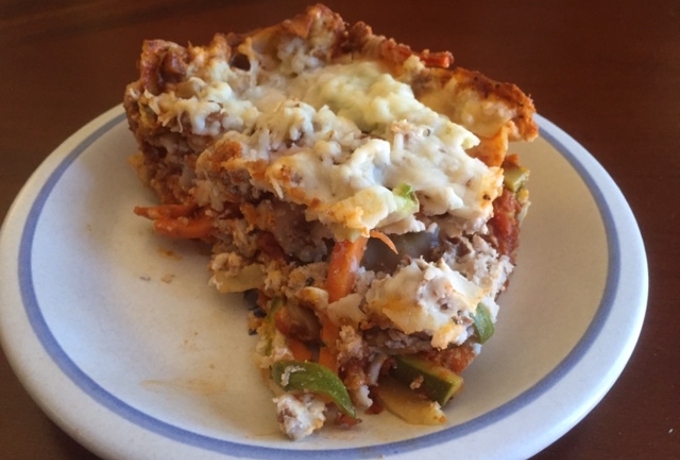
nutty lasagnaNutty Zucchini Lasagna

3 medium zucchini, thinly sliced

1 large carrot, thinly sliced or grated

3½ C marinara sauce

1/8 tsp pepper

1½ C shredded mozzarella

1 C Parmesan cheese, grated and halved

Small container ricotta cheese

1 egg

No boil lasagna noodles

1 C walnuts or pecans

Slice zucchini thin and cross ways.

Mix ricotta, mozzarella and ½ cup Parmesan, pepper, nuts and egg. Set aside.

In 9 x 13 pan cover bottom of thin layer of sauce. Cover with noodles, but don’t overlap.

Spread ¼ of the sauce, then 1/3 of cheese, then ½ carrots, top with ½ zucchini.

Repeat layers ending with cheese and remaining sauce.

Bake covered in 375-degree oven for 40 to 50 minutes. It should be bubbly in the center. Uncover and sprinkle on remaining cheese. Bake uncovered for about 20 minutes, until heated through. Let stand for 15 minutes before serving.


Calif. going after sugary drinks — again

By Lydia O’Connor, Huffington Post

If the soft drink industry thought its fight with health reformers ended in the San Francisco Bay Area last election season, a new bill in the California legislature may be a rude awakening, reviving the movement to cut the state’s sugary beverage consumption.

“I don’t think this issue is going to go away — not given the increasing concern with obesity, especially childhood obesity,” Larry Gerston, a political analyst and San Jose State University professor, told The Huffington Post.

Last fall’s soda battles focused on taxing the sweet drinks. The new challenge is warning labels. California Senate Majority Leader Bill Monning, D-Carmel, introduced a proposal Wednesday to put warnings on beverages containing added sweeteners with at least 75 calories per 12 ounces. The labels would read: “STATE OF CALIFORNIA SAFETY WARNING: Drinking beverages with added sugar(s) contributes to obesity, diabetes, and tooth decay.”

“Given the rock solid scientific evidence showing the dangers of sugary beverages, the State of California has a responsibility to inform consumers about products proven to be harmful to the public’s health,” Monning said in a press release. “This bill will give Californians the at-a-glance information they need to make more healthful choices every day.”

Read the whole story


Northstar redefines ski lodge dining

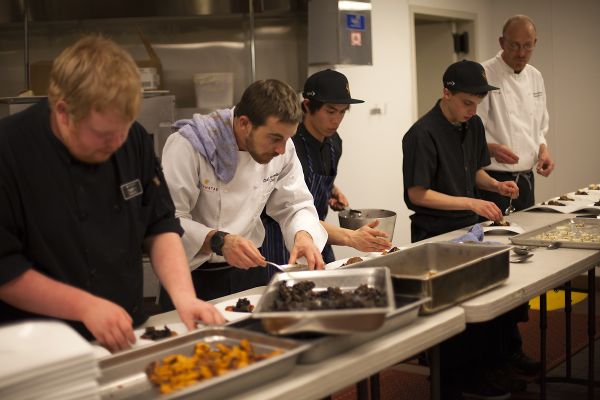
It takes a culinary team to serve up to 80 people at once at the Mountain Table Dinners. Photo/Carolyn E. Wright/Copyright

It takes a culinary team to serve up to 80 people at once at the Mountain Table Dinners at the top of Northstar. Photo Copyright 2015 Carolyn E. Wright

By Kathryn Reed

TRUCKEE – Long wooden tables elegantly adorned with place settings, each with four wine glasses, three forks and three knives. This was no ordinary dinner at a ski lodge.

Foie gras is coming out of the kitchen, bubbly is being poured. Helena Kletch and JT Chevalier are providing background music. There is no fried food, no hot cocoa, no loud screaming children. Nor are there ski boots or ski attire of any kind.

Zephyr Lodge at the top of Northstar turns into a fine-dining restaurant twice a month in what is being billed as Mountain Table Dinners. The five-course meals are created to complement that evening’s winemaker. On this particular night Frank Family Vineyards of Calistoga is featured.
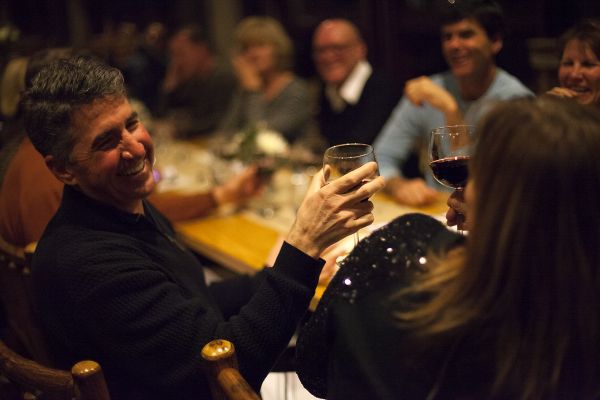
Plenty of reasons to toast -- to good food, good wine, good friends. Photo/Carolyn E. Wright/Copyright

Plenty of reasons to toast — to good food, good wine, good friends. Photo Copyright 2015 Carolyn E. Wright

Groups of friends fill up the two long tables. Some are from Tahoe, others from Sacramento, the Bay Area and farther away. It’s a festive atmosphere, especially as more wine is consumed. As the musicians played John Denver’s “Country Roads” nearly everyone started to sing the words, though not necessarily in perfect harmony.

Executive Chef Steve Anderson is a proponent of using locally sourced food as much as possible. For the pluot demi that went with the bison tenderloin he thawed a stone fruit puree that he had frozen in the summer.

Tahoe Food Hub, the nonprofit beneficiary of the night, is a main source for his fresh vegetables.
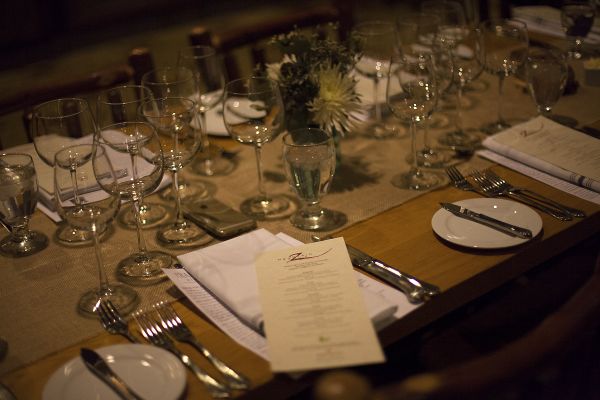
The Zephyr Lodge becomes a fine dining restaurant.

The Zephyr Lodge becomes a fine dining restaurant. Photo Copyright 2015 Carolyn E. Wright

Anderson and Chef Chad Shrewsbury are discussing how best to plate one of the dishes as servers are at the ready.

“We have completely different styles, but the same palates,” Anderson tells Lake Tahoe News of the three chefs responsible for the meal. Dan Carter is the third. “We argue back and forth.”

It’s hard to know who won, but every dish coming out of the kitchen is exquisite.

But the meal was a bit of a dichotomy by wanting to use locally sourced products while serving controversial items like foie gras – duck liver was just allowed to return to California menus; Chilean sea bass – which has environmental concerns; veal cheek – an unusual cut of an animal more people are eating less of; and bison – which is more common in the Midwest, than California.
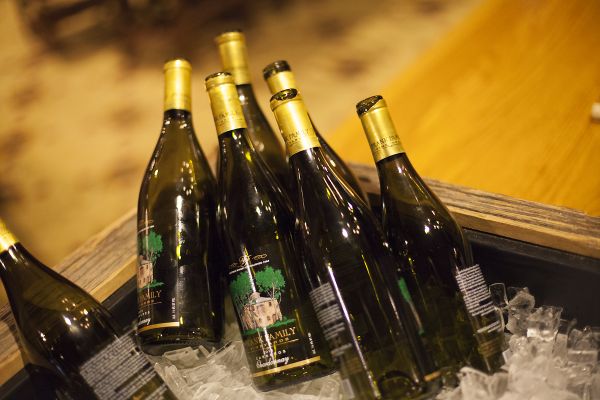
The winery says the Chardonnay has a creme brulee finish. Photo/Carolyn E. Wright/Copyright

The winery says the Chardonnay has a creme brulee finish. Photo Copyright 2015 Carolyn E. Wright

Despite what seemed to be a conflict between philosophy and what was practiced last month, dinner guests (80 is the maximum) left little if anything on their plates. And the portions were more than ample.

The sea bass was Ann Kramer’s favorite morsel of the night, but the Sacramento woman was also pleasantly surprised by the veal cheek – something she had not had before.

Bob Keller of Zephyr Cove was also impressed with the sea bass and veal. “It’s fabulous. It’s hard to cook fish. This is cooked perfectly,” Keller said.

And the veal – “It’s the best I’ve ever had,” Keller said. “It’s a fabulous dish with a lot of different flavors.”

The veal cheek was served with sweet potato gnocchi, Humboldt Fog brulee and a bing cherry glace. It was paired with a 2013 Pinot Noir, which was one of the favorite wines of the evening. It’s one of those wines that can stand on its own without food, but when paired with food has a more complex flavor and enhances the dish.

Carolyn Wright had the highest praise for the bison.

“I love game of any type. It was tough to cut, but not tough to chew. The flavors are great,” the Zephyr Cove woman said.

The 2012 Cabernet Sauvignon was paired with the bison, which Wright thought was very good, and someone else found to be young.

Everyone was complimentary of the food arriving at the tables at the same time, all hot and all plated as though it came out of a high-end kitchen. But there were no refills on any of the wines.

It takes two gondola rides to get to the restaurant. Photo/Carolyn E. Wright/Copyright

It takes two gondola rides to get to the restaurant. Photo Copyright 2015 Carolyn E. Wright

The most disconcerting part of the evening was getting to and from the venue. It required taking the gondola from the village to mid-mountain, then walking to the Zephyr lift. That lift has a few gondola cars interspersed with the regular chairs. This meant waiting in the cold for enclosed seating – which people were warned might happen. And while skiing from the top of the lift to Zephyr Lodge is no big deal, that distance suddenly seems like a ways when walking on slick, icy snow, with the wind blowing and the temperature at or below freezing. The snowmaking gun blowing on us on the way back was not pleasant.

It would seem like Northstar being a Vail Resorts property could look east for better ways to transport dining guests. At Vail, to get to Game Creek for dinner one takes the gondola out of Lionshead and from there a tricked out snowcat takes people on a 6-minute ride to the restaurant. And at Beaver Creek’s Beano’s Cabin, diners are hauled up at dusk in a sleigh pulled by a snowcat. But this is Northstar’s inaugural season to have these dinners and the other locales are seasoned venues.

—–

Notes:

• The remaining dinners are Feb. 27 featuring Ferrari-Carano Vineyards & Winery ($120), March 13 is 50/50 Brewing Co. ($85) and March 27 is with Frog’s Leap Winery ($120).

• Must be 21 to attend.

• Vegetarian options available.

• For more info, go online.

ngg_shortcode_0_placeholder (Click on photos to enlarge.)


Bill would label genetically modified food

By Sharokina Shams, KCRA-TV

A group of U.S. senators, including Sen. Barbara Boxer, D-Calif., are pushing for a law that would require labels for genetically engineered foods, but efforts to make similar laws in California have failed.

Some lawmakers want all foods that are genetically engineered to be labeled in order to alert consumers.

“Consumers have a right to know what is in the foods they eat, and parents have a right to know what they are feeding their families,” Boxer said in a news release. “This legislation will direct the Food and Drug Administration to require clear information for food that has been genetically engineered.”

Still, some scientists say genetically engineered, or genetically modified foods, are not harmful.

Read the whole story


Kids don’t have to be picky eaters

By Natalie Parletta, Washington Post

Hippocrates said, circa 400 B.C., that “food should be our medicine and medicine should be our food.” He would probably turn in his grave if he saw the amount of highly processed, sugary food and drinks marketed to children today. This food can be as addictive as cocaine or heroin. And it’s difficult for parents to counteract its appeal.

One in three children and 66 percent of adults in the U.S. are overweight or obese. This is contributing to unprecedented levels of preventable obesity-related disease such as diabetes, heart disease, and liver and kidney failure. Unhealthy diets also contribute to poor mental health and lower IQ in children.

Parents have a very important influence on their child’s health and eating choices. For starters, breastfeeding for 12 months can impact their taste preferences by exposing them to multidimensional flavors – and they can develop taste preferences for foods that mom eats too (healthy or otherwise).

Children will learn to like healthy foods, such as vegetables, if they are regularly exposed to them from a young age. When you can, cook baby foods yourself from fresh ingredients, and avoid adding sugars and salt. Children’s taste preferences are established in early life. It is best to keep it simple – introduce new vegetables and fruit one at a time so they can learn to appreciate the individual flavors.

Read the whole story


Bill would allow winemaking throughout Nev.

By Ashley Cullins, KRNV-TV

It’s currently illegal for commercial wineries to run in Washoe and Clark counties, but an Assembly bill could change that this session.

“There’s already a small wine industry with Churchill Vineyards and Tahoe Ridge in the North and then there’s some wineries in Pahrump,” said Dennis Eckmeyer, president of the Nevada Wine Coalition. “You can not have a commercial winery in counties that have more than 100,000 residents.”

Eckmeyer said it’s time for the state to let all Nevada counties get in the game. He said the coalition is using eastern Washington as a model. There wine is an $8-billion-dollar industry.

Keri Hellige of Whispering Vine Wine Co. said Nevada should give it a shot.

Read the whole story


Grocery stores running out of organic milk

By Lydia Mulvany, Bloomberg

About once a week the phone rings at the Dill Pickle Food Co-op in Chicago’s artsy Logan Square neighborhood with the same question: Got milk? Organic, to be exact.

“I’ll have people call up and say, hey, I know the truck’s coming on Tuesday, can you put aside three half-gallons?” said Dana Bates-Norden, 33, who works as the buyer of perishable goods for the store, which in 2014 started selling out of the glass-bottled milk it gets from Midwest organic dairies within two days. “When I first started two years ago, I felt like I ended up having to write off a lot of organic milk, and now, I really can’t keep it in stock.”

Americans spent an estimated $35 billion on organic groceries in 2014. About $5.1 billion of that went to dairy, more than doubling from a decade earlier, data from the Nutrition Business Journal published on the U.S. Department of Agriculture website show. With retailers like Wal-Mart Stores Inc. trying to attract more organic-food shoppers while McDonald’s Corp. uses the milk — which can cost almost twice as much as regular — in some McCafe coffees, producers are struggling to keep up with demand.

Even in Wisconsin, the state with the most organic dairies, stores are posting signs warning of shortages, the USDA has said. At Fresh Madison Market in the state’s capital city of Madison, sales of the milk have doubled over the past year and rising demand spurred a 10-day shortage in early January, owner Jeff Maurer said by telephone Feb. 9.

Read the whole story


K’s Kitchen: Spinach becomes star of dish

By Kathryn Reed

Lately I’ve been having a hankering for fresh spinach. Anyone who grew up watching “Popeye” knows it will make you stronger.

While I haven’t noticed any bulging biceps, I do know this green leaf is good for me. It is full of iron, which in turn gives me energy. It has a number of other health benefits too because it is full of vitamins.

But like any food, its nutritional value also has a lot to do with how it is cooked or what is added to it. Spinach salads are great for you depending on the dressing. Cooked spinach goes in the bad category with too much butter or cream.

I like buying a large quantity and doing a variety of things with it.

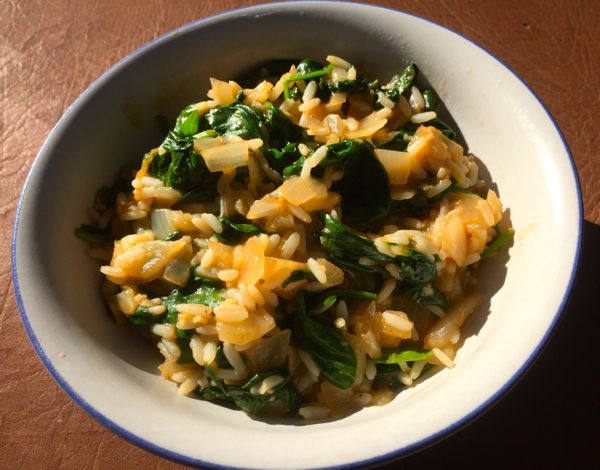
The recipe below would probably be a side dish for most people, but as a vegetarian it was my entrée. If using brown rice, it will take longer to cook. I’ve also messed up following the directions, so it’s OK if the rice is cooked in the broth. The amount of spinach will depend on your preference or how much you have.

rice and spinachSpanakoriso (spinach and rice)

1 pound, or less fresh spinach

1 C uncooked rice

2 medium onions, minced

8 garlic cloves, minced

2 bay leaves

2 C vegetable broth

2 T tomato sauce

½ C olive oil, or less

Salt and pepper

Sauté onions, garlic and rice in olive oil until the onions are soft and golden.

Add tomato sauce and stir.

Add bay leaves, salt and pepper. Mix well and then add broth. Cover and simmer for about 20 minutes.

Add spinach and cook another 25 minutes.