Prediction: Food prices to be stable through 2015

By Russ Parsons, Los Angeles Times

There’s good news for shoppers in the latest Consumer Price Index update from the Department of Agriculture, released last week. Food prices in general should show little to no increase over last year. But there are a couple of exceptions and a couple more troubling caveats.

First the good news: The latest report by the USDA’s Economic Research Service predicts that supermarket food prices will increase only 2 percent to 3 percent in 2015. Fresh fruits and vegetables are predicted to increase less than 1 percent.

What will probably be more expensive is beef. Prices are predicted to increase by 5 percent to 6 percent as the effects of the Midwestern drought linger. Though the weather improved some there this summer, it takes cattle 16 to 18 months to reach maturity, so the effects remain.

Read the whole story


The red-wine blend trend

By Lettie Teague, Wall Street Journal

They’re friendly, they’re cheap and they’re easy to drink — three very good reasons domestic red blends are some of the most sought-after wines in the market today. Although blended reds aren’t new (they’ve been produced for centuries all over the world) thanks to a number of talented winemakers and even more-clever wine marketers, these wines — particularly those made in California and Washington state — are a seemingly unstoppable trend.

Nielsen’s January 2015 report says the domestic red-blend category accounts for $900 million in retail sales annually and is one of the fastest-growing wine sales categories in the country. Much growth is fueled by drinkers “who are switching to red blends from other types of wines,” said Brian Lechner, Nielsen vice president, group client director for alcoholic beverages.

Retailers are ready to assist with the transition. I’ve found red-blend aisles in just about every wine shop and grocery store I’ve visited in the past several months, including Gary’s Wine & Marketplace in Wayne, N.J., where sales associate Jeffrey Davis said, “The public is clamoring for red blends.” With a sweep of his arm Davis took in some 75 bottles of wine.

Read the whole story


Multiple ways to enjoy asparagus

By Russ Parsons, Los Angeles Times

Can it be mere coincidence that March heralds the arrival of both my birthday and the first California asparagus? I think not. As Einstein said, God doesn’t play dice with the universe.

And while I no longer am filled with the same childlike excitement about each approaching birthday, I do feel that way — or maybe stronger — about the start of asparagus season.

For the last couple weeks, I’ve been stopping by the Zuckerman’s Farm stand at my Long Beach farmers market asking when the jumbos will be arriving. Maybe this weekend? Certainly next.

With great asparagus like this – big around as your thumb, available only for about a month ever year – the simplest cooking is best. I buy a pound a person, steam them just until they sag when lifted – they’ll be on the edge of mousse-y with almost no crispness left, and with a profound clean fresh asparagus flavor – and then dress them with good olive oil, lemon juice and coarse salt. Toss in a loaf of good bread and a bottle of Navarro Gewurztraminer and you’ve got a feast to remember.

Read the whole story


Healthy food doesn’t have to be expensive

By Marsha Maxwell, Deseret News 

One dollar and fifty cents per day could make a difference for your health. That’s the difference in cost between a healthy diet of whole foods and an unhealthy diet of processed foods, according to a meta-study by Harvard University.

“For 60 percent to 70 percent of Americans, $1.50 a day is not a big deal,” the study’s author, Dariush Mozaffarian, told Harvard magazine. However, the figure adds up to $2,200 per year for a family of four, which could be out of reach for low-income families.

Meal planning and grocery-shopping strategies can shrink a family’s overall grocery bill regardless of income, according to money-saving experts. And putting together inexpensive meals with healthy ingredients might be easier than consumers think. Three important steps to cutting a family’s grocery bill are paying attention to sale prices, planning menus in advance and buying whole rather than processed foods.

It’s important to define what a healthy diet means, if a family is trying to keep down costs. It doesn’t necessarily mean buying specialty foods, like organic grass-fed beef for $10-$20 a pound or organic quinoa for $5-$8 per pound.

Mozaffarian defines a healthy diet as one that reduces “things we know are unhealthy like processed meats, highly refined starches, sugars … trans fat, and sodium,” and that emphasizes “things we know are good like fruits, vegetables, nuts, vegetable oils, and fish.” Other foods, like chicken, eggs, whole grains and legumes are also part of a healthy diet.

Read the whole story


Grocery store spending on the decline

By Eliza Barclay, NPR

When admiring such enticing items at the grocery store as an avocado for $1.50, an $8 chocolate bar or fresh wild Alaskan salmon for $20 a pound, you’ve probably experienced sticker shock.

Indeed, retailers and restaurants offer myriad opportunities to blow your food budget in one fell swoop.

But our spending on food — proportional to our income — has actually declined dramatically since 1960, according to the U.S. Department of Agriculture. The average share of per capita income spent on food declined from 17.5 percent in 1960 to 9.6 percent in 2007. (It has since risen slightly, reaching 9.9 percent in 2013.)

Because of the overall rise in income, and the consistent shrinking of food prices adjusted for inflation, we actually have more disposable income than our grandparents did, according to Annette Clauson, an agricultural economist with USDA’s Economic Research Service who helped calculate the data in the chart.

Read the whole story


K’s Kitchen: Restaurant quality mushroom polenta

By Kathryn Reed

Sometimes it amazes me the things I’ve never made. I checked off another one last weekend. Polenta.

Considering it’s just cornmeal, it is pretty amazing restaurants can charge high prices for it. I realize it depends what is on top of it, but still.

And anytime wild mushrooms are part of any dish, the cost of the meal just went up. But the earthiness of these morsels cannot be compared to ordinary button mushrooms that are so bland.

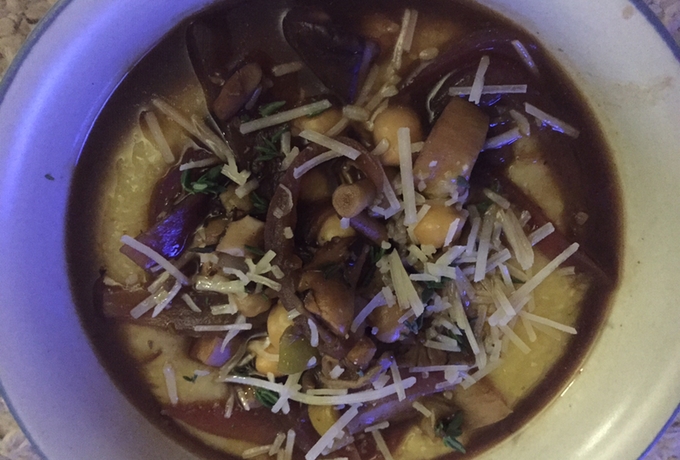
What makes this recipe so outstanding is the complexity of the flavors and the variety of textures. And it looks pretty – so guests may be impressed.

It’s not difficult to make, but there are moving parts. Keep an eye on the polenta as you focus on the mushrooms.

The only drawback is that I can see why people might be averse to eating polenta as a leftover. The consistency is nothing like it is on night No. 1. But I wasn’t going to let any of it go to waste.

Adding more cheese to the polenta will make it creamer – and then less healthy.
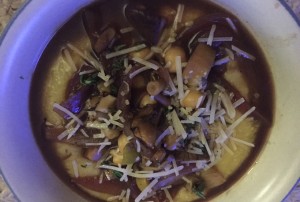
mushroom polentaWild Mushroom Polenta (serves 6)

Polenta:

3 C water

1 C stone-ground polenta

2 ounces Parmesan cheese, divided

Bring water to boil. Reduce heat to medium-high. Gradually add polenta, stirring with whisk.

Reduce heat to low and cook for 30 minutes or until thick and creamy. Keep stirring.

Stir in 1 ounce of cheese.

Mushroom concoction:

1 T olive oil

12 ounces wild mushrooms, chopped

6 garlic cloves, minced

1 large red onion, sliced vertically

2 T thyme, chopped and divided

½ C dry white wine

3 T balsamic vinegar

1 C vegetable broth

½ tsp pepper

12 mixed olives, coarsely chopped

1 14.5 ounce can unsalted chickpeas, drained

Heat oil in large skillet. Add mushrooms, garlic, onion and 1 T thyme. Cook for about 8 minute or until lightly browned.

Add wine and vinegar; cook until liquid is reduced by half.

Add broth, pepper, olives and chickpeas. Bring to boil.

Reduce heat to medium and simmer for about 6 minute or until slightly thickened.

Divide polenta evenly into 6 shallow bowls. Top evenly with mushroom mixture. Sprinkle cheese and remaining thyme on top.


New science behind low-carb training

By David Despain, Outdoors

University of Copenhagen sports physiologists first developed the “train low, compete high” protocol in 2005 for athletes looking for a performance edge. It encouraged the idea of double workouts every second day. In practice, athletes would eat breakfast to fuel their morning session, then skip lunch prior to their evening session, leaving muscles depleted of their glycogen stores.

The benefits were thought to be pretty straightforward: you force muscles into using glycogen stores more resourcefully by tricking them into becoming fat-burning machines. Dipping into fat reserves would prevent glycogen stores from depleting completely, so you’d lower your chance of “bonking,” or running out of fuel, during a long endurance race.

But the dietary protocol hasn’t stood up to the hype. “After over a decade of scientific research on ‘train low’ protocols, there have been no clear demonstrations of improved performance with competitive athletes at an elite level,” says Louise Burke, a professor of sports nutrition at the Australian Institute of Sport.

Read the whole story


Is junk-food era drawing to a close?

By Tom Philpott, Mother Jones

Not long ago, the great processed-food companies like Kraft and Kellogg’s towered over the US food landscape like the high hat that adorned the head of Chef Boyardee, the iconic canned-spaghetti magnate whose empire is now owned by ConAgra.

But now, Big Food has fallen on hard times. Conagra, which owns Hunts, Reddi Whip, Ro-Tell, Swiss Miss, and Orville Redenbacher, along with Chef Boyardee, recently slashed its 2015 profit projections and sacked its CEO. Kraft — purveyor of Oscar Mayer deli meats, Jell-O, Maxwell House coffee, and Velveeta cheese — also recently shook up top management and reported sluggish sales in 2014. Cereal titan Kellogg’s has seen its sales plunge 5.4 percent over the past year, Advertising Age reports.

There’s a “mounting distrust of so-called Big Food, the large food companies and legacy brands on which millions of consumers have relied on for so long,” said Campbell Soup’s CEO.

What gives? Part of the problem is currency fluctuations. Having conquered the U.S. market, Big Food for years has looked overseas for growth. Recently, a strong U.S. dollar has cut into foreign profits, because a pricier dollar makes overseas sales worth less when they’re converted to the US currency, as the Wall Street Journal recently reported.

Read the whole story


K’s Kitchen: A salad that is good warm or cold

By Kathryn Reed

Shredded Brussels sprouts have gained in popularity so much that it’s now possible to buy the veggie pre-shredded in grocery stores.

And while this would save a time, it seems to me that doing it yourself will mean having a fresher product. I could be wrong. Or maybe it was just that the bags I saw seemed a little brown. Plus, it really doesn’t take that long to shred them.

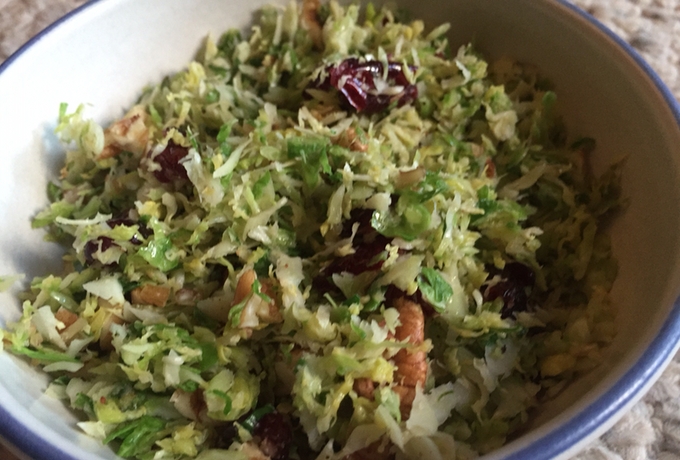
What is nice about this recipe is that is quick, easy, tastes good and is healthy. The crunchy-sweet combo of the nuts and cranberries adds great flavor and texture to the salad.

This is one of those salads that would be good year-round. It tastes great warm or cold.

With a freezer full of pecans, that is the nut I chose to use.

brussels sprout saladBrussels Sprout Salad

1 lb Brussels sprouts, shredded

2 T olive oil

½ tsp nutmeg

Kosher salt and freshly ground pepper

½ C walnuts or pecans, chopped

½ C dried cranberries

Shred the Brussels sprouts. Cook them in olive oil over medium heat until bright and slightly wilted; add nutmeg, salt and pepper. Then add nuts and cranberries.

Serve warm.


It’s official: Americans should drink more coffee

By Roberto A. Ferdman, Washington Post

When the nation’s top nutrition panel released its latest dietary recommendations on Thursday, the group did something it had never done before: weigh in on whether people should be drinking coffee. What it had to say is pretty surprising.

Not only can people stop worrying about whether drinking coffee is bad for them, according to the panel, they might even want to consider drinking a bit more.

The panel cited minimal health risks associated with drinking between three and five cups per day. It also said that consuming as many as five cups of coffee each day (400 mg) is tied to several health benefits, including a reduced risk of cardiovascular disease and type 2 diabetes.

Read the whole story