USDA nutrition labels not working

By Adam Roy, Outside

Kind’s fruit-and-nut bars have won loyal fans among hikers, bikers, and climbers for their taste, simple ingredient list, and ability to banish hunger for hours. But now, the very thing that leaves athletes satiated — their fat — has landed them in the Food and Drug Administration’s doghouse.

The FDA recently warned Kind that four of its products, including its Kind Fruit & Nut Almond & Apricot, and Kind Plus Dark Chocolate Cherry Cashew + Antioxidants bars, were in violation of federal labeling regulations. Among a laundry list of mostly minor complaints: Kind had improperly labeled all of them as “healthy,” and used the word “plus” in the name of two. But instead of punishing Kind for its word choice, the FDA should be looking inward at the heart of the issue: labeling that confuses rather than informs consumers.

When it comes to food packaging, “healthy” is one of a handful of terms that the FDA keeps on a tight leash. For an energy bar or other snack to legally include the word on its label, it must have less than 1 gram of saturated fat and 3 grams of total fat per serving.

Read the whole story


Gluten changing people’s relationship with food

By Roberto A. Ferdman, Washington Post

Gluten, which gives bread, pizza dough and other starchy foods their chewiness, is one of the most beloved proteins in the world. But it’s also quickly becoming one of the most feared — at least here in the United States. An estimated 20 million Americans believe that eating it causes them distress. And 100 million people, meanwhile, say that they are actively working to eliminate gluten from their diet.

Roughly 1 percent of humans suffer from celiac disease, an autoimmune disease that damages the body’s small intestine when gluten is digested. But the gluten-free movement has gone far beyond those who suffer from celiac, becoming a pervasive part of how Americans eat.

And yet there is a growing sense that people — in particular those who don’t suffer from celiac disease — are being a bit ridiculous about avoiding the protein.

Is there a scientific basis for all the gluten fear-mongering? Is it wrong to avoid gluten if avoiding it makes you feel better? And are people actually feeling better, or is it all just in their heads?

Read the whole story


Drought could change fish on Calif. dinner plates

By Edward Ortiz, Sacramento Bee

At Ken Beer’s fish ranch, thousands of white sturgeon and catfish thrash in round tanks or in long concrete raceways.

Beer’s 320-acre operation, called The Fishery, supplies live fish to markets and restaurants in the Sacramento region. It depends on a supply of cool water. If water temperatures are too warm, cool-water fish such as sturgeon can’t survive.

Luckily for Beer, he can tap groundwater from wells on his property to keep his business going. But some other fish farms can’t. California’s multiyear drought is changing the state’s aquaculture industry. Experts say it eventually could alter the species that wind up being sold in the state’s fish markets, farmers markets and in restaurants that buy fish directly from growers.

Read the whole story


Time alcohol consumption to not impact workouts

By Amanda MacMillan, Outside

You don’t have to give up drinking in moderation before a big race. That said, if you choose to drink, do so in amounts and at times that least impact your performance.

For athletes who enjoy alcohol in moderation, it’s hard to say how much of a difference, if any, they’ll notice by giving it up entirely.

That’s because not much has been studied on the long-term effects of moderate drinking versus teetotaling on performance.

“This is a very difficult and specific question,” says Matthew Barnes, a professor of sport and medicine, and a prominent researcher on alcohol and exercise at New Zealand’s Massey University. “Most alcohol research, including my own, has looked at acute responses to alcohol, either before or after exercise.”

In other words, we know that drinking in the hours prior to a workout is a bad idea—reduced coordination, for instance, can increase your injury risk. And we know that drinking immediately following a workout impairs recovery by interfering with muscles’ repair process. But in general, says Barnes, the effects of alcohol in moderation — defined as one drink a day for women and two drinks a day for men — are less clear.

Read the whole story


Mixed bag on benefit-harm of microwave cooking

By Karen Weintraub, New York Times

The microwave has gotten a bit of a bad rap about its effects on nutrients. Cooking and heating food by any method can result in some degradation of nutrients.

Vitamins C and B12, for instance, degrade quickly when a food is heated. But other nutrients may actually benefit from the rise in temperature. For example, carotenoids, the antioxidants found in colorful vegetables like carrots and tomatoes, increase when the proteins that bind them break down during heating, said Guy Crosby, the science editor for America’s Test Kitchen and an adjunct associate professor at the Harvard T.H. Chan School of Public Health.

The Harvard Health Letter recently concluded that microwaving may be preferable to other methods for heating food.

“Because microwave cooking times are shorter, cooking with a microwave does a better job of preserving vitamin C and other nutrients that break down when heated,” it reported. “The cooking method that best retains nutrients is one that cooks quickly, heats food for the shortest amount of time, and uses as little liquid as possible. Microwaving meets those criteria. Using the microwave with a small amount of water essentially steams food from the inside out. That keeps more vitamins and minerals than almost any other cooking method.”

Read the whole story


USDA vague on benefits of organic produce

By Peter Whoriskey, Washington Post

Are consumers right to think that organic food is safer and healthier?

It seems like a straightforward question, especially for Miles McEvoy, the chief of the National Organic Program at USDA. That’s the section of the federal government that champions organic farming practices and defines what food deserves the coveted organic label.

But in an interview Wednesday, McEvoy wouldn’t speculate about any  health benefits of organic food, saying the question wasn’t “relevant” to the role of the National Organic Program. Nor would he say whether growing consumer demand for organics reflects widening public skepticism of conventional U.S. agriculture.

Maybe McEvoy is unwilling to tout organics over conventional agriculture because, after all, conventional agriculture is the larger part of the USDA’s realm. Or maybe he thinks, as some others do, that the science on organics is too tentative.

Read the whole story


China overtakes France in wine grapes

By Rudy Ruitenberg, BloombergBusiness

China now uses more land for growing grapes than France, the world’s largest wine exporter and home of the most expensive bottles from the Burgundy region.

Chinese vine planting increased by about 5 percent last year to an estimated 799,000 hectares (1.97 million acres), according to the International Organization of Vine and Wine, known by its French acronym OIV. France’s grape area slipped about 0.1 percent to 792,000 hectares.

China more than doubled its vineyard since 2000 as domestic wine consumption increased about 45 percent, with the Asian nation last year boasting close to 11 percent of the global grape area from 3.9 percent at the start of the last decade, according to the OIV. The numbers include table grapes as well as those for wine and raisins.

Read the whole story


K’s Kitchen: Super moist carrot cake

By Kathryn Reed

Anything with the word carrot in it must be healthy, right? Not exactly.

Even withholding the frosting from carrot cake is not going to make it a health food. But it’s cake, so go for it. Cake was never meant to be healthy.

I’m often one who says hold the cake, just give me the frosting. With this recipe, I want both. The cake is so incredibly moist. It was still tasty after spending a week in the refrigerator.

This is a recipe I have been making for years after my sister, Pam, shared it with me. For those who think cakes only come out of boxes, this will have you rethinking that philosophy.

In the past I had left the pecans out because I’m not a big fan of nuts in desserts. But I happen to have pecans on hand so I used them. And they were a nice addition.

IMG_2385Pamala’s Carrot Cake

Cake

2 C sugar

4 eggs

1½ C canola oil

2 C flour

2 tsp soda

1 tsp salt

2 tsp cinnamon

3 C carrots, finely grated

¾ C pecans, chopped (optional)

Preheat oven to 350 degrees.

Beat the sugar and eggs until blended. Add oil, beat some more. Add dry ingredients. Beat until mixed. Add carrots and then nuts.

Pour mixture into greased and floured 9 x 13 pan. Bake for 55 minutes.

Frosting

4 oz. cream cheese

½ stick soft butter

½ box powder sugar

½ tsp vanilla (or more) B

lend all of the ingredients together. Frost cake when it is cool.


Farmers’ markets about to open in Tahoe

By Kathryn Reed

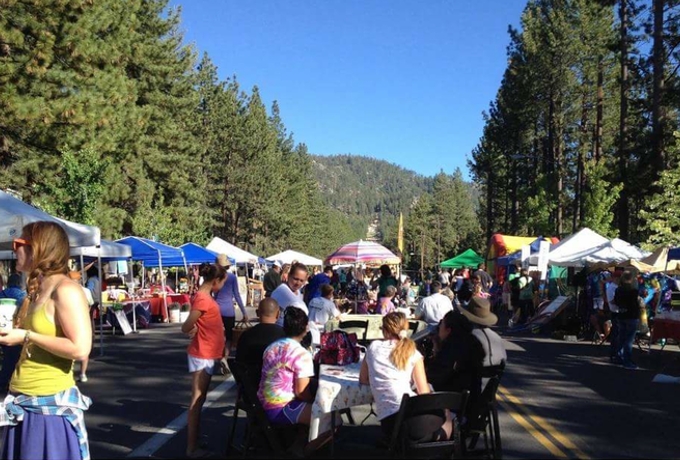
It’s time to abandon the produce section of the grocery store. Farmers’ market season in Lake Tahoe starts a week from today.

Lake Tahoe Markets, which runs three markets in the basin, is returning to Kahle Community Park on Wednesdays from 4-7pm. Last year this market moved across the highway to accommodate construction on Kingsbury Grade. Incline Village’s market at Tunnel Creek continues on Thursdays from 4-7pm and in Crystal Bay at the Tahoe Biltmore the market is Fridays from 10am-2pm. All open next week.

Produce from Steve Rozier's farm will be featured at his Tahoe markets. Photo/Provided

Produce from Steve Rozier’s farm will be featured at his Tahoe markets. Photo/Provided

Steve Rozier, who runs Lake Tahoe Markets, expects a ton of strawberries, some stone fruit and residual winter citrus to dominate the early markets.

“I believe consumers like to come out and touch the produce,” Rozier said.

Each of his markets is a little different. There is some overlap in vendors as well as site-specific purveyors of produce and other goods. Most of the farmers are from Nevada.

“All of the markets have their own personalities,” Rozier told Lake Tahoe News.

Rozier, for the first time, will also be bringing his own produce from the Carson Valley. Dani Bug Organics, at 2½ acres, is considered boutique farm.

Through the winter he has been delivering produce boxes to consumers. That ends when the markets open.
The Ski Run market has produce and entertainment. Photo/Provided

The Ski Run market has produce and entertainment. Photo/Provided

The two South Lake Tahoe markets kick off their seasons the first week of June. The El Dorado County Certified Farmers Market begins June 2 and will go through mid-October. It returns to the American Legion parking lot from 8am-1pm on Tuesdays. The Ski Run market in front of Blue Angel Café begins June 5. It is Fridays from 3-8pm.

“Some of the vegetables will be quite a bit earlier,” Jim Coalwell, who runs the Tuesday market, told Lake Tahoe News. This is because of the drought.

The pear crop in El Dorado County has been hit hard by fire blight.

“There’s been quite a bit of damage to pears and apples. Fire blight attacks and kills the blossoms,” Coalwell said.

He also runs the Placerville market, which starts this weekend.

Coalwell said the local farmers are doing OK with their water supply, and therefore what they can grow. The same is not true for the Fresno and Watsonville farmers who attend the South Tahoe market. For some of those farmers their water supply has been drastically reduced. Like last year, some fields will be fallow.

With most of the goods coming from small markets, Coalwell does not anticipate the supply of produce to be less than years past.

Some of the bigger changes Coalwell is contending with are rules coming out of Sacramento.

“The state used to take a 60-cent assessment per stall, now they want $2,” Coalwell said. “Theoretically it is used for inspectors to keep the markets honest.”

Processed food is being more tightly regulated by the state, as are some of the rules for farmers. These are all things Coalwell is still getting a handle on.

This marks the fifth year of the Friends of Ski Run market, which is run by a nonprofit. More than 20 vendors will be offering organic farm fresh produce, honey, locally raised meats, hot food for dinner, handmade ice cream, handmade chocolates and other treats.

There is also a bounce house and face painting for kids, live art performances-demos and local live music.

“We strive to support local entrepreneurs with more then 85 percent of our vendors being South Lake locals. With drought conditions and new regulations for farms, it is a crucial time to help support our local farmers and food supply,” Michaela Dickson, one of the organizers, told Lake Tahoe News.




Linking ag-food-nutrition on global-local levels

By Kathryn Reed

INCLINE VILLAGE – The average person now lives farther from where her food is produced than at any other time in history. And, yet, without food, people won’t survive.

Feeding a world of nearly 9 billion people is not easy. And while there are 100 million fewer people classified as hungry today compared to 10 years ago, there are still approximately 800 million hungry people in the world. In California, 16 percent of the households suffer from hunger. One percent of youth in the United State have chronic nutrient deficiencies.

Josette Lewis

Josette Lewis

Hunger, malnutrition, poor diets and associated diseases were the topic of a lecture at Sierra Nevada College last week. Josette Lewis, associate director of the World Food Center at UC Davis, talked about the link between agriculture, food and health.

She said if diet is not addressed on a global scale, then the next burden would be chronic disease. It’s already evident. South Asia, Lewis said, is the No. 2 area in the world for the highest number of people with diabetes and it has some of the highest areas of malnourishment.

Worldwide women and children are more likely to be undernourished.

Lewis pointed out how obesity and malnourishment go hand-in-hand. Many high caloric, high fat foods are cheap.

Next month the World Food Center and Brookings Institution are having a conference to look at the cost of obesity on low-income families in the United States.

“If we want a healthy diet, it needs to be available,” Lewis said.

That is one of the problems – especially in Third World countries – the access to a well-balanced, nutrient rich diet is not available.

Water will increasingly be part of the discussion with food production, especially with California in its fourth year of drought. Lewis said 70 percent of the fresh water in the world is applied to agriculture.

“The majority goes off into the environment; into the soil or into surface water,” Lewis said.

With drip irrigation and other applications, the water is going where it’s intended to go instead of carrying soil nutrients and chemicals into other locations.

Lewis said the ag industry has made great strides in reducing water consumption. From the 1960s to the early 2000s there has been a decrease of 14 percent of applied water in California, while at the same time crops per acre have increased 85 percent.

“We need to be more efficient with the use of water. We are working on technology for irrigation and food processing technology,” Lewis said. “We are working to help faculty develop larger scale research programs.”

Climate change is also being incorporated into the equation because it is affecting what can be grown where.

“Nut crops are particularly sensitive to temperatures. They need a certain number of near freezing temperatures at night to hibernate so they produce in the spring,” Lewis said.

Nighttime temps are increasing, which is worrisome for those growing nuts.

There may be a geographic shift, Lewis said, in where things are grown. There has already been a shift north when it comes to growing wine grapes.

However, moving an entire industry is expensive and may not even be physically possible.

Lewis said the goal of the World Food Center is to “create transformational solutions to feed and nourish the world for decades to come.”