The future of craft beer in Northern Nevada

By Mike Higdon, Reno Gazette-Journal

For almost a decade, beer geeks have asked, “Is Reno oversaturated with beer, yet?” and the answer has been a resounding “Maybe? Surely some breweries will close as the competition stiffens.” 

Yet, no brewery has closed due to lack of business. More continue to open, expand their offerings and distribute out of state. 

But while more than 28 local beer brands persist in the greater Reno-Tahoe area, they have not necessarily grown the craft beer-loving audience by a significant margin. Some brewers said they are all sharing the same few hundred or maybe thousand local beer geeks who have become a nomadic band of loyalists visiting their favorite spots.


Read the whole story


Study: 70% of produce in U.S. contain pesticide residue

By Amel Ahmed, KQED-TV

Even after being carefully washed or peeled, nearly 70 percent of fruit and vegetables sold in the U.S. contained pesticide residues, according to a review of recent tests conducted by the Department of Agriculture.

“It is vitally important that everyone eats plenty of produce, but it is also wise to avoid dietary exposure to toxic pesticides, from conception through childhood,” said Sonya Lunder, senior analyst with nonprofit Environmental Working Group, which conducted the analysis.

The reviewed data revealed a total of 230 pesticides and pesticide breakdown products in thousands of crops that were sampled.

Read the whole story


California winemakers have eye on China’s tariffs

By Julian M. Alston, Daniel Sumner and Olena Sambucci, The Conversation

California’s vintners and grape growers are among the latest potential victims in the escalating trade spat between the U.S. and China.

Responding to U.S. plans to impose import duties on goods from China, the Chinese Ministry of Commerce reciprocated by introducing new tariffs on 128 U.S. products, including an additional 15 percent import tariff on wine.

Wine producers in California are concerned about the immediate and longer-term implications of this new tariff, on top of those already in place. Reports have already begun to circulate about orders being canceled, redirected or renegotiated as a result.

How worried should U.S. winemakers be?

The U.S. wine industry

The U.S. is a major player in the global wine industry both in terms of consumption and production.

Americans consumed 3.59 billion liters of wine in 2016, or about 11.1 liters per person. About a third of that was imported.

In terms of production, the U.S. ranks fourth after Italy, France and Spain – making more than 3 billion liters in 2016. California produced about 85 percent of that.

While the vast majority of U.S. wine is consumed domestically, about 10 percent is shipped overseas. In 2017, the U.S. exported 380 million liters of wine worth $1.46 billion. Canada was the top destination, importing 28 percent of the total, followed by the U.K. with 15 percent, Hong Kong at 8 percent and Japan with 6 percent.

China’s small share

China, for its part, imports quite a bit of wine. Very little, however, comes from the U.S.

China imported about $2.37 billion worth of wine in 2016, most of which came from the European Union. Only $76 million, or 2.2 percent, was American.

That puts China sixth among top destinations for U.S. wine exports, with a share of about 5 percent.

These figures underestimate the true value somewhat because more than half of Hong Kong’s imports are then shipped or smuggled to China. Even allowing for these adjustments, Chinese consumption of U.S. wine makes up less than 1 percent of the total value of American production.

It’s clear that at the moment China is not all that important to most California wine producers. Why then are U.S. wine producers anxious about new tariffs disrupting trade to this relatively minor market?

It’s all about the future. Although per capita consumption of wine in China remains very low, China is the world’s fastest-growing wine market and is expected to soon become the second largest, after the U.S.

From 2000 to 2016, Chinese wine consumption soared from 219 million liters in 2000 to 1.24 billion liters in 2016. Some observers estimate growth was even higher. Much of that consumption was imported – especially in the premium wine segment.

Economists who have studied these markets project further significant growth in China’s demand for wine, including premium wine imports.

This would make getting pushed out of China especially troubling at a time when global per-capita wine consumption has been declining, especially in Europe.

Already at a disadvantage

Even without the new tax, U.S. exporters were facing a tilted playing field that would have constrained the potential for increasing California’s market share.

Without the new tariffs, China already collected a tariff of 14 percent on most U.S. wine – though it can reach as high as 20 percent in some categories. In contrast, wine from some countries, such as Chile, Georgia, New Zealand and, starting next year, Australia, enter China duty-free.

With the new tariff in effect, most American wines will incur duties of 29 percent.

Hong Kong, however, does offer a back door to U.S. wine. The China-governed island phased out its own steep tariffs on wine imports a decade ago. This has created an incentive for smuggling.

So what does all this mean?

Given the small share of total U.S. wine currently going to China, the new tariff would not likely have a material effect on the American wine industry, whether in terms of domestic prices or producer bottom lines. Still, it will be disruptive for particular businesses especially in the near term.

The real concern for American wine producers is that high tariffs applied today may make U.S. wine too expensive and cause them to miss out as hundreds of millions of Chinese middle-income consumers increase their wine consumption over the next decade.

More broadly, if the trade spat escalates to a trade war, serious damage will be done to all of U.S. agriculture, including grape and wine producers. Even more troubling, if the loss of trade causes broader damage to the U.S. economy, it could even affect demand for California wine in its most important market: the United States.

Julian M. Alston is director of the Robert Mondavi Institute Center for Wine Economics at UC Davis; Daniel Sumner is the Frank H. Buck Jr. distinguished professor of agricultural and resource economics at UC Davis; and Olena Sambucci is a postdoctoral scholar in agricultural and resource economics at UC Davis.
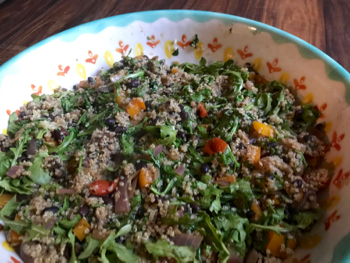


K’s Kitchen: Black Bean, Veggie, Quinoa Medley

By Kathryn Reed

It’s good to be flexible in the kitchen. Sometimes I just start throwing things in a pan and am pleasantly surprised. Such is the case with this recipe.

One of the great things about quinoa is that it is a fabulous source for protein. It can easily be substituted for rice, which has little nutritional value – white rice in particular.

Using soy sauce eliminates the need to add salt, though I’m sure some people will still want to add some.

I liked using arugula because it has a distinct flavor by itself. It’s a green I first came to love when I lived in Sonoma County and grew what seemed like bushels of it. It’s nice to see local grocery stores carrying it now.

For me, this dish was a meal unto itself. I loved having it warm, and then reheating as leftovers. But at room temp or cold would work too.

The arugula makes it seem like a salad, but it is so much more.

Black Bean, Veggie, Quinoa Medley

1 C quinoa

4 T olive oil

1 medium red onion, diced

1 yellow or orange bell pepper, diced

1 small tomato, chopped

¾ C mushrooms, chopped

1 T soy sauce

2 T lime juice

1 chipotle in adobo, minced

1 15 ounce can black beans, drained

½ C cilantro, chopped

4 C packed arugula

Cook quinoa according to directions.

In saucepan heat olive oil over medium-high heat. Sauté onion and pepper until soft. Add tomato and mushrooms. Cook for a few minutes. Then add soy sauce, lime juice and chipotle. Add black beans. Let simmer for at least 5 minutes. Add cilantro. Let flavors meld for a few minutes.

Place arugula in large serving bowl. Then add warm quinoa and veggie mixture. Stir all together and serve warm.


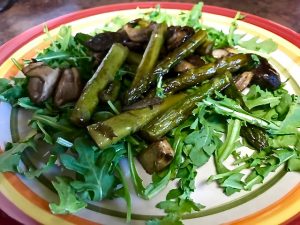
K’s Kitchen: Mushrooms and asparagus

By Kathryn Reed

Mushrooms – I could eat them every day, for every meal. Asparagus – one of the best vegetables to buy right now. Combine them, and, well, it’s a party for the palate.

This dish has lots of versatility. It can be served hot, at room temperature, as a salad, as a side and probably other ways.

While I roasted these, putting them on the barbecue would also work. I have a couple different devices I use when I don’t want to put veggies right on the grill – usually because they would fall right through.

Many grocery stores now carry a mix of wild mushrooms; this is what I used. They have a rich flavor compared to white button shrooms. Some of the ones I bought were big, so I cut them up before putting them on the baking sheet.

If you don’t have unsalted butter, just use what you have and don’t salt the veggies.

Putting the mix on a bed of arugula made it a meal for me. Doing so on a platter would make it great for serving if you are sharing with others. The arugula adds to the flavor because it is inherently spicy. Another green would work; your preference.

Roasted Asparagus and Mushrooms

1 pound asparagus, trimmed and cut in half

1 pound wild mushrooms

2 T olive oil

1 tsp kosher salt

2 T unsalted butter

2 T fresh thyme leaves

1-2 C arugula (depends on how you are using it)

Balsamic vinegar

Preheat oven to 450 degrees. Put foil on a rimmed baking sheet.

Place mushrooms and asparagus on sheet. Drizzle with oil olive and sprinkle with salt. Toss to coat.

Cook for about 15 minutes, stirring a couple times. Add butter and thyme. Toss, and cook for another 5 minutes.

Drizzle veggies with balsamic vinegar.

If using arugula, spread on a plate(s) or platter, then assemble veggies on top.


Festival to feature 30 breweries in S. Lake Tahoe

The Tahoe Brewfest is returning June 2 with 30 breweries, ciders, craft root beer, local entertainment and more.

The 2018 Tahoe Brewfest is moving up in more ways than one. More beer, more food, more bathrooms, more space, it’s even moving up in altitude. It will be at Heavenly’s Cal Lodge.

All proceeds go to the Boys & Girls Club of Lake Tahoe.

The event officially starts at 1pm, but for whoever is the first to grab the limited number of VIP tickets, the unlimited tastings start at noon with a commemorative stainless steel tasting glass. The event ends at 4pm.

VIP tickets are $50, regular tickets are $35, for those younger than 21 admission is $10, with those 5 and younger free. Tickets are available online.


Humanity’s food security at risk

By Jonas O. Bergman, Bloomberg

On this winter day, the world was upside down: it was raining in the Arctic Circle and snowing in Rome.

The contradiction was not lost on those gathered at the Svalbard Global Seed Vault, located near the top of the world. The scientists, activists, executives and government officials were in Longyearbyen, to mark the 10-year anniversary of what has become known as the Doomsday Vault, which stores seeds of the world’s most important crops deep in a mountain against the apocalyptic consequences of climate change and war.

The challenge they’re facing now is that the climate is changing far quicker than they’d imagined. The facility sprung a leak last year after construction had failed to take into account that the permafrost could melt. Norway is now spending about $20 million to secure and improve the facility. But it’s not just the building.

Read the whole story


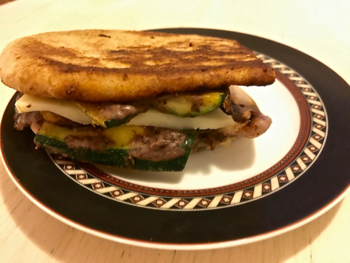
K’s Kitchen: Hot veggie sandwich

By Kathryn Reed

It always amazes me – in a bad way – how few restaurants have a vegetarian sandwich. Even more rare is a hot veggie sandwich.

Usually I think of sandwiches more as summer food. But every now and then I have a hankering for one.

A food processor would work best to pulsate the beans. I used a blender and that was overkill. I would recommend using a pastry device or even a fork to mash the beans instead of the blender. This way they will be a better texture and hold up in the sandwich.

If you don’t want to roast the peppers, the ones in a jar would suffice – and really would speed up the process.

A spicy cheese would be good with this.

This made four sandwiches. I reheated one the next day and it tasted even better.

Grilled Vegetable Sandwich

1 large red bell pepper

2 T fresh lime juice

1 tsp oregano

1 T olive oil

½ tsp ground cumin

½ tsp freshly ground black pepper

¼ tsp cayenne

1 (15-ounce) can unsalted black beans, drained

Cooking spray

1 large zucchini, cut in half and then length wise

1 small red onion, cut into slices

Bread for 4 sandwiches

¼ tsp kosher salt

½ C cheese, shredded

Preheat broiler.

Cut bell pepper in half lengthwise, place skin sides up on a foil-lined baking sheet; flatten with hand. Broil 11 minutes or until blackened. Wrap in foil. Let stand 5 minutes; peel. Cut into strips.

Place lime juice, oregano, oil, cumin, pepper, saltcayenne, and beans in food processor.

Heat a grill pan over high heat. Coat pan with cooking spray. Arrange zucchini and onion slices on pan; grill 5 minutes on each side.

Coat each half of bread with cooking spray. Spread black bean mixture over half of bread; top with zucchini, onion, and bell pepper. Sprinkle with cheese. Place sandwich on grill pan. Grill 3 minutes on each side or until cheese melts.


Tahoe doc: Diet plays major role in people’s health

Greg Bergner talks about the importance in diet in relation to health. Photo/Kathryn Reed

By Kathryn Reed

It was a new take on “you are what you eat.” Eat healthy food and you will be healthy, don’t do that and you are bound to suffer from myriad maladies.

This was the message Greg Bergner delivered March 8 to an overflowing crowd at Lake Tahoe Community College. Bergner is the director of lifestyle and wellness for Barton’s Center for Orthopedics & Wellness.

“Our bodies have a remarkable capacity to heal themselves even after we screw them up,” Bergner said.

That means it’s not too late to change your habits.

He explained how the top seven causes of death in the United States account for more than 80 percent of the deaths. Six of them are medical related. They are:

·      No. 1 – heart disease

·      No. 2 – cancer

·      No. 3 – COPD (lung disease)

·      Nos. 4-6 – accidents, stroke, Alzheimer’s

·      No. 7 – Type 2 diabetes.

Bergner said the only way to reverse heart disease is through a whole food plant based diet.

The difference between plant based and veganism is the latter is more of a lifestyle based on animal rights. Whole food would not allow something like olive oil because it’s processed, nor are French fries acceptable.

Bergner spoke of studies starting in the 1990s that illustrated how diet impacts a person’s health, most notably heart disease.

Studies are continually being done, with one from 2014 from the World Health Organization saying processed meats are a carcinogen. Bergner said it’s not a fact the U.S. government is paying much attention to.

The Mediterranean diet also shows dramatic health benefits. It allows for fish, other meats, olive oil and wine. The portions of meat are small, which could be problematic for some people.

Bergner acknowledged not everyone is going to embrace a plant based diet. But he added – we all have choices. Start with eliminating processed meats, he said.

At the end of the talk he showed a video from Canada of an older gentleman and the outcome based on choices. In one scenario he had made poor choices and was basically an invalid, the other made smarter decisions and was living an active life. The question was – What will your last 10 years be like?

The food one consumes will likely be a driving force in answering that question.


High cuisine may become an après ski tradition

By AC Shilton, Outside

Chefs are infusing more than just sweets into cannabis. High-end cannabis dining is coming to a ski town near you.

Your cannabis-related food associations probably aren’t great. There were the terrible weed brownies you made in college, with bits of plant fiber in every bite. Then there’s all the garbage food you’ve eaten while stoned. High cuisine, for many of us, has never really been anything close to haute cuisine.

But in places where cannabis is legal, chefs are working to change weed’s junk food reputation. Fine dining pop-ups and cooking classes, where marijuana is either cooked into dishes or served in some sort of complementary pairing with each course, are selling out, with everyone from first-time boomer users to veteran stoners wanting a seat at the table.

The movement is a personal one for many chefs.

Read the whole story