North Tahoe getting ready for food fundraiser

Passport to Dining, North Tahoe’s flavorful fundraiser, features tastings from up to 35 restaurants, caterers, breweries, wineries and distilleries as well as a raffle and silent auction.

The Nov. 12 event is a fundraiser for North Tahoe Business Association. It is from 6-9pm at the North Tahoe Event Center in Kings Beach.

A portion of Passport to Dining’s proceeds will be donated to Tahoe Public Art, a program dedicated to enhancing and preserving the natural beauty and history of North Lake Tahoe through visual arts that promote environmental stewardship and cultural unity. Tahoe Public Art is a collaborative effort of North Tahoe Business Association, North Tahoe Arts and Tahoe City Downtown Association.

Passport to Dining advanced tickets are available online for $40. Day of event tickets are available for $50 online or at the door  starting at 6pm. For more information or to purchase tickets with cash or check, call 530.546.9000.


Calif. winemakers using less water to grow grapes

By Ellen Knickmeyer, AP

RUTHERFORD — The grape vines that grower Frank Leeds tends in Napa Valley stand among the unheralded heroes of California’s drought, producing decade after decade of respected Cabernets and other wines without a drop of added water.

In a state where farms and dairies take the biggest gulp of the water supply, Leeds and the owners of his Frog’s Leap Winery are among a minority — but a growing minority — of California growers and winemakers who believe that when it comes to wine grapes, the less irrigation, the better.

“This is not struggling, skinny, tiny grapevines, right?” Leeds asked proudly earlier this growing season while leading a tour through the dry-farmed rows of wine grapes.

Frog’s Leap’s vines stood several feet apart from each other, giving the roots plenty of room to plunge into the soil and find moisture. Just across a narrow country road, black tubing of drip irrigation laced through another vineyard’s grape vines, more crowded but looking no less bountiful than their un-watered neighbors at Frog’s Leap.

Wine grapes, California’s No. 3 cash crop, in general are far less thirsty than the state’s No. 2 cash crop, almonds. But with 615,000 acres of wine grapes in production in California, wine industry trends in water use clearly have an impact on the overall water supply.

As wine growers close out harvest this month, California is ending a fourth year of severe drought, with mandatory cutbacks in water for cities and towns statewide, and for many farms.

Overwhelmingly, the debate in California’s wine industry over water use is driven by what’s best for the quantity and quality of the grape crop, more so than conservation.

All sides — the irrigated, the unirrigated, and the in-between — feel strongly that their way is the right way.

For Marc Mondavi, a third-generation producer in one of California’s most influential wine families, it only makes sense that grapes thrive best with an occasional sip of running water.

“I always tell people, I give them a little scenario: They put you and I in the middle of the Mojave Desert,” in a foot race, Mondavi said. “Who’s gonna run the distance? More than likely the person who’s had some water” to drink along the way.

In the early days of California winemaking, as in parts of France and Spain today, all wine was dry-farmed.

At the famed 1976 Judgment of Paris wine-tasting, which showed the world that California wines could meet or surpass French wines, some of the Napa Valley samples were dry-farmed, meaning they received no water beyond the 25 inches of rain that fall in Napa County during an average year.

By the 1980s and 1990s, however, as the wine industry boomed, water use increased.

“California producers in particular really wanted to control nature,” said George Taber, a long-time wine writer. “They realized they could have less acreage and greater production if they put their vines closer together and turned on the water.”

These days, the large majority of California’s vineyards are irrigated. That’s especially true in California’s dry Central Valley, where many of the wine grapes for the unmonied masses are produced.

Even in the lusher Napa and Sonoma valleys, home to many of the wines that define California’s industry, irrigation today is more the rule.

The fear driving irrigation for some vineyards — the “r” word.

“I do know that (various) wineries have a preference, but the overarching preference is that the fruit is sound and it arrives at the winery not shriveled up as a raisin,” said Rhonda Smith, a viticulture farm adviser in Sonoma County.

If dry-farming is haunted by the specter of raisins, the counterpoint is what wine critic and reporter Eric Asimov in 2008 dubbed Napa Valley “jammy fruit bombs ” — higher-alcohol, unsubtle wines from some irrigated grapes.

To get the water right, more and more producers, including Mondavi, use a range of high-tech moisture sensors.

And nearly a third of wine-growers are going further, ramping back watering in the belief that “deficit irrigation” generally produces better wine, said Joel Peterson, a noted winemaker at Sonoma Valley’s Ravenswood winery.

With less water, judiciously applied, the vines “will do exactly what they’re supposed to do” to produce the best grapes possible, Peterson said.

Ultimately, dry, wet or in-between, “it’s just a matter of your farming husbandry,” Peterson said. “Honestly, I think you can grow grapes either way.”

For Leeds and other dry-farmers in the Sonoma and Napa valleys, dry is the way to go, whether California’s winter rain and snow come back or not.

Dry-farm and deficit growers believe deeper roots give the grapes their taste of terroir, or place.

“We didn’t start dry-farming because of the drought, and when the drought’s over, we’re still going to dry farm,” Leeds said. “It’s for the health of the vine, and I’ll go to bat against anyone over the health of the vine.”


Why Americans eat like animals

By Abigail Carroll

American eaters, they’re like a pack of animals, hustling dinner in 10 minutes or less. It sounds like a recent complaint, but in fact it comes from 1864, when the Englishman John Francis Campbell was startled at the rapidity with which fellow steamboat passengers consumed their meals as they floated down the Ohio River. They were quick as foxhounds over their food, he marveled. Because service was family style, you risked leaving the table hungry if you failed to keep up. And Campbell wasn’t sure this speed such a good thing.

As this anecdote suggests, Americans’ affinity for hurried consumption—along with plenty of criticism for this tendency—go back a long way, at least as far back as when Campbell and his fellow passengers were journeying. The steady pursuit of efficiency, which informed new methods of travel, agriculture, and manufacturing, also informed American eating and has indelibly molded the modern American meal.

The trend was pervasive in 19th century, when European travelers often wrote amusingly of the swiftness with which Americans “dispatched” their food. They referred to meals at hotels as being “swallowed” or “gone through.” An Englishman at a hotel in Washington noted that boarders breakfasted in five minutes, while another Englishman, having learned the American way, recorded that he proudly rushed to the table to contribute his “strenuous efforts to the work of destruction”—that is, the destruction of several dishes, if not also of his digestion.

Why did 19th-century Americans have a penchant for hustling their meals? Most of the Europeans who commented on our gustatory speed failed to tender an explanation, though one observer accounted for it simply as “part of the go-ahead character of the people.” It was true: Americans were on the go, especially come the Industrial Revolution, which drove the growth of cities and changed the nature of work for a broad swath of the population. When factory clocks began to replace agricultural rhythms, meals underwent a thorough re-organization and deep transformation.

Workers in cities could no longer return home for a midday meal because of the increasing distance between work and home and the decreasing amount of time allotted for a midday recess. So dinner shifted to the evening, and a new meal emerged to fill the void: lunch. The idea here was a glorified snack, a stopgap between breakfast and dinner. Cold food was quick food, so it fit the bill, as did handheld items such as sandwiches, which didn’t require cooking, cleanup, or the use of utensils. If you wanted soup or hash or a slice of pie, you could visit one of the new cafeteria-style restaurants called quick lunches—pioneers of food service efficiency. From the one-arm joint (where you sat at a one-person table and didn’t have to waste time in conversation) to the automat (where you acquired food from a kind of giant vending machine and didn’t have to deal with wait staff or a cashier), fast food options of the late 19th and early 20th centuries abounded. They saved you time, and time was money.

Alternatively, some office workers chose to avoid the hassle of the quick lunch by eating a light meal from home at their desks. In 1904, Good Housekeeping profiled one such luncher who, complaining that his mind did not work as clearly for the first hour or two after a hot midday dinner, had shifted from restaurant meals to a sandwich prepared by his wife. “After eating in my office,” he explained, “I have a quiet hour to work without being bothered by the clamorous clients that infest a down-town law office at all other hours of the day.” For him, lunching light and alone meant productivity and peace.

Companies knew that time was money, and executives began to worry that quick lunch restaurants might cause workers to become sluggish from indigestion, reducing their productivity and compromising their profitability. Cold lunches brought from home also came under criticism because the science of the day found warm food to be more easily digested. “Neither dinner pail nor quick lunch … sends employees back to work in the afternoon with anything like the spirit with which they came in the morning,” noted Elmer Henry Fish in his 1920 managerial text, How To Manage Men. The solution was company lunchrooms that did more than serve free coffee (though that was a start); they also offered a selection of hot items at or near cost. These would fuel workers appropriately while keeping them on the premises, sparing them the stresses of undue hurry.

Breakfast underwent a similar transformation, turning lighter and quicker in the mid- to late 19th century—and efficiency became its hallmark. When reformers such as Sylvester Graham and William Andrus Alcott started promoting bread made from unbolted flour along with vegetarianism as a panacea for all manner of bodily ills, their primary aim was to improve Americans’ failing health—especially of the digestive sort. But the new, lighter, grain-based breakfast they promoted also happened to feed Americans’ desire for convenience, and convenience oiled the engines of profit.

John Harvey Kellogg of Corn Flakes fame invented a product he baptized Granola, his first cereal, not just to find a novel way of serving whole wheat at his sanitarium, but also to save time. “It was very difficult to prepare cereals,” he noted, looking back on his busy medical school life in New York City, where he had rented a small third-story room. “It should be possible to purchase cereals at groceries already cooked and ready to eat.” Instant cereal was the answer—you just added milk. Toast became a convenience food when sliced bread and pop-up toasters appeared on the scene, and it fit perfectly into the new breakfast model, upholding the twin pillars of convenience and health. While a traditional farmer’s breakfast demanded precious time and was likely to overtax the desk-worker’s digestive powers, ultimately reducing his output, cereal and toast saved time and kept your body fit for sedentary tasks.

The American pursuit of efficiency continues to shape our meals today, especially breakfast and lunch. Take, for example, the decline of Kellogg’s. Breakfast cereal was once a godsend for busy mothers, but now, as Devin Leonard reports in Bloomberg Businessweek, “Many people grab something on the way to work and devour it in their cars or at their desks while checking email.” Fast food breakfast sandwiches, single-serving yogurts, smoothies-to-go, and individually wrapped breakfast bars are taking the place of cereal and toast, and as they do, the drive for convenience carves the morning meal into an even more mobile, snack-like, and efficient eating occasion. Given our increasing interest in grazing, lunch is also looking less like a meal and more like a snack.

While many people who are disillusioned with the modern food system and our fragmented relationship with food are calling for a return to the art of the traditional meal, convenience continues to shape the way we eat. Perhaps this is because work has always shaped the way we eat, and what better way to make good on one’s time than to skip the hassle of meals altogether and simply fortify oneself with snacks? Or so the logic goes. In the 1830s, the Frenchman Alexis de Tocqueville noted the “feverish ardor” with which Americans seek to improve their well-being, and in this pursuit, he remarked, “they show themselves constantly tormented by a vague fear of not having chosen the shortest route.” Arguably, when it comes to eating, snacks and snack-like meals are “the shortest route.” In the era of industrialization, ideas about efficiency not only transformed the way we travel, work, farm, and manufacture, but also the way we eat. We Americans are still making our gustatory decisions with efficiency in mind.

Abigail Carroll is the author of “Three Squares: The Invention of the American Meal”. She has taught at Boston University, and she lives and writes in Vermont. She wrote this for What It Means to Be American, a national conversation hosted by the Smithsonian and Zócalo Public Square.


Chef Tarbell to headline Tahoe food-wine event

Award-winning chef Mark Tarbell will headline the sixth annual South Lake Tahoe Food and Wine Festival at Harrah’s and Harveys Lake Tahoe on Oct. 16-18.

Tarbell studied in Paris, receiving wine training at the l’Acadamie du Vin and earning a Grande Diplome d’Etude Culinaire from La Verenne Ecole du Cuisine. Nominated for Best Chef-Southwest by the James Beard Foundation, he has been invited to cook at many special events around the country and for a stellar line-up of political, sports, and entertainment celebrities, including the Dalai Lama, Muhammed Ali and Clint Eastwood.

Events for this year’s Food and Wine Festival include dining and tasting experiences, plus discussions, presentations and demonstrations by celebrated food and wine experts. The Grand Market Expo features dishes from Harrah’s and Harveys best restaurants, top-shelf spirits and wines of Napa Valley and beyond.


For a complete list of events and to purchase tickets, go online.


It’s time to end the tyranny of olive oil

By Roberto A. Ferdman, Washington Post

On a weekend morning not long ago, I found myself in the kitchen, near the burner, whisking eggs while a pan absorbed the heat from a light flame. I was making breakfast for a few friends. The mood was light. The coffee was dark. Music played in the background, and everyone sat silently, anticipating the meal.

That is, until I reached for the butter.

“That’s a lot of butter,” one friend uttered from behind a newspaper.

“Is there any olive oil?” another asked.

“Yeah, I would really prefer olive oil,” a third joined in. “If that’s ok,” he added, softening the demand.

I looked down at the poor, marginalized, misunderstood stick of coagulated deliciousness. And then back up at the table, where the butter skeptics sat. Three rather slender men in their late twenties, terrified of a little dairy fat.

“Fine, I’ll make my eggs separately,” I said, audibly disappointed. “But I’m not sharing.”

Read the whole story


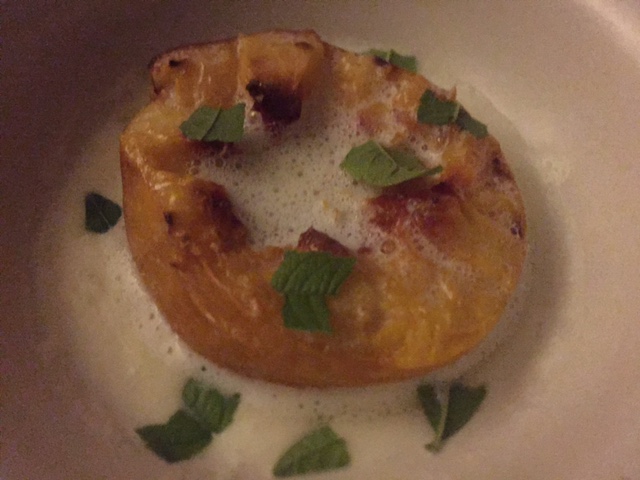
K’s Kitchen: Peaches with lemon verbena

By Kathryn Reed

I’m not sure I had heard of lemon verbena until my landscaper planted it in my herb garden. This meant needing to figure out what to do with it besides taking a leaf or two along with some peppermint and popping it in my mouth.

Brian, the landscaper, said his girlfriend makes tea out it. I can see this being good, but have not tried it.

Tearing up a few pieces and tossing them in a green salad has been fabulous.

But I have a lot so I needed a way to use even more. Fortunately, the peach season seems to be extended at the Tuesday farmers’ market in South Lake Tahoe. (The last day of the market is Oct. 13.)

Start off with a little sugar when whipping the cream. Add more until you get the sweetness you like. The peaches are going to be sweet, so take that into consideration.

For some reason the cream was not whipping into peaks the day I made this. Impatience could have been part of the problem. Still, it was thicker than pure liquid out of the container. The peaches were swimming in the cream, which still tasted great.

I could envision cooking the peaches on the barbecue as well.

peach-lemon verbena

            Peaches with Lemon Verbena Cream

2 C heavy cream

½ C fresh lemon verbena leaves, packed – plus a few for garnish

4 large ripe peaches, halved and pitted

¼ C butter (salted or unsalted) at room temperature

¼ C sugar, divided

In small pan bring cream to a simmer. Remove from heat and then add lemon verbena. Cover and steep for 15 minutes. Strain cream into bowl. Chill covered for at least one hour.

Place peaches in a rimmed pan or baking dish. Brush with butter and sprinkle with half of the sugar. Roast in 450-degree oven until peaches caramelize a bit, about 20 minutes.

Beat cream with remaining sugar into soft peaks. Serve peaches and cream together, with lemon verbena leaves as garnish.


Bartenders bring out their best for charity

More than 250 people packed into the Riva Grill on Sept. 23 for the sixth annual Signature Cocktail Contest hosted by the Barton Foundation.

The contest featured one-of-a-kind creations made by local bartenders with Tahoe Blue Vodka and their choice of ingredients. This year, garnishes were a popular addition with different drinks boasting candied beets, cupcakes, and edible flowers.

This year’s contest participants included bartenders from Artemis Lakefront Café (Bret Cram and Xain Coslow), Coldwater Brewery (Mary Potorski), Gunbarrel Tavern (Kelsey Weist), Heavenly (Stephen Camp), Landing Resort and Spa (Marc Jensen), LewMarNel’s (Gary Gramprie), MontBleu (Sarah Woldt and Isaac Croll), Riva Grill (Erick Martinez), and Tahoe Beach Retreat (Andie and Sean McDaniel).

Attendees voted Riva Grill’s Blue Linen as Best Cocktail. The drink combined Tahoe Blue Vodka with lavender, mint, cucumber, and St. Germain. Martinez was also voted Most Congenial Bartender for the second year in a row. In 2013 he also won Best Cocktail.

The winning cocktail will be served at Barton Foundation’s Gala fundraiser on Dec. 5 during the Festival of Trees and Lights. Both events raise funds to support this year’s cause: expanding medical services and community programs for Barton Hospital’s Level III Trauma Center.


K’s Kitchen: Cheese makes difference in enchiladas

By Kathryn Reed

Feta cheese for enchiladas is not something I would have come up with on my own.

I adapted the following recipe from my friend Denise. She rolls hers up more like a taquito, and therefore has less filling. I increased the amounts for all of the ingredients compared to what she did.

She uses a lemon pepper-garlic salt, whereas I used Beau Monde. The latter is a little pricy, but something I had in the cupboard. I would not buy it just for this recipe.

The flavors of this concoction are outstanding. Leftovers have been tasty as well. I’m hoping they freeze well, too.

In the future I might do a mix of green and yellow squash more for color than flavor. It would also be easy to barbecue the squash and cube it after it cools. I also think substituting one of the cans of beans for tofu would be an option. I would cook it with the zucchini.

I have some extra filling, which I will either freeze, throw into an egg scramble or put into a tortilla.

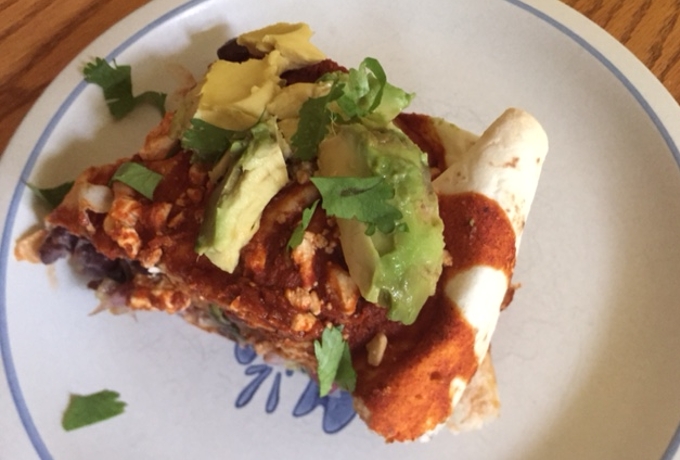
enchilada

Roasted Zucchini, Black Bean and Feta Cheese Enchiladas

4 C zucchini, diced

Olive oil

1½ tsp Beau Monde

1 medium red onion, diced

2 15-ounce cans black beans, drained

12 ounces crumbled feta cheese

28 ounces red enchilada sauce

Tortillas

Cilantro, optional

Avocado, optional

Preheat oven to 425 degrees. Place the zucchini on a rimmed baking tray, drizzle with olive oil and seasoning. With hands, coat zucchini. Roast for about 30 minutes until the edges are brown. Remove to cool.

Turn oven temp to 375 degrees.

In large mixing bowl, combine the onion and black beans. Add 2/3 of cheese. Add zucchini. Toss all together.

Over a burner, lightly char both sides of the tortillas. (This is optional.)

Pour 1/3 of enchilada sauce on bottom of 9 x 13 pan.

Fill tortillas equally with mixture. Squeeze as many enchiladas into the pan as possible. Pour remaining sauce over tortillas. Then top with remaining cheese.

Bake for 20 minutes or until tops are crisp.

Top with cilantro and sliced avocado, or serve on the side.


Wine event celebrates end of Prohibition

The Blind Barrel is an El Dorado Winery Association event celebrating the repeal of Prohibition with the passage of the 21st Amendment on Dec. 5, 1933.

Marshall Gold Discovery State Park will become a speakeasy.

A gourmet soup-line and wine tasting are part of the event. Guests will be able to mix and match bottles from the “black market” as well dance the night away. Prizes will be awarded for best Prohibition-era outfit.

A portion of the proceeds will be donated to MORE, Mother Lode Rehabilitation Enterprises.

The event is Dec. 5 from 6-10pm. The $50 tickets may be purchased online.


Chefs, vintners take home awards from Truckee event

The 30th anniversary of the Lake Tahoe Autumn Food and Wine Festival included multiple days of of activities ranging from a hands-on mozzarella making to numerous farm-to-table dinners.

Leading up to last Sunday’s grand finale at Northstar was the Blazing Pans Mountain Chef Cook Off. Executive chef Jason Friendy of the Resort at Squaw Creek/Six Peaks Grille and executive chef Rob Wyss of Sunnyside competed in the hourlong competition, producing three-course meals with this year’s secret ingredient, beer. Friendy was awarded the title of Blazing Pans Mountain Chef champion.

Sunday’s Culinary Competition and Grand Tasting featured nearly two dozen restaurants paired with premium wines, craft beers or spirits. More than 60 wines were poured during the weekend along with a selection of handcrafted beverages.

The Judges Choice Award is granted to the winner of a blind tasting by a panel of industry experts including professional wine judges, professional chefs, culinary experts and food and wine pairing experts. The second competition, People’s Choice Award, is chosen by festival attendees’ ballot votes.

The winners were:

Judges’ Choice Awards

Best Pairing of Food and Beverage

  • Gold: Northstar California Resort and Benziger Family Winery
  • Silver: Six Peaks Grille – Resort at Squaw Creek and Alaskan Amber Brewing Co.
  • Bronze: Granlibakken Resort and Emeritus Vineyards

Best Food

  • Gold: Wolfdale’s Cuisine Unique Restaurant
  • Silver: Smokey Bones Bar & Fire Grill
  • Bronze: Moody’s Bistro, Bar & Beats

Best Red Wine

  • Gold: Emeritus Vineyards
  • Silver: Chappellet Winery
  • Bronze: Veedercrest Vineyards

Best White Wine

  • Gold: Gruet Winery’s Champagne
  • Silver: ZD Wines
  • Bronze: Lumen Wines

Best Beverage Other than Wine

  • Gold: Charbay Distillery & Winery

People’s Choice Awards

Best Beer: Goose Island Brewery’s Seasonal Oktoberfest
Best Other Than Wine: Charbay Distillery & Winery
Best White: ZD Wines
Best Red: Orin Swift Cellars
Best Table Presentation: Northstar
Best Food: Campo Reno
Best Pairing: Northstar and Benziger Family Winery.