Shape of glass can make beer taste better

By AC Shilton, Outside

In 2016, instead of talking about the nuances of Cascade versus Saaz hops, we’re going to spend the year talking about how a concave bottom and bulbous top maximize aromas and help keep a beer’s head foamy.

And it will be really, really pretentious.

Matthew Cummings is a glass-blowing artist who likes to drink beer with his artsy friends.

“If you’re drinking your beer in a chilled shaker pint, you might as well be drinking water,” says Cummings, who now owns The Pretentious Beer Glass Company. “Shaker pints were designed to fit into cocktail shakers and stack well, not to make your beer taste better.”

Read the whole story


Nonprofit to certify organic Nevada foods

By Andi Guevara, KTVN-TV

Recently the Nevada Department of Agriculture closed the program that certifies organic produce for our state, leaving questions as to where and how farmers and others would get that certification. Now a local, nonprofit organization has received accreditation to take over the process.

Knowing where their food comes from and how it is raised is important to the Andelins. Just off Pyramid Highway in Spanish Springs is the Andelin family farm, where chickens, goats and pigs are given plenty of love and attention.

The Andelin family farm uses both organic and traditional methods and they’re dedicated to sustainable farming.

Read the whole story


Eating right can save the world

By Tim Zimmermann, Outside

“Tell me what you eat and I will tell you what you are.” That’s what the French lawyer Jean Anthelme Brillat-Savarin, who happened to have a deep love of gastronomy, wrote in 1825. A century later, a diet-hawking American nutritionist named Victor Lindlahr rendered it as: “You are what you eat.” I propose revising it further: Tell me what you eat and I will tell you how you impact the planet.

Most of us are aware that our food choices have environmental consequences. (Who hasn’t heard about the methane back draft from cows?) But when it comes to the specifics of why our decisions matter, we’re at a loss, bombarded with confusing choices in the grocery-store aisles about what to buy if we care about planetary health. Are organic fruits and vegetables really worth the higher prices, and are they better for the environment? If I’m a meat eater, should I opt for free-range, grass-fed beef? Is it OK to buy a pineapple flown in from Costa Rica, or should I eat only locally grown apples?

The science of food’s ecological footprint can be overwhelming, yet it’s important to understand it. For starters, in wealthy societies food consumption is estimated to account for 20 to 30 percent of the total footprint of a household. Feeding ourselves dominates our landscapes, using about half the ice-free land on earth. It sends us into the oceans, where we have fished nearly 90 percent of species to the brink or beyond. It affects all the planet’s natural systems, producing more than 30 percent of global greenhouse gases. Farming uses about 70 percent of our water and pollutes rivers with fertilizer and waste that in turn create vast coastal dead zones. The food on your plate touches everything.

“If you look at the heavy-hitter list of global-scale changes that are human induced, how we feed ourselves is invariably near the top,” says Peter Tyedmers, a professor at Dalhousie University’s School for Resource and Environmental Studies (SRES) in Halifax, Nova Scotia, who has been studying the world’s food systems for 15 years. “But the great thing about food is that we have choices, and we have the opportunity to effect change three times a day.”

So what does a sustainable diet actually look like? I’ve thought a lot about my food choices and became a vegan a few years ago, but I still don’t know all the answers. So I set out to find them.

I didn’t go hunting for a crazed notion of perfection. I was simply looking for an attainable way to eat—whether you’re a vegan, a vegetarian, or an omnivore. Here’s what I discovered.

Read the whole story


No two hot cocoas the same in Lake Tahoe

Hot cocoa at Alpina in South Lake Tahoe comes with great flavor and a fun design. Photos/Kathryn Reed

Hot cocoa at Alpina Cafe in South Lake Tahoe comes with great flavor and a fun design. Photos/Kathryn Reed

By Kathryn Reed

Long before chocolate was routinely consumed as a solid form it was a beverage.

There was a time when chocolate was for the elite members of society. The chocolate tree’s scientific name is Theobroma cacao. In Greek it means food of the gods.

Dutch chemist Coenraad Jhannes van Houten is credited as being the first to separate the fat from the liquid. This was in 1828. The residual could be crushed to make cocoa powder. Thus began the realization it could be more than a drink.

Today, hot chocolate is a beverage the masses can afford to consume. But there is technically a difference between hot chocolate and hot cocoa. The former uses actual chocolate that is then melted in hot water or milk. Hot cocoa uses cocoa powder and is usually sweeter than hot chocolate.

Lake Tahoe News spent a few weeks sampling this popular winter beverage. Regional establishments have all sorts of ways to create the drink. For our purposes, we are interchanging hot cocoa and hot chocolate, and not adhering to old school definitions.

The whip cream at Bert's is a reason to order hot chocolate.

The whip cream at Bert’s is a reason to order hot chocolate.

Anne only has good things to say about the cocoa at Paul Schat’s Bakery in Carson City. A small at $2.95 was plenty big. It is made from Ghirardelli chocolate, according to the menu board. She said the best part is it is not too sweet. The bonus was having the whipped cream made as she waited.

Rude Brothers in South Lake Tahoe also uses Ghirardelli. Customers may choose the type of milk. I had nonfat. It’s whipped on the espresso machine, making it frothier and creamier; and no need for whipped cream. The medium at $3.25 seemed like a good price.

Blue Angel Café in South Lake also uses the barista method for hot cocoa. They use light and dark chocolate syrups from Guitars – one is more bitter, one more sweet – along with 2 percent milk.

“If you use the steam wand correctly, it makes the chocolate velvety,” owner Jeff Cowen explained. He wasn’t kidding. It’s worth the $3.50.

I preferred all of the hot chocolates made barista style with steamed milk. My favorite was at Alpina in South Lake Tahoe. They use a mocha powder they mix in the back. Then the customer has the choice of milk. I had the medium hazelnut hot cocoa with nonfat milk — $3.40. This was my first hazelnut cocoa – and it won’t be the last. It’s on the menu year-round along with the regular cocoa and white chocolate. During other times of the year there are specialty flavors like peppermint. Depending on the barista he might make a design, like a leaf, out of the foam on top. A nice added touch.

Blue Angel's cocoa is a reason to stop by this South Tahoe restaurant.

Blue Angel’s cocoa is a treat, especially because it is light.

The nonfat peppermint cocoa at Starbucks inside Harveys at Stateline tastes like it’s spiked. Presumably, it’s like having Schnapps without the calories or alcohol in the middle of a workday. The price, though, for a medium was $4.02. Anything over $4 seems pricy for hot chocolate.

Prices at the Starbucks inside the Safeway at the South Lake Tahoe are $2.85, $3.35, and $3.55. While it was good to be warmed up while shopping, the flavor was nothing to brag about. Clearly not all cocoa with steamed milk has a wow factor. The Peet’s inside Safeway in South Lake was lacking chocolate. Prices are $3, $3.30 and $3.60.

Hot chocolate comes out of a machine at Bert’s in South Lake Tahoe. It’s sweet (says Kae) and lacks a chocolatiness (says Sue). It tastes like any other machine processed hot chocolate. What is great is the value. The mug is big – cost is $2.50. The heap of canned whip cream made the presentation great.

The Lodge at Big Springs’ hot cocoa machine is self-serve. Instructions are to fill the cup so far and then let go. Either the instructions are wrong or the cups were too big at Northstar’s mid-mountain café. It required a few pushes to get a full cup. It was average at best.

At least one day at Sierra-at-Tahoe’s West Bowl they had to improvise because there was no hot water with which to fill the machine. The kitchen made the cocoa. It was sweet, but not as overbearing as machine-manufactured cocoa. A small is $3.76 and large is $4.20. The small was plenty big, and considering it was at a ski resort, definitely worth the price.

Machine ready cocoa is festive at Red Hut.

Machine ready cocoa is festive at Red Hut.

Red Hut on Ski Run in South Tahoe came out of a machine served in a coffee cup. The best part was the ample whipped cream with sprinkles on top. Cost — $2.19.

The Beacon restaurant’s cocoa – also out of a machine – is also average.

The best part of the hot cocoa at Artemis near the Y in South Tahoe is the cinnamon in the whipped cream. The cinnamon mixed in with the chocolate throughout. A powder is used with water. It’s not on the menu; cost is $3.

Also using a powder is Casey’s in Round Hill. It wasn’t too sweet, but could be chocolatier, according to me, Sue and Brenda. For $2.95, it was worth it. We got a tip in mixing the powder and water – start with the mix and a little water, stir with a fork to make sure there are no lumps, add more powder and water, mix more and then serve.


Vineyard’s dirt affects what’s in your glass

By Dave McIntyre, Washington Post

“Let’s go dig a hole!”

Ernest “Bubba” Beasley grabbed an auger and led the way along the vine rows. We were at Pollak Vineyards in Greenwood, Va., west of Charlottesville, on a sweltering summer day last July. Beasley, a geologist, and Lucie Morton, a viticulturist, wanted to show me their research on the relationship of vineyard soils to wine quality. And that meant a “dirt tasting.”

Then Beasley led us about 50 feet up the row and repeated the process. Here, the soil was visibly different: clay on the top but a gravelly loam farther down, an assessment verified by matching the soil’s colors to the chart.


To wine lovers, the vineyard’s effect on a wine’s quality seems self-evident. Yet “terroir” is many things, including sun exposure, microclimate, even the personality of the winemaker.

Read the whole story


A campfire cookbook for real outdoorspeople

By AC Shilton, Outside

Just-add-water stroganoff is a convenient and light dinner option when you’re backpacking, but that’s where the “pros” list ends. Cons, on the other hand, range from “mushy” to “tasteless” to “can this legally be called stroganoff?”

You can do better. In fact, you deserve better. And a new book promises that with a few key techniques and recipes, you’ll never give freeze-dried food a second glance.

Author Nikki Fotheringham is a longtime adventurer and travel writer. She grew up in South Africa, where outdoor cooking over built-in fireplaces is the norm. She says that no one there cooks with gas when barbecuing; cooking over fire is a proud South African tradition that she’s happy to pass on to readers.

Read the whole story


Food from a different century

By Daniel Neman, St. Louis Dispatch

Imagine the exciting world of 1900.

Dresses were more daring, and by 1910 hemlines would rise almost all the way to the ankle. William McKinley was re-elected president, though he would not be destined to serve long. The Wright Brothers conquered the air in 1903. The world of art was undergoing a massive revolution.

And with its World’s Fair in 1904, St. Louis briefly became the center of the universe.

It was an exciting time for food, too. In the first decade of the new century, brownies were invented, Necco wafers came into being and the first patent was issued for instant coffee. Peanut butter and jelly sandwiches and hot fudge sundaes were created then, too.

Read the whole story


Homegrown flavor from an indoor garden

By Melinda Myers

Add some homegrown flavor to your winter meals. From microgreens to tomatoes, it is possible to grow produce indoors.

Microgreens are a quick and easy way to add some flavor and crunch to your plate. Just plant seeds labeled for sprouting or microgreens in a shallow container filled with a sterile potting or seed starting mix. Within two weeks you will be harvesting nutritious mini vegetable and herb leaves for salads, sandwiches or snacking.

Take it one step further and grow a few of your favorite herbs on a warm sunny windowsill. Select a container with drainage holes and set on the appropriate size saucer to protect your woodwork. Fill the container with well-drained potting mix and plant seeds or transplants. Purchase basil, chives, parsley, oregano and rosemary plants from your local garden center or the produce department.

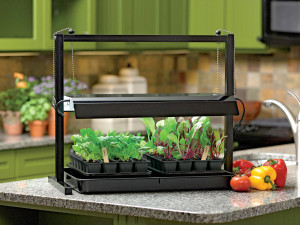
Energy efficient and long lasting high intensity grow lights will provide the greatest yields when growing tomatoes and other fruiting plants indoors. Photo/Gardener’s Supply Company

Energy efficient and long lasting high intensity grow lights will provide the greatest yields when growing tomatoes and other fruiting plants indoors. Photo/Gardener’s Supply Company

Greens, like lettuce and spinach, will also grow in a sunny window or better yet under artificial lights. Grow them in a container filled with a well-drained potting mix similar to your windowsill herb garden. Plant seeds according to the seed packet. Continually harvest the outer leaves when they are 4 to 6 inches tall.

Those that like a bit of a challenge may want to try growing a compact tomato, pepper or eggplant. You’ll get the best production with a combination of natural and artificial light or full spectrum lights.

Natural sunlight and full spectrum lights contain the variety of light plants need to grow, flower and fruit. Blue light promotes leaf and stem growth, while red combined with blue promotes flowering. Consider investing in energy efficient and long lasting high intensity grow lights for the greatest yields when growing tomatoes, peppers, eggplants and other fruiting plants indoors.

Leave lights on for 14, but no more than 16 hours each day. Plants need a dark period as well as bright light each day to grow and thrive. Use a timer to ensure the plants receive the right duration of light.

Most flowering and fruiting plants need a high intensity of light, so keep the lights six to twelve inches above your plants. Use reflective surfaces under and around the plants to bounce light back into larger plants.

Increase your indoor growing space by going vertical. Shelf units with built-in light fixtures provide multiple layers of growing space.

And once your tomatoes, peppers and eggplants start flowering, you will need to shake things up a bit. Gently shake the plants several times a week, better yet daily, to move the pollen from the female to the male parts of the flower so fruit will develop. A gentle breeze from a fan or vibrations from a battery-operated toothbrush work well.

Indoor gardening won’t yield the same results as a sunny outdoor garden, but the flavor can’t be beat when gardening outdoors is not an option.

Gardening expert, TV/radio host, author columnist Melinda Myers has more than 30 years of horticulture experience and has written more tha 20 gardening books, including “Small Space Gardening” and the “Midwest Gardener’s Handbook”>


Can a glass affect the taste of wine?

By Stephy Chung, CNN

Sonic decanters, slip-on wine thermometers, devices to pour your wine without pulling the cork — the list of fancy wine accessories is growing apace, as global wine enthusiasts look for newer, better ways to appreciate their favorite tipple.
But James Molesworth, Senior Editor at Wine Spectatormagazine says expensive gadgets are largely unnecessary. “You don’t need much else besides a simple decanter, corkscrew and stemware.”

The inclusion of the latter — quality stemware, which can easily cost upwards US$100 per glass — is becoming a popular choice in many of the world’s leading high-end restaurants.

Read the whole story


K’s Kitchen: A slightly healthier cream soup

By Kathryn Reed

Sometimes I just need something easy for dinner. But I still want it to taste good. And this time of year I usually want it to be warm, if not hot. Soup is often the answer.

Cream of broccoli soup has a reputation for being unhealthy. Cream soups in general get a bad rap – and rightly so. Still, if you aren’t eating them every week, they are probably no worse than a lot of things in your diet.

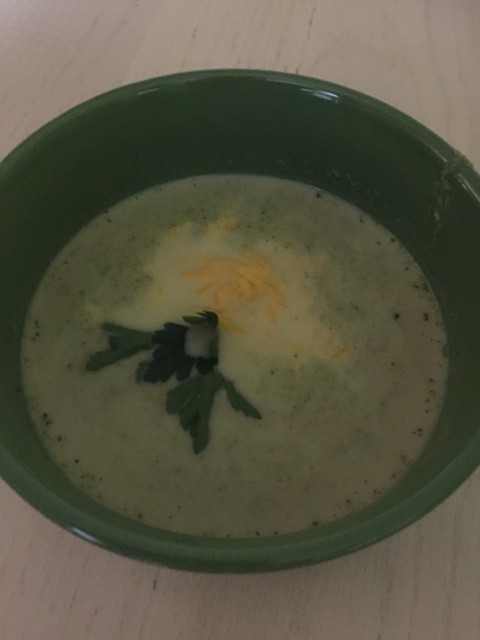
It’s also possible not to use the cheese or let everyone put in the amount they like. It will melt quickly, so if you are using it for a presentation factor, be ready to serve it quickly.

The parsley on top is a nice addition when serving to others where presentation matters. A few shakes or turns of the pepper grinder would be pleasing as well.

I blended the ingredients so there was still some texture from the broccoli. This made it seem less creamy as well, as did not having so much cheese.

           cream of broccoli soup Cream of Broccoli Soup

4 C vegetable stock

2+ C broccoli florets, chopped

1 C yellow onion, chopped

1 large carrot, chopped

Salt

Pepper

5 garlic cloves, chopped

1 C half-and-half

4 ounces extra-sharp cheddar cheese

Flat-leaf parsley leaves, optional

Bring the first seven ingredients to a boil in a large saucepan. Then simmer 10 minutes, making sure the broccoli is tender. Use an emulsion blender or regular blender until smooth. Over reduced heat, stir in half-and-half. Top evenly with cheese and parsley, sprinkle with pepper.