Gardeners needed for asparagus study

The master gardener phenology and grow-out trial is designed to determine the suitability of asparagus in the Truckee-Tahoe region.

To facilitate the evaluation master gardeners and public gardeners with an interest in science reporting and with special interest in growing asparagus for personal consumption are needed. Those participating will receive instructions on the history and cultivation techniques related to asparagus  Each participant will have the opportunity to receive at no cost several asparagus plants to grow.

During the course of this study, those participating will be able to obtain assistance in cultivating the plants, including information on plant maintenance and pest management.  The project is expected to take a minimum of two growing seasons, and with success possibly a third season.

For more info, contact Ericka Kay at erickarkay@gmail.com.


Study challenges benefits of wine consumption

By Angus Chen, NPR

You’ve probably heard that a little booze a day is good for you. I’ve even said it at parties. “Look at the French,” I’ve said gleefully over my own cup. “Wine all the time and they still live to be not a day younger than 82.”

I’m sorry to say we’re probably wrong. The evidence that alcohol has any benefit on longevity or heart health is thin, says Timothy Naimi, a physician and epidemiologist at Boston Medical Center.

He and his colleagues published an analysis 87 of the best research studies on alcohol’s effect on death from any cause in the Journal of Studies on Alcohol and Drugs on Tuesday. “[Our] findings here cast a great deal of skepticism on this long, cherished belief that moderate drinking has a survival advantage,” he says.


K’s Kitchen: Lentil soup full of health benefits

By Kathryn Reed

Lentils come in a variety of colors, with each having its own characteristics. But not all are good for every dish.

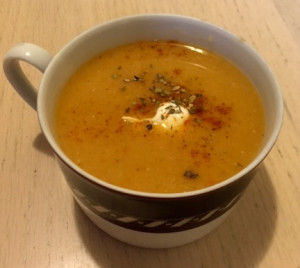
Red lentils tend to be sweeter and nuttier in flavor compared to brown and green lentils. They also get mushy when cooked. This can make them ideal for soups. With this recipe calling for the soup to be blended, it doesn’t matter that lentils are mushy.

Lentils in general have a tremendous amount of health benefits, though each color varies so read the label. Fiber, protein and iron are some of good things in lentils.

Fresh tomatoes would be fabulous for this dish in summer. I have a hard time using fresh tomatoes this time of year because they are waxy and lack flavor. That is why I used canned.

I sprinkled the top with a little oregano and paprika to make it look prettier, but that is truly optional.

lentil soupRed Lentil Soup

2 T unsalted butter

1 medium onion, chopped

2 carrots, finely chopped

3 celery stalks, finely chopped

5 garlic cloves, thinly sliced

1 tsp ground cumin

½ tsp ground coriander

½ tsp chile powder

1 14½ ounce can stewed tomatoes

2 C red lentils

8 C water

Salt

Yogurt, optional

Naan bread, optional

Melt the butter in a large pot, then add onion, carrots, celery and garlic. Cook over medium heat for a few minutes until vegetables are softened. Add cumin, coriander and chile powder. Add the tomatoes and cook for 3-4 minutes. Add the lentils and 8 cups of water.

Simmer until the lentils are soft, about 30 minutes.

Puree the soup with a blender. Season with salt.

Serve with a dollop of yogurt per serving. Use naan bread for dipping.


Cabs weathering California drought

By Laurie Daniel, San Luis Obispo Tribune

The drought has led to all sorts of agricultural challenges, but it doesn’t appear to have hurt the quality of California’s wines. The warm, dry growing conditions have led to a string of high-quality vintages.

That certainly was the case with cabernet sauvignon in 2013. There were excellent wines made all over the state, but you can’t really talk about California cabernet without taking a look at the Napa Valley.

A tasting at the recent Premiere Napa Valley trade event offered the opportunity to sample 17 of the valley’s 2013 cabs alongside the same wines from the 2011 and 2012 vintages. I’ve also tasted a number of 2013s in other settings, including blind tastings at home. Many of the top wines haven’t been released yet, but more and more bottlings are starting to make an appearance.

Read the whole story


Cereal, a taste of nostalgia at a crossroads

By Kim Severson, New York Times

King Vitaman and I were tight when I was young. Sweetened cereals were a rarity in my house, so beating my siblings to breakfast was the only way to make sure the king and I would have some time together.

I got up early to follow his animated adventures on the back of the box. Even the ingredient list, with its parade of unintelligible words and the promise of a full day’s supply of vitamins and iron, seemed endlessly fascinating. I was rapt until the bowl was empty and his sugarcoated golden crowns had turned the milk to syrup.

Now, I watch my young daughter stare at her cereal box in the morning, pondering a stalk of organic wheat or the plight of a koala. I wonder if she will ever have the sentimental pleasure of her own King Vitaman.

Breakfast cereal, both as a cultural marker and a profit center, is at a crossroads. Since the late 1990s, its popularity has been slowly fading. Sales, which totaled $13.9 billion in 2000, dipped last year to about $10 billion.

Read the whole story


Fresh pasta isn’t always better than dried

By Tim Carman, Washington Post

Until he apprenticed at Incanto in San Francisco, Michael Friedman considered fresh pasta sort of the holy grail of Italian cooking — something chefs should strive to make and perfect.

To make your own fresh pasta meant “you were at the height of your craft,” says Friedman, the chef behind the linguine, rigatoni, paccheri and other pastas at Red Hen in Bloomingdale. “I believed that for a really long time.”

But then Friedman worked with chef Chris Cosentino at the now-shuttered Incanto, and the Washingtonian discovered the many possibilities of dried pasta. Cosentino pushed the boundaries of the pasta that many simply shake from a box. He was extruding and drying pastas in-house, designing shapes unique to Incanto, such as a noodle that resembled tripe, which was then paired with two types of actual tripe, remembers Friedman.

Read the whole story


World is running low on old single malt Scotch

By Sophia Yan, CNN Money

Bottoms up! Whisky lovers are draining the world’s supply of old single malt Scotch.

Thirst for the liquor is booming around the world — from the U.S. to developing countries like China — pushing prices of older vintages through the roof, attracting savvy investors hoping to cash in and forcing distilleries to scramble to meet demand.

“The shortage of old and rare single malt … has already started, and it’s going to get worse,” said Rickesh Kishnani, who launched the world’s first whisky investment fund.

Read the whole story


Scientists disagree whether salt is killing us

By Peter Whoriskey, New York Times

The debate over the perils of salty diets may be one of the most polarized in all of science.

On one side, scientists warn ominously that most Americans are killing themselves with salt. On the other, scientists insist most Americans are fine.

The inability to resolve this question may seem puzzling. It is a question with deadly consequences, at least potentially. How much salt is healthy? Given the marvels of technology, it seems like that ought to be an easy one.

Now a review of hundreds of papers on the topic indicates that the inability to reach a consensus stems at least partially from the fact that the two groups of scientists operate, in essence, in parallel scientific universes.

Read the whole story


‘Ugly’ fruits, vegetables can help solve world hunger

By Elizabeth Royte, National Geographic

Tristram Stuart has 24 hours to produce a restaurant meal for 50 people—to plan a menu, gather food, then welcome guests to a venue in a city not his own. Complicating what sounds like a reality-show contest is a singular rule: Nearly all the ingredients must be sourced from farms and vendors intending to throw them out.

After racing back to New York City from a New Jersey farm where he gleaned 75 pounds of crookneck squash deemed by the farmers too crooked to sell, Stuart bolts from a car creeping through traffic and darts into a Greenwich Village bakery. Tall and blond, with a posh English accent, he launches into his ten-second spiel: “I run an organization that campaigns against food waste, and I’m pulling together a feast tomorrow made with food that won’t be sold or donated to charity. Do you have any bread that we could use?” The bakery doesn’t, but the clerk hands him two broken chocolate-chip cookies as consolation.

Across cultures, food waste goes against the moral grain. After all, nearly 800 million people worldwide suffer from hunger. But according to the Food and Agriculture Organization of the United Nations, we squander enough food—globally, 2.9 trillion pounds a year—to feed every one of them more than twice over. Where’s all that food—about a third of the planet’s production—going? In developing nations much is lost postharvest for lack of adequate storage facilities, good roads, and refrigeration. In comparison, developed nations waste more food farther down the supply chain, when retailers order, serve, or display too much and when consumers ignore leftovers in the back of the fridge or toss perishables before they’ve expired.

Read the whole story


Amador County Barbera turning heads

By Mike Dunne, Sacramento Bee

Though the San Francisco Chronicle Wine Competition in Sonoma County is a strictly all-American show, this year it drew 98 Barbera entries.

My panel at the competition tasted just one of the Barberas, Healdsburg’s Portalupi Wine 2013 Amador County Shake Ridge Ranch Barbera ($45), a faithfully vibrant and solidly built interpretation of the varietal. (The 2013 no longer is available, but the 2014 has been released at the same price.) It was the only one to be nominated for sweepstakes consideration.

Though the Portalupi wasn’t ultimately crowned the best red wine in the competition, it was fitting that a Barbera in the final round was from Amador County, which further enhanced its standing as the epicenter of modern Barbera production in the nation.

Read the whole story