How climate change affects wines of the world

By Esther Mobley, San Francisco Chronicle

Has global warming been improving the wines of France over the last few decades?

That’s part of the claim being made by a new study by NASA and Harvard University. However, the study warns that the upswing in quality may not last forever, and a hotter planet looks like bad news for French vineyards in the long run.

In California, meanwhile, the relationship between climate change and wine quality is not nearly as straightforward as what the study authors observe in France.

Read the whole story


Lake Tahoe Brewing closes throughout the region

By Mike Higdon, Reno Gazette-Journal

In the last two months, Lake Tahoe Brewing Co.’s four locations in Carson City, Truckee, Fernley and Reno closed or never opened. What would’ve been the region’s largest locally-owned beer franchise fizzled down to nothing after a series of legal troubles flattened the brand.

Brewery owner, Michael Candelario, said he is wrapping up closure of the final Fourth Street location that he planned to open as a tap house and largest barrel-aging facility in the region. In Carson City, the brewery represented the fourth brewery to close in the same downtown location since Stew’s Brewery, Doppelgangers and High Sierra Brewing Co. shuttered in 2011 and 2014 respectively.

The troubles for Lake Tahoe Brewing started in February when Lake Tahoe Brewing was evicted from its downtown Carson City location.

Read the whole story


Expiration law may cut food waste

By Tara Duggan, San Francisco Chronicle

Food waste is a hot topic quickly moving into the political mainstream, largely because it touches so many issues at once — the environment, hunger, household budgets and the overall economy.

Now, proposed legislation from Assemblyman David Chiu, D-San Francisco, aims to address the issue by changing one simple but crucial thing: the expiration dates on food.

As of now, shoppers see myriad versions of expiration dates indicated on packages of food, be it fresh ground beef or a can of chili. Common verbiage includes “best by,” “freshest by,” “sell by” or any number of other similar phrases.

With the exception of infant formula, none of these dates is federally regulated, and all are determined by the manufacturer. In the majority of cases, the dates indicate the manufacturer’s best guess as to when product is at best quality — and don’t have anything to do with safety, even with that suspect carton of milk.

Read the whole story


K’s Kitchen: Quinoa and veggies with tahini

By Kathryn Reed

Until recently I didn’t realize quinoa comes in a variety of colors. After doing a little research, I learned there isn’t much difference between them.

Cooking times may vary. A reason not to just buy white is a little color might make a dish stand out more.

I used red quinoa for this dish, but it’s not necessary. And at the store I was at it was a lot more expensive than the regular white.

I used white rice because it’s what I had in the cupboard. Brown rice would make it healthier. And the brown rice could be the color instead of the red quinoa. Brown rice takes longer to cook and often needs more water.
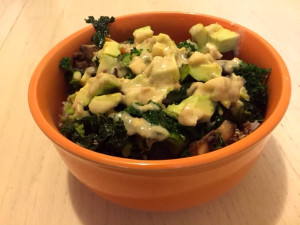
quinoaQuinoa and Rice Bowl with Vegetables and Tahini

1 C rice

1 C red quinoa

¼ C olive oil

1 small onion, diced

1 carrot, cut into matchsticks

1/4 pound baby bella crimini mushrooms, thinly sliced

1 small zucchini, cut into matchsticks

Salt

1 head of broccoli, chopped

1 10-ounce bunch kale, large stems discarded

¼ C tahini, at room temperature

½ C fresh lemon juice

5 garlic cloves, minced

2 T warm water

¼ tsp crushed red pepper

1 ripe avocado, diced

1 C mung bean sprouts

In a medium saucepan, cover the rice with 2 inches of water and bring to a boil; then cover and cook over low heat until the rice is just tender. This can take about 40 minutes.

Combine the quinoa with 2 cups of water in small saucepan and bring to a boil; then cover and simmer over low heat until the quinoa is tender and all of the water has been absorbed, 20 minutes.

Add 2 tablespoons of oil large skillet. Over medium heat cook onion until translucent. Add the carrot, cook until starts to soften. Add the mushrooms; then zucchini. Season with salt. Transfer to a bowl.

Add the remaining 2 tablespoons of oil to the skillet. Cook broccoli until deep green, about 5 minutes. Add the kale, cook until just tender. Season with salt. Stir in the other vegetables.

In a small bowl, whisk the tahini with the lemon juice, garlic, warm water and crushed red pepper. Season with salt.

Put equal amounts of rice and quinoa to bowls. Top with the cooked vegetables, diced avocado and bean sprouts. Drizzle tahini mixture on top.


Study: Calif. pays lower taxes on alcohol than average

By Daniel Wheaton, Los Angeles Times

Californians can consider themselves lucky: their state charges less in taxes than the national average for import taxes on beer, wine and liquor.

A report from the Tax Foundation breaks down excise taxes by state. These are paid by the person or business that buys the alcohol from the manufacturer, and are often passed down to the consumer. California’s rate is 20 cents per gallon of beer. That amounts to 2.5 cents for each pint. On top of that however, is a federal tax of 58 cents per gallon of beer, or 7 cents per pint.

As with nearly every other good, taxes vary based on where you’re purchasing them. Regionally, there is significant variation in how much states tax beer: The South has the highest beer taxes; in Wyoming, it’s barely anything at all.

Read the whole story


Learn to make beer from professionals

Slow Food Lake Tahoe and Alibi Ale Works are joining together to offer a half-day skillshare for people interested in learning how to make beer at home.

The skillshare will cover the fundamentals of making great beer at home through a hands-on demonstration and sampling some local homebrewed creations. Beginning (extract) and intermediate (all-grain) brewing techniques will be demonstrated. Whether you are a do-it-yourselfer, a curious beer geek, or have already taken up the hobby of homebrewing, the goal is to leave with a better understanding of the ancient tradition of making beer.

The Homebrewing Skillshare will be led by long-time home brewers Kevin Drake and Rich Romo, who are the owners/founders of Alibi Ale Works, a craft brewery in Incline Village.  The skillshare will be held at Alibi Ale Works on April 2nd from noon-4pm at 204. E. Enterprise St. in Incline Village.

The cost is $25 per person or $20 for Slow Food members and may be purchased online. All attendees must be at least 21 years old to participate.


Scientists: Vegetarian world would be better

By Megan Rowling, Reuters

By eating less meat and more fruit and vegetables, the world could avoid several million deaths per year by 2050, cut planet-warming emissions substantially, and save billions of dollars annually in healthcare costs and climate damage, researchers said.

A new study, published in the Proceedings of the National Academy of Sciences of the United States of America, is the first to estimate both the health and climate change impacts of a global move toward a more plant-based diet, they said.

Unbalanced diets are responsible for the greatest health burden around the world, and our food system produces more than a quarter of greenhouse gas emissions, said lead author Marco Springmann of the Oxford Martin Programme on the Future of Food.

Read the whole story


Community soup night in Truckee

Slow Food Lake Tahoe and Tahoe Food Hub’s next soup is April 6 at Fifty Fifty Brewing Company in Truckee.

Community soup nights have been an ongoing tradition in the Truckee-Tahoe community, with event series each spring and fall. They began as an effort by Project Mana to fill a need to bring the community together for a warm, affordable, delicious meal.

Each soup night is on a Wednesday evening, from 6-7:30pm.

All are welcome to attend, and the cost is $5 at the door for soup and bread.

Each evening there is live music and a raffle. Proceeds are used to cover the costs, and to educate and reconnect the local community to our sustainable and regional food system.

For additional information or to volunteer, contact Trish Geary at pfgeary@gmail.com.


Future of U.S. wine isn’t where you’d expect

By Mark Ellwood, Bloomberg

Dan Dunn spent much of his adult life drinking, albeit for professional reasons (he’s the former nightlife columnist for Playboy). He’s a whisky aficionado, cocktail expert, and beer enthusiast. The only tipple that never tempted him was wine.
So when he finally decided he needed a break from the fast lane, Dunn decided to take a slow road trip around the U.S.—and it occurred to him he could structure it around eliminating his last booze blind spot.

So on that 15,000-mile trip, he set himself a single mission: learn everything he could about wine.

He turned that booze-soaked road trip into the new memoir-slash-travelog, “American Wino: A Tale of Reds, Whites and One Man’s Blues”. He wanted to understand, in particular, how wine drinking and making had changed stateside since the Judgment of Paris, when upstart American wines bested French vintages in a blind tasting. That was 40 years ago this May, and the unexpected New World victory kickstarted a Californian wine rush. After sipping his way through dozens of vineyards across the country, he has a prediction for what’s next. “At least right now, they’re not making wine anywhere in the United States better than California. Forty years from now? Things are going to look a whole lot different.”

Read the whole story


Alcohol distribution in Nev. signals economic recovery

By Adelaide Chen, Las Vegas Review-Journal

Credit tourism — more alcohol is flowing across Nevada.

Compared with five years ago, distribution of wines increased 18.2 percent, spirits went up 14.8 percent and draft beer 10 percent, all in gallons, according to the state’s taxation department.

“I can guarantee you anytime you see big swings like that, very rarely is it occurring by local consumption. People don’t just change their drinking habits that dramatically,” said David Ozgo, senior vice president of economic and strategic analysis for the Distilled Spirits Council of the United States.

Statewide, an average of 7.6 million gallons of alcohol per month were distributed in 2015 – the best so far in the years following the recession – but fell 164,000 gallons short of the pre-recession peak in 2007, based on state taxation figures.

Read the whole story