Climate cracks showing in Nev. pine nut harvest

By Henry Brean, Las Vegas Review-Journal

BAKER — Along a dirt road just north of Great Basin National Park, Dayer LeBaron plucks a cone from a pinyon tree and shakes its contents into his calloused hand.

The pine nuts almost shine in their varnished, dark-brown husks, but all he can see is their size. These are Nevada soft-shelled pine nuts; they’re supposed to be bigger than this.

“There’s definitely something going on,” says LeBaron, a commercial harvester from El Paso, Texas. “Being in these mountains for 40 years, I’ve seen it with my own eyes. I know something’s going on.”

But the work isn’t easy, and the yields aren’t what they used to be. All it takes is an insect invasion or a sudden change in the weather to turn a good year bad. LeBaron says he’s been seeing more of both lately, something he blames on climate change.

Read the whole story


Tahoe to be featured in ‘Booze Traveler’ TV segment

Cocktail connoisseur Jack Maxwell sets out on a mission to find the best bars and drinks in the United States for any and every occasion in Travel Channel’s new special “Booze Traveler: Best Bars.”

It will premier Oct. 11. The special was filmed around the Denver, Lake Tahoe, and greater Los Angeles areas.

Maxwell hunts down Prohibition-style bars hidden from view, as well as bars with spectacular and unforgettable views.

During the specials, Maxwell gets an all-access pass to the secret world of drinking that goes on behind closed doors, bookcases and vending machines, and also enjoys bars that deliver cool drinks and stunning scenery.


K’s Kitchen: Summer squash on the barbecue

By Kathryn Reed

Even though the calendar says fall, there is still plenty of squash to be found.

Using different colors and varieties will make this dish look even better.

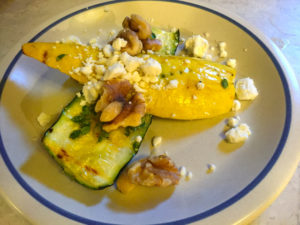
This recipe is an ideal side dish. It’s light and flavorful. While I cooked it outside on the barbecue, it could easily be made in the oven. The broiler would probably work the best.

Definitely would chop the nuts – something I didn’t do.

summer squashSummer Squash with Blue Cheese and Walnuts

½ C walnut halves

Kosher salt

Pepper

2 lbs mixed zucchini

¼ C olive oil

1 tsp lemon zest

3 T fresh lemon juice

1 T honey

1 tsp thyme leaves

2 ounces blue cheese, crumbled

Toast walnuts on the grill or in the oven or in a pan on the stove. Then chop them.

Quarter the summer squash lengthwise. Ideally all of the pieces will be about the same size.

In a large bowl, toss squash with 2 tablespoons olive oil and season with salt and pepper.

Grill all of the squash over moderately high heat, turning once until lightly seared.

In a small bowl whisk the lemon zest and juice with the honey, thyme and the remaining 2 tablespoons of olive oil; 
season with salt and pepper. Add the grilled squash and toss.

Serve squash with the crumbled blue cheese and toasted walnuts on top.


Culinary boot camp at LTCC

South Lake Tahoe’s regional adult education network, Advance, will debut a culinary boot camp this fall, rolling out a workplace skills program to align with the beginning of the winter hiring season.

Developed with the guidance and input of local culinary industry leaders and employers, this 40-hour program will offer participants an intensive, hands-on experience learning the basic skills, terminology, and practices of a professional kitchen. Topics will include kitchen sanitation and safety, knife skills, butchery, baking, cost controls, and more. Students will prepare a series of meals in Lake Tahoe Community College’s full-sized commercial kitchen, studying each step from planning and preparation to completion and cleaning.

There will be two schedules. A one-week program will offer participants an immersive experience working eight hours per day, and a five-week course with a pair of four-hour meetings each week.

This workshop is intended both to familiarize prospective chefs with basic culinary skills and to provide a refresher course to current employees or those seeking promotion

For more information, contact Josh Sweigert at 530.541.4660, ext. 672 or sweigert@ltcc.edu


Spending on alcohol continues to rise

By Bill Swindell, Santa Rosa Press Democrat

Total U.S. alcohol spending for the past 12 months has increased 3.8 percent, according to a report, as consumers continue to trade up for more expensive brands.

Total U.S. consumer spending on alcoholic beverages was at $229.8 billion for the past 12 months ending Aug. 31, according to the consulting firm bw166, analyzing state and federal data.

Spending may be up, but consumption has stayed substantially the same.

Read the whole story


Sandoval calls for more appealing school lunches

By Sandra Chereb, Las Vegas Review-Journal

Cafeteria lunches have been the butt of jokes for generations of schoolchildren. Mystery meat, chef’s surprise and cardboard often come to mind.

Jokes aside, it’s a conundrum Gov. Brian Sandoval contemplates seriously. Why can’t school lunches taste better?

Sandoval raised the issue Tuesday as the state Board of Examiners approved nine contracts between the Nevada Department of Agriculture and various vendors worth $16.7 million to provide food for school breakfast and lunch programs. Funding comes from the federal government.

Read the whole story


Time to harvest pine nuts in Nevada

The pine nut harvest season is under way on lands managed by the Nevada Bureau of Land Management and Humboldt-Toiyabe National Forest.

The length of the pine nut harvest season varies depending on crop quality and seasonal weather conditions. It is generally September to late October when pine nuts are still available for harvest.

The BLM and U.S. Forest Service have two types of pine nut harvesting: personal use and commercial use. Personal use is the harvesting of relatively small amounts of pine nuts not intended for sale. Commercial use is when harvesters intend to sell their nuts or if they are harvesting large quantities for personal use.

Individuals may gather up to 25 pounds of nuts per season/per household without a personal use permit and at no charge. Anyone who would like to gather more than 25 pounds must contact their local BLM or Forest Service office.

Even though the general public is allowed to harvest pine nuts under personal use without obtaining a permit at one of the BLM or U.S Forest Service offices, it is recommended that individuals stop by the local office to obtain specific pine nut harvesting information. This information could include maps of good crop areas, closure information, fire restrictions, areas to avoid, and more.

Personal use harvesting is allowed anywhere that pinyon pine trees may be found on BLM managed lands. The Ely and Battle Mountain Districts have issued a total of 10 commercial permits for the collection of just over 90,000 pounds of pine nuts.

For more information on BLM commercial use,  contact Coreen Francis at 775.885.6161 or c1franci@blm.gov.


Sustainable wine industry a work in progress

By Kathryn Reed

INCLINE VILLAGE – Economically, wine is huge for California – it’s a $58 billion industry, attracts 24 million tourists a year and employees 30,000 people.

But it’s not the most environmentally friendly crop. UC Davis wants to change that reality.

Jill Brigham, executive director of the Sustainable Wine and Food Processing Center at UCD, gave a talk last week at Sierra Nevada College about the science of wine and how to optimize the sustainability of winemaking.

“Just with winemaking it takes six volumes of water for every volume of wine that is produced. We want to reduce that to 1:1,” Brigham said. “Irrigation and growing of grapes takes a lot more, but it varies greatly.

“We want to teach our students to respect the earth and make wine in the most sustainable way.”

While there is a vineyard and full winery on campus, none of the wine produced is for consumption or sale. Yes, students get to taste it, but it’s all part of the learning process. Lots of spit buckets are on site with the goal of not much being swallowed. (The Legislature last year approved a bill allowing students younger than 21 to be in a class with wine tasting as long as spitting was the protocol.)

It was state lawmakers who in 1880 mandated UC regents create a viticulture program at UC Berkeley. A vineyard was planted at Davis in what became the university. The program went away during Prohibition, but was resurrected in 1935 at was then UC Davis.

While the winery building on campus is green – LEED platinum – the art of winemaking has a ways to go to be as efficient.

The university is in the process of creating wine that is sustainable. This will include multiple uses for water – recycling what comes off the roof and reusing what is used in the winemaking process. How the soil and end product reacts to the grey water is being studied.

Various root stocks are being studied to find ones that use less water. Davis has 300 varietals in its vineyards.

The university is partnering with General Electric on a reverse osmosis system to create potable water.

Water is huge in the wine industry, right down to needing to sanitize the bottles.

“A big part of the carbon footprint is the bottle,” Brigham said. “Hopefully, we will see better wines put in wine boxes. Glass bottles are also heavy and it impacts transportation.”

The college is also looking at capturing the carbon dioxide that is released during the fermentation process.

Solar panels are in place to generate energy, with the excess being stored in lithium batteries. The winery is creating more energy than it uses. Solar is powering the ice machine.

One area that uses a ton of energy is refrigeration. Studies are under way to see how that consumption can be reduced.

Even though the Sacramento Valley has weeks where the mercury hits triple digits, the winery has no air conditioning. The building is that well insulated. At night windows or ventilation ducts draw in the cool air to reduce the temp inside and it stays that way the entire next day.

The goal is any innovations the university creates would then eventually be used throughout the industry.


Beer and wine festivals at Squaw on long weekend

The Village at Squaw Valley kicks off Labor Day Weekend with the return of the 27th annual Foam Fest and the 28th annual Alpen Wine Fest.

The Foam Fest is where beer enthusiasts may sample more than 40 craft breweries. Last year’s festival raised more $30,000 for Achieve Tahoe, a nonprofit that brings people with disabilities to the slopes.

The Alpen Wine Fest allows wine enthusiasts to sip on a variety of wines from Northern California. Last year’s festival raised more than $40,000 for Can Do Multiple Sclerosis, a nonprofit providing supportive and empowering programs for people and families living with Multiple Sclerosis.

Foam Fest is from 2-6pm on the KT Sun Deck. Tickets are $30 with advanced online purchasing, $35 at the door, and $10 as a donation fee for entry without beer. Kids 12 and under are free. For more information or to purchase tickets, go online.

The Wine Fest is from 2-5pm at the village. Tickets are $40 now, $50 day of the event.


K’s Kitchen: Incredible summer dessert

By Kathryn Reed

You’ll want to devour this dessert. It’s decadent, delicious and divine.

Having a cordial with dessert is rather common, especially at restaurants. This concoction is the libation and dessert in one.

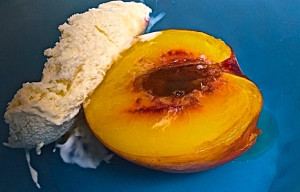
With peaches being so wonderful right now, this is the perfect way to end a summer dinner. It would be just as easy to grill the peaches, which would also give it a slightly different taste than the oven.

It’s fast, so if you are serving it to guests, you will not be taken away from the party for long.

peachesAmaretto and Peaches

5 peaches, halved and pitted
1 T butter
½ C Amaretto
¼ C brown sugar
1 tsp vanilla

Vanilla ice cream, optional

Heat the butter, Amaretto, sugar and vanilla in a small saucepan until the sugar is dissolved. Remove from heat.

Baste the peach halves with the sauce. Place them cut side down in a pan. Cook in 350-degree oven. Turn after a few minutes, when peaches start to soften and skins begin to lightly shrivel. Then fill pit area with more sauce. Bake until liquid is absorbed.

Serve with ice cream. Spoon a little sauce onto each peach.