Balanced meals for seniors in El Dorado County

Looking for something different for lunch, something homemade, fresh and affordable? Look no further than the casual and friendly dining centers of the El Dorado County Senior Nutrition Program. Adults 60 years or older will find fresh homemade entrees that change daily Monday through Friday, and served between noon–12:30pm for the suggested donation of $3 per meal.

Enjoy a variety of tasty entrees carefully planned by a registered dietitian to meet one-third of an adult’s recommended dietary intake.

Dining centers are located in South Lake Tahoe, Placerville, Diamond Springs, Pollock Pines, Greenwood, Somerset and El Dorado Hills.

For more information, call the Senior Nutrition Program at (530) 621.6160. To learn more about other senior programs and services call Senior Information and Assistance at (530) 621.6369.


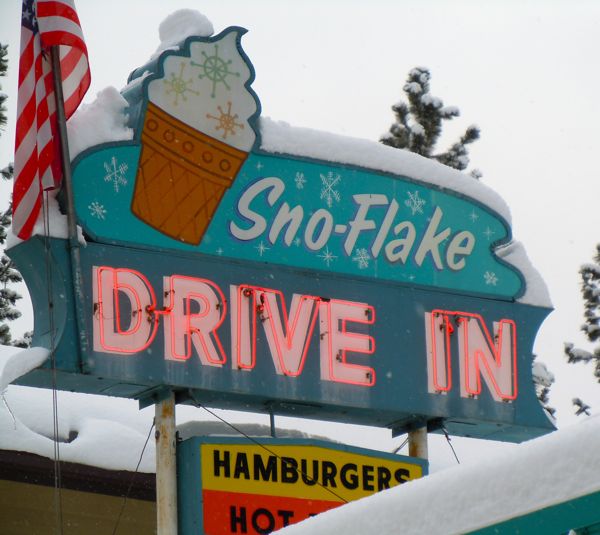
Sno-Flake celebrating 50 years of flipping burgers in Tahoe

By Kathryn Reed

Even after being harassed by his family every night for years that he smelled like French fries when he came home from work doesn’t keep Bill Schneider away from the Sno-Flake Drive-In.

He and his wife, Trudy, eat at the old-style hamburger joint every time they come to South Lake Tahoe – which is about once a month. The Minden couple owned the restaurant from 1989 to about 1992.

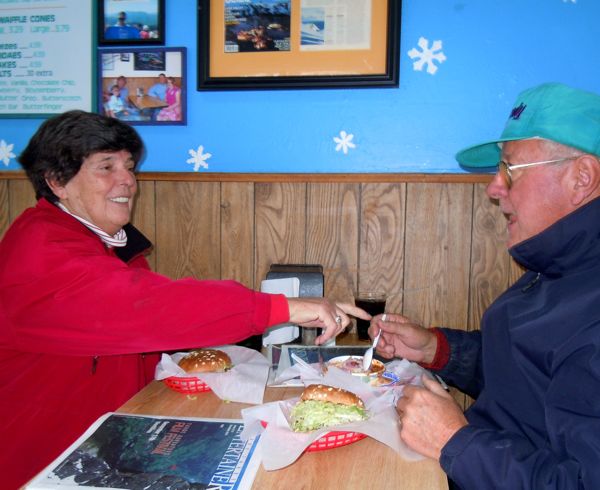
Trudy and Bill Schneider used to own the Sno-Flake. Photos/Kathryn Reed

Trudy and Bill Schneider used to own the Sno-Flake. Photos/Kathryn Reed

On Monday they were in town for their usual – turkey burgers.

Sno-Flake is in its 50th year, having opened July 19, 1961.

“When we bought it there was a lot of Mexican food. We changed it to hamburgers, French fries, chili and hotdogs,” Bill Schneider said as his burger and chili were delivered.

During their ownership it was the Alpine burger what was popular. The burger with Swiss cheese and a slice of ham is no longer on the menu.

“We didn’t make much money on it, but we had a lot of customers,” Schneider said.

For current owners Duncan and Lisa Sennott it is the $5.79 Tahoe burger that is the best seller. It comes with sautéed mushrooms, onions and Monterey jack cheese.

The Sennotts have owned the Sno-Flake for six years, having bought it from Pete and Susie Richards. The Richards bought it from the Schneiders.
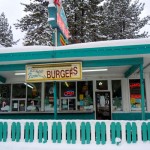
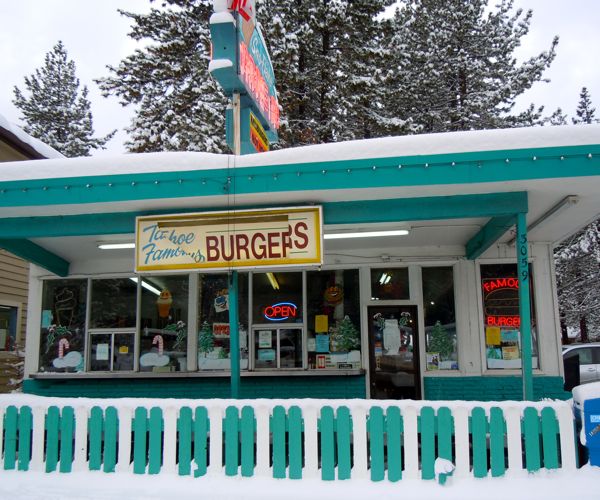
The Sno-Flake will be 50-years-old in 2011.

The Sno-Flake will be 50-years-old in 2011.

Every owner has made changes to the building as well as to the menu.

Duncan Sennott said regulars won’t let him take things off the menu, so he spends time adding to it. The one thing he did eliminate was the deep fried burritos.

“We have probably doubled the milkshakes and the health options,” Sennott said.

The Oreo shake is the most popular, but the seasonal shakes like the eggnog and pumpkin, which he is whipping up now, sell no matter the outside temperature.

Upgrading the ingredients started early, which includes using as much fresh stuff as possible.

“I wanted to make sure the food really tasted great,” Sennott said. “There’s not much I can cut. The burgers all have a following.”
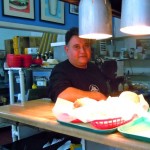
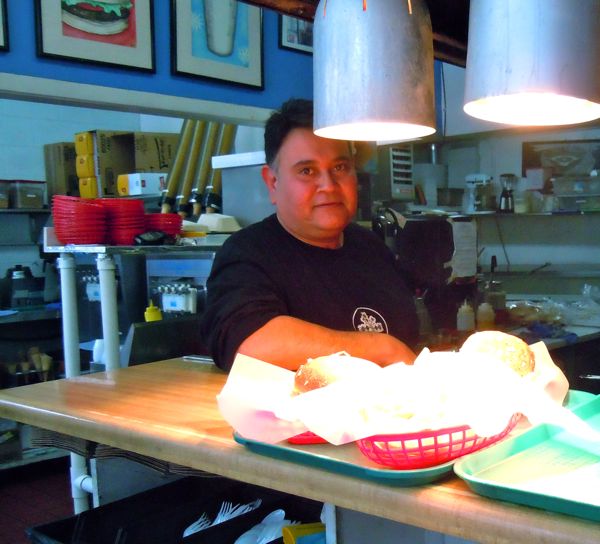
Cook Rene Rizo mans the kitchen.

Cook Rene Rizo mans the kitchen.

He said some people have been getting the same burger for the last 20 years.

The couple left life in corporate America to operate the burger joint. He used to be in international banking in San Francisco, while she was an attorney in the Bay Area. Lisa, who was his fiancée when they bought the place, now works for Laub & Laub.

Since buying the place they’ve added to their family. They have a 4-year-old daughter and 2-year-old son.

Duncan Sennott spends at least five days a week at the low-key eatery doing a bit of everything.

“I had been taking cooking classes at the culinary academy for years. We moved here and it seemed like a natural change,” Sennott said. He has no regrets, but admits it’s harder work than he ever imagined.

It’s the little things like being closed three days last week because the fire suppression system went off.

He’s not sure why Sno-Flake has lasted 50 years. Partly he thinks it’s the old building.

Sno-Flake workers know many customers by name.

Sno-Flake workers know many customers by name.

“It’s a time warp to my childhood,” Sennott said.

Consistently good, hot food are other reasons. Location hasn’t hurt either – being walking distance to El Dorado Beach. Lines are the norm during the summer. It’s one of the few places to get soft serve cones on the South Shore. French fry connoisseurs (like this reporter) swear by their fries.

As for how to celebrate Sno-Flake turning 50, Sennott doesn’t have all that worked out. But he is entertaining rolling back prices to 1961 – if only for a day.

California seniors eligible for food aid not applying for it

By Joan Aragone, AARP Bulletin

Bob Hyman, a retired salesman with health problems, stocks up at the weekly food pantry at his subsidized senior housing facility. From food provided by the San Francisco Food Bank, he selects carrots, cabbage, potatoes, celery, onions, apples, pears, canned beans, bread and rice.

“It’s a good program, and it helps,” he said. “It’s free. I’m thankful.” Chicken, which was formerly offered, hasn’t been available for months. He buys eggs occasionally at a nearby grocery store, “but it’s expensive.”

Hyman, 79, lives on a monthly income after rent of less than $700 from Social Security and a pension. He takes public transportation, eats $2 lunches at another senior housing facility and cooks at home. He dismissed any need for government food assistance. “I’m thrifty and smart about food,” he said.

Hyman is one of the estimated 90 percent of Californians over 60 who are eligible for the state’s CalFresh food assistance program but don’t participate.

Read the whole story


K’s Kitchen: Tortilla Black Bean Casserole

By Kathryn Reed

A few dishes I know how to make by memory, though this actually means it’s never made the same way twice. Such is the case with the tortilla black bean casserole.

kitchenI just made it. And then I thought I would go see what I do differently from the recipe. That’s always an interesting revelation.

I have not been putting cumin in my mixture. I must remember to remedy that next time I make the recipe. And I seldom put in tomatoes because I put in more picante sauce than the recipe calls for.

Unfortunately, I don’t remember where I originally got the recipe. Maybe I have adjusted it enough to call it my own creation.

What I like about this medley of food is the spiciness can be adjusted depending on who else is at the table, it feeds a lot of people and it tastes even better the next day. Plus, it freezes well for leftovers down the road. Even better, it’s easy and fast to make.

The cheese can be whatever you like. If you have bigger tortillas, just wing it. When I have fresh cilantro I throw it into the mix or on top or serve on the side – or all of the above. Sour cream and avocado go with most any Mexican dish.

For a complete meal I like to serve it with Spanish rice and a green salad.

Tortilla Black Bean Casserole

1 medium-large onion, chopped

1 green pepper, chopped

1 16oz. jar picante sauce

2 cloves (at least) garlic, minced

2 tsp ground cumin

2 15 oz. cans black beans, drained

12 6-inch tortillas

2 C (at least) Monterey jack cheese, grated

1 can diced green chilies

In large skillet, combine onion and green pepper. Sauté until onion is transparent. Add garlic, cumin and picante sauce. Bring to boil, reduce heat. Simmer uncovered for 10 minutes. Stir in beans and green chilies.

In 9×13 pan spread 1/3 of bean mixture, top with tortillas, overlapping as necessary, then half of the cheese, more beans, tortillas, beans and cheese.

Bake in 350-degree oven for 30-35 minutes or until heated through.


Sonoma County vineyards to irrigate with wastewater

By Clark Mason, Press Democrat

Wastewater and winegrapes may not seem like a complementary pairing, but they soon will be in Healdsburg.

The City Council on Monday unanimously approved a project to irrigate more than 300 acres of vineyards with highly treated wastewater from Healdsburg’s new state-of-the-art treatment plant.

The reclaimed water could be used as early as next summer on vineyards owned by Syar Industries that surround the $32 million plant west of town.

Reclaimed water has been used for years on wine grapes and other crops in parts of Sonoma County that include the prestigious Carneros region, according to Jim Flugum, Healdsburg’s assistant public works director.

“It’s not new. It’s just new in the northern part of the county,” he said.

The city had to get the approval of state water regulatory officials and address the concerns of clean-water advocates before it could proceed.

Read the whole story


What food says about class society in the U.S.

By Lisa Miller, Newsweek

For breakfast, I usually have a cappuccino—espresso made in an Alessi pot and mixed with organic milk, which has been gently heated and hand-fluffed by my husband. I eat two slices of imported cheese—Dutch Parrano, the label says, “the hippest cheese in New York” (no joke)—on homemade bread with butter. I am what you might call a food snob. My nutritionist neighbor drinks a protein shake while her 5-year-old son eats quinoa porridge sweetened with applesauce and laced with kale flakes. She is what you might call a health nut. On a recent morning, my neighbor’s friend Alexandra Ferguson sipped politically correct Nicaraguan coffee in her comfy kitchen while her two young boys chose from among an assortment of organic cereals. As we sat, the six chickens Ferguson and her husband, Dave, keep for eggs in a backyard coop peered indoors from the stoop. The Fergusons are known as locavores.

foodAlexandra says she spends hours each day thinking about, shopping for, and preparing food. She is a disciple of Michael Pollan, whose 2006 book The Omnivore’s Dilemma made the locavore movement a national phenomenon, and believes that eating organically and locally contributes not only to the health of her family but to the existential happiness of farm animals and farmers—and, indeed, to the survival of the planet. “Michael Pollan is my new hero, next to Jimmy Carter,” she told me. In some neighborhoods, a lawyer who raises chickens in her backyard might be considered eccentric, but we live in Park Slope, Brooklyn, a community that accommodates and celebrates every kind of foodie. Whether you believe in eating for pleasure, for health, for justice, or for some idealized vision of family life, you will find neighbors who reflect your food values. In Park Slope, the contents of a child’s lunchbox can be fodder for a 20-minute conversation.

Over coffee, I cautiously raise a subject that has concerned me of late: less than five miles away, some children don’t have enough to eat; others exist almost exclusively on junk food. Alexandra concedes that her approach is probably out of reach for those people. Though they are not wealthy by Park Slope standards—Alexandra works part time and Dave is employed by the city—the Fergusons spend approximately 20 percent of their income, or $1,000 a month, on food. The average American spends 13 percent, including restaurants and takeout.

And so the conversation turns to the difficulty of sharing their interpretation of the Pollan doctrine with the uninitiated. When they visit Dave’s family in Tennessee, tensions erupt over food choices. One time, Alexandra remembers, she irked her mother-in-law by purchasing a bag of organic apples, even though her mother-in-law had already bought the nonorganic kind at the grocery store. The old apples were perfectly good, her mother-in-law said. Why waste money—and apples?

Read the whole story


Uncertainty swirls around pesticide OK’d for state strawberries

By Kurtis Alexander, Santa Cruz Sentinel

State regulators plan to give strawberry growers the OK to use methyl iodide this month.

The pesticide, which kills bugs, weeds and disease that are particularly threatening to berries, is touted as a better alterative to methyl bromide, which is being phased out because of harm it’s done to the ozone layer. But a last-ditch campaign is under way to halt approval of methyl iodide, citing problems with the alternate choice.

“We’ve heard that methyl iodide is a carcinogen. That’s not disputed…. So why are we even having this conversation?” said state Assemblyman Bill Monning, D-Carmel.

Monning was among a coalition of environmentalists, researchers and organic farmers that gathered Monday at Jacobs Farm in Santa Cruz County – and at six other sites statewide – protesting the impending use of methyl iodide and asking the governor or governor-elect to block it. The Legislature, Monning said, was not in a position to intervene now and future legislative efforts would be slow and uncertain.

“We want to stop it before it’s in the fields,” he said.

Critics of methyl iodide cite not only the proven cancer-causing qualities of the pesticide but the potential for methyl iodide to leach out of the field and contaminate water supplies.

Read the whole story


Winery owner believes petite sirah ideal for Sierra foothills

By Mike Dunne, Sacramento Bee

One way to cut down the number of wines to sample at a tasting where hundreds are being poured is to ask each winemaker for a taste only of his or her flagship wine.

The wording is important: Don’t ask for a taste of the favorite wine – you run the risk of hearing that tired refrain that asking vintners to pick their favorite wine is akin to asking them to pick their favorite child.

At the Family Winemakers of California tasting in San Francisco late this summer, the most surprising answer to the flagship question came at the table of C.G. Di Arie Vineyard & Winery of El Dorado and Amador counties.

Without pause, owner-winemaker Chaim Gur- Arieh singled out petite sirah. That was startling – he seemed likely to name a wine that more often is credited with bringing attention and acclaim to his winery, such as primitivo, zinfandel, barbera or syrah among his varietals; or among his blends, a proprietary release like “Sierra Legend,” a finely tuned mix of Italian and French grapes.

Read the whole story


Bring out the Barrel wine tickets on sale

Bring out the Barrel tickets are on sale.

The Jan. 29-30 event in El Dorado County allows people to enter winemakers’ cellars and be among the first to taste what they’re calling “an extraordinary vintage” — straight from the barrel.

Light food pairings and special sales of limited quantity wines are part of the weekend event.

A Weekend Pass good both days is $20; Sunday only $15; designated drivers $10; Friends 4-Pak is four for the price of three.

Advance sales online only.

Prices increase $5 after Jan. 23.


Senate passes major U.S. food safety legislation

By Andrew Zajac, Los Angeles Times

WASHINGTON — After languishing for more than a year, a food-safety bill that has enjoyed strong bipartisan support passed the Senate on Tuesday, raising prospects for tougher and more extensive federal inspections and other safeguards.

The bill, which President Obama supports, still needs to be reconciled with differing provisions in legislation passed by the House in July 2009.

But the Senate action was cheered by advocates as a sign that the long delay could be nearing an end and that the nation’s food-safety laws will receive their first major overhaul in decades.

Read the whole story