Opinion: We need true discourse, not a cheer(leader)

To the community,

In Mayor Claire Fortier’s June message to the community, she spoke of a trip to Monterey and Livermore sponsored by TahoeChamber.org. The mayor’s purpose of sending the message was to cheer the good things those cities have done to rebuild Monterey and Livermore. The mayor spoke warmly about Livermore’s rerouting a main artery. The later was a subtle endorsement of the purposed loop road in South Lake Tahoe without using the term loop road. The mayor contends that Tahoe is “… a place with a vision, not a quagmire of contention. Let’s hope we can realize that vision and not stall in fear or indecision.”

Bill Crawford

Of course the mayor may cheer for whatever she wishes to cheer for. However, her hopes and cheers should not stop discourse and discussion on any subject that’s vital to the general public. Contentions arise out of need. South Tahoe is a border town and often the state line divides us in more ways than one. Example: For whatever reasons the City Council and Douglas County reps have canceled planning meetings.

The bottom line is some folks fear discourse because they might lose the debate or have to compromise. It is vital to have discourse on the loop road because if it gets done, it will not ever be undone. Also, some rushed to start the convention center, the crater in the ground. Well, it hasn’t been done, and there is no vision in sight to undo what was incompletely done. We need a healthy dose of skepticism and caution to avoid another quagmire like the convention center.

Bill Crawford, South Lake Tahoe


California chefs attempt to repeal foie gras ban

By Jesse McKinley, New York Times

PEBBLE BEACH — The countdown to foie-mageddon has begun.

With less than a month until California’s first-in-the nation ban on foie gras takes effect, fans of the fattened duck and goose liver are buying out stocks of the delicacy, searching for legal loopholes and sating themselves at a series of foie-heavy goodbyes.

“We want to get our fill before it’s gone,” said Terrance L. Stinnett, a lawyer from Alamo, who attended a farewell lunch here recently. “This is a wake.”

July 1 is the start date of the hotly debated and divisive ban, which prohibits the sale of any product derived from the force-feeding of birds to enlarge their livers — the only way to mass-produce foie gras. (The law was passed in 2004, but included a seven-and-a-half-year grace period.)

As the deadline approaches, some of the best-known chefs in California — including Thomas Keller, Gary Danko and Michael Mina — have been mounting a repeal effort and promising new ethical standards. But they are also making practical preparations for the likelihood that they won’t be able to overturn the law before it takes effect. Even opponents of the ban say going to bat for high-priced foie gras, after all, isn’t exactly an easy political stance in an age of animal rights and fiscal austerity.

So how will chefs replace foie gras, with its butter-soft texture and rich, subtle taste? The short answer, they say, is that they can’t, and the sense of loss is palpable.

Read the whole story


Placer County wrestles with declining revenues

The Placer County Board of Supervisors adopted a proposed 2012-13 budget this month, a move that ensures the county will have a balanced spending plan in place when the next fiscal year begins July 1.

Development of the five-year strategy is part of the board’s ongoing efforts to protect the county’s fiscal health and preserve core services despite revenue losses caused by the economic slowdown and state budget crisis. The strategy also will seek to ensure that board priorities are met over the next five years.

A draft strategy will be presented to the board in the coming weeks.

The plan will look at ways to:

Reprioritize revenues to more fully implement board priorities;

Pursue strategies that will allow the county to best meet resident needs with limited resources;

Reduce the use of one-time revenues for ongoing operations; and

Increase the General Fund reserve to position the county to withstand the next economic downturn.

By adopting the proposed budget, board members completed the first of the county’s two-phase budget-development process. The board is scheduled to have budget workshops Aug. 16-17, have a public hearing on a proposed final budget Sept. 11 and adopt a final budget Sept. 25.

Interim County Executive Officer Holly Heinzen emphasized the $690.1 million proposed budget will preserve core services to the public, but notes the county continues to face budget challenges in such areas as library services, fire protection, deferred building maintenance and capital infrastructure needs.

The proposed budget is $59.2 million or 7.9 percent lower than the 2011-12 budget, largely due to a $53.9 million reduction in the county infrastructure budget. Infrastructure funding was higher a year ago because of two major projects: a seismic retrofit and paint job under way on the Foresthill Bridge and construction of a jail at the county’s Bill Santucci Justice Center in Roseville.

Property tax revenue, the county’s leading source of discretionary revenue, is projected to drop by 1.1 percent next fiscal year. That would result in a cumulative loss of $16.4 million, or 12.4 percent, in property tax revenue since the 2007-08 fiscal year.

Since 2007, the general fund budget has dropped $17.8 million, or 4.8 percent, and the size of the county workforce is down 15.4 percent to approximately 2,150 filled positions as a result of the hiring freeze.


What is the best thing to come out of the Angora Fire?


Students help environment, learn about yesteryear Tahoe

By Kathryn Reed

CAMP RICHARDSON – Ridding the swales between Tallac and Taylor creeks of invasive species could help reverse the decline of native fish species so in future years third- and fourth-graders might be able to see what the Washoe were accustomed to harvesting from Lake Tahoe.

Back in the day when Washoe summered at the lake and wintered in the Carson Valley, there was a two-week period when they could wade knee-deep into the lake and come out with a basket full of fish.

“There was a seasonal abundance that Lake Tahoe would provide,” Joy Barney, conservation education coordinator with the U.S. Forest Service, explained.
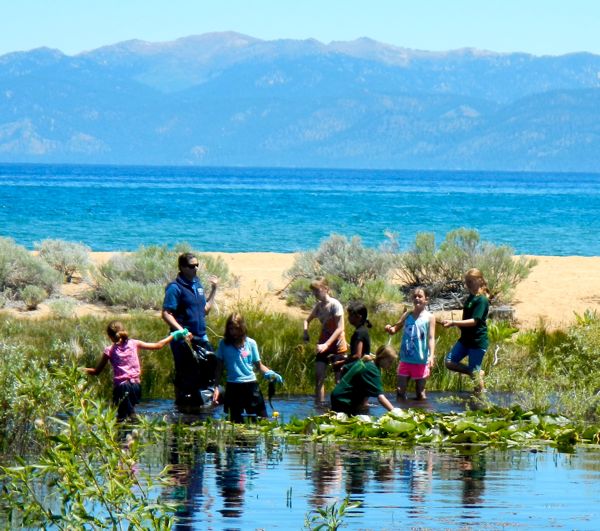
Fifth-graders from the magnet school on June 12 pull milfoil from the swale at Baldwin Beach. Photos/Kathryn Reed

Part of what fourth-graders were learning Tuesday is the historic food web and then comparing it to today.

Speckled dace, tui chub, Lahontan, redsides, Tahoe sucker – while all these fish still exist in Lake Tahoe, their numbers are dwindling because of invasive species.

Meandering through the various old estates that are now owned by the Forest Service, the children are broken into groups to be taught Trees are Terrific, Ways of the Washoe (which has been approved by the tribe) and Founding Families.

For many of the youngsters, this is their first trip to this part of the South Shore. The same could be said for some of the parent chaperones.

Valhalla to Baldwin Beach became an outdoor classroom on June 12 for third-, fourth- and fifth-graders from the environmental magnet school. Third- and fourth-graders in Lake Tahoe Unified and Incline have been spending time at the Tallac Historic Site learning outside the classroom — but using curriculum that meets state requirements.

“The overall theme of the day for the Children’s Forest program is that people and the environment are and always have been intricately connected,” Barney told Lake Tahoe News.

At Baldwin on this particular day are the fifth-graders from the Meyers school. Looking at this small body of water that sits at the edge of the parking lot it seems like a swamp that rational people would not willingly venture into. The beach separates this unattractive wet area from Lake Tahoe.

While the swale is natural in its formation, what isn’t native is what’s living in it – Eurasian milfoil and bullfrogs.

Students are pulling the milfoil out by hand.

“It feels slimy (in the water), but when it comes out, it feels like a leaf plant,” student Summer Furrer says.

She pulled out about 10 handfuls that went into one of the seven garbage bags her class collected.

Part of the class helped put a large black mat that is something like permeable landscaping cloth at the bottom, center part of the swale. This will essentially smother the milfoil, while allowing for oxygen to get to the macro invertebrates that might be under the covering.

What stopping the photosynthesis process does is one of the educational components of the day.

Forrest McCann is articulate beyond his years – clearly demonstrating some adults are not smarter than a fifth-grader.

Part of Barney’s time in the classroom that preceded the field trip was to talk about interpretive signs – what they are good for, how to write one and how to illustrate one.

McCann’s “Save the Swale” sign is so good that it may become the actual sign the Forest Service posts to educate people who come to the area.

This is one of four swales in the area.

Some students are in waders and booties, some are in shorts. All are getting wet to some degree. The deepest part of this particular swale is 3½ feet. Measuring the swale was part of the job for the day – and one way it became a math lesson.

While the students this day are not dealing with the estimated 500,000 bullfrogs that call this area between Tallac and Taylor creek waterways home, they know it would be better if they literally croaked.

“The bullfrogs are bad because they eat native species and make the water dirty,” McCann said.

Sarah Muskopf, aquatics biologist with the Forest Service, is the mastermind behind this particular project. In her waders, she is in the water with the students to help and educate at the same time.

She explains the three treatments going on – hand pulling, the fabric liner and then the jute, which is a rope-like mat that will not have to be removed.

The learning process will continue in the fall when other students will remove the fabric barrier to see if it worked to get rid of the milfoil.

“Even when the whole swale is treated, it will need to be maintained,” Muskopf explained. “It’s like weeds in a yard, it’s never a done deal.”

ngg_shortcode_0_placeholder (Click on photos to enlarge.)



Douglas County’s Kite bounced from Assembly

Three-time Douglas County commissioner and current assemblyman for the area Kelly Kite lost his seat Tuesday night.

Jim Wheeler won the Republican primary for Assembly District 39 with 2,397 votes (41.54 percent). Kite had 2,012 votes (34.87 percent), and Gary Schmidt 1,361 votes (23.59 percent). Wheeler will face Independent American candidate David Schumann in November.

In the Douglas County Commission race, Barry Penzel came in with 46.21 percent of the votes (2,515), Michael Olson 38.37 percent (2,088), and Dianne Humble 839 (15.42 percent).

The Las Vegas Sun reports, “The establishment GOP candidates for state Senate made a clean sweep Tuesday over the more conservative candidates, giving Republican leaders the races they wanted in their effort to take over the state’s upper house. Senate Republicans need to win four out of five competitive seats in November to take back control of the state’s upper house for the first time since 2007.”

Nevada News Bureau says, “The big surprise of the night in the primary may have been the overwhelming defeat of state Sen. John Lee, D-North Las Vegas, in the Democratic primary against newcomer Patricia Spearman. Spearman had 63 percent of the vote to 37 percent for Lee.”

 — Lake Tahoe News staff report


Image caught by camper confirmed to be wolverine

By Bill Lindelof, Sacramento Bee

A Sacramento man believes he has snapped a live picture of what only remote motion-sensitive cameras have captured before: a wolverine in the Sierra Nevada.

David Messa, 51, was on a camping trip in Nevada County on May 19 when around nightfall he took a picture of a creature walking on a thawing lake.

Wildlife biologists working for the U.S. Forest Service and the state Fish and Game Department on Thursday confirmed that the animal is a wolverine.

The rare sighting came at 8:41 p.m. during an all-day hike at Beyers Lake.

“It was fairly dark,” Messa said Thursday. “I hear him come galloping across the lake. I wasn’t sure exactly what it was.”

Read the whole story


Strategist brought in to help resolve Raleys’ union-management strife

By Dale Kasler, Sacramento Bee

After a week of strike talk and increasing bitterness, Northern California supermarket workers have called in a strategist from their union’s international headquarters to help with stalled contract negotiations.

William McDonough, director of bargaining for the United Food and Commercial Workers, came to the Bay Area on Monday at the invitation of the three UFCW locals in Northern California.

Union officials and labor experts said it’s common to bring in reinforcements when negotiations aren’t going well. The Northern California supermarket talks have dragged on since last fall.

“This is getting late in the game in the bargaining, so it’s not unusual,” said Mike Henneberry, a spokesman for UFCW Local 5 in San Jose. He said McDonough helped the union obtain a new contract in Southern California last fall after eight months of negotiations.

McDonough’s arrival in Northern California followed one of the most difficult weeks yet in the contract talks.

First, Raley’s workers voted to authorize a strike against the West Sacramento grocery chain. Then, a three-hour bargaining session Friday ended with the UFCW and Raley’s seemingly farther apart than ever.

Read the whole story


Sierra hosting mud obstacle race for all ages, abilities

The Tahoe Tri Club will host its first mud obstacle race at Sierra-at-Tahoe on July 14.

The spectator-friendly course starts at an elevation of 6,800 feet and offers multiple options for distance and age.

Organizers say the race course will be built by a sadistic crew of licensed contractors designed to test people’s strength and fortitude. Three levels of competition will be offered for adults including a Green Route that is four-miles long, a Blue Route that is seven-miles long and a Black Route that is 11-miles long.

Challenging obstacles along the way will include ropes, ice baths, nets, wall climbs, beams, and the ever-popular slip ‘n slide.

Families are also welcomed to participate in the Kiddie Recon, where children ages 7-14 tackle a one-mile course with six to eight obstacles or children ages 6 years old and under conquer a half-mile course with four to six obstacles.

Racers start and end on the Broadway trail.

Music by Lavish Green, and food and beverages will be on on the Tiki Deck.

The awards ceremony will be hosted in Opal Lounge at MontBleu at 5pm where winners will be crowned, and participants can view photos and videos from the race.

Participants may register online or on race day at Sierra-at-Tahoe from 7-10am. The cost per person is $65 for the Green Route, $75 for the Blue Route, and $85 for the Black Route until June 30, when prices will increase. The Kiddie Recon will be $35 in advance and $45 on the day of the race.


Americans saw wealth plummet 40% between 2007-10, Federal Reserve says

By Ylan Q. Mui, Washington Post

The recent recession wiped out nearly two decades of Americans’ wealth, according to government data released Monday, with ­middle-class families bearing the brunt of the decline.

The Federal Reserve said the median net worth of families plunged by 39 percent in just three years, from $126,400 in 2007 to $77,300 in 2010. That puts Americans roughly on par with where they were in 1992.

The data represent one of the most detailed looks at how the economic downturn altered the landscape of family finance. Over a span of three years, Americans watched progress that took almost a generation to accumulate evaporate. The promise of retirement built on the inevitable rise of the stock market proved illusory for most. Homeownership, once heralded as a pathway to wealth, became an albatross.

The findings underscore the depth of the wounds of the financial crisis and how far many families remain from healing. If the recession set Americans back 20 years, economists say, the road forward is sure to be a long one. And so far, the country has seen only a halting recovery.

“It’s hard to overstate how serious the collapse in the economy was,” said Mark Zandi, chief economist for Moody’s Analytics. “We were in free fall.”

Read the whole story