Amador County casino debate reignited

By Peter Hecht, Sacramento Bee

The last time the town of Plymouth and its 980 residents felt so agitated about the prospect of an Indian casino rising on their golden meadows, voters recalled the mayor and two other City Council members.

Jon Colburn made sure one of those getting the boot was his own brother, then-council member Gary Colburn.

“I helped run it,” Jon Colburn, 72, said of the 2004 recall. “The people were pissed off. They gave their opinion and the council said, ‘We don’t care.’ ”

Now, rural Amador County faces the possibility of having not one but three tribal casinos – a development that has reignited tensions and the Colburn family feud in Plymouth.

On May 25, the U.S. Bureau of Indian Affairs ruled that the Ione Band of Miwok Indians has the right to take 228 acres into trust as tribal land to build a proposed $250 million gambling resort just off Highway 49 in Plymouth.

The decision comes as Amador, a county of 38,000 residents east of Sacramento that is home to the Jackson Rancheria Casino & Hotel, has been fighting a mostly losing legal battle to stop a third tribe – the Buena Vista Rancheria – from building a casino near the town of Ione.

In Plymouth, Gary Colburn, now 74, had joined City Council colleagues in 2004 in supporting negotiations with the Ione Band on an $85 million, 20-year agreement aimed at offsetting the effects of the tribe’s planned casino, a 120,000-square-foot structure with a five-story hotel and events center.

That effort, born of the belief that the town couldn’t stop the casino and should bargain for concessions, made Gary Colburn an ex-council member.

Now the issue is back, five years after Amador County unsuccessfully sued the federal government over the Plymouth project and six years after 84 percent of Amador voters declared in an advisory vote that they didn’t want more casinos in the county.

Read the whole story


Big ad money flowing into Nevada for presidential campaign

By Charlie Cook, National Reader

Everyone who avidly follows politics has his or her own list of the true “swing states” in this presidential election. The lists that really matter, however, are the ones kept by top strategists for the Obama and Romney campaigns, and the ones kept by the one large Democratic and five Republican-oriented super PACs and by other major presidential advertisers this year. Figures compiled by Elizabeth Wilner of Kantar Media’s Campaign Media Analysis Group show that, beginning on April 10—the day Rick Santorum dropped his presidential bid, effectively making Mitt Romney the Republican nominee—and through May 29, there have been 63,793 television spots run in 57 out of the nation’s 210 media markets.

CMAG figures look at all broadcast and cable, national, and local television ads in each of those 210 media markets. They are analyzed by CMAG’s staff and divided by the number of Electoral College votes that each state has. Nevada ranked first with $677,332 per Electoral College vote. Iowa came in second with $496,088, and Ohio was third with $467,068. In fourth place was Virginia with $331,680, followed by Colorado with $313,653. New Hampshire came in sixth with $283,342, and North Carolina came in seventh with $237,329. In eighth and ninth places, respectively, were Pennsylvania at $204,670 and Florida at $101,107. These data potentially call into question the Romney campaign’s seriousness about contesting Pennsylvania and about how long Democrats plan to compete for Florida.

According to Wilner, $8,407,220 was the total aired from April 10 to May 29 in Ohio alone—tops on the national list in total general-election television spending so far. Virginia was in second place with $4,311,840; Pennsylvania came in third with $4,093,400; and Nevada fell into fourth place with $4,063,990. Ranking fifth, sixth, and seventh were North Carolina with $3,559,940; Iowa with $2,976,530 (including spending in neighboring Omaha); and Florida with $2,932,110. Colorado came next with $2,822,880, followed by New Hampshire with $1,133,370.

Read the whole story


Lawmaker will take her vagina comments to Capitol steps

By Huffington Post

LANSING, Mich. — A Michigan lawmaker barred from speaking in the state House after she used the word “vagina” during a debate on an anti-abortion bill will participate in a performance of the Tony Award-winning play, “The Vagina Monologues,” on the state Capitol steps.

Michigan Democratic Party fundraiser Laura Hornshaw said Saturday in an email that Monday evening’s performance was planned in response to Rep. Lisa Brown not being allowed to speak on the House floor Thursday.

Read the whole story


TRPA: Angora creates personal and professional challenges

By Joanne Marchetta

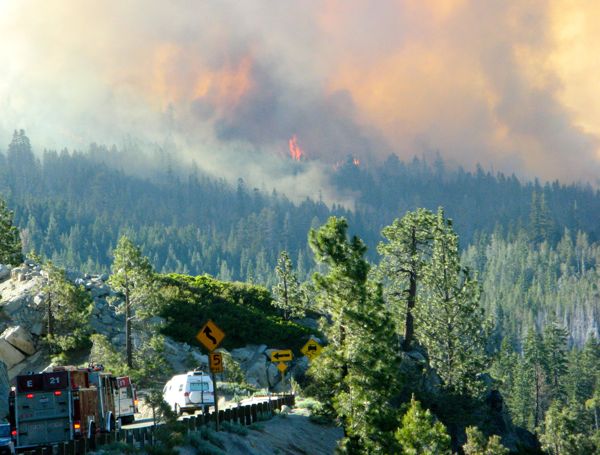
I was working at the kitchen table in the middle of a languid Sunday afternoon in June when I heard Nancy call to me, “Hey, come look at this.” We climbed to our second floor and both took a look from our upper deck. We could see a small white wisp of smoke far off in the distance toward Angora Ridge, and remarked to one another, “Hmm, that looks like a fire.” I recall the memory fleeting across my consciousness of the eerie experience of the Oakland Hills fire from years back when I lived in the Bay Area. And I immediately came back to the present and became aware of the day’s weather in Tahoe – unusually high winds and hot.

Angora Fire -- 5 years later

“Not good,” I thought to myself. I felt my stomach pinch with uneasiness, but I went back inside hoping for the best despite an edge of disquiet. Only five minutes later, just as I settled back into my task, I again heard Nancy call, “You really need to come outside and look at this.”

This time I heard the concern and emphasis in her voice and it left me a little startled. I hurried outside.

As we climbed up on the boulders across the street from our house, that white wisp in the distance we saw only minutes ago had transformed into a now pervasive, ominous black cloud hanging low over distant neighborhoods and Angora Creek drainage. As we stood there, other neighbors too began to gather at the top of the boulders to gain a vantage point. We looked at one another and chattered nervously.

One remarked, “I’ve lived here 20 years; this is serious.”

Another climbed down hurriedly off the boulders and jogged toward the fire station only three doors down on the corner. Minutes later, she returned saying, “Yes, it’s been reported and they’re on it. It’s under control.” We could take no real comfort from the report because of the dissonance of the scene we were living.

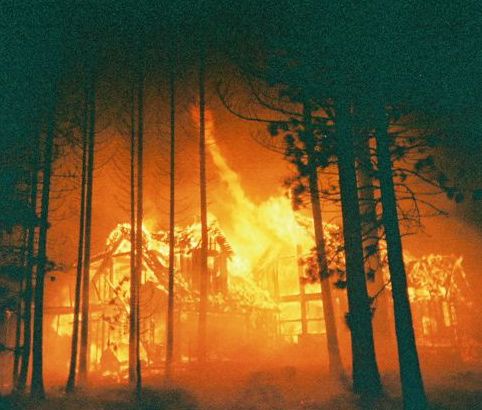
Now as we watched, we could make out bright red flames through the black smoke. It was clearly a fire and it was spreading fast. It was obviously in the tree canopy and the wind was whipping the speed of the spread. The neighbors looked at one another a last time and agreed, “We need to get out of here now.”

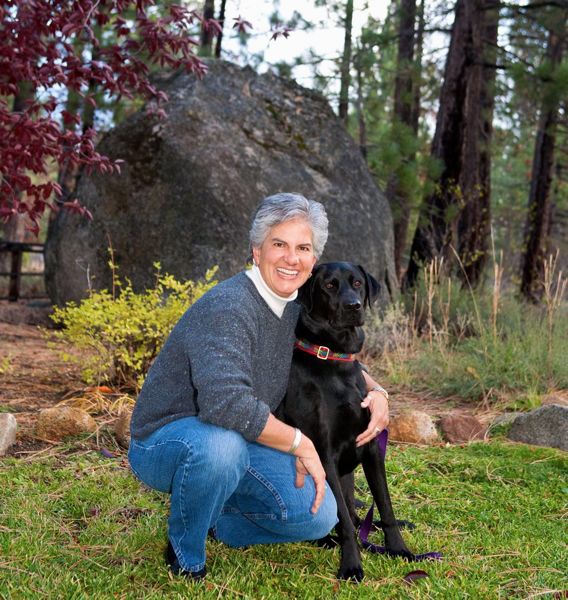
One of Joanne Marchetta's first priorities was to make sure her dog Zin got out of the fire safely. Photo/Joy Strotz

As we scrambled off the boulders, I took one last look that said it all. From that high vantage, we could no longer see through the wall of black smoke, but we could see the orange red flames of the crown fire on Clear View Circle only a block and a half away. The fire was headed straight toward us and was nearly on us.

It had been less than 20 minutes since we first saw the small white wisp in the distance.

We scrambled off the boulders and sprinted to the house. Now my heart was racing. We threw open the door, looked at one another with that twinge of adrenaline charged panic and succinctly agreed, “Get the dog and the fire box.” Beyond that, I recall grabbing one arm-full of clothes out of the downstairs bedroom closet, another arm-full from the chest of drawers and scrambled into the garage. I threw what I had grabbed into the back seat of the car. As I had passed by the kitchen window, I could see that the roof of the house behind ours had caught fire and recall yelling, “We need to get out now, the house behind us is burning!”

Nancy made sure the dog was safely secured in the car. Then we each stood for a brief moment in the garage with one car parked behind the other. Nancy said, “Should we take one car.” I said “No, we need to take both; I think it will be all that we have left after this.”

We quickly arranged to meet at the Raley’s parking lot to regroup. And as we pulled away from the house, we joined a procession of cars headed toward the Y, moving slowly but moving steadily away.

Only minutes later we rendezvoused at the Y shopping center, feeling bewildered and anxious. Noticeable were the burning and charred embers floating on the winds of that afternoon, and the smoke stinging our eyes and airways. We spoke briefly to neighbors again to trade cell phone numbers to make sure we could reach one another.

I said, “We need to get out of the basin, it’s still spreading.”

Not sure exactly where we could go, we knew we couldn’t stay stationary and again headed east on 50 trying to put distance between us and the fire. We stopped briefly at a point familiar at least to me, the TRPA parking lot, and regrouped again. Even at that distance, embers swirled in the air around us, carried miles from where we had last seen the fire. From there, we called friends in Gardnerville, asking if we could head their way. “Of course,” they said. “We are in Placerville and headed home now.”

They knew nothing at that point of the day’s event except they could see smoke even in Placerville, so they knew there was fire somewhere. We hung up the phone and dropped down Kingsbury out of the basin.

That evening, looking from the valley back toward the 10,000 foot mountains of the Lake Tahoe Basin, black smoke poured relentlessly out above the peaks into the upper atmosphere. We talked with our friends, but I don’t really recall anything we discussed. We were glued to local TV news reports. All I recall is the image of a certain TV clip replaying again and again that showed our back yard on fire, the dead and down logs in the back of the lot were burning. We couldn’t see the house in the blackness of the background of the video footage, but every time it played, I kept straining to try to see through to the image of the house. It lent no answers.

I haven’t owned or watched TV in 20 years for exactly this reason – it disassociates truth from experience. I didn’t know what to think, and ended up thinking the worst based on the TV clips, but honestly I could barely think a lucid thought at all. I felt numb and appreciative that we had good friends to be with in that moment.

I spoke briefly at about 9pm with Norma Santiago, El Dorado County supervisor and one of my TRPA board members. She knew I lived in the county, and was kind enough to call to find out my house number and location. She said she would let me know if she found out anything definite. In the middle of the night, my cell phone rang.

“Your house is standing.”

I made her repeat it, both the house number and the result. Again she said, “The best information we have is that your house is standing.”

I thanked her and cried just to release pure anxiety.

We stayed at MontBleu for 10 days afterward: with the dog in our hotel room, living out of the trunk of the car where we had flung the random belongings we grabbed without even a moment to think, and wearing the eclectic mix of clothes we had grabbed in the flurry to flee.

We were lucky. We were among those able to return to a house intact. We had defensible space, and that may have helped to save us from devastation. Even so, the fire seemed capricious. The winds had been so fierce and squirrely and the fire moved so fast, it was hard to say why one and not another house burned. The house with the cedar shake roof just across Lake Tahoe Boulevard withstood the siege while almost all of the houses farther up Boulder Mountain burned. It turned out that the fire claimed only two houses on our street – both on the corner and directly across from the Lake Valley Fire Station – nothing but cinders left of them. The fire melted the siding off a third house and then moved on.

The experience left me with an indelible truth. We are blessed to live in a forest and to call it home. With that privilege comes a special responsibility to live lightly, responsibly, and as special stewards of this magical and spectacularly beautiful place we are so fortunate to call home and haven.

I thank the firefighters for risking their lives to protect us and I thank the community for coming together afterward to help those who lost so much. I am proud to call Tahoe my home and my reverence for the place and the people has only grown since the humbling experience of nature’s indomitable force that we were so powerless to reckon on that night of June 24, 2007.

Joanne Marchetta is executive director of the Tahoe Regional Planning Agency and was chief counsel for TRPA at the time of the Angora Fire.


Landscaping becomes a challenge as Mother Nature changes

By Linda Fine Conaboy

Nearly five years ago as I drove my SUV from Reno to South Lake Tahoe to cover the aftermath of the Angora Fire for a Reno magazine, the farthest thing from my mind was the vegetation.
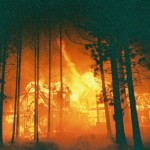
Angora Fire -- 5 years later

My photographer and I were assigned to interview residents and bring back a firsthand report on the devastation that we had only heard or read about in Reno.

As we edged our car into the long line of returning evacuees, we accepted rubber gloves and masks from one of the many volunteers at one of the checkpoints, not knowing exactly how and if we would use them.

It didn’t take long before we realized the masks were important gear as we entered what looked very much like what I expect a war zone may look, including the shell-shocked expressions on many of the faces of the people inspecting their once pristine property.

Smoke streamed lazily upward as if it were escaping from unseen vents drilled into Mother Earth, making the air unpleasant enough that we decided to wear the masks, like many of the returnees.
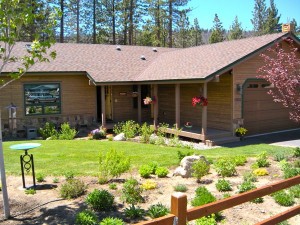
Houses in the Angora burn area were featured on a 2010 home tour. Photos/LTN

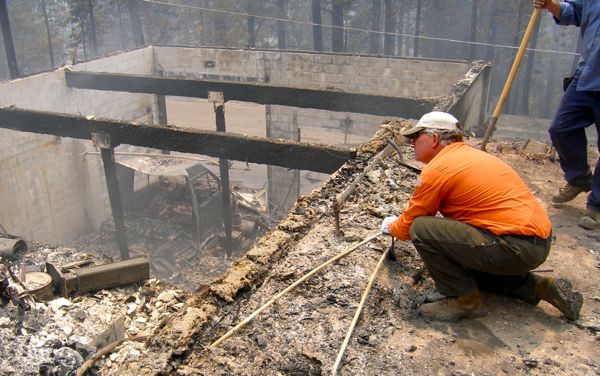
Some still-smoking trees stood but no underbrush was visible. In the place of the once heavily forested and landscaped yards were the bodies of non-recognizable cars resting on their frames along with melted bicycles and shards of glass and pottery strewn about.

Now, though, the tables have turned and because of the grit and tenacity of the returned residents, houses have popped up, albeit with little or no visible vegetation. Trees are widely spaced, many with scarred, blackened burn marks snaking up the tree meeting greenery about two-thirds of the way up.

The houses stand naked against the landscape where once grew a lush, mountain forest, where the trees would act as shields and wind screens protecting the privacy of those who live there.

According to Rita Mustatia, silviculturist (a person who looks after trees in the forest) with the U.S. Forest Service, the expression devastation is a misnomer. “I would use the word devastating in reference to the homes that were lost and lives that were changed because of the fire, but not to the forest itself,” she said.

“Fire in the forest is a natural thing and depending on factors such as location, climate, forest type, fire or some other disturbance, [fire] is needed for vegetation, including trees, to exist as part of a healthy functioning ecosystem,” Mustatia told Lake Tahoe News. “Disturbances such as fire eliminate competition between trees by reducing density and creating openings for regeneration.”

However, Mustatia said, most of the Angora Fire burned at high intensities leaving vast areas of little to no vegetation including trees. But about 40 percent of the fire burned at low to moderate intensities, she said, resulting in still living trees and some surviving vegetation.
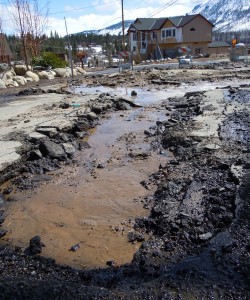
The high water table had roads in the burn area undriveable in 2011.

Some of these trees have subsequently died because of the damage caused during the fire as well as insects that have attacked them. But, Mustatia said, most of the survivor trees are healthy today.

“In some areas where the fire burned,” she continued, “it stayed on the ground as a surface fire resulting in mortality, mainly in smaller, shade-tolerant trees. The Jeffery pine, with its fire-adaptive traits, survived for the most part, resulting in a relatively healthy, post-fire condition. In other areas, where there was heavy fuel loading, the fire burned on the surface as well as through the crowns.”

Susie Kocher, natural resources advisor for the UC Extension Service, agreed with Mustatia. “Some forests are set up to burn every few years, like the Yellowstone fire in the 1980s.”

She said forests in the Lake Tahoe Basin are used to frequent, low intensity fire, but that has not been happening. “Now we have a high density of fuels and trees; consequently, we now have high intensity fires over a larger area killing a large number of trees.

“Part of it is that we’re good at putting out forest fires. But we kind of have a perfect storm in a way,” she said, attributing climate change and less snowpack to a longer fire season.

The question now for homeowners is, according to Kocher, do they want a forest or do they want a shrub field? “If you leave the forest that is located in a south-facing area on its own, not a lot of trees will come back soon — for about 60 years.”

Kocher stated the obvious: the Angora Fire killed a lot of trees in a large area. “There are no naturally, regrowing trees; there’s no seed source because there are no trees. If you want a forest, you need to replant or wait 60 or 70 years.”

She said areas without what she called “treatment” will see fire adaptive shrubs return; plants such as manzanita and white thorn. “And yes, the mushrooms are back, along with lupine and other wild flowers,” Kocher said. “After a wildfire, it’s a great time to collect mushrooms.”

But along with the good plants, invasive species like bull thistle make themselves at home too.

Homeowner Tony Colombo, who lives on Mount Olympia Circle, in a large, green, newly rebuilt Victorian, is angry about the fire for several reasons, not the least of which is his inability to re-establish his landscaping.

Colombo, and his wife, Tara Brennan, lost not only their home to the Angora Fire, but also all of the naturally occurring evergreens and vegetation that made their yard beautiful. “The soil was burned and contaminated,” he said. “And two-thirds of my new trees and shrubbery have died.”

Blaming the high water table in his area on his inability to grow anything except lawn, Colombo said the water on his property is so high in every month except during the summer, it is literally drowning his new trees.

Colombo’s high degree of frustration boils over as he talks.
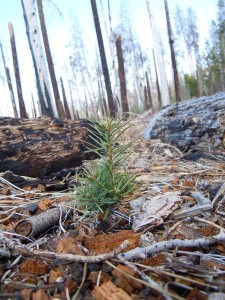
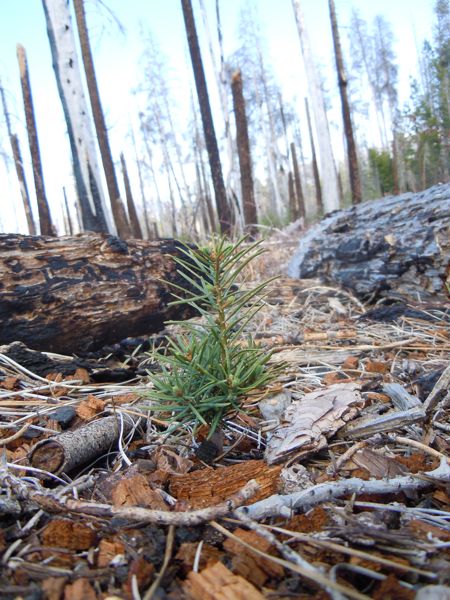
Natural regrowth in May 2012 near the ignition point of the Angora Fire.

“I’ve spent $45,000 of my own money for landscaping. Now we need a hydrologist out here. I don’t have the money for a professional landscaper, so we’re doing it ourselves. It seems nobody wants to address the water problem.

“The conundrum is now it’s really windy because there are no trees. When it’s hot, it’s barren, but in the winter, during rain and snow storms it floods. The water doesn’t sink into the ground.”

Enter John Fellowes, the owner of Aspen Hollow Landscape Nursery, who concurs. Yes, there is a high water table in some of the area where the Angora Fire burned. And, yes, now it’s windy and presents somewhat of a barren landscape.

“Myself and a few others have pointed out that this area is full of water. It sits on a glacial moraine — Angora Ridge. Springs come out of the mountain from the glaciers. The reason it never showed up in the past is because the lodge pole pine was as thick as hair on a dog’s back. There was a mix of about 80 percent lodge pole, with the rest being pine and a mix of incense cedar, white fir and Jeffery pine.”

Fellowes said he has concluded that in year’s past there were aspens and willows in the area, but over the years pines, the tree of choice by homeowners, have slowly replaced them. He said before the fire, these thick stands of pines made good use of the water coming out of the mountain, mitigating the high water problem.

Now that they’re gone, the water is back, playing havoc with some of the new gardens and especially the trees, although high water doesn’t seem to be a universal problem throughout the entire subdivision.

“My theory,” Fellowes said, “is the whole site, except for a few areas, should be replanted in a more riparian fashion. If willow and aspen had been planted [directly after the fire], they would have gotten started, made habitat and screens for people’s houses. Then, at a certain rate, the evergreens would have come back naturally.

“Unfortunately, the Forest Service planted most of what had already burned, probably conifers. If they’re dry, they won’t grow and if they’re wet, they get root rot and die. In the Gondola Fire (near Heavenly), they did the exact same thing and had 100 percent mortality — there was no resource to hand water [the new trees].”

Fellowes said he believes aspen and willows should have been planted where the natural water sites are, instead of the evergreens. He added that the Forest Service is now looking at using other species of trees.

Another problem at the Angora site is a lack of good fill dirt in which to grow healthy plants. To rid the area of hazardous material caused by the fire, nearly everything natural was removed from the burn sites.

“The contractors dug too deep and too wide. They were overly zealous. They took at least 50 percent of the topsoil and in many cases, 100 percent. Our problem is that fill dirt and good soil needs to be brought in; however, TRPA frowns on that.

“You couldn’t mimic an old natural site if you wanted to. Natural things like bitterbrush, manzanita and white thorn aren’t what people want. They don’t appreciate that they’re evergreen. You need everything to grow in the forest so you can trap the matter and assist the tree seedlings to grow.

“It’s extremely difficult to grow things now and I’m proud of the people who’ve persevered. Some have become apathetic and some have moved away. Some have been able to pull it off.”

Unlike Colombo, Lisa and Joe McAvoy were able to secure professional help to assist them with their landscaping issues. Fellowes was their man.

The McAvoys spent untold hours rebuilding their home, although not on their original lot. The result is an attractive craftsman style bungalow built and designed by them with a little help from their friends. But as the McAvoys said, the sweat equity was worth it; they knew what they were getting and got exactly what they wanted.

Yes, there is a high water table now, Joe McAvoy said, adding that before the fire, high water wasn’t what he worried about. But in order to alleviate the problem, they innovated as they went along.

“We have a dry creek bed that diverts a lot of water from our house,” he said. “We poured a curb around the foundation to divert water and waterproofed the foundation. We also have French drains.”

With Fellowes’ assistance, they augmented their soil and because of the steep street in front of their home, did a lot of water channeling. “We knew it was going to be a moonscape, so we worked hard to make it beautiful.”

So beautiful in fact, that the McAvoys’ home will be featured on the Lake Tahoe Historical Society’s annual garden tour to commemorate the fifth anniversary of the Angora Fire. The tour is July 29.



STPUD tested as it keeps water flowing during fire

By Dennis Cocking

The South Tahoe Public Utility District was formed in 1950 to provide wastewater collection and treatment for the then very small community of South Lake Tahoe. Drinking water in South Tahoe’s early years was supplied by private domestic wells or from small privately owned water companies. Well more than two dozen private companies existed on the South Shore in the 1960s and three of them still exist today.

Angora Fire -- 5 years later

With the passage of the Safe Drinking Water Act of 1974, many of these privately owned systems realized the cost and difficulty meeting the act’s requirements and sought to sell their companies to the district. Since joint water and wastewater agencies are commonplace in California, the district was the likely entity to purchase these smaller systems. Slowly these small systems were cobbled together into the system the district operates today.

Unfortunately, little thought was given to adequate water flows for firefighting since many of the systems were built with surplus 2-inch galvanized steel pipe available in large quantities after World War II. The flows provided by these systems were adequate for domestic use, but woefully inadequate for structure or wildland fires.

Fast forward to Oct. 19, 1991, in the Oakland Hills. An incompletely extinguished grass fire explodes in a three-day fire storm that ultimately consumed 1,520 acres, 3,354 single family dwellings, 437 condos or apartments, injured 150, and killed 25 individuals. Economic damages were estimated in excess of $1.5 billion. Water agencies across the state and beyond had a wake-up call and realized they could be in a similar situation with regards to fire flows.

While fire flows are not mandated by law, in early 1992 the district’s board of directors proposed an aggressive water infrastructure replacement program to increase the firefighting capability of the systems that it had inherited as a matter of sound public policy. Public meetings were held, public support obtained, and the district embarked on a system-wide replacement of undersized waterlines, installation of fire hydrants, construction of new larger water storage tanks, construction of booster pump stations, and auxiliary power generation capability projects that continues to this day. While the district’s Engineering Department estimates at least an additional decade to complete this undertaking, the district is light years from where it was in the early 1990s.

South Tahoe PUD crews on June 25, 2007, check on the Boulder Mountain water storage tank. Photos/STPUD

The experience the district gained during the Angora Fire has shaped future water supply projects, operational procedures, and long-range planning as it pertains to water supply. The district, like the vast majority of South Tahoe residents, had never experienced a wildfire of this magnitude and maintaining fire flows became priority No. 1. The Angora Fire, generally regarded as the worst fire experienced within the Lake Tahoe Basin in well over a century, tested the water distribution system as well as the dedicated employees who maintain and operate it. District employees literally were in the middle of the firefight trying to make sure water tanks and fire pumps continued to work and supply water to the fire crews. By the luck of the draw, in the decade prior to the fire, more than $18 million of district customer funds were spent on water supply infrastructure improvements in the Angora area including, most significantly, the auxiliary fire pump station located at Lake Tahoe Boulevard and Boulder Mountain Road. This critical pump station, which has emergency power generating capability, continued to operate despite the almost immediate loss of power due to the fire. Had this significant investment in upgraded infrastructure not been made, it is likely the fire could have been far worse than it was.

During the 24-hour period from the start of the fire on June 24, 2007, until June 25, the district produced 17.6 million gallons of water. Average water production at that time of the year is about 10 MGD. From June 24 through June 30 the district produced a record 89.91 million gallons of water. Even with that volume of production on June 24 the pumps continued to run at full capacity just to maintain demand levels. Early on the morning of June 25, district crews, following firefighters’ observations, discovered the reason that the pumps could not keep up with demand was that each home that was destroyed was an active three-quarter inch (the most common residential connection size) water leak. Multiply that by 254 and it becomes very significant. District crews immediately began to shut off water services that could be quickly located and crimp off those that could not be readily located.

The fire nearly consumed the STPUD pump and control building at Boulder Mountain.

Within hours, water storage tank levels and water pressures began to rise to more normal parameters. USFS Angora Fire Incident Commander Rich Hawkins stated at a fire status briefing that it was highly unusual, at a fire of this size, to not completely run out of water at some point. He noted that the district was able to keep firefighters in water, albeit some low pressures at times, for the duration of the fire. When the fire threatened to move behind Gardner Mountain and jump Highway 89, it was a challenge to access our facilities as residents attempted to evacuate their homes. Nevertheless, once the fire was fully contained, demands on the water distribution system returned to normal.

In the wake of the Angora Fire, California Gov. Arnold Schwarzenegger and Nevada Gov. Jim Gibbons commissioned the Blue Ribbon Fire Commission. One of the commission’s recommendations was greater funding support by federal and state agencies for improved water infrastructure for firefighting in the Lake Tahoe Basin. In 2009, the district acted as lead agency to form the Lake Tahoe Community Fire Protection Partnership. The partnership is comprised of the public water agencies in the Lake Tahoe Basin, both in California and Nevada. The mission of the partnership is to seek federal funding to replace undersized and inadequate water supply infrastructure in the Tahoe basin. Since 2009, the partnership, in concert with the U.S. Forest Service, has secured $12 million in federal funding. Matched 50-50 with local funding, nearly $24 million in critical water supply projects all with a nexus to fire protection, have been completed. Lake Tahoe is a safer place as a result of the success of this local-federal partnership.

District crews crimp water supply lines in the burn area.

Operational-planning lessons learned:

• Waterline replacement projects took on a higher priority in overall Capital Improvement Plan

• Increased emphasis on water distribution and redundancy of the water system

• Increased water production capacity became a higher priority

• Order of projects were changed in the CIP

• Viewed distribution vulnerability more critically

• Added water storage projects and increased sizing of water storage projects

• Moved to install fire hydrants at 500 foot intervals on all lines 6 inches or larger

• Re-evaluated and reprioritized waterline replacement projects

• Determined in future emergencies to insert district staff into incident command structure earlier

While no water agency wants to have their emergency management plan challenged in the real world, the district has taken the opportunity to learn from the events of the Angora Fire and made planning and operational changes that reflect the lessons learned.

Dennis Cocking is the public information officer for South Tahoe Public Utility District.


University study delves into specifics of Angora Fire

By Susan Wood

A first-of-its-kind study examining behavior and protocol surrounding a major wildland blaze features Lake Tahoe’s most significant — the Angora Fire of 2007, which consumed 254 homes, forced the evacuation of more than 3,000 residents and caused about $160 million in damage over nine days starting June 24.

Angora Fire -- 5 years later

As the five-year anniversary approaches, South Shore residents will be asked in a 30-minute phone survey their views of how well the community responded to and coped with the disaster. This is for the University of Colorado study that is funded by the National Science Foundation. The research also examines the Lake Arrowhead area, which endured its own large fire disaster in 2007. Both regions are considered rural, remote and tourism-based economies.

“What we were looking for were two rural communities that had a significant event and comparable character,” study analyst Jeannette Sutton, who works in the Colorado Springs-based university’s Trauma, Health and Hazards Center, told Lake Tahoe News.

Sutton spearheaded the research, which last year wrapped up its participant questionnaire of which this reporter took part in. The Q&A brought the study group to South Lake Tahoe where selected participants within categories from public safety and mental health to media and leadership were asked about the effectiveness of fire prevention efforts before the major blaze and how well the town recovered. The research also evaluated a predominant theme: whether information dissemination was adequate enough.

“Information online was a really big question,” Sutton told Lake Tahoe News in a recent phone interview. “Then, we had to look at how people could get information if they can’t access the Internet.”

While the Angora Fire peaked that Sunday, the research discovered citizens failed to get emergency broadcast updates, and no local radio stations covered the disaster. In addition, perceptions were expressed by people in the two study areas who believed print newspapers “lacked significant online presence, real time information” and concentrated more on “human interest stories”.

At the time of the Lake Tahoe disaster, the Sierra Nevada Media Group of which the Tahoe Daily Tribune is a part of tried to keep up online with pertinent, real-time updates but split its time on its print versions. (Lake Tahoe News did not exist in 2007.) There were times when citizens voiced concerns of feeling lost. At the outset, even initial phone calls channeled to the California Highway Patrol Truckee dispatch center within minutes of seeing the huge plume of smoke were met with pessimism over whether the wildfire sparked by an illegal campfire near Seneca Pond along the North Upper Truckee Road was actually a control burn.

Since then, local leaders and public safety officials have agreed systems need to be put into place to prevent the lack of real-time information from not reaching citizens from happening again. At least South Lake Tahoe city police dispatch was on top of the catastrophe with all hands on deck and longtime dispatch supervisor Leona Allen demonstrating grace under pressure while her home burned.

A university study is looking into various aspects of Angora, including response time. Photos/Lake Valley Fire

Stories abound of how citizens and their leaders coped with the stress and angst of such a disaster, and the study served to examine that.

As the city put up a command center at Lake Tahoe Airport in council chambers, an evacuation center was set up at the city Parks and Recreation building. Within days, town hall meetings were scheduled at the South Tahoe Middle School. Lake Tahoe Community College posted a list of houses that had burned, partially or completely. LTCC also collaborated with the American Red Cross on recovery efforts. A communitywide fund to aid in the recovery was established, and fundraisers with donation centers were organized for those in need.

Help was there, but this was no easy time for the community.

“We were looking at different themes in both areas and will survey the two communities to see the contrasting of how the community adapted,” said Jessica Lambert, who created the study as part of her post-doctoral work at the Colorado university.

Another theme presented itself in the research. For both lake areas, factors influenced the magnitude of the fires. Lake Arrowhead had a massive bark beetle infestation in 2007. The South Lake Tahoe area endured “restrictive environmental policies aimed at protecting natural resources,” the study’s summary concluded.

For that, a bistate Blue Ribbon Commission was formed to evaluate such policies with then Republican Govs. Arnold Schwarzenegger of California and Jim Gibbons of Nevada overseeing the effort.

Years later, the U.S. Forest Service has worked with local fire agencies and councils to conduct fuel reduction projects. Shortly after the Angora Fire started, “slash piles” – the buildup of brush and ladder fuels to be set in control burns — became the enemy of the community vernacular as citizens complained they contributed to increasing the wildland blaze.

Residents of Lake Tahoe will be part of a study about wildfires.

Resilience stood out in the research as the psychology of dealing with a disaster also concluded the two communities’ citizenry accepts catastrophe as part of its life for “hearty mountain folk” who “choose to live remotely, while connected to the land, trees and mountains.” Those interviewed painted a picture of resiliency; as even “strong fluctuations in (a) tourism economy requires a resolve to remain (here) during difficult periods.”

When the study is complete, which will be after the citizen surveys are taken, the document is intended to serve as a model for other fire-prone communities of how to prevent a wildfire, but also how to respond when it does happen.

According to Lambert, “The goal is to learn more about factors that contribute to resilience in rural communities that face disasters. I think the hope is that findings could be used to inform policy.”


Snippets about Angora

• Tucked off on the right side of Lake Tahoe Boulevard near Angora Creek just before Dead Man’s Curve is a labyrinth on a parcel that backs to the burn area that was created by Jay Newburgh.

• When deciding what clothes to evacuate with, take your dirty laundry – those are the clothes you wear most often.

• Emergency Preparedness Guide helps people think about what to do before a tragedy strikes.

• The Community Disaster Resource Center that was established during the Angora Fire is still alive as a nonprofit in case another disaster on the South Shore occurs.

• During the Angora Fire more than 5,000 meals were cooked in the St. Theresa kitchen. Breakfast, lunch and dinner were available to anyone needing nourishment.


Father’s Day — an annual celebration for 30 years

The idea of Father’s Day was conceived slightly more than a century ago by Sonora Dodd of Spokane while she listened to a Mother’s Day sermon in 1909. Dodd wanted a special day to honor her father, William Smart, a widowed Civil War veteran who was left to raise his six children on a farm.

A day in June was chosen for the first Father’s Day celebration. June 17, 1910, was proclaimed by Spokane’s mayor because it was the month of Smart’s birth.

The first presidential proclamation honoring fathers was issued in 1966 when President Lyndon Johnson designated the third Sunday in June as Father’s Day. Father’s Day has been celebrated annually since 1972 when President Richard Nixon signed the public law that made it permanent.

The estimated number of fathers across the nation is 70.1 million, according to the Survey of Income and Program Participation

Number of single fathers in 2011 was 1.7 million, which represents 15 percent of single parents, according to Census Bureau.

The estimated number of stay-at-home dads in 2011 is 176,000. These married fathers with children younger than 15 have remained out of the labor force for at least one year primarily so they can care for the family while their wives work outside the home. These fathers cared for about 332,000 children, according to America’s Families and Living Arrangements.


Plein air event in Alpine County

The second annual Markleeville Plein Air event is June 19-23.

Exhibition and sale is June 23-July 31.

Watch the artists paint vistas in Alpine County from sunrise.

On Saturday morning, all the artists will be painting in the Markleeville. Reception starts at noon.

High Meadow by Bonita Paulis