Gardening possible even in small plots, cold places

By Melinda Myers

Picture yourself harvesting a few fresh strawberries for your cereal in the morning or perhaps picking a few apples from your backyard tree to cook up into a pie.

It is possible, even if you garden on a balcony or small lot. And even if you have plenty of space, you will still appreciate the fun and convenience of reaching out the backdoor and harvesting some homegrown fruit.

Strawberries are excellent container plants. Grow everbearing or day neutral varieties so you will be harvesting strawberries throughout the growing season. Reduce your workload and increase success with a self-watering hanging basket. Or dress things up a bit more with a decorative container.

The haystack hanging baskets have the beauty of the coco fiber lined planters, but require half the watering. The liner is a combination of coir and recycled plastic designed to conserve moisture. This means better results with less watering.

But don’t stop there. Add some dwarf fruit trees to your patio plantings. A dwarf apple, peach or pear will provide beautiful spring flowers, nice foliage for the summer and fruit for you to enjoy. Select self-fertile varieties, those that only require one plant to produce fruit, if space is limited. Grow your dwarf trees in large weather-proof pots with drainage. Those in cold climates will need to provide some winter protection, but the first harvest will make that extra bit of work well worth the effort.

Or try your green thumb at growing lemons, limes and other citrus in a container. The fragrant flowers and glossy green leaves are a beautiful prelude to the tasty fruit. Even cold weather gardeners can put their green thumb to the test by growing a Meyer lemon, Kaffir lime or other citrus in a container. Just move the potted plant indoors for the winter and back outdoors next season once the danger of frost has passed.

And don’t forget the blueberries that are high in antioxidants and flavor. These nutritious beauties require moist well-drained acidic soil. Something most gardeners do not have. This makes growing them in containers, where you control the soil, a good option. Blueberries provide seasonal interest with their nodding white bell-shaped flowers in spring, colorful fruit in summer and yellow, orange or red color in fall. Though only one plant is needed to bear fruit, keep in mind that your harvest will more than double if you grow two.

So survey your patio, deck, balcony or garden for space to add a container or two of fruiting plants that are sure to add beauty and flavor to your garden and meals this season.

Gardening expert, TV/radio host, author and columnist Melinda Myers has more than 30 years of horticulture experience and has written more than 20 gardening books.


Opinion: Be responsible in bear country

By Carol Singleton

May is Be Bear Aware Month and the California Department of Fish and Wildlife reminds the public to act responsibly when in bear country.

Spring is the time of year when California’s black bears emerge from their winter dens in search of food. Because bears are attracted to anything edible or smelly, their search often leads them into campsites and residential neighborhoods, where trash and food is readily available.

There are an estimated 30,000 bears in California. Throughout spring and summer, CDFW receives many calls when bears break into homes, rummage through trash bins and raid campsites. These bears are often labeled “nuisance” bears, but in reality they are just doing what comes naturally to them, foraging for food.

“Human-bear conflicts are largely the fault of humans. People need to adjust their behavior when they live and recreate in bear country,” said Jesse Garcia, CDFW’s bear program manager. “It is absolutely necessary to secure food and trash receptacles to avoid attracting bears. Campers and residents can prevent expensive property damage, safeguard people from injury and save the lives of bears by exercising a little common sense. Bears that become habituated to humans or conditioned to eating our food and trash often have to be killed.”

Bears have keen noses and can smell an easy meal from miles away. They can easily tear a front door off its hinges if they smell food left out on the kitchen counter.

The best defense against bear break-ins is not to attract them to your property by following these tips:

  • Purchase and properly use a bear-proof garbage container.
  • Wait to put trash out until the morning of collection day.
  • Don’t leave trash, groceries or animal feed in your car.
  • Keep garbage cans clean and deodorize them with bleach or ammonia.
  • Keep barbecue grills clean and stored in a garage or shed when not in use.
  • Only provide bird feeders during November through March and make them inaccessible to bears.
  • Don’t leave any scented products outside, even non-food items such as suntan lotion, insect repellent, soap or candles.
  • Keep doors and windows closed and locked.
  • Consider installing motion-detector alarms, electric fencing or motion-activated sprinklers.
  • Harvest fruit off trees as soon as it is ripe, and promptly collect fruit that falls.
  • Securely block access to potential hibernation sites such as crawl spaces under decks and buildings.

No one wants to worry about housekeeping on a camping trip, but maintaining a clean campsite is the responsible and safe thing to do when visiting black bear country.

Here are a few tips for bear-proofing campsites:

  • Use bear-proof garbage cans whenever possible or store your garbage in a secure location with your food.
  • Store food (including pet food) and toiletries in bear-proof containers or in an airtight container in the trunk of your vehicle.
  • Clean dishes and store food and garbage immediately after meals.
  • Clean the barbecue grill after each use.
  • Never keep food or toiletries in your tent.

The only species of bears in California are black bears. However, they do range in color from blonde to black, with cinnamon brown being the most common color.

There are an estimated 30,000 black bears in California.

Black bears will seek to avoid confrontation with humans. If encountered, always leave them an escape route.

Males are much larger than females and can weigh up to 500 pounds, although average weight is about 300 pounds.

Black bears can sprint up to 35 mph and they are strong swimmers and great tree climbers.

A typical wild bear diet consists of berries, plants, nuts, roots, honey, honeycomb, insects, larvae, carrion and small mammals.

As winter approaches, bears will forage for food up to 20 hours a day, storing enough fat to sustain them through hibernation. Bears often hibernate in large hollow trees 40 to 60 feet off the ground.

Bears that are accustomed to people can become too bold and lose their fear of humans.

Carol Singleton works for the California Department of Fish and Game.


Report: Climate change will lead to less nutritional food

By Evan Halper, Los Angeles Times

Climate change threatens to undermine not only how much food can be grown but also the quality of that food as altered weather patterns lead to a less desirable harvest, according to a study.

Crops grown by many of the nation’s farmers have a lower nutritional content than they once did, according to the report by the Chicago Council on Global Affairs.

Research indicates that higher carbon dioxide levels in the atmosphere have reduced the protein content in wheat, for example. And the International Rice Research Institute has warned that the quality of rice available to consumers will decrease as temperatures rise, the report noted.

The U.S. should embrace research into animal biology and plant management with the kind of enthusiasm it did space exploration in the 1960s, the council said, warning that the consequences of inaction could be severe.

Read the whole story


Immunization law affects students in 2014-15

A California law that began Jan. 1 affects students entering child care or kindergarten, or advancing into the seventh grade, for the 2014-15 school year.

Assembly Bill 2109 changes the process for parents to request immunization exemptions for their children.

“The purpose of this new law is to better inform parents about the benefits and risks of immunizations,” Lynnan Svensson, supervising public health nurse with the El Dorado County Health and Human Services Agency, said in a press release.

The law also affects children transferring into California schools from another state or country.

Under AB2109, parents or legal guardians who choose to waive required immunizations must first meet with a health care provider to receive education about the benefits and risks of immunizations as well as the dangers of vaccine preventable diseases. The parent or legal guardian and the health care provider must sign the new personal belief exemption form.

“Childhood immunization rates have begun slipping over the last several years, while requests for immunization exemptions have increased,” Svensson said. “The personal belief exemption rate for kindergartners in El Dorado County is now 8.2 percent, while the overall rate in California is only 2.8 percent. Our concern is that as fewer children are immunized, we will begin to see large-scale and potentially serious disease outbreaks among school children and the community at large.”

Additional information, including questions and answers about AB2109, may be found online.


2 job forums in El Dorado County

El Dorado County Connections — One Stop is hosting two free employer forums to help connect job seekers to local businesses who may be hiring.

During these informational sessions, representatives of local businesses will speak to job seekers and give insight into their organization and how to apply for open positions. Even if the employer is not currently hiring, this information can be invaluable.

Individuals are advised to bring resumes and to dress professionally.

The events are:

  • May 28, 11am at Connections – One Stop located at 3047 Briw Road in Placerville.
  • June 4, 10:30am at the El Dorado County Child Support Services Building located at 3883 Ponderosa Road in Shingle Springs.

For more information, call 530.642.4850.


Tveten land being used as Caltrans staging area

The old Tveten property is not getting an overhaul despite all the equipment on the lot in Meyers.

Don Garcia Excavating and Paving has leased the rundown site for three years as it does work for Caltrans on area highways.

“The contractor has to provide traffic management, sweeping and stormwater management plans to TRPA and Lahontan, and depending on the site location there may be other environmental studies required before it’s approved for use,” Steve Nelson with Caltrans told Lake Tahoe News.

This particular property has been a bone of contention for years. It used to be a gas station. Now the remaining structure is often covered in graffiti. El Dorado County has long wanted to get new owners for the property or at least for the owners to make it less of an eyesore.

County officials deferred comment to Caltrans regarding the current use.

J.E. Tveten Corporation, Sarbjit Singh Kang, and the estate of Joe Erik Tveten were fined $250,000 in 1999 by the Lahontan Water Quality Control Board for failure to cleanup and abate petroleum contamination in ground waters.

A 1997 leak from the old Beacon station was eventually cleaned up by the state. Two wells used by South Tahoe Public Utility District became contaminated and were shutdown.

Some Meyers residents question how the staging contract got approval from all the necessary agencies because it is considered part of the view corridor per Tahoe Regional Planning Agency regulations.

— Lake Tahoe News staff report


Then and now: Zephyr Cove — from private to public

Zephyr Cove resort in the 1960s. Photo/Lake Tahoe Historical Society/ Empey file

Zephyr Cove resort in the 1960s. Photo/Lake Tahoe Historical Society/ Empey file

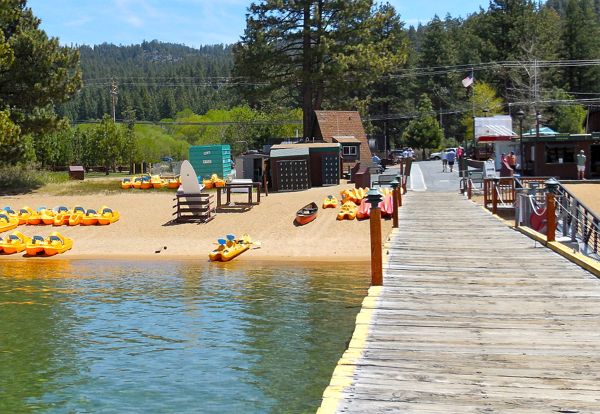
Zephyr Cove Resort is a popular historic spot at Lake Tahoe. Originally it was privately owned, but now it is operated under contract with the U.S. Forest Service.

Part of the beach and pier at Zephyr Cove are seen here, 50 years apart.

Zephyr Cove remains popular today, especially in the summer. Photo/Bill Kingman

Zephyr Cove remains popular today, especially in the summer. Photo/Bill Kingman

Today, the smaller boats tether to the other side of the pier, while the large M.S. Dixie II paddle-wheeler docks at the end. A long sandy beach extends to the right of each photo.

— Bill Kingman


A walk in the woods without a defined end point

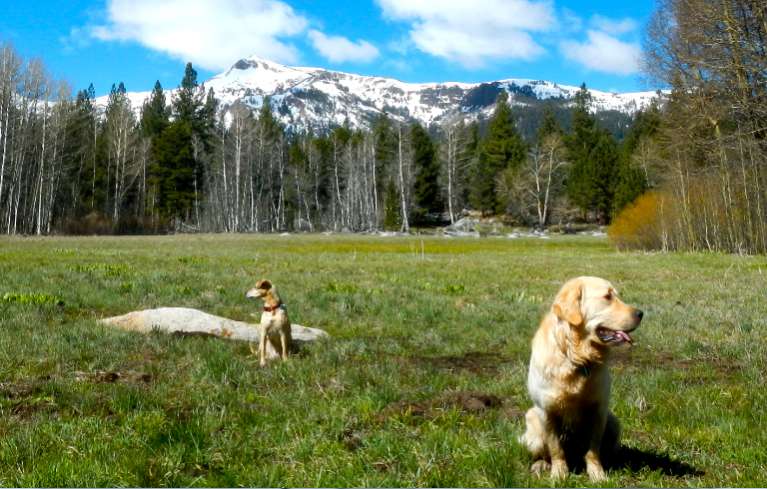
AJ and Cody with Red Lake Peak in the background. Photos/Kathryn Reed

AJ and Cody with Red Lake Peak in the background. Photos/Kathryn Reed

By Kathryn Reed

HOPE VALLEY – Sometimes it’s not about where you go, but who you are with and being in the moment. Such was the case earlier this month on a hike out of Hope Valley.

A fresh dusting of snow covered the parking lot at Pickett’s Junction, as well as along the trail. The temperature was so cold at the start Rosemary and I both guessed the other was going to cancel.

Nope. We just bundled up and looked a bit like we were on a winter excursion. Such is Tahoe in May – unpredictable.

While the original intent was to hike to Burnside Lake, we opted to set a time instead. We said two hours.

For runners out there, this is plenty of time to make it to the lake. Bri, Rosemary’s daughter, made it to Burnside and back to the car in the two hours. Her 13-plus miles also included a few detours off the main route.

We, too, were lured off trail. There are a multitude of U.S. Forest Service roads. Even the main trail we are on is really a road. This road in the Humboldt-Toiyabe National Forest is closed about a quarter mile from the parking area in the winter – or when conditions are still wet and muddy.

The topo map – which we didn’t have with us – shows Burnside Lake pretty much a straight line from the highway. In reality there are turns in the main trail with a ton of off-shoot options. Don’t take them if you want to make it to the lake.

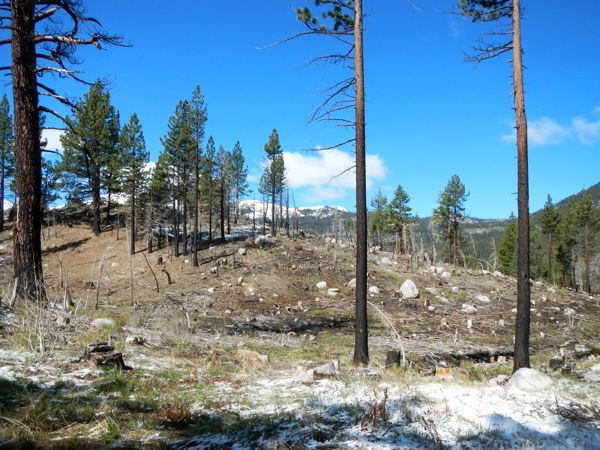
Remnants of the Burnside Fire from a few years ago are still visible.

Remnants of the Burnside Fire from a few years ago are still visible.

I had my four-legged daughter, AJ, and Rosemary had her four-legged grandson, Cody. It was Mother’s Day, after all. And this was AJ’s first real hike since hiking in the Carson Valley that ended with several stitches after she splayed her hindquarters on something sharp.

She was running wild, like this could have been her first romp in the woods. With being part greyhound, I’m sure she is faster than California Chrome. At least it looked that way as I watched a sleek blonde streak through the forest.

The part of the trail we did was for the most part a gradual uphill climb. It’s a dirt road – plenty wide for all of us when the dogs chose to join us.

It didn’t matter that we didn’t reach the lake. The beauty captivated us — as did our conversation. Sometimes a hike in the woods is more about friendship and what is right there than what is at the end of the trail.

One of our forays off the main road led us to a wonderful meadow with a spectacular view of Red Lake Peak. At 10,061 feet, it’s hard not to notice it at various points.

The first people, outside of native Americans, to have talked of hiking the peak were John C. Fremont and Charles Preuss. They did so in February 1844. It was from Red Lake Peak that Fremont first saw Lake Tahoe.

Getting there:

From South Lake Tahoe, take Highway 50 west. Turn left in Meyers past the bug station onto Highway 89. At the T go straight into the parking lot. Start walking.


Letter: County should listen to Meyers residents

Publisher’s note: This letter was first sent to the El Dorado County Board of Supervisors on May 21, 2014.

Dear Chair Santiago and members of the Board of Supervisors:

I am writing to you on behalf of California’s South Tahoe Chamber of Commerce (California Chamber) board President George Alm and the board of directors as a follow-up to my letter of May 2, 2014.

A meeting was held May 19 from 3pm to 5:10pm between me and five Meyers area residents and your Principal Planner Brendan Ferry at the county’s South Lake Tahoe office on Emerald Bay Road. The purpose of the meeting was to discuss the content of the May 2, 2014, letter and other related issues to planning in Meyers.

On behalf of the Meyers area contingent, I want to thank Brendan Ferry for taking time to meet and listen to our concerns and discuss the planning efforts to date. We all know that this planning effort has had challenges. We know as well that challenges can lead to opportunities for a successful outcome. We acknowledge that efforts are being made to make the planning process more inclusive. The Meyers area residents who attended (the May 21) meeting and our chamber board are committed to working with the county of El Dorado and TRPA officials to arrive at a plan that is acceptable to the community.

It is clear that a notable portion of the Meyers community has only recently began to understand the significance of the emerging new Area Plan and TRPA’s land use changes from the Regional Plan update. Many current residents and business owners and operators have heard great concern and confusion expressed by their community members. This condition creates a greater opportunity to ensure that the new Meyers Area Plan works for the community because community members are now more aware of and anxious to engage the planning process.

The product of our discussions (May 21) was acknowledgement that there is a great diversity of opinion regarding how residents, property owners, and business owners and operators view the future of Meyers as well as great confusion and lack of understanding of proposed land-use changes. This diversity of opinion about the future is in itself the core condition that must be assessed and evaluated in a manner that helps County officials to arrive at a verifiable and democratically-based decision on land use and restores faith that the entire community has had its voice heard.

Issue, concerns, and suggestions


The May 2, 2014, letter highlighted a number of issues and concerns of Meyers’ residents, and I will not repeat them here. I am highlighting issues that are reinforced by (the May 21) conversation and offer a community-based perspective on them.

1. A verifiable method for the county to determine that it has gained a wide range view of the proposed Meyers Area Plan. A “validated” communitywide survey of all residents and property owners is needed to guide and shape the final Meyers Area Plan. Such a survey would allow all interested parties in Meyers to have a voice in this 20-year plan. It would also provide the opportunity for all community voices to be heard. This request has been made in the past and is reiterated herein.

2. Defer any final action on the plan until a new county supervisor is elected and seated to allow him or her input on the new 20-year plan. The voters of the 5th District will elect a new supervisor in November and the man or woman elected should have an opportunity to be heard and decide on a final area plan. I am told and believe that all candidates for county supervisor for the 5th District support this suggestion.

3. Verification in the plan document that available incentives provided under the plan will be applicable to existing business and property owners. We understand that that changes to the draft (but not yet public) plan have been made to do so, and we are anxious to see specific language in this regard.

4. Specifically define height limitations in all planning areas. There should be a specific height standard written in the plan for all land uses leaving no room for creative interpretation of the plan.

5. Define clearly what criteria will be used and by whom to grant variances to building standards including height restrictions if variances are permitted under the plan.

6. Affirm in writing verbal assurances made by staff to make available to all existing business and property owners incentive allowed under an Area Plan.

7. Eliminate mixed land use additions to the plan that could compromise existing business uses (e.g. motel next to an industrial use). Do not allow the creation of uses near existing businesses that compromise the ability of owners to conduct their businesses. I am told that there is great interest in the community to maintain land uses under the 1993 Community Plan or some iteration thereof. Existing Meyers business owners and operators need to be carefully consulted so that land use decisions are clear and in line with the interests of Meyers’ business owners and operators and residents.

8. Ensure in language of the plan that all existing business will be permitted uses in any new plan adopted and that the owners of the businesses can sell their property for the same use to a subsequent owner.

9. Include in specific language of the plan that the County does not support and will not use of eminent domain (acquisition of private property over the objection of the property owner) to achieve plan goals and objectives nor will the county support the use of this extraordinary confiscatory power by other agencies.

10. Define in the plan that county and TRPA officials must carefully explore with Caltrans alternative ways to ensure safe passage of pedestrians and cyclists across Highway 50 including installation of a traffic signal. Options for safe passage must then be reviewed with the Meyers community to ensure that they are acceptable.

11. Maintain community character while striving for community improvements. Community members do not oppose new development in Meyers. They do want to retain the rural character of the community.

12. Write the language of the plan in plain English, not “planners speak.” Make the document user-friendly and informative.

13. Determine if the California Tahoe Conservancy is still willing to leave existing CTC-owned parcels vacant for community open space if Meyers residents want this to happen. I am told that this was a promise made earlier in the planning process.

14. Let the people of Meyers decide their future. Comments have been made to Meyers’ owners and operators over the course of the current planning process by certain policy makers and planners that Meyers should be changed and allowed to develop like “cities” in Europe living and working in a “Pack & Stack” world. Meyers is of course not a city. This “Pack & Stack” notion and “European” future scenario needs to be tested against what the people who live and work there think and want. It is the people of the community’s future that is being planned, and they need the ultimate say in the decision. The Board of Supervisors needs to hear from the community in a verifiable and inclusive way before making changes that impacts them.

Thank you all for taking time to read and consider the comments made in this letter. All of us appreciate the time and effort you make to serve us and our county. The California South Tahoe Chamber of Commerce Board remains ready to assist you, the Meyers community and our friends at TRPA to ensure a successful outcome. Copies of this letter will be sent to the members of the TRPA Governing Board and interested parties.

Sincerely,

Dave Jinkens, chamber board member and government affairs liaison volunteer



U.N. official: Obesity No. 1 threat to global health

By Melissa Healy, Los Angeles Times

The United Nations’ leading voice on hunger has declared that the international community must mobilize to combat obesity and unhealthy diets, not a lack of food, and called on U.N. members to rally around a “bold framework” of regulations limiting access to salty, sugary foods that are high in saturated fats and contribute to obesity.

Olivier De Schutter, special rapporteur to the U.N. on the right to food, said Monday that the global struggle against tobacco use offered a model for efforts to stem the rising tide of obesity and poor nutrition in countries both developed and developing.

De Schutter renewed his call for a raft of measures proposed in his 2012 report to the United Nations Human Rights Council, including the imposition of taxes and other regulations on unhealthy foods, crackdowns on the marketing of junk foods, an overhaul of agricultural subsidies that drive down the costs and drive up availability of some unhealthy foods (including sweeteners), and increased support for local food production.

Read the whole story