South Lake Tahoe attorney going to prison for 3 years

South Lake Tahoe attorney Alfred Nash Villalobos was sentenced Thursday to three years in prison.

The 46-year-old could have been sent away for 30 years after being convicted in August 2011 on federal extortion and obstruction of justice charges.

Villalobos is the son of Alfred J.R. Villalobos of Stateline, a former director on the board of the California Public Employees’ Retirement System. The elder Villalobos faces his own legal troubles involving CalPERS and bribery.

— Lake Tahoe News staff report


Energy saving tips to use on a daily basis

By Mandy Kendall

I read something the other day which shocked me (and that’s not easy I can tell you). According to EarthSave.org, it takes 2,500 gallons of water, 12 pounds of grain, 35 pounds of topsoil and the energy equivalent of one gallon of gasoline to produce one pound of feedlot beef. Figures from other organizations differ slightly but the general consensus is that it takes a lot of resources to produce meat, especially beef.

When you consider how many people could be fed on the grain that is used to produce one 8 ounce steak it really doesn’t make sense. If giving up one steak could essentially feed many people, maybe we really can each make a difference? I know it’s easy to think “What can I possibly do that will make an impact?” and not bother trying, but as my dear old Mum used to say. “Where would we be if everyone did that?” If we all decided that we were able to make a difference, just imagine what we could achieve.

Mandy Kendall

So I got to thinking about what day-to-day things we can do as individuals that would make a difference and impact the world in some way.

Here are some Qwik-e tips that really do make a difference:

1. Go meat free at least once a week. If Americans ate just one fewer meat dish per week, it would free up 7.5 million tons of grain, enough to feed the 25 million Americans who go hungry each week. If 10 percent of the world’s population gave up eating meat, it would be enough to feed the estimated billion people who go hungry annually.

2. Paper or plastic? Well, neither is good to be honest. Last year 12 million barrels of oil were used to make the 88.5 billion plastic bags used in the United States alone. Try keeping reusable shopping bags in your car but if you forget the usable bag (as we all do), choose paper, if you will recycle it, or plastic, if you will reuse or recycle it.

3. Bottle your own water. It takes 26 bottles of water to produce the plastic container for a one-liter bottle of water, and that process pollutes 25 liters of groundwater. Stainless steel water bottles are the most durable. If you do have to buy water in a plastic bottle check the number on the bottom first. Plastics with numbers 3, 6 and 7 could pose a health risk so try and find ones numbered 1 ,2, 4, or 5.

4. Unwanted catalogs. Every year, 53 million trees and 56 billion gallons of water are used to produce the 19 billion catalogs mailed out to Americans. CatalogChoice.org allows you to stop unwanted catalogs and help you do your bit for the environment.

5. Laundry. Almost 90 percent of the energy needed to wash laundry goes to heating the water. With modern day detergents most clothes will come clean in a cold water wash and rinse. Also, these days many natural detergents are just as effective at cleaning clothes at lower temperatures as their less environmentally-friendly counterparts. Try one that’s biodegradable as well and double your benefit to the earth.

6. Leaking toilets. Apparently as many as one in five toilets leak, which wastes between 30 to 500 gallons of water a day! To test your toilet, put a few drops of food coloring in the toilet tank and if the dye shows up in the water bowl after 15 minutes or so the toilet has a leak.

7. Paper towels. If every household in America replaced one roll of “virgin fiber” with 100 percent recycled paper towels we could save 544,000 trees. Better yet, try using re-usable microfiber cloths for mopping up those spills.

8. Dishwasher. If you have a dishwasher, running it (fully loaded) without pre-rinsing the dishes can use a third less water than washing the dishes by hand, saving up to 10 to 20 gallons of water a day. Also using the air dry setting (instead of heat dry) will use 50 percent less energy.

9. Standby. Computers and monitors left on overnight or appliances left plugged in will continue to draw electricity even when they are not being used. Unplugging appliances that are not used very often (TVs in guest bedrooms, etc.) can save upward of 20 percent of a household’s electricity bill.

10. Tires. If everyone kept their tires properly inflated (which apparently a third of us don’t do!) we would save the country 2.8 billion gallons of gas a year.

11. Finally, my favorite tip (because it’s got to be the easiest one): Brushing your teeth. If you are brushing your teeth for the recommended two minutes (of course we are), switching off the faucet whilst brushing can save approximately 5 gallons of water. This can be extended to hand washing too. Every little helps.

Until next time.

Mandy Kendall operates Health Connective in South Lake Tahoe. If you have any questions, would like some advice, or would like to request some Qwik-e tips on any health and wellbeing topic, please feel free to drop me an email at healthconnective@gmail.com, visit us on Facebook, or keep an eye out on Lake Tahoe News for regular Qwik-e tips on how to make healthy changes one Quick and Easy step at a time.



Opinion: Loop road possibilities need to be studied

Publisher’s note: This letter was sent to the South Lake Tahoe City Council and is reprinted with the author’s permission.

I sat in at the Lodging Association meeting last Thursday and heard the loop road presentation from Carl Hastings. [sic]

I was not happy with Plan No. 1 or Plan No. 2, so am glad the City Council voted for a third option.

Here’s my two cents for a third option:

1. Being that two-thirds of the traffic on Highway 50 goes right on through the state line without stopping (according to Carl Hastings) [sic] let’s excavate the Highway 50 corridor and put through traffic underground.

2. Leave the existing loop road, businesses and resident homes intact.

3. Close off H50 at Park Avenue where traffic would either turn right for Raley’s, Marriott, Harrah’s, etc. or left toward beach, Harveys, Horizon and Edgewood on the lower loop road.

4. Close traffic off at the loop road by Edgewood and traffic either goes right or left locally onto the existing loop road as above.

5. Casino parking is off the loop road.

6. The western facing traffic tunnel would start between Kingsbury Grade and the loop road intersection on the NV side.

7. The eastern traffic tunnel would start somewhere near the entrance to Tahoe Meadows on the CA side.

8. The existing Harveys to Harrah’s pedestrian tunnel would be removed and replaced with pedestrian overpass with shops and gambling space or restaurant over the road. (That would be up to Harrah’s.)

9. The traffic tunnel would be one lane either way going underground with a drop off lane in front of each casino for buses, etc.

10. A middle lane for emergencies. Five lanes total underground.

11. Entrance and exit to the tunnel would be one lane down and one lane up.

12. The walking mall would be designed so traffic could go through there in an emergency.

Results:

Fantastic Walking Mall between Park Ave. and Edgewood Loop intersection.

An area that will enhance a future convention center (Hole in the Ground).

As the casinos go out of business (Horizon) can be converted to a Macy’s type shopping center possibly or a large entertainment venue.

Increase in value of the “hole in the ground” and encourage someone to finish it.

Reduce air pollution and the stop and go traffic as their would be no lights for submerged through traffic until they got to Kingsbury Grade.

A mall atmosphere would exist that locals would like to go.

It will cost more than the other plans, but a public works project should be done first class.

Nearly every major city in Europe has a grand square that bans cars and is the place for locals and tourists to visit and shop.

Who is going to pay for it? All of us.

Happy trails,

Les Wright, South Lake Tahoe


Mountain bike trail work days on both ends of the lake

TAMBA has two trail building days coming up.

The first is with the U.S. Forest Service and Hilride Progression Development Groups on June 24. They are hosting a work day to train people on building progressive features on the Corral Trail.

Meet at the lower parking area at 8:30am Oneidas Street off Pioneer Trail in South Lake Tahoe. Turn onto Oneidas and proceed for roughly 1.25 miles to the dirt parking area located on the left hand side.

All participants need to have typical personal protective equipment for trail work including: eye protection, gloves, long pants, long sleeves, sturdy shoes. In addition, bring personal items needed to stay safe and comfortable in the field, such as lunch, water, and sunscreen.

The work day activities will focus on building features as shown on the final plan set developed by Hilride. Training will include a discussion on layout of features to ensure proper flow and user speed, risk management, and shaping of jump features to achieve the desired experience. Work will continue through the day, and be finished by 4:30pm.

TAMBA’s trail day in Tahoe City is June 30 where a new connector trail between the Tahoe Rim Trail and Forest Service Road 16N49 near Cedar Flat will be installed.

Meet at 9am that Saturday at Tahoe XC, 925 Country Club Drive, Tahoe City. It’s about a 2-mile bike ride up to the work site. Lunch will be provided and Tahoe XC is hosting a post work BBQ. Bring water and long sleeves, long pants, gloves and helmet.


California may change rules for fire retardants

By David Siders, Sacramento Bee

Gov. Jerry Brown urged state regulators this week to reduce the prevalence of chemical flame retardants in household furniture, joining a growing number of critics who argue the chemicals are toxic and unnecessary.

“Toxic flame retardants are found in everything from high chairs to couches and a growing body of evidence suggests that these chemicals harm human health and the environment,” the Democratic governor said in a prepared statement. “We must find better ways to meet fire safety standards by reducing and eliminating – wherever possible – dangerous chemicals.”

The directive follows the defeat last year of legislation that would have let furniture manufacturers avoid using chemical flame retardants in their products by providing an alternative test for meeting state fire prevention standards.

Opponents of the legislation, including the chemical industry-backed Citizens for Fire Safety Institute, said the bill would increase the risk of fire and weaken safety standards they characterize as among the strongest in the United States.

On Monday, the group issued a statement saying its members “welcome any public stakeholder review process of such an important issue.”

The author of last year’s failed bill, Sen. Mark Leno, D-San Francisco, said Brown’s intervention “definitely shifts the debate.”

Read the whole story


Report: Replanting in Angora on CTC property a success

By Kathryn Reed

With some areas of the Angora burn having lost 100 percent of its trees, human assistance was needed to restore what a human was ultimately responsible for destroying.

Replanting of mostly Jeffery pines was what the California Tahoe Conservancy chose. The state agency owns about 90 acres of the nearly 3,100 acres that burned in the June 2007 fire. Of those, 40 acres had nothing left.

Mastication of trees like what the USFS did is also the approach the CTC took on some of its land in the Angora burn area. Photo/LTN file

Susie Kocher with the UC Cooperative Extension gave an update June 20 to the California Tahoe Conservancy board about the 40 acres that endured the high intensity fire.

Kocher explained how the loss was much greater than what a natural fire would have left behind. The Angora Fire whipped through the North Upper Truckee area on June 24 five years ago after an illegal campfire was not properly extinguished at Seneca Pond. Ultimately, it destroyed 254 houses.

While the forest is showing resiliency, Kocher informed the board that it would be 60 years before the forest returns to what the average person would call a forest. For now, the seedlings that were planted are just a few inches tall.

About 130 trees have been planted per acre. In addition to the Jeffery, sugar pines are the other primary species. Some incense cedar has been planted, but they are not thriving. This is because they prefer shade and right now it’s direct sunlight in the burn.

Kocher has been studying the recovery process on the CTC acreage since the first analysis of the burn was conducted in July 2007. A report was released this year about the restoration, with Wednesday’s meeting at Inn by the Lake being the first time the board heard the information.

“Where there has not been planting, there are very (few) trees coming back,” Kocher told the board.

Larry Sevison, chairman of the CTC board and Placer County supervisor, questioned whether the 86 tons of fuel load per acre was going to create a fire hazard.

Kocher said even though mulch from the masticated trees along with limbs are on the forest floor, the alternative would be leave the charred trees standing. Those would eventually fall, be in larger pieces and create more of a fire threat.

“Though the fire risk cannot be calculated at this time as computer models do not accurately predict wildfire behavior in masticated fuels, it is generally accepted that masticated fuels burn with lower flame lengths than natural fuels and are more difficult to ignite because compaction impedes the fire’s access to oxygen,” according to the preliminary assessment report of restoring CTC lands post-Angora that was prepared by Kocher and Daylin Wade of the CTC.

Kocher told the board when it comes to leaving the mulch, “It’s a trade off between erosion control and fire risk, but I can’t tell you how much.”

Norma Santiago, CTC board member and El Dorado County supervisor, questioned the threat of the white thorn growing in the burn area.

While Kocher called it a “fire adaptive species”, she said there is less of the prickly bush in the treated areas.

Overall, Kocher said the treatments applied to the Conservancy land have been effective. She said the ultimate goal of creating a healthy forest is on track five years after the flames whipped through the area.


Underemployed, underpaid lost in recession

By Michael Cooper, New York Times

Throughout the Great Recession and the not-so-great recovery, the most commonly discussed measure of misery has been unemployment. But many middle-class and working-class people who are fortunate enough to have work are struggling as well, which is why Sherry Woods, a 59-year-old van driver from Atlanta, found herself standing in line at a jobs fair this month, with her résumé tucked inside a Bible.

She opened it occasionally to reread a favorite verse from Philippians: “And my God will meet all your needs according to the riches of his glory in Christ.”

Woods’s current job has not been meeting her needs. When she began driving a passenger van last year, she earned $9 an hour and worked 40 hours a week. Then her wage was cut to $8 an hour, and her hours were drastically scaled back. Last month she earned just $233. So Ms. Woods, who said that she had been threatened with eviction for missing rent payments and had been postponing an appointment with the eye doctor because she lacks insurance, has been looking for another, better job. It has not been easy.

“I’m looking for something else, anything else,” she said. “More hours. Better pay. Actual benefits.”

These are anxious days for American workers. Many, like Woods, are underemployed. Others find pay that is simply not keeping up with their expenses: adjusted for inflation, the median hourly wage was lower in 2011 than it was a decade earlier, according to data from a forthcoming book by the Economic Policy Institute, “The State of Working America, 12th Edition.” Good benefits are harder to come by, and people are staying longer in jobs that they want to leave, afraid that they will not be able to find something better. Only 2.1 million people quit their jobs in March, down from the 2.9 million people who quit in December 2007, the first month of the recession.

“Unfortunately, the wage problems brought on by the recession pile on top of a three-decade stagnation of wages for low- and middle-wage workers,” said Lawrence Mishel, the president of the Economic Policy Institute, a research group in Washington that studies the labor market. “In the aftermath of the financial crisis, there has been persistent high unemployment as households reduced debt and scaled back purchases. The consequence for wages has been substantially slower growth across the board, including white-collar and college-educated workers.”

Now, with the economy shaping up as the central issue of the presidential election, both President Obama and Mitt Romney have been relentlessly trying to make the case that their policies would bring prosperity back. The unease of voters is striking: in a New York Times/CBS News poll in April, half of the respondents said they thought the next generation of Americans would be worse off, while only about a quarter said it would have a better future.

Read the whole story


Meeting focuses on transportation in El Dorado County

The El Dorado County Department of Transportation is inviting the public to attend a workshop on the Travel Demand Model Update.

The Travel Demand Model is an essential tool that helps determine the county’s future transportation needs. Not just for transportation engineers, the workshop will answer general questions about development, purpose and use of the new model, scheduled for completion this fall. The workshop will be presented by county staff, as well as representatives from Kimley-Horn & Associates Inc., the county’s project consultant.

The workshop is June 28 at 7pm in the Planning Commission hearing room at 2850 Fairlane Court, Building C, Placerville.


Meeting focuses on Dollar Creek trail

Public and interested parties are invited to comment on the Dollar Creek shared-use trail project until July 6. There is a meeting about the trail on June 28 from 6-8pm at the North Tahoe Event Center, 8318 North Lake Tahoe Blvd., Kings Beach.

The project is located in Placer County, primarily with California Tahoe Conservancy and North Tahoe Public Utility District owned properties, between the intersection of Dollar Drive and Highway 28 and the terminus of Fulton Crescent Drive. This 2.2-mile trail will extend the existing Tahoe City to Dollar Point Trail and connect neighborhoods, schools, shopping and recreation.

For further information, contact Peter Kraatz at (530) 581.6230 or pkraatz@placer.ca.gov.


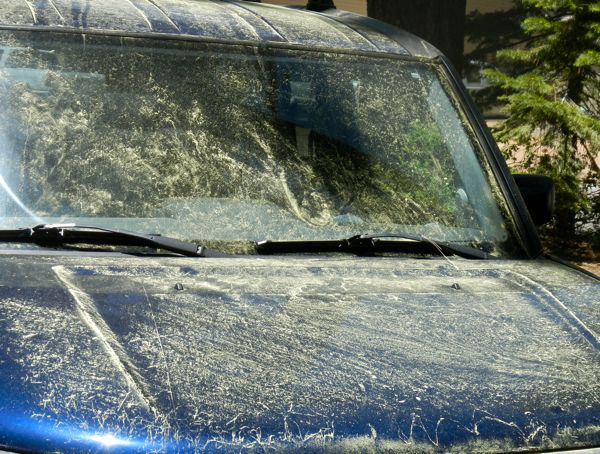
Coat of pollen mucking up most of Tahoe

The yellow haze blowing through the South Shore is the annual pine pollen.

In addition to kicking up allergies and leaving behind yellow everywhere, the winds are a fire threat. A red flag warning is in effect for the Lake Tahoe Basin and most of northwestern Nevada until 10pm Thursday.

The wind is expected to dissipate on Friday, but the temps will be dropping. The high on June 22 in South Lake Tahoe is expected to be 65, dipping to 61 on Saturday and returning to 65 on Sunday. Lows will be in the 30s.

— Lake Tahoe News staff report

Car washes should be doing good business.

Pollen collects in a swale at the end of a driveway.

Pollen floats on Lake Tahoe. Photos/Kathryn Reed