Washoe County deputies defend actions against RGJ photographer

By Jaclyn O’Malley, Reno Gazeztte-Journal

Washoe County sheriff’s deputies said they cited a Reno Gazette-Journal photographer because he entered an active fire scene in Sun Valley without authorization and repeatedly resisted deputies’ commands as they tried to confirm his media affiliation, according to statements made by officers in incident reports that were released Tuesday to the newspaper.

Tim Dunn, the Gazette-Journal’s photo chief, was cited June 18 on suspicion of obstructing and resisting as he was trying to take photos and video of a destructive residential fire near East Fourth Avenue and Flora Way.

Last week, Dunn filed a complaint with the sheriff’s office, citing excessive force was used when he was obeying deputies’ commands to leave the area. He said he received scrapes to his face and hands after being taken to the ground by two deputies.

Dunn, 60, said a boot came down on his back and a deputy pushed his face in the gravel.

He said Capt. John Spencer accused him of impersonating a firefighter because he was wearing protective fire gear — yellow jacket and pants, a helmet and goggles — which is recommended to be worn by media covering wildfires. This gear is often issued to journalists by fire agencies.

But according to deputies’ reports, Spencer said no one touched Dunn’s face or head, and that he never accused Dunn of impersonating a firefighter. Spencer said that Dunn was asked multiple times to stop approaching the fire area, but Dunn ignored his commands and those of deputies Ethan Blosch and Miguel Diaz.

Nevada law states it is the general policy of police to allow reporters with valid identification to pass through police lines into disaster areas after the reporter is made aware of known hazards, according to the Nevada Press Association. However, the reporters’ presence must not interfere with emergency operations, and reporters should be aware of the potential for a citation, the association said.

Dunn was grabbed after he had turned to head toward a media area, and Spencer said this was because Dunn kept walking and said, “I’m leaving” when Blosch told him to stay where he was. Blosch said Dunn’s “continued refusal to follow instructions and continued efforts to resist us forced us to guide him to the ground.” Dunn continued to resist, wrote Blosch, who said he placed his left knee on Dunn’s back and used his right leg to brace Dunn’s arm against his body while he tried to handcuff him. During the takedown, Blosch tore his uniform pants and received a minor injury to his knee, he said.

“It should be noted that had Dunn simply stopped when directed by either Diaz and Blosch, my direction to the deputies would have been for them to escort Dunn to the perimeter, verify his media identification and direct him to the Fire Media Command Post,” Spencer wrote.

An Aug. 1 court date was scheduled in Sparks Justice Court.

Deputies wrote in reports that firefighters initially ran to where Dunn was being taken to the ground because they thought he might have been a fellow firefighter suffering a medical condition.

“I advised Dunn that it seemed suspicious that he was dressed similar to a firefighter but had no outward markings or identification reflecting an association with the RGJ,” Spencer wrote.

Dunn said he was not asked to show identification until after he was handcuffed.

Dunn said that during the takedown he was trying to protect expensive cameras, which might have caused deputies to believe he was resisting.

Spencer wrote that Diaz and Blosch each had to put one of Dunn’s arms in an arm bar so he could be handcuffed. He said Diaz put the camera in Dunn’s hand on the ground, while the other camera remained around Dunn’s shoulder.

“Dunn clearly did not attempt to bring his arms toward his body where the camera was strapped,” Spencer wrote in disputing Dunn’s stating his resistance was related to protecting his cameras.



Debate over Sam Clemens’ campsite divides scholars

“The Lake burst upon us – a noble sheet of blue water lifted six thousand three hundred feet above the level of the sea, and walled in by a rim of snow-clad mountain peaks that towered aloft full three thousand feet higher still! It was a vast oval, and one would have to use up eighty or a hundred good miles in traveling around it. As it lay there with the shadows of the mountains brilliantly photographed upon its still surface I thought it must surely be the fairest picture the whole earth affords.”

– Mark Twain

By Katherine E. Hill

TAHOE CITY – The debate rages on about the location of Sam Clemens’ campsite along Lake Tahoe’s shores in September 1861 when he and a companion burned down a swath of forest while trying to stake a timber claim.

“I must confess to you that my memory is not what it when to be,” Mark Twain, as portrayed by McAvoy Layne, said before the debate. “When John Kenny and I hiked over we camped at … I seem to be getting a headache. Let’s see if one of these fine gentlemen can restore my aged memory.”

McAvoy Lane won't cast the deciding vote on where Sam Clemens started the fire in Lake Tahoe. Photos/Katherine E. Hill

The North Lake Tahoe Historical Society hosted the debate between authors David Antonucci and Robert Stewart at the Gatekeeper’s Museum last week. Antonucci advocates a site near present-day Speedboat Beach on the North Shore based on scientific research, while Stewart believes the campsite was located south of present-day Sand Harbor State Park on the East Shore based on historical documentation from the 1860s. Both authors are adamant in their theories of the location of Clemens’ campsite – one located in California, the other in Nevada.

In September 1861, Clemens, who later adopted the pen name Mark Twain, traveled to Lake Tahoe with John Kenny to stake a timber claim and become wealthy timber barons. Clemens recounted his journey to Tahoe in his 1872 book “Roughing It” in which he and Kenny walked to Tahoe. During their journey, the pair starting a forest fire where they were attempting to lay a claim. After the fire, the claim was abandoned. It is the location of Clemens’ claim that has remained a mystery since.

Campsite in Tahoe Vista

Using scientific research as his basis, Antonucci asserts that Clemens’ timber stake was located in Tahoe Vista, which he also details in his book “Fairest Picture: Mark Twain at Lake Tahoe.” Antonucci’s debate is based on Twain’s description of the adventure in “Roughing It.” He compared the descriptions to conditions at Lake Tahoe in 1861 – the water level of the lake (before the Truckee River was dammed at Tahoe City) and the beaches that existed during this time period, the diameter of trees described by Twain, the presence of both grey and white boulders, and the route by which the pair hiked from Carson City to Lake Tahoe.

David Antonucci

Antonucci says his evidence is based on “the intersection of literature, science and history,” noting that he believes Clemens and Kenny travelled up Ash Canyon and the Washoe Trail from Carson City to reach Tahoe before coming to Hidden Beach. They then rowed across Crystal Bay to Stateline Point, according to Antonucci, where they then traveled to a site near Speedboat Beach where they staked their claim.

“In the analysis of his descriptions (in ‘Roughing It’), it’s the only route that meet all six criteria given by Mark Twain,” Antonucci said.

“I say, look at both sides and decide for yourself,” he said.

 East Shore location for campsite

Stewart, on the other hand, looked at original, historical documents to draw his conclusion that Clemens’ claim was on the East Shore of the lake. Using surveys, letters and court documents from the 1860s, Stewart, author of “Finding Sam Clemens Cove,” puts the claim about one-quarter of a mile above the present-day Thunderbird Lodge.

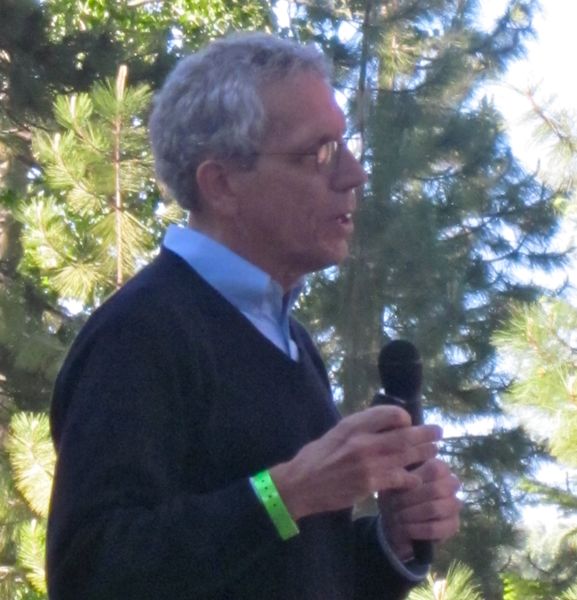
Robert Stewart

Clemens and Kenny traveled to Lake Tahoe over an existing road near Spooner Summit to a site located just north of The Brigade Claim, made by companions of Clemens, according to Stewart. The location of The Brigade Claim is important in making his assertions because of Clemens’ relationship with the men. Stewart claims that Clemens’ would have traveled to The Brigade Claim and then used their skiff and food stores to make his own stake.

Clemens and Kenny traveled down to present-day Glenbrook, Stewart claims, before rowing across Glenbrook Bay and continuing on to a site south of Sand Harbor State Park.

Stewart said his research is “based on documentation and the survey by the Ormsby County surveyor, so the plate (for The Brigade Claim) had to be in Ormsby County,” which was a former county in Nevada that incorporated the East Shore. Stewart argues that since The Brigade Claim was in Nevada, so must be Clemens’ stake.

Both historians refuted the others claims in a rebuttal, but left much of the audience split down the middle on which site seemed to be the correct one.

“It comes down to (Stewart’s) historical narrative versus Antonucci’s empirical data,” as one audience member noted.

Even Clemens remained confused about the location of his claim.

“I feel like an envelope without an address … I’m the most mixed up person at the lake.”

The debate was part of the North Lake Tahoe Historical Society first Thursday series, which continues in July and August. For more information, go online. The debate will continue on the website, where comments are welcome on this ongoing issue.


Snippets about Lake Tahoe

• Pottery Barn was doing a shoot this month at a Truckee residence for the holiday catalog. Look for bottles of Truckee River Winery’s Volo and White Barn Pinot Gris to be in the photos.

• The Truckee Police Department has returned some officers to bicycles in Regional Park and the Legacy Trail area, downtown, and Donner Lake.

• Five U.S. Olympians have joined the Lake Tahoe Winter Games Exploratory Committee’s efforts to develop a bid for the Tahoe region for the Winter Olympics. The Olympians are Andy Gabel, Bret Hedican, Jonny Moseley, Tamara McKinney, and Kristi Yamaguchi.

• Ironman Lake Tahoe (Sept. 22, 2013) sold out in less than 24 hours.

• Race the Lake of the Sky is a standup paddleboard event at El Dorado Beach on June 30 and July 1. For more information, go online.


El Dorado supes spend a day talking about Tahoe

By Kathryn Reed

Little was accomplished Tuesday when the El Dorado County Board of Supervisors schlepped to Tahoe for the once-a-year meeting in the basin.

An update five years after the Angora Fire was given to the board as well as a presentation on the Tahoe Regional Planning Agency’s Regional Plan update.

A discussion about the Meyers Community Plan didn’t amount to much other than the supes wanting to know  the community’s preference before they vote for anything.

Supervisor Norma Santiago wanted to rename the Meyers Roundtable the Meyers Community Advisory Council, but that was nixed until she gets feedback from residents.

The Meyers Community Plan was approved in 1993, with revisions in 1995 ad 1998. Talks are already under way to update the plan so it parallels the TRPA update and could possibly be adopted by the county the first quarter of 2013.

Supervisor Ray Nutting, who has represented the basin in the past and worked on the Meyers plan, said, “A plan is only as good as the ability to implement it.”

He is wary of creating another document that will sit on a shelf as well as duplicating what has been done and spending more money on consultants than on an action plan.

“The energy needs to be from the community, not from a consultant who is paid by a grant,” Nutting said.

Michael Ward, the consultant being paid by a grant, told the board the plan is to build on what Meyers is doing by being recreation and family centric.

“There is a clear identity we can build on,” Ward said.

Supervisor John Knight spoke about how gaming on the South Shore diminished by 50 percent from the heyday and how that has hurt the economy and how Meyers needs to evolve.

What he failed to mention was how it was the county supervisors who voted to allow Red Hawk Casino to be built in Shingle Springs, how Indian casinos have hurt Tahoe, and that the concerns of the eastern side of the county were met with deaf ears when Red Hawk was being discussed.

When it came time to discuss the Washoe – who are not the tribe at Red Hawk – but instead are the tribe that called Tahoe home before the white man displaced them, the supervisors decided not to rename Lakeview Commons. They didn’t even mention the Washoe, despite previous meetings where there was talk of using a Washoe name. City Councilman Hal Cole, who was instrumental in Lakeview Commons since his first stint on the council, suggested a sign on the beach that explained the history of the area, including who gave the land for perpetual use by the people of El Dorado County and visitors. Who will pay for a sign and when it would be erected remain to be determined.


Opinion: Mayor didn’t need to dig up the past

To the community,

On June 20, at the dedication for the new El Dorado Beach project, Mayor Claire Fortier said in praise of the project manager he, Jim Marino, “had to deal with two contentious city councils.” Why the mayor would drag previous councils into what was supposed to be a celebration is a mystery because the facts don’t support her statement.

The contentious part of the project, if there was contentious behavior, developed because of a lawsuit against the city. In the beginning the City Council by a vote of 4-1 let the contract for the project to contractor A. At that point contractor B sued the city.

Bill Crawford

The court decided that the contract let to contactor A by the City Council was flawed. Thus, the project was delayed for a year. Contractor B was awarded the project contract and completed the project.

The reason for the messy delay and the city’s loss in court is clear. The city attorney in great haste advised the City Council to let the contract to contractor A. Thus, the 4-1 vote. After the court’s decision, the City Council questioned the city attorney about why he advised the council as he did. In a moment of candor, he said he had been pressured by members of the council to hurry up, rush to let the contract and he gave in to the pressure. As for Mr. Marino, he supported letting the contract to contractor A.

I have no idea what the court case cost the city in dollars. In the beginning, I voted with the majority on the 4-1 decision. I felt, after listening to the city attorney’s confession that I had been duped, made a fool. Just why Mayor Fortier would open up this can of worms, I have no idea. But she did.

Bill Crawford, South Lake Tahoe


Where is the best place to watch fireworks?


Change in Nevada lawmakers could alter future of state’s involvement in TRPA

By Anne Knowles

Nevada’s future in the Tahoe Regional Planning Agency is still up in the air despite the recent defeat of the man who sponsored the bill that was approved last year that threatens to remove the state from the Compact.

Sen. John Lee, D-North Las Vegas, the main proponent of Senate Bill 271 passed by the 2011 Nevada Legislature, lost to Patricia Spearman in the state’s primary earlier this month. Spearman was backed by a broad coalition of groups, including the Sierra Club and the Nevada Conservation League, that were unhappy with Lee’s record on a number of issues, including the effort to withdraw Nevada from the Tahoe Regional Planning Agency Compact unless certain reforms are made.

Lake Tahoe will always be part of Nevada, but whether Nevada will always be part of TRPA remains an unknown. Photo/LTN file

“When we made the decision to try to defeat Lee in this election we were hopeful it would improve our chances to repeal this legislation,” says Kyle Davis, political and policy director, Nevada Conservation League. “Our goal is to see repeal of that legislation next session.”

Nevada Assemblyman Kelly Kite, R-Minden, a co-sponsor of SB271, whose district includes the Douglas County portion of Lake Tahoe, also was defeated in the primary. Retired Gardnerville rancher Jim Wheeler, who bested Kite and a third Republican candidate, Gary Schmidt, will face Independent American David Schumann in the general election in November.

Lee and Kite still sit on the Legislature’s interim committee that oversees the TRPA and Kite is one of the members of a three-person delegation tasked with meeting with its legislative counterparts in California to negotiate changes to the agency. The Nevada delegation, which also includes Assemblywoman Marilyn Kirkpatrick, D-North Las Vegas, and Sen. James Settelmeyer, R-Minden, is expected to have the first meeting with its California colleagues during the annual Lake Tahoe Environmental Summit being hosted by Sen. Dean Heller, R-Nev, at Edgewood Tahoe in Stateline on Aug. 13.

Then the Nevada group is required by the law to deliver a report on the state of the TRPA to the interim committee by Oct. 15, when the interim committee wraps up. That’s also the deadline for the committee – called the Legislative Committee for the Review and Oversight of the Tahoe Regional Planning Agency and the Marlette Lake Water System – to request up to 10 bill drafts for the 2013 legislative session.

In the meantime, Leo Drozdoff, executive director of Nevada Department of Conservation and Natural Resources, and John Laird, California’s secretary of Natural Resources, have been meeting to discuss the TRPA. They plan to meet again in July, according to Kay Scherer, deputy director of the Nevada department.

Laird, who attended his first California Tahoe Conservancy meeting this month (usually a delegate sits in for him on the board), said he and Drozdoff hope to have something to be able to present at the environmental summit.

One of Nevada’s main complaints about the bi-state agency has been its inability to deliver a Regional Plan update. The TRPA recently produced a draft RPU and the accompanying environmental impact documents and has had four public meetings to discuss it, with another today in Kings Beach and one Thursday in Stateline. The agency is taking public comment until June 28, with the goal of delivering a final update by year end.

“I’m optimistic the new RPU will be adopted before the new (legislative) session or soon after,” Nevada Conservation League’s Davis told Lake Tahoe News. “We’re hopeful that Nevada won’t pull out if they develop a new RPU.”

The bill draft or drafts requested by the interim committee could end up in any number of committees during the 2013 legislative session. SB271, for example, emanated from Senate Government Affairs, then chaired by Lee. The make-up of the committees for 2013 is unknown as is the number and content of bill drafts the interim committee on the TRPA will request.

The new members of the next interim committee overseeing the TRPA, which by statute meets every interim, will be determined by the Legislative Commission after the 2013 session.

Wheeler, the winner of the Republican primary for Assembly District 39, is the heavy favorite to win the seat. For his part, he says he would like to be assigned to Natural Resources, Agriculture and Mining, although there is no guarantee he will be appointed to the committee of his choice.

Wheeler opposed the incumbent largely on Kite’s vote to pass Assembly Bill 561 during the 2011 session. The bill, negotiated by the leadership of both parties with Gov. Brian Sandoval, extended a number of taxes to raise $620 million for the state. Wheeler has signed a pledge, available at his website, to not to raise any taxes if he were elected to office.

“I am a very, very conservative person, and I feel the constituents are very conservative,” Wheeler says.

Wheeler says instead he would look to cuts in state government employment through attrition and the education budget to balance the budget.

“You have to look at everything,” Wheeler says. “The education budget is 51 percent of the budget. We’ve been throwing money at it and it hasn’t worked for 50 years.”

He says he supports Sandoval’s plan to provide vouchers for education.

“We need more charter schools. We need to bring private enterprise into the school system.”

Wheeler also supports SB 271.

“We need to get the TRPA straightened out,” he says. “It was a good bill passed in the last Legislature.”


Cefalu resigns from LTUSD board effective immediately

By Kathryn Reed

The abrupt resignation Tuesday of Judy Cefalu from the Lake Tahoe Unified School District board upstaged everything else on the agenda.

Not even board President Wendy David was given a heads-up about the letter written by Cefalu. That letter was addressed to Superintendent Jim Tarwater.

Reached at home by Lake Tahoe News on Tuesday, Cefalu didn’t believe her departure mid-term was newsworthy even though the electorate voted her in for a four-year term. She had nothing to say to them.

“I just think it was time we have someone else come in. It’s as simple as that,” Cefalu said. She thinks new, younger ideas are what the board needs at this point.

She mentioned she would soon be turning 74, and that it would be good to pass the baton onto someone younger.

Her resignation is immediate. She did not attend the June 26 meeting.

The board discussed Cefalu’s resignation in closed and open sessions. The board has 60 days to appoint someone to fill the remainder of the term that expires in December 2013.

As in the past when there has been a vacancy, the board conducts interviews in open session and makes the decision in open session.

Cefalu only had good things to say about the board, administration and district as a whole.

In other action, the board approved the 2012-13 budget.


Adventure kayak trips on Lake Tahoe

Tahoe Adventure Company is offering several astronomy kayak and full moon kayak tours, as well as sunset kayak tours every Friday.

The next full moon kayak is July 3 from 7-10pm and the astronomy paddle is July 6 from 6-10pm.

For more information, call (530) 913.9212.


Olympic Day at South Lake Tahoe BMX

South Lake Tahoe BMX partners with USA BMX and the U.S. Olympic team to host a free race at the track on June 28.

The race is open to all ages and abilities and all participants will receive an Olympic Day certificate. All riders must wear long pants, long sleeve shirt and a helmet. Bicycles must pass a safety inspection prior to riding.

Registration begins at 5:30pm and racing starts at 7pm.

For more information, call the track hotline at (530) 542.9337.

The track is at 1100 Lyons Ave., South Lake Tahoe.