Electric power a big component of water delivery

By KQED

When you open that faucet, it’s more than water that’s flowing.

A few years back, number crunchers at the California Energy Commission tried to add up how much electrical power (and other forms of energy) goes into using water in California. The bottom line number they came up with: 19 percent. That is, nearly a fifth of all the power generated in California — as well as huge quantities of natural gas and diesel fuel consumed in the state — goes into water-related uses. You might call that report, entitled California’s Water-Energy Relationship, as The Great Wake-Up Call. The idea that so much power could go into this one vital activity—moving and treating and using water—is both stunning and captivating. And it has spurred both state agencies and water and power utilities into action.

The California Public Utilities Commission, responsible for overseeing the activities of the state’s big investor-owned electric utilities on one hand and numerous small water providers on the other, responded to the 19 percent number by authorizing a series of pilot projects to assess how to cut the amount of power used in connection with water. Since the CPUC is supposed to make sure that utility investments are cost-effective and don’t burden ratepayers with excessive charges, the focus of most of the pilots was on areas where utilities could get the most bang for the buck. Mostly, that turns out to be water conservation.

Read the whole story


Students being taught with public money that Loch Ness Monster is real

By Valerie Strauss, Washington Post

This would be funny if it weren’t so, well, not funny.

A biology textbook used by a Christian school in Louisiana that will be accepting students with publicly funded vouchers in the fall says that the Loch Ness Monster in Scotland is real. And it isn’t just any monster but a dinosaur — an effort to debunk evolution and bolster creationist theory.

The story, reported in the Scotsman newspaper in Scotland, says that Eternity Christian Academy in Westlake is one of the many Christian schools in the United States that uses these books published by Accelerated Christian Education.

The Biology 1099 edition includes a passage about the Loch Ness Monster that says, in part, according to the newspaper:

“Are dinosaurs alive today? Scientists are becoming more convinced of their existence. Have you heard of the ‘Loch Ness Monster’ in Scotland? ‘Nessie’ for short has been recorded on sonar from a small submarine, described by eyewitnesses, and photographed by others. Nessie appears to be a plesiosaur.”

Marie Carrier, principal of Eternity Christian Academy, was quoted by the New York Daily News as saying that she would like to accept 135 voucher students for next year to join the 38 children already attending the school in grades 1 through 8.

The reason all of this matters now to the public is that Louisiana Gov. Bobby Jindal recently signed a law that sets up the largest voucher program of any state in the country. Some 125 private and religious schools from across the state are qualified to participate in the Louisiana Believes program, which gives families public money to pay school tuition for their children.

Read the whole story


El Dorado County winery offering weekend food-wine lunch pairings

Miraflores Winery in El Dorado County is offering “PAIRINGS” — four-course lunches, prepared by regional chefs and paired with award-winning Miraflores wines. Lunches are served on the terrace overlooking estate vineyards on weekends through Oct. 14.

This is an opportunity for guests to visit with chefs and wine specialists to learn more about why these pairings work.

Each chef creates a menu using the fresh, local ingredients.

PAIRINGS reservations are available from 11am-3:30pm Saturday and Sunday. The prix fixe menu is $30 for Miraflores wine club members, $40 for non-club members.

Call Miraflores Winery at (530) 647.8505 for reservations. A limited number of seats are available for winery visitors on a drop-in basis.

A schedule of the chefs who will be cooking is online.


California nonprofit pot clubs flush with cash

By Joe Mozingo, Los Angeles Times

In the first raid, Orange County sheriff’s detectives hit a Dana Point marijuana storefront, the San Clemente home of its director and a “stash house” he allegedly maintained nearby.

In the two homes, they found cash stuffed everywhere: in buckets in the garage and attic, in an Igloo cooler in a bedroom, under a mattress, on an ironing board, in a dresser. According to a search warrant affidavit filed in November, they recovered more than $700,000.

At the shop, investigators found spreadsheets showing sales over 10 months totaled $3.17 million, according to the affidavit, with $2.47 million “cash on hand.” Paperwork indicated that a silent partner, a convicted drug dealer named John M. Walker, controlled the shop and six others in Orange and Los Angeles counties.

A subsequent raid of one of Walker’s properties recovered a Beretta handgun, a shotgun, a Chinese AK-47 with a bayonet and grocery bags filled with four dozen rubber-banded bundles of cash; one of the bags contained a note with calculations totaling $99,324.

The discoveries and many others like them across California are starkly at odds with the image presented by medical marijuana providers, who label themselves as “compassionate caregivers” and say they work on slim margins, give away cannabis to the poor and comply with the law.

Many medical marijuana dispensaries have been making huge sums of money even as they claim to be nonprofit, according to court and law enforcement records, industry insiders, police and federal agents. The Times found a cash-infused retail world unlike the one pitched to voters who passed the Compassionate Use Act for “seriously ill Californians” in 1996.

Few would suggest that everyone in the industry is making huge profits; many dispensaries do struggle to stay afloat. Nor do the court cases capture the relief truly ill patients ascribe to high-quality marijuana they might have difficulty getting if these shops did not exist.

Read the whole story


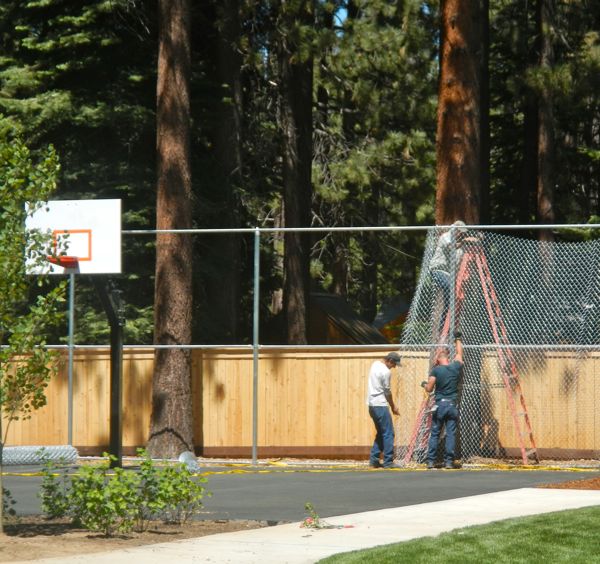
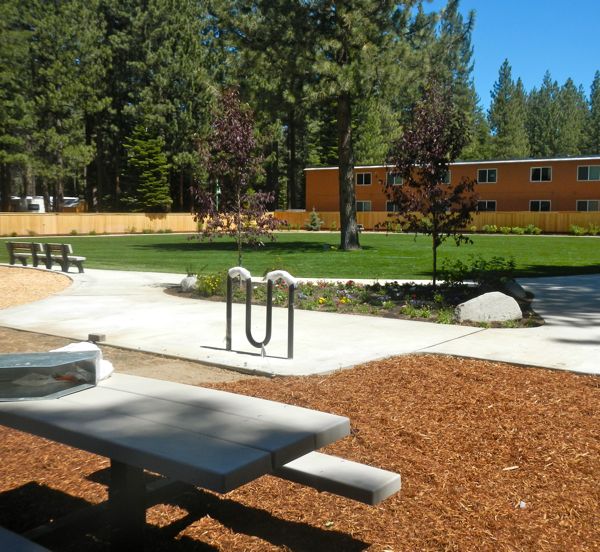
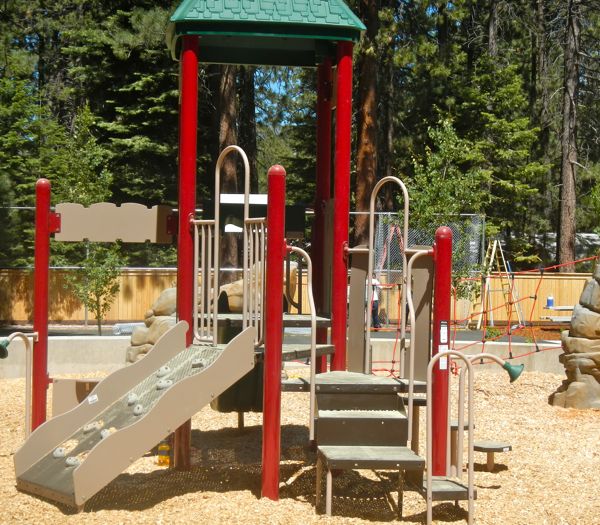
Bonanza Park 2 weeks from opening

South Lake Tahoe’s newest park is slated to open July 14.

On June 28 workers were putting up the fence behind the basketball court.

The play structure is in, sod is laid and plants are in the ground.

Bonanza Park is the result of Edgewood Companies buying a dilapidated hotel on Bonanza Avenue and turning the property into a park.

Bonanza Park has seating, play area, grass and basketball. Photos/LTN

–– Lake Tahoe News staff report


What is the future of Lake Tahoe Airport?

Lake Tahoe Airport’s future could be decided this year when the 1992 Settlement Agreement expires in October.

What is the Settlement Agreement?

Why was there an agreement?

Is commercial air service the answer?

How can the environment and the economy be equally weighted when discussing this airport in South Lake Tahoe?

Answers to those questions will be answered by Lake Tahoe News in a three-part series beginning July 5.


German eatery with 21st century flair opening in South Tahoe

By Kathryn Reed

Bringing a different food profile with a high level of service at an economical price to South Lake Tahoe are the goals of Himmel Haus owners and employees.

German food with American and Californian twists will be coming out of the kitchen of the old Christiana Inn starting July 6.

The correct glass is used for each beer at Himmel Haus. Photos/LTN

While schnitzel is on the menu, the breading is pretzels.

Truckee Sourdough Bread Company is creating a pretzel bun specifically for Himmel Haus.

The signature dish is a hamburger of sorts, but it’s made with pork instead of beef. It is made with three types of pork – ground bratwurst patty, grilled Black Forest ham and bacon.

“Each pork has a different flavor profile,” chef Josh Bushnick said. “We didn’t want to just do a hamburger.”

Besides interesting twists on traditional German food, the bar is stocked with imported beer from Germany – including from the world’s first brewery that opened in 1032. The nuns are still crafting this brew in the old style with just four ingredients.

Most of the beer vendors also supply a special glass for their particular beer to be poured into.

“Our goal is to be one of the top three restaurants,” owner Matt Eastling told Lake Tahoe News while sitting at one of the communal tables last week. (Zak Latzka is the other owner of the restaurant.)

In large part that will be Bushnick’s responsibility because he is the chef. He has more than 25 years of experience in the service industry. Using the freshest, most organic ingredients is the plan.

Local wood was used to build aspects of the bar area.

It’s the tables, though, that will also set this eatery apart from others in the area. Much like a Basque restaurant where strangers sit together, the same will be at Himmel Haus.

While work still needed to be done last week on the interior – like installing the 12-foot television screen in the bar and tweaking a few other things, the historic restaurant at the foot of the Heavenly’s base lodge is ready to throw its doors open. Expect plenty of Olympic coverage to be shown on that TV.

About 15 people will be employed at the restaurant. The ratio of full time vs. part time will depend on how busy the establishment is. Everyone on the front end of the house is local.

This location has had its ups and downs. When it was the original Christiana Inn it was hopping – one of those dining establishments that had to be visited on any trip to Tahoe. Plus, it was popular with locals. But it eventually closed.

Linda Catron remodeled the building, bringing everything up to code. She reopened it in 2007 under the same name. The renaissance didn’t last long.

Then came Jens Dressler who had been the chef at Blue Angel Café. He bought that restaurant and renamed the Saddle Road eatery Fallen Angel, opening in December 2010. He skipped town a few months later owing several people money and to this day has not had charges filed against him.

But Eastling isn’t concerned about the most recent history of the building, as the newest tenant he is confident the area is ready for something new.

Besides good food and unique beers, the owners want education to be part of the experience. Eastling said he wants to connect people to the food and beer. On a monthly basis vendors will be brought in to discuss the finer points of beer, or there could be a cooking class or some other lesson to be taught.

—-

Notes:

• Address – 3819 Saddle Road, South Lake Tahoe

• Phone – (530) 721.7230

• Opening – July 6

• Hours – Tuesday-Wednesday 4:30pm-midnight; Thursday-Saturday 4:30pm-2am.


Reduce high blood pressure through exercise, diet

By Mandy Kendall

In today’s fast-paced world circumstances arise in most of our lives that have our stress levels rising, along with our blood pressure. Although occasional increases in blood pressure are not dangerous, it does become an issue when the pressure levels don’t drop again.

Mandy Kendall

Unfortunately high blood pressure often has no detectable symptoms and can lead to an increased risk in serious health problems including heart attack and stroke; this is why this condition is often referred to as the “silent killer.”

What is blood pressure? It refers to the amount of pressure exerted on the blood vessel walls as the heart pumps blood around the body. A blood pressure reading will have two numbers. The first (top or Systolic) number refers to the pressure in the blood vessels while the heart is beating. The second (bottom or Diastolic) number refers to the pressure while the heart is relaxing between beats.

What should my blood pressure be? The Mayo clinic offers the following guidelines:

Top number (systolic) in mm Hg Bottom number (diastolic) in mm Hg Your category* What to do**
Below 120 and Below 80 Normal blood pressure Maintain or adopt a healthy lifestyle.
120-139 or 80-89 Prehypertension Maintain or adopt a healthy lifestyle.
140-159 or 90-99 Stage 1 hypertension Maintain or adopt a healthy lifestyle. If blood pressure goal isn’t reached in about six months, talk to your doctor about taking one or more medications.
160 or more or 100 or more Stage 2 hypertension Maintain or adopt a healthy lifestyle. Talk to your doctor about taking more than one medication.

Our lifestyles have a huge effect on our health and there are many things we can do to help prevent the onset of high HBP or to reduce it.

Here are some Qwik-e tips to help the fight against this silent killer:

1. Cut down on salt. No more than 2,300mg (a teaspoon) of salt is recommended per day per adult under 50 years of age with no more than 1,500 mg (just over half a teaspoon) being recommended for children and adults over 50. Just remember hidden salt (in processed foods like soups and convenience foods) can often give you much more than your daily allowance.

2. Reduce your waistline. Studies have shown that waist measurements are a better indicator (compared to weight or BMI) of risk factors for heart disease and other serious conditions. If waist measurements (measuring at the level of the belly button) are greater than 35 inches for women or 40 inches for men, it could indicate an increase in the risk of cardiovascular disease, diabetes and HBP along with other metabolic problems. Even a loss of just 5 pounds can lower your blood pressure.

3. Maintaining a healthy diet can help control HBP. The Mayo Clinic recommends the “Dietary Approaches to Stop Hypertension” (DASH) diet, which promotes fruits, vegetables, whole grain foods along with plenty of potassium which can help prevent and control high blood pressure.

4. Exercise. Thirty minutes a day (even if it’s just a brisk walk) can help lower your blood pressure.

5. Limit alcohol. Even if you have normal blood pressure alcohol will tend to increase pressure levels. The Mayo Clinic recommends limiting consumption to one drink per day for women and two drinks per day for men. There is also, however, strong advice against saving-up personal quotas until the weekend for what is considered binge-type drinking as this can also strongly increase blood pressure levels.

6. Stop smoking. As well as causing damage to the whole body, smoking speeds up the process of hardening of the arteries, which in turn can increase the risk and dangers of HBP.

7. Reduce stress. Stress can be a huge contributor to HBP. Relaxation techniques, meditation, deep breathing, anger management and plenty of sleep can go a long way to reducing risks of HBP. (Just saying “no” occasionally to that extra demand on your time and energy will also help too!)

8. Monitor yourself. Advances in modern technology now means blood pressure monitoring at home is possible. Even if these machines are not as highly accurate as clinic machines, taking readings at different times of the day and at regular intervals will allow you to chart patterns and changes in your pressure. Blood pressure readings taken in clinics can also often be affected by “white coat syndrome.” This is a phenomenon where patients, possibly due to nervousness, unwittingly exhibit higher blood pressure readings in a clinic setting than they would normally. This sometimes leads to an incorrect diagnosis, and monitoring pressure at home can be a useful comparison to lessen the chances of this happening.

9. Symptoms not to be ignored. Symptoms like frequent headaches, dizzy spells, disorientation, tightness in the chest, prolonged fatigue, irregular heartbeat or blurred vision should not be ignored as they could be an indication of HBP or other serious health conditions.

As will all things health-related, consult your doctor before making any changes to your lifestyle and health regime.

Until next time.

Mandy Kendall operates Health Connective in South Lake Tahoe. If you have any questions, would like some advice, or would like to request some Qwik-e tips on any health and wellbeing topic, please feel free to drop me an email at healthconnective@gmail.com, visit us on Facebook, or keep an eye out on Lake Tahoe News for regular Qwik-e tips on how to make healthy changes one Quick and Easy step at a time.



Edgewood Lodge wants to be driver in high-end market

By Kathryn Reed

STATELINE – With a history in Lake Tahoe that dates to 1896, the Park family’s Edgewood Companies is poised to build the first high-end lodging establishment on the South Shore.

Thursday marked the final day people could comment on the draft environmental impact statement for the Edgewood Lodge. Testimony was taken during the Tahoe Regional Planning Agency’s Governing Board meeting, to which only people in support of the 154-room hotel spoke. There will also be 10 fourplexes, or casitas.

The League to Save Lake Tahoe had submitted a letter on June 27 praising the environmental improvements that would accompany the project if it were to be permitted. But the League does have concerns.

Edgewood Companies expects the TRPA Governing Board to vote on the lodge project in September.

The letter says, “… the League remains concerned with the expansion of the urban boundary that was necessary on recreation land to allow development such as the proposed project.”

Lew Feldman, the attorney representing Edgewood, told the Governing Board there would be no impact to the urban boundary.

“We absolutely disagree it is a legal issue,” Feldman said.

It’s possible the final EIS will be released in late July, with the Governing Board taking action in September. If the green light is given, Edgewood Companies could start by rerouting hole 9 on the golf course and working on the other affected holes.

The hotel will take two construction seasons, so the earliest anyone could book a room is fall 2015.

Patrick Rhamey, vice president of real estate for Edgewood Companies, told Lake Tahoe News the other factor is obtaining financing and making sure the economy is ready for what his company wants to deliver.

For the area, it is expected to bring in $24 million a year to the local economy from what guests spend, $1.7 million a year in sales tax, and $2 million annually in hotel tax.

“I hope this becomes the model for our community as we go forward,” Carol Chaplin with Lake Tahoe Visitors Authority told the board.

She said NBC is ready to highlight the project during the American Century Celebrity Golf Championship that is at Edgewood Tahoe each July.

Bill Chernock, who used to have the job Chaplin has but is now head of the Carson Valley Chamber of Commerce and Visitors Authority, said, “The hole in Tahoe’s tourism product is the lack of high-end lodging. It’s what separates Tahoe from the Aspens, Montereys and La Jollas of the world.”

Gone will be the parking lot with a view of Lake Tahoe.

“I call it the world’s most scenic parking lot. It needs to go,” Rhamey said at the June 28 meeting.

At the lodge will be parking. Plus, there will be a few spaces for day use.

Of all the thresholds TRPA deals with, noise is the only one this project will not address.

Environmental gains include stopping a half million pounds of sediment from reaching Lake Tahoe and stopping fertilization on 24 acres of turf. Edgewood Creek will flow into Lake Tahoe naturally, not via a pipe. This will improve the fish habitat. It’s estimated the amount of nitrogen reaching the lake will decrease by 13 percent and phosphorous by 26 percent. Those two elements contribute greatly to the loss of clarity.

The beach at this Stateline property will be open to the public – which it isn’t now. No retail, other than sundries for guests, is planned. A spa, though, will be on site.

Expansion of the current clubhouse is also in the works.


Most California state parks to remain open

By Kevin Yamamura, Sacramento Bee

Nearly all of the 70 California state parks originally slated for closure Sunday will remain open for now, despite a line-item veto of parks funding by Gov. Jerry Brown, state parks officials said today.

The Department of Parks and Recreation has already struck deals with private donors, foundations and non-profit groups to continue operating 40 that were on the endangered list, including the Governor’s Mansion in Sacramento. At the direction of Brown and lawmakers last year, the parks department had targeted the parks for closure based on attendance and how much revenue they generated.

Because the state has found outside partners interested in sparing an additional 25 parks, it will keep them open using a sliver of special funds that Brown retained in the budget he signed Wednesday night, parks officials said. Democratic lawmakers added $41 million back into their budget to keep parks open, but Brown line-item vetoed $31 million of it.

That leaves five parks for which the state has struggled to find donors or other agencies willing to chip in: Benicia State Recreation Area; the California Mining and Mineral Museum in Mariposa; Gray Whale Cove State Beach near Montara; Zmudowski State Beach near Moss Landing; and Providence Mountains State Recreation Area in San Bernardino County.

It remains to be seen what will happen to those parks come Sunday, but at least one – the Mining and Mineral Museum – is planning to shut its doors and pack up more than 13,000 objects in its collection, according to curator Darci Moore.

Read the whole story