Comment period on TRPA’s Regional Plan update ends

By Kathryn Reed

STATELINE — It’s over. That would be the comment period for the draft environmental documents for the Tahoe Regional Planning Agency’s Regional Plan update.

On the final day – June 28 – 21 people spoke during the Governing Board meeting in Stateline. Two were opposed to the preferred alternative. About a dozen spoke at the Kings Beach meeting the day before.

Many who spoke and hundreds of others also put their thoughts in writing.

On Monday the El Dorado County Board of Supervisors was given an update by John Hester, TRPA planning director.

Supervisor Jack Sweeney chastised Hester a bit by saying TRPA is wrong to interchange the words clarity and quality when describing the waters of Lake Tahoe. Sweeney’s example was how he had a spring on his property providing clear water that was of poor quality.

The supes also harped on TMDL, even though those requirements are from another agency – the Lahontan Water Quality Control Board.

“You have to convince me that more density doesn’t make us have to pickup the cleaning tab at Lake Tahoe,” Supervisor Ron Briggs said.

Creating town centers is what TRPA’s goal is so people walk more, while also getting current structures out of sensitive areas.

Hester responded, “Redevelopment has had a dramatic reduction on load and pollutants.” The translation being that density would not be an economic hindrance.

TMDLs also came up Thursday. The EPA’s Jack Landy wants some resolution on how the Regional Plan update will affect current law. Lahontan is an arm of the EPA, and while it only governs waters in California, the NDEPA is its Nevada counterpart and also reports to the EPA.

TRPA Executive Director Joanne Marchetta said it’s premature to know if that issue will be resolved before or after the RPU vote is taken in December.

Back at the supes meeting, Supervisor Ray Nutting said, “I think your thresholds are based on politics and not science.”

To this, Hester said, “I don’t disagree.”

He explained to the supes how for the first time in the 40-plus history of the TRPA the agency had the threshold evaluations peer reviewed.

Hester and Supervisor Norma Santiago, who is also chair of the TRPA Governing Board, said the agency was told to look more closely at the thresholds, how information is gathered and were told some measures don’t make sense.

On Thursday it was agreed to reconvene the TRPA’s Regional Plan Update Committee so members can be working on the issues that were never resolved.

An October release of the final EIS is on the calendar, with board deliberations in November and a vote in December. However, there will be multiple meetings this summer where the board will discuss aspects of the Regional Plan update.


Fire restrictions begin in Tahoe National Forest

By Barbara Barte Osborn, Sacramento Bee

NEVADA CITY — Fire restrictions will go into effect Sunday in the Tahoe National Forest due to dry conditions.

“I’d also like to remind folks that all fireworks are illegal in the national forests,” Forest Supervisor Tom Quinn said in a news release.

Because illegal and abandoned campfires are the main cause of human-caused fires in the forest, campfires will be permitted only in developed campgrounds and other designated sites, in the metal rings and grills provided.

In the backcountry, portable stoves — but not charcoal barbecues — will be permitted with a valid campfire permit. Permits are free and are available at all U.S. Forest Service offices.

Read the whole story


Women motorcycle riders to gather in Carson City

Carson City is hosting the 2012 American Motorcycle Association’s International Women & Motorcycling Conference July 26-29.

Women riders will spend the weekend in the capital city with a slew of activities planned including inspirational speakers, demonstrations, product showcases and plenty of opportunities to ride.

Since 1924, the organization has promoted the motorcycle lifestyle.

The AMA International Women & Motorcycling Conference allows attendees to connect with and learn from other women riders.

Event information is online.


Tahoe publisher looking for poets

Bona Fide Books annually awards the Melissa Lanitis Gregory Poetry Prize for an unpublished collection of poems.

Submissions for this year’s contest are being taken until Aug. 31.

The winner will receive publication, 10 copies, a $500 cash award, and a reading at Lake Tahoe. Submit a previously unpublished, full-length poetry manuscript of between 48 and 100 pages. For more information, go here.

Lexa Hillyer, winner of the 2011 prize for her collection, “Acquainted with the Cold” (to be published by Bona Fide Books this year), will be in South Lake Tahoe to read on Nov. 2 as part of Lake Tahoe Community College’s Writers’ Series.


Opinion: Young adults need to understand finances

By Mark Hanson

As children blossom into young men and women, most insist on planning and running their own lives. Parents worry about all the basic essentials for their kids’ independent living, like housing, eating properly, staying warm, being careful at night and more.

But most parents forget to teach their youngsters one of the most important lessons of all – financial responsibility. The resulting turmoil can spell disaster for a child’s future.

Consider this: The average young adult amasses $45,000 in debt by the time they turn 29, according to a recent PNC Bank report.

This generation of 20-somethings was raised during an economically-thriving period. Undisciplined spending habits, student and car loans, and a tough job market have stymied their financial growth. Perhaps the worst culprit is financial ignorance, but we can count this as a lesson for future 20-somethings.

For young people, organizing finances can be intimidating to the point of prohibitive.

We need to have a curriculum in schools, from kindergarten through 12th grade, that ensures our kids graduate with financially literacy. From balancing a checkbook to understanding what it means to pay – and earn – interest, kids need basic money management skills to survive in the world, and most aren’t getting them.

All teens should know and practice so they can control their financial destinies:

• Saving for dreams – the three-envelope method: Use the first envelope for your day-to-day expenses: gas or lunch money. Pause before blowing this money at the movie theater or a fast-food restaurant. Envelope No. 2 is for short-term goals, which might be clothing or a new laptop. The third envelope is for long-term goals such as a car, college or a “future millionaire club” fund.

• How to create a budget: A budget lets us know what’s possible, and not possible, with money. There are six steps to creating a budget. 1. List all of your expenses. 2. List all income. 3. List monthly expenses. 4. Add up these lists separately. 5. Tweak your budget so you can meet your expenses with money left over for savings. 6. Review your budget every week.

• How to set and follow through on goals: First, figure out what your current finances are, then determine what they will be in the future — one year out, then two years out, then four years later, etc. How will you get to your one- or two-year goal? You need a plan, and most of the time that means either earning more money, spending less, or a combination of the two. Finally, you have to stick to your plan in order for it to work.

• Understanding interest rates, such as credit cards: Interest is a fee paid for using someone else’s money. Simple interest is straightforward: 5 percent accrued in your bank account with $100 yields $5 in interest at the end of the year. Compound interest, however, means ever-increasing amounts. This is crucial to understanding debt you may take on from lenders. Know what you are borrowing, and the terms thereof. Just as your money can work for you in a bank account, money borrowed can work against you if it is not paid back in a timely manner.

• How to write checks and balance a checkbook: These days, it’s easier than ever to review accounts online, which automatically tracks exchanges. However, banks do make mistakes, which is why it’s wise to track your accounts independently. Ask. Don’t be embarrassed. Banks are putting a premium on service and want to establish a positive relationship with young customers. If you have a question, speak to someone at the bank. As you take control of your money, you’ll also take control of your life.

Mark Hansen is a successful businessman, a former Palm Beach County, Fla., elected school board member and motivational speaker.


Al Tahoe homeowners open their doors to look at the past

AAUW home tour focuses on old cabins

By Jessie Marchesseau

Original old Tahoe cabins all over the area. The little box-like ones clad in weathered wood siding or just plain logs. It’s hard not to wonder what those little gems look like inside and what they looked like way back when.

Saturday’s American Association of University Women Home Tour provided an opportunity to find out.

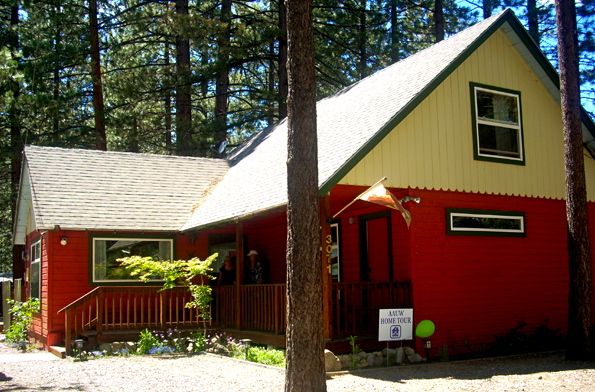
The tour is a biennial event and past tours have been in the Angora burn area, Cascade Properties, the Tahoe Keys and other prominent South Shore neighborhoods. This year’s tour, entitled At Home in Al Tahoe: Historic Retreats at The Lake, featured eight cabins in South Lake Tahoe’s oldest neighborhood. The cabins, all built between the 1920s and 1940s, have been extensively maintained, restored, updated and upgraded by their respective owners.

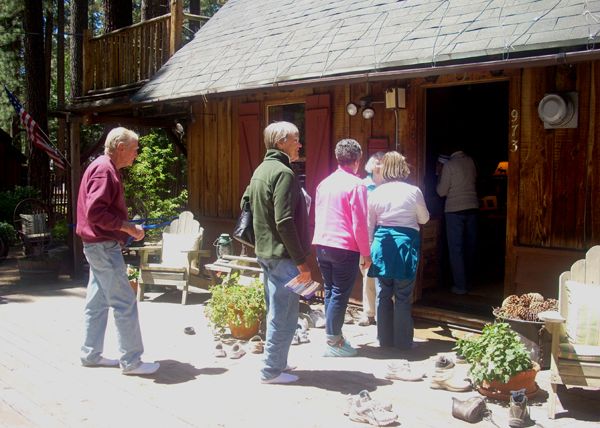
The AAUW home tour in Al Tahoe on June 23 was sold-out. Photo/Jessie Marchesseau

The self-guided tour started on Cave Rock Avenue at a cabin built in 1937. The front deck is almost as big as the cabin. A step inside revealed that this was one that had been more restored than upgraded. The beams, though redone, still showed signs of the bark that had been left in place when the cabin was erected. The steep log staircase leading to a loft above looked more like a ladder than an actual stairway and made many tour-goers more than a little nervous on the descent. A stove against the wall and refrigerator in the corner were the only real indications of where the kitchen area was in the big room that served as kitchen, living and dining space.

Carolyn MacRae, interior designer and owner of The Design Shoppe in South Lake Tahoe, purchased the cabin for her father in 2003. She took on the task of redoing some of the previous remodel work to make it appear more original and creating a space for her father to house his extensive collection of Native American artifacts, including a totem pole standing proudly in the living room.

“One of the goals with it is to make the setting feel like the collection feels, and like it’s always been here,” MacRae said.

But not all the cabins on the tour were redone with the intension of making them look and feel original.

Some still had logs or wood paneling for walls, while others had been upgraded to sheet rock. Nearly all have experienced some sort of expansion, as the tiny footprint of these cabins does not leave much room for modern conveniences. Some additions were designed to blend seamlessly with the original architecture, but others had details such as granite countertops and two-person Jacuzzi bathtubs which were dead giveaways of modern upgrades.

Many cabins in Tahoe have the same footprint as when they were built decades ago. Photo/Provided

Barb Childs, president of AAUW South Lake Tahoe branch since 2010, said part of her criteria in choosing the cabins for the tour were that they had been not so much remodeled as restored, maintaining the original integrity of the era.

Though some cabins flaunted more contemporary updates than others, they all managed to maintain original elements that make it almost immediately known to any visitor that this home has a story to tell. All of the cabins displayed a great deal of wood; from floors to walls, ceilings to cabinetry, the warm ambience of natural wood prevailed. Nearly all the homeowners managed to work some antlers into their décor and there was no shortage of the obligatory pinecones, bears and photos from the TV show “Bonanza” – which was filmed in Lake Tahoe.

Janet De La Motte of San Luis Obispo attended the tour with her daughter. As the owner of an Al Tahoe cabin built in 1939, something that has been in her family since the day it was built, De La Motte said she loved the rustic charm displayed by all the homes.

“It shows you that you don’t have to go and remodel as soon as you buy a vintage home,” she said, noting that on HGTV the first thing anyone does when they buy an older property is completely gut it.

De La Motte and her daughter, Janelle, gathered some ideas for their cabin from the tour and were delighted that they were able to walk the entire route, a detail that was no accident.

Childs said with the opening of Lakeview Commons, the AAUW, in addition to their focus on a historical tour, wanted to do something to encourage people to bike, walk and enjoy the entire area.

As the final stop, refreshments and silent auction items were available to attendees at Pichetti Winery.

The event, which is always well-attended, sold-out of the 350 available tickets on Friday. Tickets were $20 in advance.

One hundred percent of the proceeds from the event go toward AAUW’s scholarship funds. The group awards scholarship to women transferring from LTCC to four-year universities, as well as to middle school girls who wish to attend Tech Trek, a science, math and computer summer camp at UC Davis. AAUW focuses on advancing equity for women and girls.

“You can’t change the world,” said Kay Henderson, chairman for this year’s Home Tour, “but sometimes you can change a little part of it.”


Truckee Humane Society needs $1 mil. to complete shelter

The Humane Society of Truckee-Tahoe has relaunched its Heroes Now & Forever campaign to raise the final $1 million needed to build an animal shelter that will serve the region.

HSTT has raised $2.4 million to fund the shelter’s construction. While the nonprofit organization is well on its way and almost there, it has encountered a shortfall. The Humane Society has just announced that they have an urgent, pressing need to raise an additional $1 million to cover higher than anticipated construction costs.

The Heroes campaign seeks 850 individuals, groups or businesses to make a commitment to contribute $1,000 each. Larger contributions are, of course, welcome. Payment plan options are available as donations can be split into two or four payments.

The new shelter will provide much needed expanded space and will replace a dilapidated, inadequate facility. Built to house eight dogs and 30 cats, the current shelter has as many as 30 dogs and 60 to 80 cats at any given time. The existing shelter is open to the public only two hours per week; the new shelter will be open to the public 40 hours per week.

Those who commit to becoming a hero will receive recognition on a permanent donor wall in the lobby of the new shelter and an invitation to a private grand opening celebration. Super Heroes (those contributing $5,000) will be also be recognized prominently on the donor recognition wall. Naming opportunities of the new facility’s various wings, hallways, rooms or outdoor areas are also available to honor donors, families, businesses or beloved pets for gifts larger than $5,000.

The new HSTT animal shelter will be located on land donated by Truckee just above downtown off Donner Pass Road on Stockrest Springs Road.

Call (530) 587.5948 for more info about donating.


Magazine industry dependent on survival of USPS

By Lauren Kirchner, Columbia Journalism Review

Early on a February morning, in a glass-walled conference room high up in the Hearst Tower in Manhattan, Postmaster General Patrick Donahoe spoke in a careful, reassuring tone. “We can do this; I know that we can do this,” he told the audience, which included representatives from magazine-industry heavyweights like Condé Nast, Hearst, and Time Inc. “Hang in there with us.”

Donahoe’s talk was a keynote at a “Postal Summit” organized by The Association of Magazine Media (MPA, formerly the Magazine Publishers of America) to address the inarguably dire situation currently facing the United States Postal Service, and the complications that situation is causing for the businesses that depend on its survival.

Despite Donahoe’s assurances, his audience couldn’t be blamed for being skeptical. In the past decade, the postal service has been hit by a perfect storm of technological and cultural shifts, economic recession, and political gridlock. Since 2000, the USPS has seen a precipitous decline in the volume of mail. From 2006 to 2011, as people have increasingly sent e-mails instead of letters and paid bills online, first-class mail volume has dropped 25 percent. As the housing and financial sectors sank, so did the amount of direct mail they sent to prospective customers. The country’s second-largest civilian employer (after Walmart), the USPS has been squeezed by rising health-care costs for its half-million employees, plus the requirement to pre-fund their pensions.

While the service has often run a deficit during its 237-year history, it now faces the possibility of insolvency. Following a loss of $5.1 billion in fiscal year 2011, the service reported a $3.3 billion loss in the first quarter of fiscal 2012 alone—a period that’s typically the most profitable of the year because of mail sent in the winter holiday season. The USPS’s total deficit as of last December was already $12.9 billion, and in February, the agency projected that it may run out of cash completely by October.

All of this is alarming news for the magazine industry, which, despite its recent forays into digital publishing, still depends on the postal service to deliver almost 90 percent of its circulation. Some publishers at the summit wondered aloud just how worried they should be. What would happen if the USPS actually shut down?

“The one thing I will not do is cry wolf,” said Donahoe as he wrapped up his speech. “I will not say ‘We’re not going to deliver mail.’…If I say that, you will say, ‘I need some alternative solution.’ And once you go to that alternative solution, we may never get you back. So that’s not going to happen.”

The magazine industry’s fate and that of the USPS have always been inextricably linked. Since the very beginning of the postal service in 1775, periodicals have enjoyed an extremely favorable shipping rate, an agreement rooted in the Founding Fathers’ conviction that the spread of information and opinion across the country was vital to democracy. “Magazines and newspapers accounted for nearly all of the weight of the mail in the first half of the 19th century—as much as 80 to 95 percent—and they only paid five to 15 percent of the revenue,” said Richard R. John, a historian of communications at the Columbia University Graduate School of Journalism. “And that was almost never a controversial issue.”

The postal service, meanwhile, needs to keep magazines in the mail. As mail volume decreases, Donahoe explained in his keynote, advertising (a.k.a. junk mail) becomes an ever-larger portion of it; magazines keep people coming back to their mailboxes, which in turn keeps the postal service in business. “They need us as much as we need them,” agreed James Cregan, executive vice president of government affairs for the MPA. Both Donahoe and Cregan said that it is unlikely that the preferential pricing scheme for periodicals will end, though some above-inflation price hikes are possible as the postal service tries to quickly reduce its debt. What is perhaps more of an immediate concern, though, is the impact of worsening service.Read the whole story


Man stabbed in arm, suspect at large

South Lake Tahoe Police responded to a report of a stabbing in area of 11th Street and Eloise Avenue earlier today.

Police and South Lake Tahoe Fire Department found a 22 year-old male who had a stab injury to his arm. He was transported to Barton Hospital for treatment.

The suspect was described as a white male adult wearing a Boston Celtics hat, blue plaid shorts and a back pack, and riding a skate board. The suspect was last seen running west across Emerald Bay Road and up into the area of 10th Street and Roger Avenue. With assistance from El Dorado County Sheriff and California Highway Patrol, police searched for the suspect for about an hour but were unable to locate him.

Lake Tahoe News calls to the police for more details were not immediately returned.


California ski resort won’t reopen in the winter

By Hugo Martin, Los Angeles Times

June Mountain, the Eastern Sierra resort that has failed to make a profit in 26 years, is closing for the summer and won’t reopen for the upcoming ski season, the resort operator has announced.

The closure will give the resort operator time to evaluate how to make the mountain popular and profitable again, said Rusty Gregory, chairman and chief executive of Mammoth Mountain Ski Area, which operates June Mountain and the more popular Mammoth Mountain.

Mammoth Mountain, the most popular ski resort for Southern Californians, has 3,500 acres of skiable area and a summit of 11,053 feet. June Mountain, about 20 miles north of Mammoth, is known as a less-crowded, family-friendly resort, with about 500 acres of skiable area and a summit of 10,090 feet.

In a recent radio interview, Gregory said June Mountain has been operating at a deficit of $1.5 million a year.

Read the whole story